
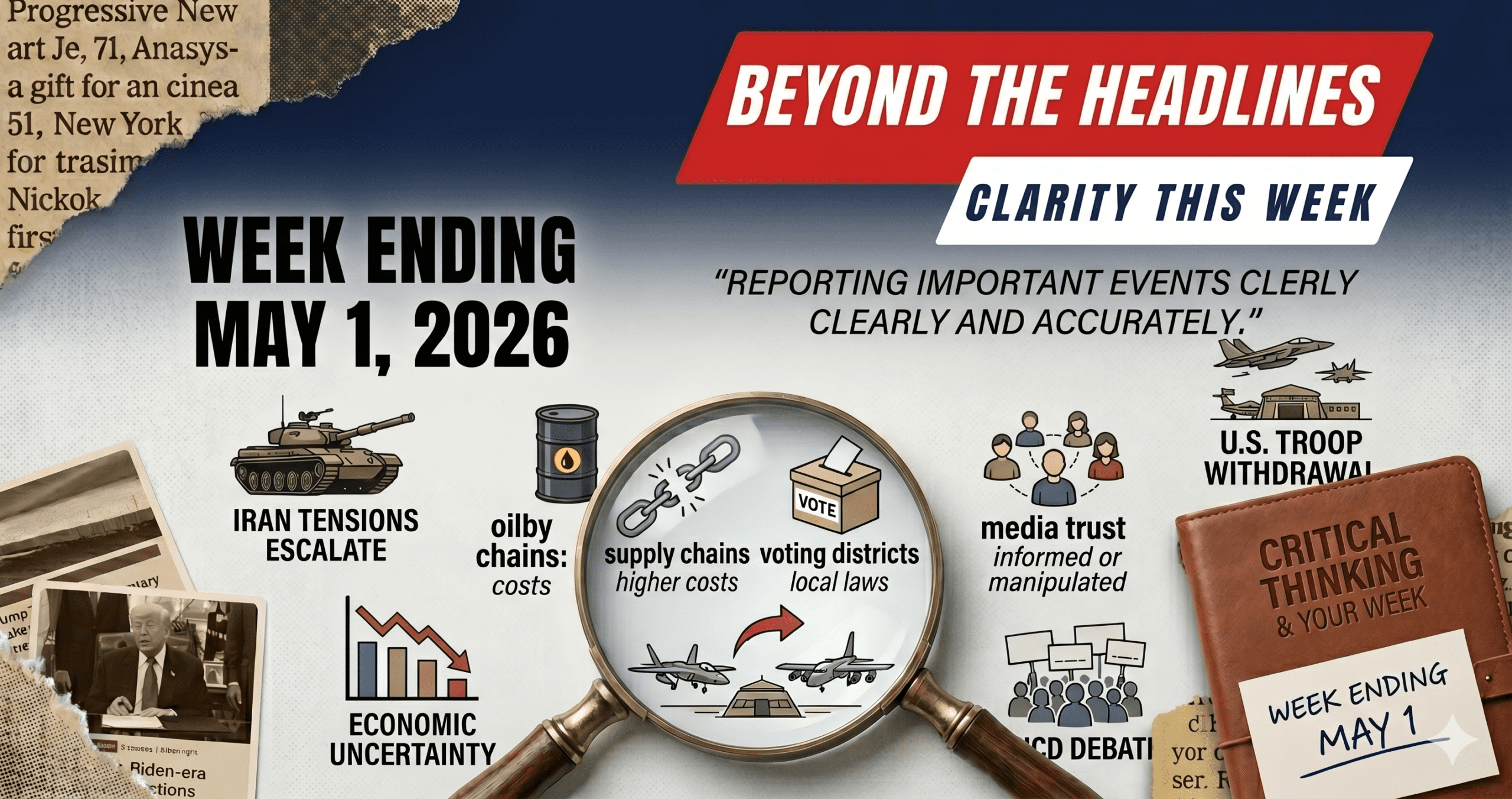
This week’s headlines covered a lot of ground—U.S.–Iran tensions, market volatility, troop withdrawals, and a gala dinner that somehow became a national controversy. On the surface, these stories seem unrelated. But look closer, and a single thread connects them all:
The gap between perception and reality.
Between what we’re told and what we experience. Between what institutions say and what they do. Between what one side sees and what the other refuses to acknowledge. That gap is where confusion, division, and distrust live—and this week, it was on full display.
Two of this week’s biggest stories—Iran and the White House Correspondents’ Dinner—weren’t just covered by the media. They were shaped by it.
When tensions escalate between the U.S. and Iran, the facts on the ground matter, but so does the framing. One outlet leads with “aggression” and “provocation.” Another leads with “defense” and “restraint.” Both may be reporting real events, but the words they choose tell you what to feel before you’ve had a chance to think.
This is the information bubble in action. You’re not necessarily seeing false information—you’re seeing a filtered version of reality. And when two people walk away with completely different understandings of the same event, the result isn’t just disagreement. It’s an inability to even have the conversation.
How to tell if the news you’re reading is reporting facts or pushing a narrative: Ask yourself three questions:
- What’s missing? If a story only presents one side’s perspective without acknowledging the other, you’re getting a filtered view.
- What language is used? “Aggression” vs. “defense,” “retreat” vs. “realignment”word choice reveals framing.
- Who benefits? If the coverage makes you feel angry or fearful without offering context, it may be designed to keep you engaged rather than informed.
The best practice: compare how at least two different outlets cover the same event. The gaps between them are often where the truth lives.
The White House Correspondents’ Dinner made this dynamic visible in a different way. The backlash wasn’t really about the jokes—it was about the image. A room full of powerful people laughing together on camera while millions struggle to pay rent became a visual metaphor for a system that serves itself.
Why do journalists and politicians seem so disconnected from regular people? Part of it is structural: the people who attend events like the WHCD live and work in a small geographic and social circle—Washington, D.C., and New York media hubs. Their daily concerns (access, sourcing, ratings wars) are vastly different from those of a factory worker in Ohio or a teacher in Arizona.
Part of it is cultural: when elites socialize together, they develop shared assumptions that feel obvious to them but alien to everyone else. This isn’t necessarily malicious, it is human. But it creates the perception of a “club” that ordinary people aren’t invited to, which breeds distrust regardless of the actual reporting quality.
Are we seeing a “culture war” play out over a comedy roast? In a sense, yes—but the dinner is a symptom, not the cause. The culture war exists because large segments of the population feel that institutions serve themselves rather than the public. The jokes themselves are almost incidental. What matters is the image—and in the age of viral clips, images are weaponized faster than context can catch up.
The other two stories this week—market volatility and troop withdrawals—share a different kind of gap: the distance between high-level decisions and daily life.
When U.S.–Iran tensions disrupt shipping lanes and oil prices spike, the headline says “markets react.” But what that actually means is:
As a rule of thumb, every $10 increase in the price of a barrel of crude oil translates to roughly 25–30 cents more per gallon of gasoline. For the average household, that can mean an extra $40–$60 per month at the pump alone. But the hidden costs matter too: higher diesel prices raise trucking costs, which push up grocery prices. Heating oil and electricity generation are also affected. A global conflict far from home can quietly reshape your weekly budget.
When the Federal Reserve debates rate changes, the language is abstract: “monetary policy,” “inflation targets,” “yield curves.” But the impact is concrete: your mortgage payment, your credit card interest, your ability to save.
How can I protect my savings when the economy feels so unstable? There’s no perfect shield, but a few principles hold steady:
- Diversify—don’t keep all your assets in one type of investment.
- Avoid panic selling—market dips are normal; reacting emotionally often locks in losses.
- Build an emergency fund—aim for 3–6 months of essential expenses in a high-yield savings account.
- Focus on what you control—spending habits, debt reduction, and skill development matter more than predicting the market.
The U.S. troop withdrawal from Germany follows the same pattern. The headline is about geopolitics. The reality includes questions like: Will this actually save money, or just relocate costs elsewhere? Once bases are closed, infrastructure dismantled, and families relocated, re-establishing a presence is expensive and slow. The financial picture is rarely as simple as “cut troops = save money.”
And then there’s the perception gap: one narrative says “bringing troops home,” another says “abandoning allies.” Both contain elements of truth. Both leave out context the other side provides. The full picture requires looking at both—and acknowledging that neither is complete on its own.
Whether we’re talking about media trust, economic stability, or global security, the core issue is the same: people feel like they’re not getting the full story. And when that feeling persists, it doesn’t just create skepticism—it creates cynicism. It creates the belief that the system is rigged, that institutions serve themselves, and that ordinary people are left to navigate the consequences alone.
How can we rebuild trust between the media and the public? Trust isn’t rebuilt through slogans or apologies—it’s rebuilt through consistent behavior over time. That means newsrooms hiring reporters who reflect the communities they cover, not just coastal elites. It means clearly separating news from opinion, rather than blurring the line for engagement. It means owning mistakes loudly and promptly instead of quietly editing them away. And it means accepting that some skepticism toward media is healthy—the public should question what they read. The goal isn’t blind trust; it’s earned credibility.
Is the White House Correspondents’ Dinner still relevant in the age of social media? The honest answer: it depends on who you ask. Supporters argue the dinner reaffirms the principle that the press has the right to question power. Detractors say the event has become a spectacle that undermines that very principle. In the social media era, clips travel faster than context, meaning the dinner’s relevance is increasingly defined by its worst moments rather than its intended message. Whether it survives may depend on whether it can adapt—or whether the optics have become too damaging to defend.
Could the troop withdrawal be reversed by a future administration? Technically, yes. Troop deployments are executive decisions, not permanent treaties. A future president could halt or reverse the withdrawal, but the practical challenges are significant. Once bases are closed and families relocated, re-establishing a presence is expensive and slow. History shows that military redeployments often become de facto policy regardless of which party holds the White House, simply because the momentum of removal is hard to undo.
This week’s headlines weren’t just about Iran, markets, troops, or a dinner. They were about how we understand the world, and how easily that understanding can be distorted.
When you live in an information bubble, you don’t know you’re in one. When institutions operate in their own bubble, they don’t know they’ve lost touch. The only way to close the gap is to actively seek what’s missing, whether that’s the other side of a story, the hidden cost of a policy, or the human impact behind an abstract statistic.
How to break out of a bubble:
- Follow at least one source you don’t agree with
- Compare headlines from multiple outlets
- Ask: What might be missing from this story?
- Be aware of emotional reactions (strong reactions = strong influence)
The information you consume shapes how you see reality. The question is: are you seeing the full picture—or just the version someone chose for you?
Related Reading:
No discussions yet
Be the first to join the discussion and share your thoughts with the community.