
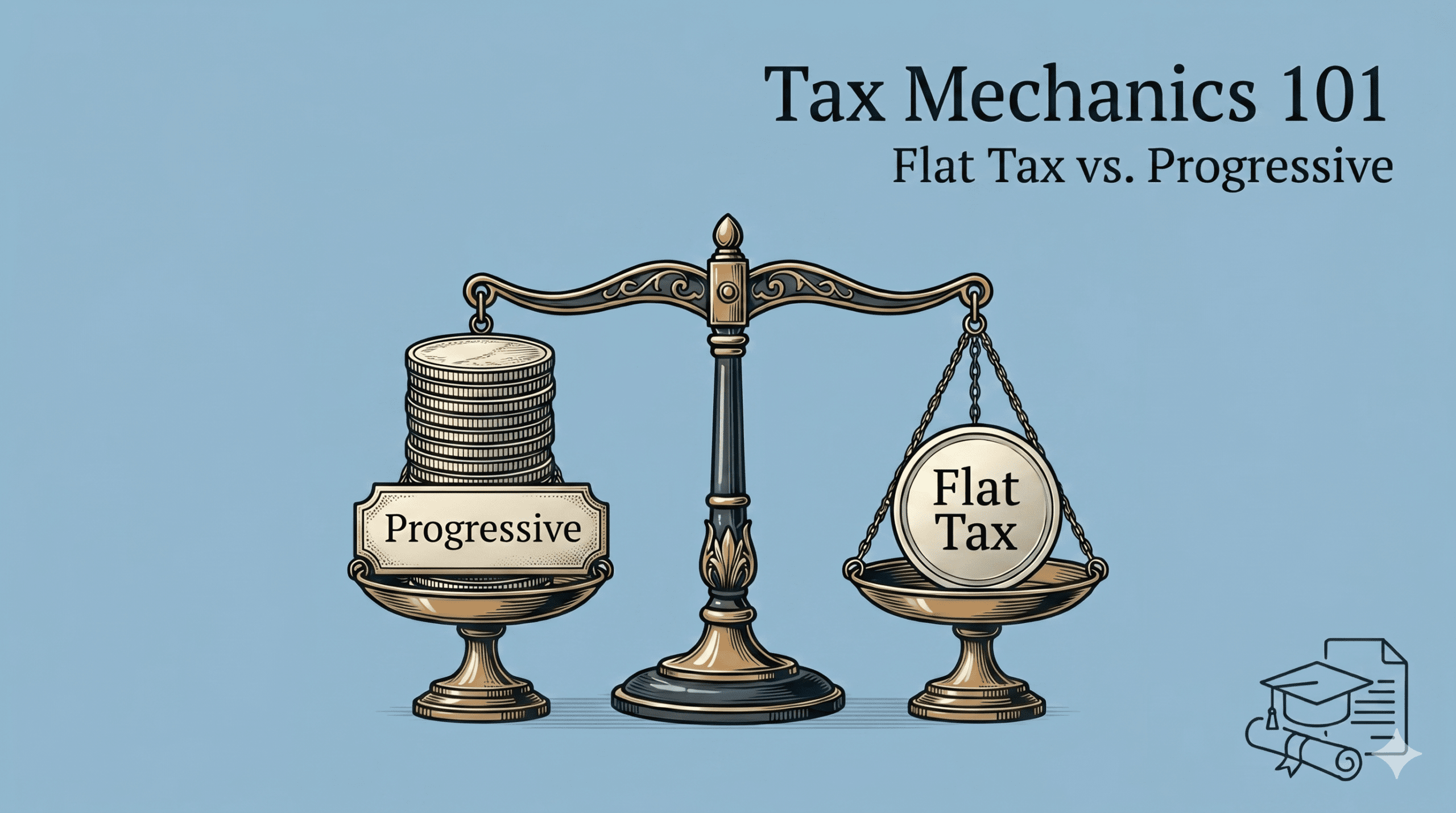
How the U.S. Tax System Works: Taxable Income, Deductions, and the Flat Tax Debate
Politics 101 Tax Series #1
Course Module: Fiscal Policy & Government Revenue
How the U.S. tax system works is often misunderstood. Many Americans assume they pay taxes on every dollar they earn, but the IRS taxes taxable income, not gross income. Many Americans assume they pay taxes on every dollar they earn, but that is not how the U.S. tax system works. Before taxes are calculated, deductions, retirement contributions, and tax credits can significantly reduce the amount of income that is actually taxed. Understanding how the U.S. tax system works helps explain why people with similar incomes can end up paying very different tax bills.
Gross Income vs. Taxable Income
A common misconception is that the federal government taxes gross income, or total earnings. In reality, the IRS taxes taxable income.
The U.S. tax system works like a filter. Before tax rates are applied, certain legal adjustments, deductions, and credits can reduce the final amount a person owes.
Why Two People With the Same Income Can Pay Different Taxes
Consider two hypothetical taxpayers, Person A and Person B, both earning a gross salary of $100,000 in the 2025 tax year.
| Factor | Person A: The “Optimizer” | Person B: The “Standard” |
|---|---|---|
| Gross Income | $100,000 | $100,000 |
| Adjustments | -$23,000 401(k) Contribution | $0 |
| Adjusted Gross Income | $77,000 | $100,000 |
| Deductions | -$35,000 Itemized | -$16,000 Standard Deduction |
| Taxable Income | $42,000 | $84,000 |
| Tax Credits | -$2,000+ Child/Energy Credits | $0 |
| Estimated Effective Tax Rate | About 5–10% | About 15–20% |
Tax Deductions and Tax Credits Explained
Person A lowers their taxable income by using several parts of the tax code. First, pre-tax retirement contributions reduce adjusted gross income. Then, itemized deductions reduce taxable income further. Finally, tax credits directly reduce the tax bill.
Person B takes the standard deduction, which is simpler but may not reduce taxable income as much.
The lesson: The U.S. tax code is not only a revenue system. It is also a policy tool used to encourage certain behaviors, such as saving for retirement, buying a home, donating to charity, or investing in energy efficiency.
Key Tax Terms to Know
- Marginal Tax Rate: The tax rate applied to the last dollar earned.
- Effective Tax Rate: The actual percentage of total income paid in taxes.
- Deduction: An expense that reduces taxable income.
- Credit: A direct reduction of the tax owed.
- Itemized Deduction: Specific eligible expenses listed instead of taking the standard deduction.
- Standard Deduction: A fixed amount that reduces taxable income for most taxpayers.
Flat Tax vs. Progressive Tax
The current U.S. income tax system is progressive, meaning higher levels of income are taxed at higher rates. A flat tax would apply one tax rate to all taxpayers above a certain income threshold.
Supporters of a flat tax argue that it would simplify the tax code, make taxes easier to understand, and reduce loopholes. Critics argue that it could shift more of the tax burden onto lower- and middle-income households while reducing revenue for public programs.
Arguments For and Against a Flat Tax
The Case for a Flat Tax
Supporters believe a flat tax would make the system more transparent and easier to administer. They argue that fewer deductions and fewer brackets could reduce confusion and improve compliance.
The Case Against a Flat Tax
Critics argue that a flat tax may appear equal on paper but not feel equal in real life. A single rate can affect lower-income families more heavily because they spend a larger share of their income on basic needs.
Why This Debate Matters
Tax policy affects paychecks, family budgets, government services, and national priorities. Debates about deductions, credits, tax rates, and flat taxes are really debates about fairness, responsibility, and what government should encourage or fund.
Discussion Questions
- Is a tax system fairer when it is simple, or when it accounts for ability to pay?
- Does the current system encourage positive behavior, or mainly benefit people with more resources?
- How does tax complexity affect public trust in government?
Frequently Asked Questions About the U.S. Tax System
Do Americans pay taxes on all of their income?
No. The U.S. tax system taxes taxable income, not gross income. Deductions, retirement contributions, and other adjustments can reduce the amount of income subject to tax.
What is the difference between a deduction and a tax credit?
A deduction reduces taxable income. A tax credit directly reduces the amount of tax owed.
What is a progressive tax system?
A progressive tax system applies higher tax rates to higher levels of income.
What is a flat tax?
A flat tax applies one tax rate to all taxpayers above a certain income threshold.
Why do some people support a flat tax?
Supporters argue that a flat tax would simplify the tax code, reduce compliance costs, and make the system easier to understand.
Why do some people oppose a flat tax?
Critics argue that a flat tax may place a larger burden on lower-income households and reduce the government’s ability to use tax policy for social goals.
Further Reading
To better understand how tax policy connects to government power, read our guide on Federalism Explained.

No discussions yet
Be the first to join the discussion and share your thoughts with the community.