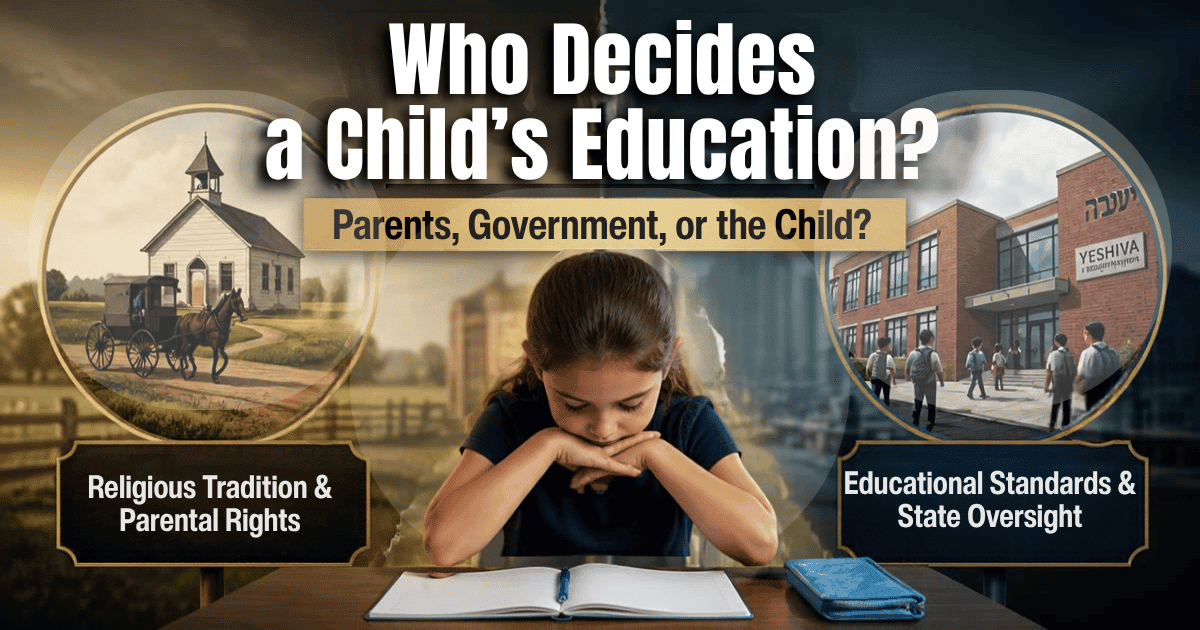
From Amish one-room schoolhouses to New York’s yeshiva battles, what happens when religious freedom, parental rights, and a child’s future collide?
The question at the heart of this article: Parents have the right to pass down their beliefs. But should children also have the education necessary to decide, someday, whether they share them?
The Child Who Has No Vote
Imagine a thirteen-year-old girl who wants, more than anything, to become a pediatrician. She’s bright, curious, and already reading library books about human anatomy for fun.
But her parents have decided that formal schooling beyond eighth grade is unnecessary — even harmful to their family’s faith and way of life.
By the time she turns eighteen, she’ll have a deep religious education, strong community bonds, and valuable practical skills. What she may not have is the math, science, or academic preparation needed to pursue medicine. She could try to catch up later, but the road would be considerably harder than it needed to be.
This girl is hypothetical, but the dilemma is real.
Nobody in this story is necessarily a villain. Her parents love her. Her community supports her. Their religious beliefs are sincere. And the state has a legitimate interest in ensuring children receive an education that prepares them for adulthood.
But here’s the uncomfortable detail hiding in plain sight: of everyone at the table — parents, religious leaders, educators, lawmakers, and judges — exactly one person has no vote and often no meaningful say in the decision. The child.
So who gets to decide what education that child receives? And does protecting a parent’s freedom also mean protecting the child’s ability to make different choices someday?
American courts have wrestled with these questions for generations. One Supreme Court case involving Amish families brought the conflict into sharp focus — and more than fifty years later, a battle over religious schools in New York is raising some of the same uncomfortable questions.
The Bigger Picture: Three Rights, One Difficult Question
Three important American principles collide in this debate.
Parental rights: Parents have broad authority to decide how their children are raised and educated.
Religious freedom: The First Amendment protects religious communities from government interference, including pressure to abandon their traditions.
A child’s education: States require children to attend school or receive an approved alternative education because preparing the next generation is a public responsibility.
Most of the time, these principles coexist without much trouble. But what happens when parents believe that the education the state requires threatens their faith?
And what happens when the child grows up wanting a future that education never prepared them for?
In 1972, the Supreme Court confronted the first question. The second proved much harder to answer.
What’s Actually Happening
Part 1: The Supreme Court and the Amish — Wisconsin v. Yoder (1972)
In 1971, three fathers in Wisconsin found themselves in court over a decision that might seem ordinary today: they refused to send their children to high school.
Jonas Yoder and Wallace Miller belonged to the Old Order Amish church. Adin Yutzy belonged to the Conservative Amish Mennonite Church. Their children had completed eighth grade, but Wisconsin law required schooling until age sixteen. The fathers refused, and each was fined $5.
For these families, education wasn’t the enemy. Their children learned reading, writing, and arithmetic, followed by practical training through farming, apprenticeships, and community life. They believed high school would expose their children to values that threatened their religious traditions and way of life.
Wisconsin saw things differently. The state argued that education prepares children for adulthood, citizenship, and opportunities beyond their immediate communities. Should religious beliefs exempt parents from requirements that applied to everyone else?
In 1972, the Supreme Court ruled 6–1 in favor of the fathers.
Chief Justice Warren Burger acknowledged that the state’s interest in education was exceptionally important, but it wasn’t absolute. The Court emphasized the Amish community’s long history of self-sufficiency, its established educational practices, and the relatively limited additional schooling Wisconsin required.
In other words, the justices weren’t saying that religion automatically overrides education laws. They concluded that, under these particular circumstances, Wisconsin hadn’t justified forcing the children to attend another year or two of formal schooling.
But the ruling left an uncomfortable question unanswered: What if one of those children wanted to go to high school?
The Court had protected the parents’ religious freedom. Whether the children wanted the same future was another matter entirely.
Part 2: The Question the Court Didn’t Resolve
Not everyone on the Supreme Court agreed.
Justice William O. Douglas raised a question that the other justices had largely overlooked: What about the children?
The case centered on the parents’ religious freedom, but Douglas wondered whether their children shared those beliefs or simply had no choice in the matter.
Only one child, fifteen-year-old Frieda Yoder, had testified. She supported her parents’ position. But what about the others? What if a child wanted to attend high school, pursue a different career, or eventually leave the community?
Douglas argued that children have religious freedoms of their own, separate from their parents. Before deciding their educational futures, shouldn’t someone at least ask what they wanted?
The majority wasn’t persuaded that the issue required further consideration in this case.
But Douglas had exposed a problem that remains unresolved: a child’s beliefs at fourteen may not be the same at twenty-four.
Parents have every right to teach their children their faith. But if an education leaves those children unprepared to pursue a different life, how meaningful is their freedom to choose?
More than fifty years later, that question has resurfaced in an unexpected place: New York’s religious schools.
Part 3: New York’s Yeshiva Debate
But this time, some of the loudest voices demanding change are former students.
In 2015, Young Advocates for Fair Education (YAFFED), an organization founded by former yeshiva students, helped bring a complaint to New York City’s Department of Education. Signed by 52 graduates, parents, and teachers, it alleged that 39 yeshivas were failing to provide boys with adequate secular education.
The concern wasn’t religious instruction itself. It was what some students weren’t learning: English, math, science, and history.
New York law requires private and religious schools to provide an education “substantially equivalent” to public schools. That doesn’t mean abandoning religious traditions. It means ensuring children receive essential academic instruction.
The investigation dragged on for eight years, amid delays and findings of political interference. When the results arrived in 2023, city officials determined that four yeshivas failed to meet the standard and recommended the same finding for another fourteen, subject to state review.
Did You Know?
Naftuli Moster, the founder of YAFFED, grew up in a Hasidic community. When he pursued college, he needed remedial English courses that didn’t count toward his degree. He eventually graduated from CUNY and earned a master’s degree at Hunter College.
His experience raises a difficult question: Why should students have to spend years catching up on an education they were entitled to receive?
At one boys’ school in Williamsburg, investigators reported observing no English-language instruction. The school taught primarily in Yiddish, with little evidence of the required secular subjects.
What Former Students Say
Some former students describe entering adulthood without sufficient preparation in English, math, and other academic subjects. They argue that religious education should not come at the expense of opportunities for college, careers, or independent choices.
What Parents Want to Protect
Many parents value schools that preserve religious traditions, language, and community identity. They worry that government oversight could gradually undermine their ability to raise children according to their faith.
A Legal Battle That Isn’t Over
In June 2025, New York’s highest court upheld regulations allowing the state to determine that a private school failing educational standards could no longer count toward compulsory schooling requirements. The ruling did not itself order any yeshiva to close.
Meanwhile, lawmakers had amended the state’s education requirements, creating additional ways for private schools to demonstrate compliance and extending certain deadlines into the 2032–33 school year. Supporters argued the changes protected parental rights and religious independence. Critics said they weakened accountability.
Then came another development.
Michael Rebell, the education-law attorney behind New York’s landmark Campaign for Fiscal Equity litigation, brought a lawsuit on behalf of yeshiva students. He argued that the state’s changes undermined their constitutional right to a sound basic education.
On January 30, 2026, New York’s attorney general moved to dismiss the case, arguing that the state constitution’s education guarantee does not impose the same obligation on private religious schools as on the public school system.
In June 2026, a separate case brought by YAFFED produced another important ruling. A New York appeals court held that the organization could challenge the state’s handling of complaints about inadequate yeshiva education. The judges recognized that educational deficiencies can affect former students long after graduation. The ruling didn’t settle whether the schools met educational standards, but it allowed the legal challenge to continue.
If the state requires every child to receive an education, who is responsible when that education leaves a child unprepared for adulthood?
Justice Douglas asked whose freedom mattered in 1972. More than fifty years later, students and former students are still pressing for an answer.
Good to Know: What About Homeschooling?
Homeschooling deserves an article of its own. It’s legal in all fifty states, but educational oversight varies widely. Some states require testing and progress reports; others have few requirements for measuring academic achievement.
You’ve probably heard that homeschooled students outperform public school students. Some studies do report higher scores, but comparisons can be misleading when families volunteer to participate or when researchers cannot fully account for differences in family resources and parental education.
The question isn’t whether homeschooling can succeed. It can. The question is how we know every child is receiving an adequate education when oversight and reliable data are limited.
Why People See This Differently
At the heart of these disputes are two very different ideas about freedom.
For parents and religious communities, freedom means raising children according to their beliefs without the government deciding which traditions are acceptable. History offers plenty of examples of governments using education to pressure minority communities into abandoning their identities. Those fears aren’t imaginary.
For advocates of children’s educational rights, freedom means having the knowledge and skills to make meaningful choices as adults. A child may embrace their family’s traditions or choose another path. But shouldn’t their education prepare them for either possibility?
And for the state, the challenge is deciding where parental freedom ends and its responsibility to children begins — without turning educational standards into a tool for cultural conformity.
The difficult question isn’t whether religious freedom or education matters more. It’s how to protect both when they come into conflict.
Real-World Impact: When Choices Have Consequences
An education does more than prepare someone for a job. It shapes their ability to understand a contract, manage finances, evaluate information, participate in democracy, and make decisions about their future.
For children who receive limited academic instruction, the consequences may not become clear until adulthood. College, professional training, and certain careers can become difficult to pursue. Even those who remain within their religious communities may benefit from skills that help them navigate an increasingly complicated world.
But government oversight carries responsibilities of its own. Educational standards should protect children’s opportunities without unnecessarily erasing the cultural and religious traditions that give their families meaning.
Key Message: The goal isn’t to tell children what to believe. It’s to give them the knowledge and skills to decide for themselves.
What You Can Do
1. Know your state’s education requirements.
Every state has compulsory education laws, but oversight of private schools and homeschooling varies widely. Visit your state’s Department of Education website to see what’s required and how educational progress is measured.
2. Ask whose voice is missing.
When debates arise over parental rights, religious freedom, or school oversight, pay attention to who’s making the decisions. Are students being heard? Are former students’ experiences being considered? Remember Justice Douglas’s question: What about the children?
3. Look beyond the headlines.
Not all religious schools are failing, and not every government regulation threatens religious freedom. Look at the actual educational standards, documented findings, and proposed solutions before deciding where you stand.
What This Means for You
Parents have the right to pass down their beliefs, traditions, and values. But children eventually become adults, with dreams and decisions of their own.
The question isn’t whether a child will choose to follow their parents’ path. Many will, and happily so.
It’s whether their education has prepared them to choose a different one.
More than fifty years after Wisconsin v. Yoder, that question remains as relevant as ever.
Join the Discussion
Should every child be guaranteed a basic education in reading, math, science, and civics, regardless of their parents’ religious beliefs?
And where should we draw the line between protecting a family’s traditions and protecting a child’s freedom to choose their own future?
Next in this series: How proposals to expand parental rights and reduce government oversight could reshape American education — and what that might mean for the next generation.
Related Articles


No discussions yet
Be the first to join the discussion and share your thoughts with the community.