
Why It Matters: Understanding what no-fault divorce is, why it was created, and what the numbers actually show.
This article is the first in a VoteView series examining how American family law has changed over the past century. Future articles will explore women’s financial rights, workplace protections, domestic violence laws, and how those changes continue to influence today’s political debates.
Opening
Have you heard someone say that no-fault divorce destroyed the American family?
You’re not alone. Over the past few years, Republican lawmakers in several states — including Louisiana, Oklahoma, Nebraska, and Texas — have introduced or publicly discussed legislation that would restrict or eliminate no-fault divorce. In 2022, the Republican Party platforms in Texas and Nebraska were amended to call for its removal. Vice President J.D. Vance has publicly criticized no-fault divorce, calling it “one of the great tricks that the sexual revolution pulled on the culture.” Organizations connected to Project 2025 have advocated for ending it.
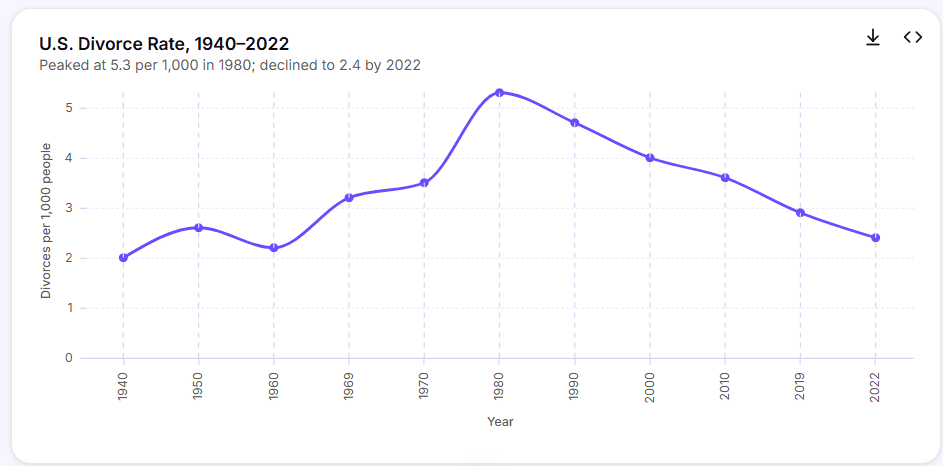
Meanwhile, the actual U.S. divorce rate has been declining for over forty years.
So here’s the question: If politicians are blaming no-fault divorce for high divorce rates, but divorce rates are already near historic lows, what’s really going on?
To understand this debate — and to form your own opinion — it helps to understand what no-fault divorce actually is, why it was created, and what the statistics really mean.
The Bigger Picture
Throughout American history, debates over marriage, education, healthcare, religion, and parenting often come back to the same question: Where should government authority end and personal freedom begin?
When we talk about no-fault divorce, we’re really talking about whether the government should make it harder for people to end a marriage — and whether making it harder would actually make families stronger, or just keep more couples legally married.
The answer is more complicated than any political sound bite suggests.
What’s Actually Happening
Part I — What Is No-Fault Divorce?
Before no-fault divorce laws existed, ending a marriage was legally difficult. To get a divorce, one spouse generally had to prove that the other had committed wrongdoing — and the list of acceptable reasons was narrow:
- Adultery
- Cruelty (physical or mental)
- Abandonment
- Habitual drunkenness
- Other specific, legally recognized grounds
If none of these applied, a couple might be legally stuck — even if both wanted out. In practice, this meant some couples fabricated accusations, manufactured evidence, or simply remained in unhappy or unsafe marriages because they couldn’t meet the legal requirements.
No-fault divorce changed that. Under no-fault laws, a couple can end a marriage without proving that one spouse did something wrong. Instead, many states allow reasons such as “irreconcilable differences” or an “irretrievable breakdown” of the marriage.
| Comparison | Fault Divorce | No-Fault Divorce |
|---|---|---|
| Requirement | Must prove legal grounds | No proof of wrongdoing required |
| Evidence | Often requires witnesses or documentation | Usually based on a stated request |
| Process | Can become lengthy and adversarial | Often simpler and less contentious |
| Blame | One spouse is assigned fault | Neither party must be blamed |
Part II — Why Was It Created?
The push for no-fault divorce didn’t happen in a vacuum. It grew out of real problems in the legal system.
Courts were filled with exaggerated or fabricated accusations. Because couples had to prove fault, some spouses manufactured evidence — staging or exaggerating cruelty, adultery, or abandonment just to qualify for a divorce. Judges knew this was happening. Lawyers knew. Everyone in the system understood that the requirements had created a culture of dishonesty.
Many unhappy couples remained legally married because they couldn’t meet the legal grounds. If your spouse hadn’t committed adultery, hadn’t been cruel in a way the law recognized, and hadn’t abandoned you, you might have no path to divorce — regardless of how unhappy or unsafe the marriage was.
The legal system was forcing people to assign blame even when both parties agreed the marriage was over. This made divorces longer, more expensive, and more damaging — especially for children caught in the middle.
California became the first state to adopt no-fault divorce in 1969, when Governor Ronald Reagan signed the Family Law Act. Other states followed over the next decade and a half. By 1985, no-fault divorce was available in some form in nearly every state.
No-fault divorce did not emerge because of a single political movement. It was one part of a much broader period of legal, economic, and cultural change that reshaped American family life.
Part III — America Was Changing
No-fault divorce didn’t arrive in isolation. It came during one of the most dramatic periods of social and legal change in American history.
Consider what else was happening in the 1960s and 1970s:
- More women entered the workforce. Between 1960 and 1980, women’s labor force participation rate rose from roughly 38% to over 51%. For the first time, many women had enough independent income to envision life outside a marriage.
- The Equal Credit Opportunity Act (1974) made it illegal for banks and lenders to discriminate based on sex or marital status. Before this law, banks could — and routinely did — require a husband’s signature for a woman to get a credit card, loan, or mortgage. A married woman might be denied credit in her own name.
- The Pregnancy Discrimination Act (1978) amended Title VII of the Civil Rights Act to prohibit employment discrimination based on pregnancy. Before this, employers could legally fire women for being pregnant, force them onto unpaid leave, or refuse to hire them.
- Growing awareness of domestic violence. For most of American history, domestic violence was treated as a private family matter — something police were reluctant to intervene in and courts were reluctant to address. The 1977 case of Francine Hughes, who killed her abusive husband after years of severe beatings, became a national turning point. Her acquittal and the subsequent TV movie “The Burning Bed” starring Farrah Fawcett brought domestic violence into public consciousness in a way that hadn’t happened before.
- Changing expectations about marriage itself. The idea that marriage should be a partnership based on mutual respect — rather than an arrangement based on duty, economics, or social expectation — was gaining traction.
These changes didn’t cause divorce by themselves. But they gave people — especially women — the economic, legal, and social ability to leave marriages that previously had no exit.
Timeline: How Family Law Changed in America
| Year | What Happened | Why It Matters |
|---|---|---|
| 1969 | California becomes the first state to adopt no-fault divorce. | Couples no longer have to prove wrongdoing to end a marriage. |
| 1974 | The Equal Credit Opportunity Act becomes law. | Women can no longer be denied credit because of their sex or marital status. |
| 1977 | Francine Hughes is acquitted after killing her abusive husband. | The case brings national attention to domestic violence. |
| 1978 | The Pregnancy Discrimination Act becomes law. | Employers can no longer fire or refuse to hire women because they are pregnant. |
| 1980 | The U.S. divorce rate reaches its highest recorded level. | Family structure becomes a major political issue. |
| 1985 | Every state has adopted some form of no-fault divorce. | The new legal framework becomes the national norm. |
| Today | Divorce rates are significantly lower than their 1980 peak. | The political debate continues even as divorce becomes less common. |
Part IV — What the Numbers Actually Show
Here’s where things get interesting — and where a lot of people get confused.
There are two different measurements that get mixed up:
Measurement 1: Crude Divorce Rate The number of divorces per 1,000 people in the population in a given year. This tells you how common divorce was in the general population during that year.
Measurement 2: Lifetime Divorce Risk The estimated percentage of marriages from a particular era that eventually ended in divorce. This tells you how likely it was that a couple who married in, say, the 1970s would eventually divorce.
Here’s what the crude divorce rate looks like over time:
And here’s the estimated lifetime divorce risk by marriage era:
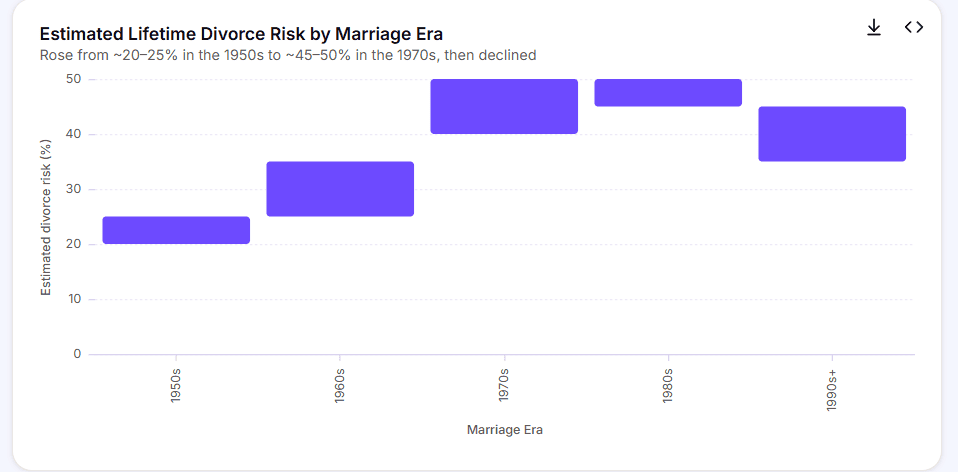
Notice something important: both measurements tell the same broad story — divorce was lower in the mid-20th century, rose sharply in the 1960s and 1970s, peaked around 1980, and has been declining ever since.
But notice what the numbers do NOT tell you:
They don’t tell you whether the marriages that stayed intact were happy. A low divorce rate in 1960 doesn’t mean marriages were healthier — it might mean people had fewer options to leave.
They don’t tell you why people divorced. Statistics count divorces, not reasons. A divorce might represent someone escaping abuse, or it might represent two people who simply grew apart.
And they don’t account for the fact that the “rules” were different. In 1960, divorce was legally harder, socially stigmatized, and economically devastating for many women. Comparing the divorce rate then to now without accounting for those differences is like comparing test scores from two schools with completely different admission standards.
Part V — Why People See This Differently
This is where the debate gets real. Both sides have genuine concerns, and both sides have evidence they can point to.
The View From Those Who Want to Restrict No-Fault Divorce:
Advocates for tightening or eliminating no-fault divorce — including some Republican lawmakers and conservative organizations — argue that making divorce easier has weakened families. Their concerns include:
- Higher divorce rates. Divorce did increase after no-fault laws were adopted. Proponents argue this represents real harm to families, not just a statistical adjustment.
- Effects on children. Research consistently shows that children generally do better in stable, two-parent households. More divorce means more children experiencing family disruption.
- Community stability. High divorce rates can affect neighborhoods, schools, and community institutions.
- One-sided exits. Under current no-fault laws, one spouse can end a marriage even if the other wants to reconcile. Some argue this is unfair to the spouse who wants to save the relationship.
- Marriage should be harder to leave. The argument here is that making marriage difficult to exit strengthens commitment — that people will work harder on their relationships if the legal exit door is narrower.
The View From Those Who Want to Protect No-Fault Divorce:
Critics of rolling back no-fault divorce — including domestic violence advocates, women’s rights organizations, and many legal professionals — argue that restricting divorce would cause harm. Their concerns include:
- Trapping people in abusive relationships. Before no-fault divorce, many people — overwhelmingly women — had no legal path out of dangerous marriages. Returning to fault-based divorce could make it harder to leave abusive situations, especially if abuse is difficult to prove in court.
- A lower divorce rate doesn’t mean happier families. The low divorce rates of the 1950s coincided with an era when many women had limited economic independence, restricted legal rights, and little social support for leaving unhappy or unsafe marriages. Low divorce rates can mask suffering.
- The current decline happened under no-fault laws. Divorce rates have been falling for over four decades — all under the no-fault system. If no-fault divorce were the problem, why has the rate been declining?
- Economic realities. Making divorce harder doesn’t address the underlying causes — financial stress, lack of childcare, economic inequality — that strain marriages. It simply makes it harder to end one.
- Personal freedom. Many people believe that consenting adults should be able to end a marriage without having to prove wrongdoing to a judge.
Common Ground:
Most people on both sides actually agree on several things:
- Healthy, stable marriages benefit families.
- Children generally do best in safe, stable environments.
- Abuse is unacceptable and should never be tolerated.
- Strong families matter to communities and to the country.
The real disagreement isn’t about whether families matter. It’s about how society best supports them — and whether government should make divorce harder, or whether it should focus on addressing the economic and social pressures that strain marriages in the first place.
Real-World Impact
What would actually happen if a state repealed no-fault divorce?
Based on what we know from the era before no-fault laws and from the states that have experimented with “covenant marriage” (a stricter form of marriage available in Arizona, Arkansas, and Louisiana that requires premarital counseling and fault-based grounds for divorce):
- Some marriages would remain legally intact that would otherwise have ended. Whether those marriages would be healthier is a different question.
- Court systems would see more contested cases. Fault-based divorce tends to involve more litigation, more evidence, more witnesses, and longer proceedings — which means higher legal costs and more conflict.
- Some people would remain in unsafe situations. Domestic violence advocates are particularly concerned about this. Abuse can be difficult to prove in court, and requiring proof of fault could trap vulnerable spouses.
- The economic burden would fall hardest on those with fewer resources. Longer, more expensive divorces disproportionately affect lower-income families.
- It’s unclear whether divorce rates would actually fall. The states that have covenant marriage options have not seen dramatically different divorce rates, and adoption of covenant marriage has been very low.
People Are Asking
“Didn’t divorce rates skyrocket after no-fault divorce?”
Yes — but the story is more complicated than that. Divorce rates rose in the late 1960s and 1970s, coinciding with no-fault laws. But they also coincided with women entering the workforce in large numbers, expanded access to credit, growing awareness of domestic violence, and changing expectations about marriage. Multiple forces were at work simultaneously. It’s not possible to isolate no-fault divorce as the single cause.
“Are divorce rates high right now?”
No. By historical standards, today’s divorce rate is relatively low — roughly 2.3–2.5 divorces per 1,000 people, compared to 5.3 at the 1980 peak. The rate has been declining for over four decades.
“If no-fault divorce caused high divorce rates, why are rates falling now?”
This is one of the strongest challenges to the argument that no-fault divorce itself is the problem. Divorce rates have been falling for over forty years — all under the no-fault system. Demographers attribute the decline to factors including people marrying later, more selective matching, changing economic conditions, and generational shifts in attitudes toward marriage.
“What about the claim that half of all marriages end in divorce?”
That figure is generally considered an overstatement today. Current estimates place the lifetime divorce risk for first marriages at roughly 40–45%. For college-educated couples who marry after 25, it’s often below 30%.
What You Can Do
Stay informed about your state. Divorce law is set at the state level. Check whether your state legislature has introduced or debated any changes to no-fault divorce laws. Your state’s legislative website is the best source.
Read beyond the headline. When you see a politician or commentator making a claim about divorce rates, ask: Which measurement are they using? Are they comparing annual rates or lifetime risk? Are they accounting for the legal and economic differences between eras?
Talk to people who lived through these changes. If you have family members in their 60s, 70s, or 80s, ask them what it was like. Many women who came of age before 1974 personally remember being unable to get credit in their own name.
Support families, not just marriage. If the goal is stronger families, consider whether policies like paid family leave, affordable childcare, domestic violence prevention, and economic opportunity might do more to support healthy marriages than restricting divorce.
What This Means for You
If you’re married, considering marriage, or know someone who is, this debate affects the legal framework that surrounds your relationship.
If no-fault divorce were restricted in your state, it could affect your ability — or your children’s ability — to end a marriage that isn’t working. It could affect how courts handle custody, property division, and spousal support. It could affect how domestic violence cases are handled.
The outcome of this debate will shape what marriage means as a legal institution for the next generation.
Discussion
- If divorce had remained extremely difficult to obtain, would families necessarily be stronger — or just more legally bound?
- How should we measure the “health” of American families? Divorce rate alone? Children’s well-being? Economic security? Something else?
- Should public policy focus more on encouraging marriage, supporting families after divorce, or both?
- Is there a middle ground between “divorce should be easy” and “divorce should be very difficult”?
- What role should domestic violence considerations play in shaping divorce law?
Pattern to Notice
When people compare America “then” and “now,” they often compare the outcomes without comparing the rules people lived under. A low divorce rate in 1960 doesn’t necessarily mean marriages were healthier. It might mean people had fewer options.
This pattern shows up in lots of political debates — not just divorce. When someone says “things were better back then,” it’s always worth asking: Better for whom? And under what rules?
Key Takeaway
Divorce statistics tell part of the story, but they cannot tell us whether marriages were healthy, equal, or safe. The debate over no-fault divorce is really about something bigger: what role government should play in private life, and whether making it harder to leave a marriage would actually strengthen families — or simply keep more people legally bound to relationships they’d otherwise leave.
Related Articles
- Could Women Really Not Open a Bank Account? (coming soon)
- Could Employers Fire Women for Being Pregnant? (coming soon)
- When Domestic Violence Was Considered a Private Family Matter (coming soon)
- Was the 1950s Family Really Better? (coming soon)
- What Do Politicians Mean When They Say Family Values? (coming soon)




No discussions yet
Be the first to join the discussion and share your thoughts with the community.