
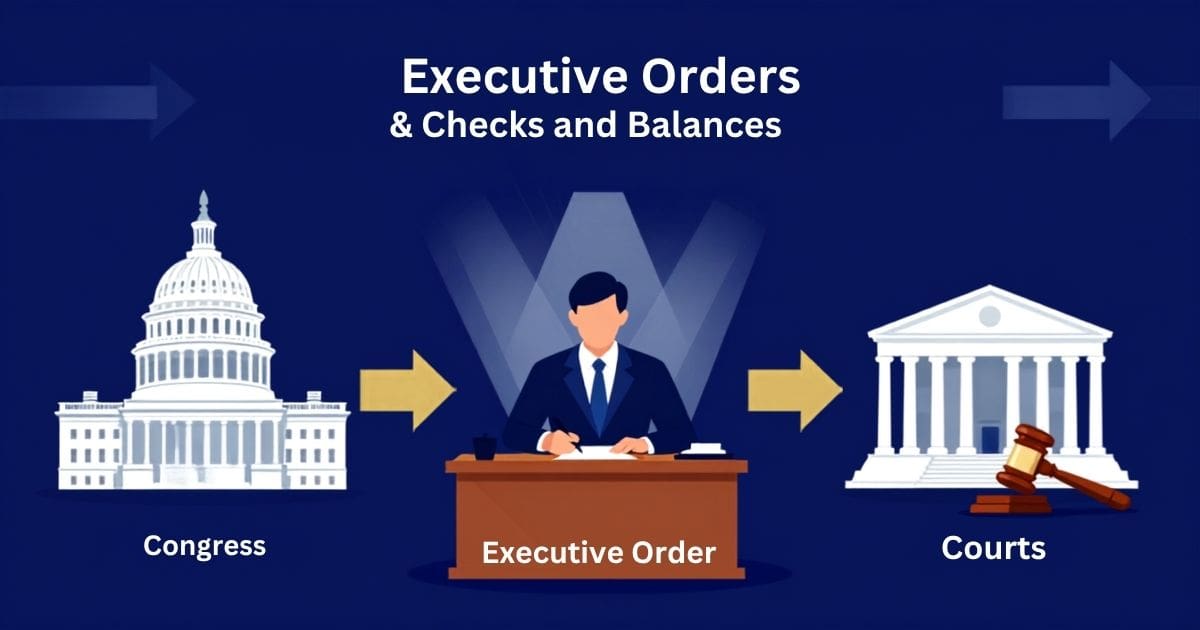
CIVICS 101
What Is an Executive Order?
How Presidents Direct the Executive Branch — And Why the Courts Can Say No
In Plain English
An executive order is a directive from the President that tells federal agencies how to carry out existing laws. It can shape government policy quickly, but it cannot create new laws or override the Constitution.
Executive Orders at a Glance
- They direct federal agencies.
- They cannot create brand-new laws.
- They must rely on the Constitution or laws Congress already passed.
- They can be challenged in court.
- They can be reversed by a future president.
Why You’re Seeing So Many Executive Orders
In recent years, executive orders have received more attention than ever before. Whether issued by Republican or Democratic presidents, they often become front-page news because they can change federal policy quickly. Understanding how executive orders work helps explain why they are both powerful and controversial.
You’ve seen the moment on TV dozens of times. A president sits at a desk, surrounded by smiling advisors, picks up a pen, and signs a document in front of flashing cameras. The headline the next morning reads: “President Signs Executive Order.”
It sounds dramatic — like the president found a secret trapdoor in the Constitution to bypass the rules.
But executive orders aren’t a magic trick. They’re a legal tool with deep historical roots, real limits, and enormous consequences for your daily life.
To understand the true power of that signature, go back to a winter day in January 1948. High-ranking military officials gathered in a quiet corner of the Pentagon, facing an urgent situation. America’s armed forces were entirely segregated, and Congress refused to pass a law to fix it.
Rather than waiting, President Harry Truman took out his pen and signed Executive Order 9981, desegregating the military with a single stroke.
That is the raw power of an executive order. It bypasses the long, noisy debates of Capitol Hill and changes the course of the country in seconds. But what exactly gives one person that kind of authority — and what are the limits?
What Is an Executive Order?
Think of the U.S. government as a massive corporation where the President is the CEO.
The executive branch is headquarters. Under it sit giant departments — Defense, Homeland Security, Education, Justice, and more. When a CEO needs managers to implement a new policy, they do not call a board meeting. They send a company-wide memo.
That is what an executive order is. The president is not writing a brand-new law from scratch. They are giving clear instructions to federal agencies on how to carry out laws that already exist.
| What an Executive Order Is | What an Executive Order Is Not |
|---|---|
| A directive to federal agencies | A new law passed by Congress |
| Instructions on how to enforce existing law | A constitutional amendment |
| Subject to legal and budgetary limits | Unlimited presidential power |
| Reversible by the next president | Permanent legislation |
Key Takeaway
An executive order is the president telling their own staff what to do. It does not create new authority — it directs how existing authority is used.
Where Does the Power Come From?
A president cannot wake up and write an order about anything they want. Every executive order must trace its power to one of two sources.
Source 1: The Constitution
Article II of the Constitution says two important things: “The executive power shall be vested in a President” and the president “shall take care that the Laws be faithfully executed.”
Notice: the phrase “executive order” appears nowhere in the Constitution. But for more than 200 years, presidents have used these clauses as their legal permission slip to issue binding directives to federal agencies.
Source 2: Acts of Congress
Congress often passes large bills that set broad goals but leave the details blank. In effect, Congress tells the president: “Here is the general policy — you figure out how to implement it.”
When a president issues an executive order under this framework, they are not seizing power. They are fulfilling the mandate Congress gave them.
Fun Fact
Not every presidential directive is called an “executive order.” The White House uses different tools depending on the situation.
| Type of Directive | What It Does | Who Reads It |
|---|---|---|
| Executive Order | Sets legally binding policy for federal agencies | Federal employees and the public |
| Presidential Memorandum | Gives less formal instructions or sets up study groups | Specific agency heads |
| Proclamation | Makes a public announcement or honors a group | The general public |
Turning Points in History
Throughout American history, presidents have used executive orders to make major, landscape-shifting moves without waiting on Congress.
| Executive Order | Year | President | What It Did |
|---|---|---|---|
| Emancipation Proclamation | 1863 | Lincoln | Used wartime authority to free enslaved people in Confederate states |
| EO 6102 | 1933 | FDR | Made it illegal for private citizens to hoard gold during the Great Depression |
| EO 9066 | 1942 | FDR | Forced relocation and imprisonment of more than 120,000 Japanese Americans |
| EO 9981 | 1948 | Truman | Ended racial segregation in the armed forces |
| Birthright Citizenship Order | 2025 | Trump | Attempted to deny citizenship to children of non-citizen parents |
Key Takeaway
Executive orders have been used to free the enslaved and to imprison the innocent. The same tool can advance justice or inflict injustice. The power itself is neutral; the person wielding it determines the outcome.
How an Executive Order Gets Made
An executive order does not pop into existence because a president has an idea during breakfast. It goes through a strict review process.
| Step | Who Does It | What Happens |
|---|---|---|
| 1. Initial Draft | White House policy advisors or agency experts | Identify a problem and write a rough draft |
| 2. Legal Check | Department of Justice | Reviews whether the president has the legal authority to sign it |
| 3. Budget Check | Office of Management and Budget | Determines whether agencies can afford to implement it |
| 4. Final Signature | The President | Signs the order; it receives a tracking number and is published in the Federal Register |
If the lawyers say no, or the budget does not work, the order stalls. The president can override the advice, but doing so risks immediate court challenges.
Even After It’s Signed…
Federal agencies still have to:
- Write regulations
- Train employees
- Spend money
- Enforce the policy
Signing an order is often the beginning — not the end — of the process.
Who Can Stop an Executive Order?
It is easy to look at this process and think the president has total control. But the American system has built-in safety brakes.
Limit 1: The Courts Can Block It
Federal judges can declare any executive order unconstitutional. If the president oversteps their authority, a judge can issue an injunction stopping the order.
The landmark case: In Youngstown Sheet & Tube Co. v. Sawyer (1952), President Truman tried to seize private steel mills to prevent a strike during the Korean War. The Supreme Court stepped in and said he did not have that power. Truman was forced to back down.
Constitution Connection
Remember Marbury v. Madison from the Supreme Court series? Judicial review does not just apply to Congress. It applies to the president too. The Court can strike down executive orders just as it can strike down laws.
Limit 2: Congress Holds the Wallet
Congress cannot tear up an executive order directly, but it can make the order useless. If an order requires money — hiring new border agents, building infrastructure, or funding research — Congress can refuse to fund it.
The Constitution gives Congress control over federal spending. An unfunded executive order is often just a piece of paper.
Limit 3: The Next President
This is the biggest downside of relying on executive orders: they are written in pencil, not ink.
Because an order is a directive from the current president, the next president can reverse it. It has become common for new presidents to sign orders canceling parts of the previous administration’s agenda.
Key Takeaway
Executive orders are powerful but fragile. They can change the country overnight — and disappear just as fast.
Why the Tension?
If executive orders are a legal, established tool, why do they cause so much political fighting?
The answer comes down to polarization.
When Congress is divided and cannot pass major legislation, presidents increasingly use executive orders as a fast track to get things done and keep campaign promises.
| What Supporters Say | What Critics Say |
|---|---|
| The President needs to operate efficiently in a fast-changing world. | This bypasses democracy because citizens and businesses have less voice. |
| When Congress is gridlocked, the President must act. | Policy whiplash after every election creates instability. |
| Executive orders implement laws Congress already passed. | Orders increasingly create new policy rather than execute existing law. |
Both sides have valid points. The tension is not about whether executive orders should exist. It is about where the line is between directing the executive branch and creating new law.
Why Don’t Presidents Just Ask Congress?
- Sometimes Congress agrees.
- Sometimes Congress is divided.
- Sometimes a president wants immediate action.
- Sometimes an executive order is the only available tool.
Fun Fact: Executive Orders by the Numbers
Not every president uses executive orders the same way. Some issue them frequently because of war, crisis, or gridlock. Others use them more sparingly.
| President | Years in Office | Total Executive Orders | Per Year Average |
|---|---|---|---|
| FDR | 1933–1945 | 3,726 | 307 |
| Truman | 1945–1953 | 484 | 61 |
| Eisenhower | 1953–1961 | 484 | 61 |
| JFK | 1961–1963 | 214 | 107 |
| LBJ | 1963–1969 | 325 | 54 |
| Nixon | 1969–1974 | 346 | 62 |
| Ford | 1974–1977 | 169 | 69 |
| Carter | 1977–1981 | 320 | 80 |
| Reagan | 1981–1989 | 381 | 48 |
| GHW Bush | 1989–1993 | 166 | 42 |
| Clinton | 1993–2001 | 364 | 46 |
| GW Bush | 2001–2009 | 291 | 36 |
| Obama | 2009–2017 | 276 | 35 |
| Trump, first term | 2017–2021 | 220 | 55 |
| Biden | 2021–2025 | 160 | 40 |
| Trump, second term to date | 2025–2026 | 268 | About 187 |
Key Insight
The number of executive orders a president signs often reflects crisis, circumstance, and congressional gridlock — not just party or personality.
In Real Time: When the Court Says No
Sometimes the best examples are not in history books. They are happening right now.
On January 20, 2025, President Trump signed an executive order attempting to end birthright citizenship for children of undocumented immigrants and temporary visa holders. The order argued that the Fourteenth Amendment’s phrase “subject to the jurisdiction thereof” did not cover these children.
On June 30, 2026, the Supreme Court held in Trump v. Barbara that the executive order seeking to end birthright citizenship was inconsistent with the Fourteenth Amendment and could not take effect. Writing for the Court, Chief Justice John Roberts explained that the Fourteenth Amendment guarantees citizenship to virtually everyone born in the United States, reaffirming the Court’s longstanding interpretation dating back to United States v. Wong Kim Ark (1898).
Whether readers agreed or disagreed with the policy itself, the case demonstrates an important constitutional principle: executive orders are subject to judicial review. A president can direct the executive branch, but that authority must remain within the limits of the Constitution.
| What Happened | Why It Matters |
|---|---|
| President signed order on Day One | Shows how quickly executive orders can reshape policy |
| Multiple lower courts blocked it | Shows how federal judges can respond when executive power is challenged |
| Supreme Court ruled against the order | Demonstrates the ultimate check on executive power |
| The Court relied on precedent | Shows how historical rulings continue to protect constitutional rights |
Constitution Connection
This is the same basic principle from Youngstown. Truman tried to seize steel mills. The Court said no. Decades later, another president tried to redefine citizenship through executive action. The Court said no again. The precedent holds.
Why This Matters
Executive orders are not abstract legal theory. They can affect your workplace, immigration rules, environmental protections, healthcare programs, education policies, and privacy rights. When a president signs an executive order, they are not just making a political statement. They are changing how the federal government operates.
How Executive Orders Affect Daily Life
| Area of Your Life | How Executive Orders Reach You |
|---|---|
| Workplace | Federal contracting rules, labor standards, vaccine mandates |
| Immigration | Border enforcement policies, deportation priorities, travel restrictions |
| Environment | EPA regulations, drilling permits, emissions standards |
| Healthcare | Medicare and Medicaid rules, public health emergency declarations |
| Education | Federal funding conditions, Title IX enforcement guidance |
| Your Phone | Surveillance rules and data privacy directives for federal agencies |
Frequently Asked Questions
Can the President do anything with an executive order?
No. Executive orders must be based on either constitutional authority or a law Congress already passed. If the president invents authority that does not exist, courts can block it.
How many executive orders do presidents typically sign?
Most modern presidents issue between 200 and 400 executive orders during their term. Franklin D. Roosevelt holds the record with more than 3,700.
What is the difference between an executive order and a law?
A law is passed by Congress and signed by the President. It can only be repealed by another law or struck down by a court. An executive order is issued by the President alone and can be reversed by the next President.
Can a president use an executive order to bypass the Supreme Court?
No. If a court declares an order unconstitutional, the president must comply. Attempting to ignore a court ruling would trigger a constitutional crisis.
Executive Orders at a Glance
President identifies a problem → Advisors draft the order → DOJ checks legal authority → OMB checks budget feasibility → President signs → Order is published in the Federal Register → Courts can block it, Congress can defund it, and the next president can reverse it.
Bottom Line
An executive order is one of the fastest ways a president can influence the country. But speed comes with trade-offs.
Executive orders can respond quickly to emergencies, direct the work of federal agencies, and shape national policy without waiting for Congress. At the same time, they are among the least permanent tools a president possesses.
Courts can block them. Congress can limit them. Future presidents can reverse them.
Final Thought
Executive orders remind us of one of the central ideas of the Constitution: power is strongest when it is balanced.
Continue Learning
This Civics 101 lesson connects to several other VoteView topics:
- How the Supreme Court Works
- What Is Judicial Review?
- The Three Branches of Government
- Checks and Balances
- Can the President Ignore Congress?
Coming Next in Civics 101
Executive orders are just one way the President shapes policy. But what happens when Congress pushes back? What happens when a president refuses to enforce a law? Next: Can the President Ignore Congress? — when executive power meets legislative authority.
No discussions yet
Be the first to join the discussion and share your thoughts with the community.