
Women, Work & Economic Independence
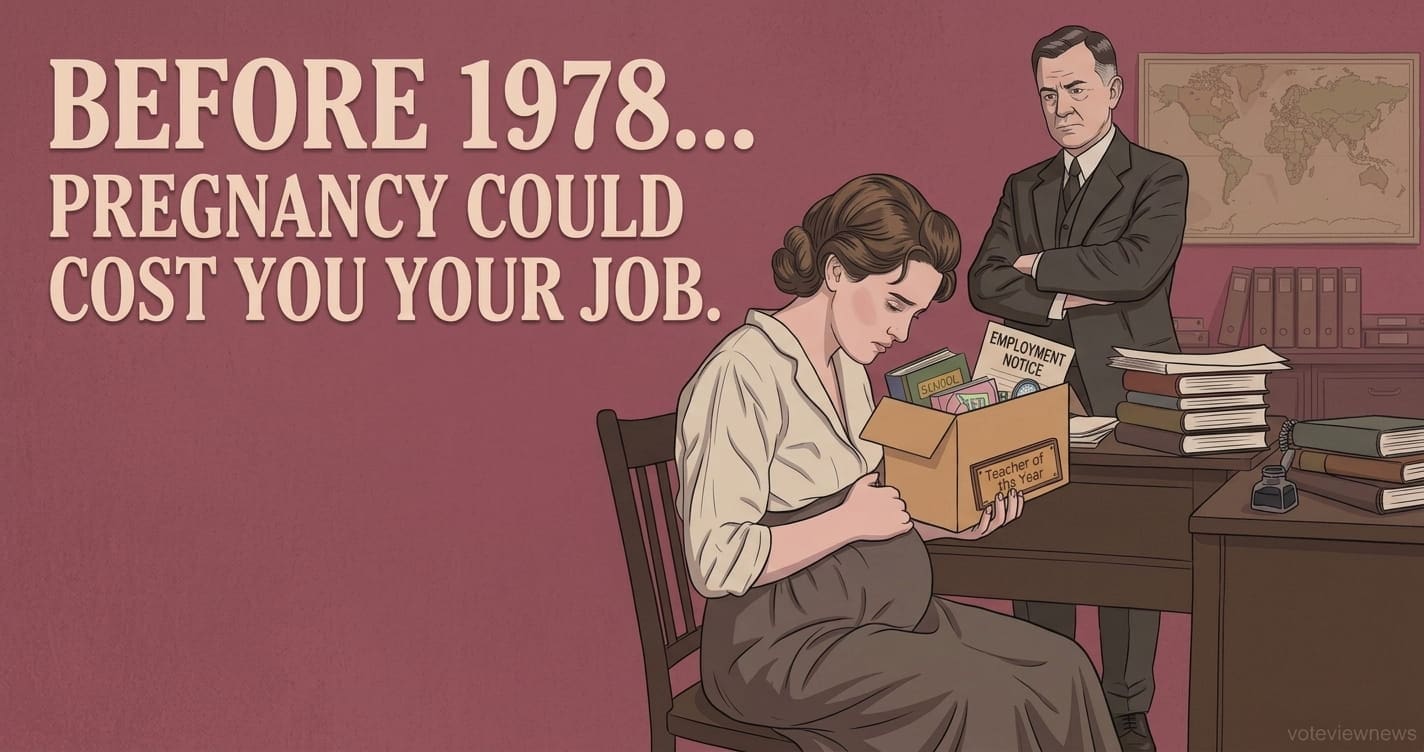
For much of modern American history, pregnancy could threaten a woman’s job. The protections workers rely on today were built piece by piece — and some are much newer than many people realize.
Imagine Having to Hide Your Pregnancy
Imagine finally landing a job you’re good at. You haven’t done anything wrong. Your boss likes your work.
Then you become pregnant.
Nobody discusses maternity leave. Nobody asks when you’ll return. Instead, your employer tells you that you can no longer work there.
For millions of American women, this wasn’t hypothetical. Some women hid their pregnancies under loose clothing for as long as they could, knowing that once they began to show, they could lose their jobs.
So, here’s the central question of this article:
For much of modern American history — yes.
And even after federal law prohibited pregnancy discrimination, protections developed piece by piece, decade by decade. The full set of protections most workers rely on today is younger than many of your coworkers.
People Are Asking
Was firing pregnant women actually legal?
Yes. For decades, federal law generally did not prevent an employer from firing a woman because she was pregnant. Some states provided protections earlier, but broad federal protections did not arrive until the 1960s and ’70s — and the newest major federal protection didn’t take effect until 2023.
What changed it?
Several laws and Supreme Court decisions, spread across nearly sixty years: Title VII (1964), General Electric Co. v. Gilbert (1976), the Pregnancy Discrimination Act (1978), the Family and Medical Leave Act (1993), Young v. UPS (2015), and the Pregnant Workers Fairness Act (2023).
Some expanded protections. One exposed a major loophole. Together, they show how pregnancy protections developed piece by piece rather than arriving all at once.
Does this affect anyone today?
Directly. The rules about light duty, bathroom breaks, and water bottles on shift are current workplace law, not history. And even today, having a legal right to keep your job is not always the same as being able to afford time away from it.
Part I — Pregnancy Was Treated as Incompatible with Work
Start with the assumptions underneath the old rules.
Pregnancy wasn’t viewed as a temporary medical condition followed by a return to work. Employers frequently assumed that a pregnant woman would — or should — leave the workforce entirely.
Teachers were hit especially hard. Many school districts had rules that required women to resign when they married or forced pregnant teachers out of the classroom — sometimes as soon as their pregnancy became visible. Marriage bars and pregnancy rules could stack on top of each other. But the pattern stretched across occupations.
The important distinction: women weren’t always pushed out because they couldn’t do the job. Sometimes pregnancy itself was enough.
A woman could be performing perfectly — and still be shown the door the moment she showed.
Part II — The Strange Legal Problem: Was Pregnancy Discrimination Even Sex Discrimination?
Here’s where the story gets strange.
Congress passed Title VII of the Civil Rights Act in 1964, banning employment discrimination based on sex. So, you might assume: problem solved.
It wasn’t.
Courts had to figure out a genuinely odd question: does treating pregnancy differently count as discrimination “because of sex”?
Only women can get pregnant. You’d think the answer was obviously yes.
But in 1976, the Supreme Court ruled in General Electric Co. v. Gilbert that an employer’s disability insurance plan could exclude pregnancy without necessarily violating Title VII’s ban on sex discrimination.
The Court’s reasoning was remarkably narrow: the plan divided workers into pregnant and nonpregnant groups — not simply women and men.
Because the nonpregnant group included women too, the Court concluded that excluding pregnancy benefits wasn’t automatically discrimination “because of sex.”
A door Congress had opened in 1964 turned out to have a gap shaped exactly like a pregnant worker.
Congress noticed the gap. And two years later, it closed it.
Part III — Congress Responds: The Pregnancy Discrimination Act of 1978
Congress essentially overruled the Court.
Just two years after Gilbert, Congress passed the Pregnancy Discrimination Act of 1978, amending Title VII to make something explicit that many people assumed the law already meant: discrimination because of pregnancy is sex discrimination.
The law made clear that discrimination based on pregnancy, childbirth, or related medical conditions is a form of sex discrimination. It also required covered employers to treat women affected by pregnancy the same as other employees who were similar in their ability — or inability — to work.
What Changed in 1978?
Pregnancy could be excluded from protections given to other medical conditions.
Federal sex-discrimination law did not clearly prohibit it.
Pregnancy, childbirth, and related medical conditions were explicitly covered by Title VII.
Covered employers could no longer discriminate because of pregnancy.
The gap Gilbert exposed was closed.
But another problem remained: protecting a woman’s job because she was pregnant didn’t mean paying her while she recovered from childbirth.
Part IV — But That Still Didn’t Mean Paid Maternity Leave
Now tackle a misconception, because this one confuses people constantly:
The 1978 law said covered employers couldn’t discriminate against women because of pregnancy. It did not guarantee paid time off to recover from childbirth or care for a newborn.
That’s a different thread entirely.
The Family and Medical Leave Act (FMLA) of 1993 finally gave eligible workers at covered employers up to 12 weeks of job-protected, unpaid leave for qualifying family and medical reasons — including the birth or adoption of a child. But not every worker qualifies for FMLA, and “job-protected” still doesn’t mean “paid.”
And paid family leave? To this day, whether you receive pay during that time can depend on your state, your employer, or both. The United States still has no universal federal paid maternity leave.
Among the 38 OECD countries, the United States is the only one without paid maternity leave at the national level.
That’s worth sitting with. Pregnancy discrimination became illegal. Some workers eventually gained job-protected leave. But the United States never took the next national step that every other OECD country did: guaranteeing paid maternity leave.
These Are Not the Same Thing
| Protection | What It Actually Means |
|---|---|
| Pregnancy discrimination law | Covered employers can’t discriminate against you because of pregnancy, childbirth, or related medical conditions. |
| FMLA (1993) | Eligible workers at covered employers can take up to 12 weeks of unpaid, job-protected leave for qualifying reasons. |
| Paid family leave | Pay during leave depends on state law or employer policy — not guaranteed federally. |
Three different ideas. One arrived in 1978. Another arrived in 1993. The third still hasn’t arrived nationally.
The right to keep a job is not necessarily the same as the ability to afford having a baby.
Part V — “Fine, You Keep Your Job — But Can You Do It?”
Firing was settled. Accommodation was not.
Picture a pregnant warehouse worker whose doctor says: don’t lift more than 20 pounds for the next few months. Her employer routinely gives temporary light duty to some workers with lifting restrictions — but refuses it for pregnancy.
Is that discrimination?
A version of that question reached the Supreme Court in Young v. UPS (2015).
Peggy Young was a part-time UPS driver. During her pregnancy, her medical providers recommended that she not lift more than 20 pounds early in the pregnancy and 10 pounds later. UPS required drivers in her position to be able to lift much more. Young asked for light duty, but UPS denied the request, even though it provided accommodations to certain other categories of workers who couldn’t perform their usual duties.
The Supreme Court did not say every pregnant worker was automatically entitled to the same accommodation given to any other worker. Instead, it gave pregnant employees a way to challenge policies that placed a significant burden on pregnant workers while employers accommodated many nonpregnant workers with similar limitations.
In plain English: an employer couldn’t necessarily point to a policy that looked neutral on paper and end the conversation. How that policy actually treated pregnant workers mattered too.
If your job requires standing for eight hours and pregnancy makes that temporarily impossible, being told “We’re not firing you — you just have to keep doing the job exactly as before” may not feel like much of a protection.
The larger problem remained: protecting women from being fired because of pregnancy hadn’t completely settled what employers had to do to help pregnant workers stay employed.
A woman could keep her job in theory and lose it in practice.
Part VI — The Law Changes Again: The Pregnant Workers Fairness Act (2023)
Which brings us to the newest major federal change — and the date may surprise you.
The Pregnant Workers Fairness Act (PWFA), which took effect in 2023, requires covered employers to provide reasonable accommodations for a worker’s known limitations related to pregnancy, childbirth, or related medical conditions, unless the accommodation would create an undue hardship for the employer.
That Can Mean:
- More frequent bathroom or rest breaks
- Being allowed to sit instead of stand
- Having water available during a shift
- Temporary lifting restrictions
- Schedule changes
- Time for prenatal appointments
We’re not talking only about major workplace changes. Sometimes we’re talking about letting a pregnant cashier use a stool or allowing an employee to keep a water bottle nearby.
If you’re thinking, Wait — we didn’t clearly require that until 2023?
Correct.
That’s why this history is easy to misunderstand. People hear “pregnancy discrimination became illegal in 1978” and understandably assume the rest came with it.
It didn’t.
Pregnancy Protections Developed in Stages
Pregnancy Discrimination Act
Don’t discriminate against her because she’s pregnant.
Family and Medical Leave Act
Give eligible workers at covered employers up to 12 weeks of job-protected, unpaid leave for qualifying family and medical reasons.
Not every employer is covered, and not every worker qualifies.
Young v. UPS
Pregnant workers gained a stronger way to challenge accommodation policies that significantly burdened them while other workers with similar limitations received accommodations.
Pregnant Workers Fairness Act
Provide reasonable accommodations for pregnancy-related limitations so workers can stay on the job when possible.
Pregnancy protections didn’t arrive all at once. Laws and court decisions built them piece by piece over nearly half a century.
And This Is Still Being Tested
The Pregnant Workers Fairness Act may be new, but disputes over what employers actually owe pregnant workers haven’t disappeared.
In September 2026, four former Amazon warehouse employees filed a proposed nationwide class action accusing the company of denying pregnant workers accommodations such as seating, additional bathroom and water breaks, and time for prenatal appointments—and of retaliating against some workers who sought them.
Amazon denies the allegations and says it approved more than 99.9% of pregnancy-related accommodation requests in the previous year.
The lawsuit has not established that Amazon violated the law. But its timing underscores something important: the newest step in America’s pregnancy-protection staircase is still being tested in real workplaces.
Part VII — Why This Matters to the 1950s Family Debate
This connects directly to the broader question running through this series: how much choice did women actually have?
It’s easy to look at old photos of suburban families and conclude that women simply preferred staying home. Many did. But those preferences existed inside a system with marriage bars, pregnancy firings, banking rules, credit discrimination, and limited legal protection against sex discrimination.
That doesn’t mean every woman was trapped. It means we shouldn’t confuse what was common with what women freely chose from an equal menu of options.
A woman who “chose” to leave her job when she became pregnant, knowing that her employer could force her out once she began to show, was making a rational decision inside a rigged framework.
That’s not the same thing as preference.None of this means staying home with children wasn’t a real choice — or that it isn’t a real choice today. It means choice is easier to measure when saying “no” is also realistically possible.
If a woman can choose to stay home or remain employed while pregnant, those are alternatives.
If pregnancy itself can remove the employment option, the resulting family arrangement tells us much less about what she would have chosen if both doors had remained open.
Sometimes history records the choice people made without recording the choices they didn’t have.
Part VIII — The Bigger Picture
Zoom out, and this article clicks into the series around it.
Could women work? Yes.
Could married women work? Yes — although discrimination and marriage bars existed in parts of the workforce.
Could pregnancy threaten a woman’s employment? Absolutely.
Could women be denied financial products independently? Yes, in various circumstances before stronger credit protections.
Could women leave an unhappy or abusive marriage? Legally, sometimes. Practically, that could be much harder.
The question was never “Were women allowed to do anything before the 1970s?” Of course they were.
The better question is: how many independent choices did women realistically have — and what happened when they made a choice society didn’t expect?
But fairness demands the other half of the story. What’s happened since the 1970s?
The Scorecard Since 1970
Taken. Never Given. Never Finished.
A Constitutional Right to Abortion
In 2022, the Supreme Court’s Dobbs v. Jackson Women’s Health Organization decision overturned Roe v. Wade, ending the federal constitutional right to abortion that had existed for nearly 50 years.
The Pregnancy Discrimination Act was untouched. Federal protection against being fired or otherwise discriminated against because of pregnancy did not disappear.
But Dobbs changed another part of reproductive and economic autonomy: the choices available when someone becomes pregnant.
And the effects didn’t stop at the courthouse. Research published in 2026 found that residency programs in states with abortion restrictions experienced significant decreases in applications relative to programs in states without those restrictions — among both women and men, with larger differences in specialties that may provide or refer patients for abortion and other reproductive care.
Travel changed too. In 2025, about 142,000 people crossed state lines to obtain abortion care; 98,000 traveled from states with total, six-week, or twelve-week bans.
That’s why Dobbs belongs in this broader story. It didn’t reverse pregnancy-employment protections. But it demonstrated that a constitutional protection Americans had lived with for nearly half a century could disappear in one Supreme Court decision — and the consequences could affect where people seek medical care, train, work, and build their lives.
National Paid Maternity Leave
The United States remains the only OECD country without paid maternity leave at the national level.
FMLA provides up to 12 weeks of unpaid, job-protected leave for eligible workers at covered employers — but, as we’ve already seen, not every worker qualifies, and unpaid leave isn’t the same thing as being able to afford leave.
So this protection wasn’t taken away.
At the federal level, it was never created.
Equal Pay
The Equal Pay Act passed in 1963, even before the Pregnancy Discrimination Act.
More than sixty years later, women working full-time still earn less on average than men. The size and causes of that gap vary by occupation, hours worked, experience, caregiving responsibilities and other factors — and researchers continue to study the role discrimination plays.
The gap has narrowed.
It hasn’t disappeared.
The fuller story since the 1970s isn’t steady loss. It’s mostly gain — with one genuine reversal, one missing piece, and one unfinished promise.
Pregnancy protections expanded dramatically. Women gained legal protections their mothers and grandmothers didn’t have.
But history didn’t simply move in one direction.
Everything in this article happened within living memory.
Your grandmother may have worked under these rules. Your mother may remember them.
Which raises an uncomfortable question worth sitting with — and one we’ll take up in our next piece:
We’ll look at Iran in 1979, Margaret Atwood, and a 150-year-old law suddenly back in the news, and ask whether history can repeat itself.
Final Thought
The history of pregnancy discrimination isn’t really a story about whether women were allowed to work.
Women have always worked.
It’s a story about whether women were allowed to keep working when their lives changed.
Pregnancy didn’t suddenly make women incapable of working. Too often, the rules made continued work impossible.
That distinction — being allowed to work versus being allowed to keep working — helps explain why these protections became such a core part of women’s economic independence.
The staircase took decades to build. Understanding that doesn’t mean living in fear that every step will disappear tomorrow. It means knowing what those steps are, why they were built, and why they still matter.
Discussion
Did anything here surprise you — a rule, a case, a date? If a woman in your family worked through a pregnancy before the 1980s, ask her what it was like.
Bring her answer back to the comments. I read every one.


No discussions yet
Be the first to join the discussion and share your thoughts with the community.