
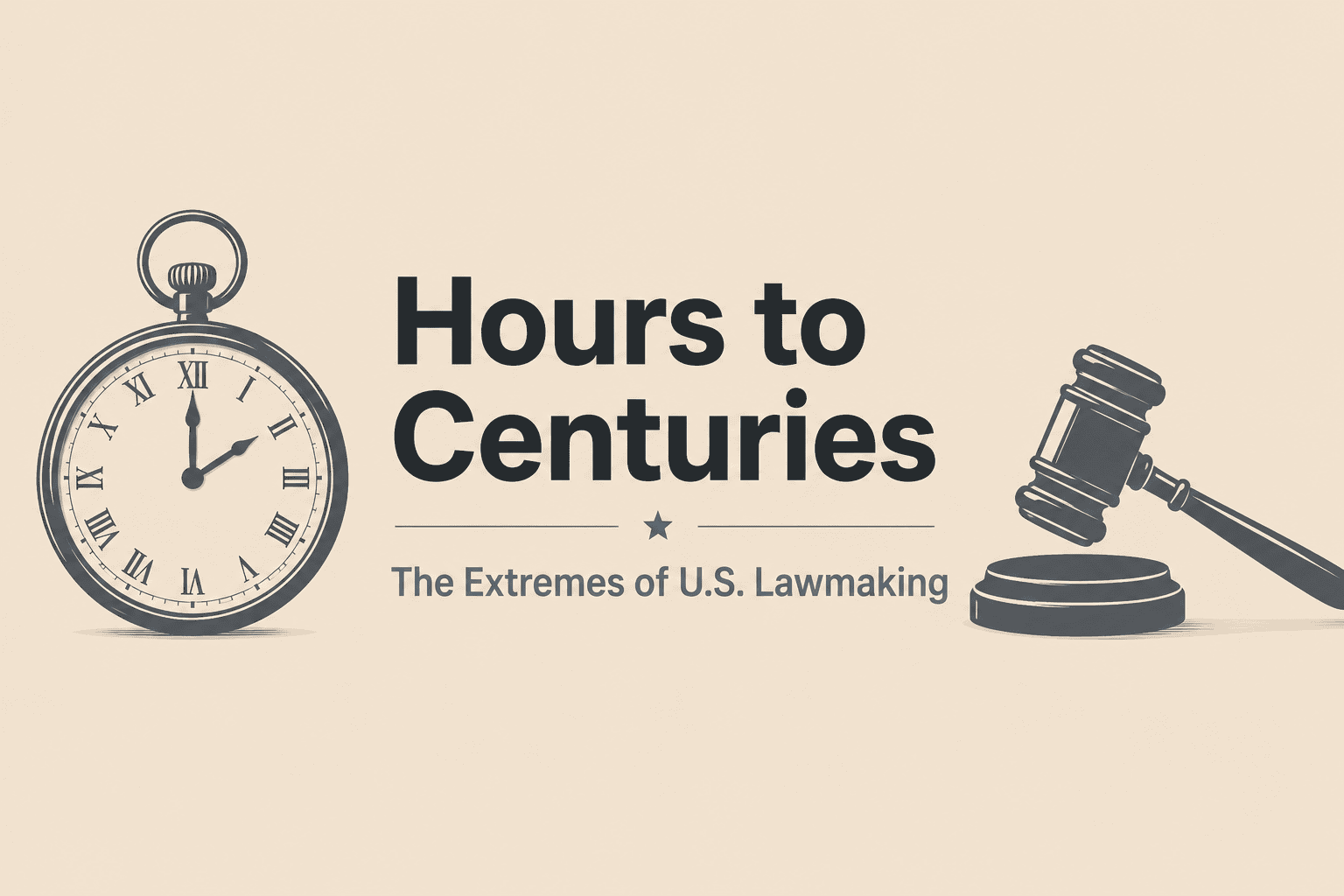
The Standard Timeline
⏱️ Follow the Clock
Every law follows the same basic process—but not the same timeline.
One of the biggest misconceptions about American government is that there is a “normal” amount of time for a bill to become law. There isn’t.
As you read this article, watch how the clock speeds up during national emergencies and slows down when lawmakers face complex problems or constitutional changes.
As you move through this article, notice that the same legislative process can produce dramatically different timelines. The difference usually depends on the urgency of the problem, the amount of political agreement, and whether Congress is passing an ordinary law or changing the Constitution itself.
While learning the standard step-by-step process of how a bill becomes a law is crucial for civic literacy, the actual timelines of those bills can vary wildly.Examining the shortest and longest laws passed in American history reveals just how unpredictable the legislative pipeline can be.
For the small fraction of legislative proposals that actually survive the modern congressional gauntlet, the journey from introduction to a presidential signature averages between 260 and 300 days. Because an official term of Congress lasts exactly two years, any bill that fails to clear both chambers before the closing gavel automatically dies.
History Behind the Shortest and Longest Laws: Speed Records
When a national crisis threatens the stability of the country, the traditional committee review process is swept aside, resulting in some of the shortest and longest laws being decided in a flash. Following the widespread banking panics of the Great Depression, President Franklin D. Roosevelt called a special session of Congress.
The resulting Emergency Banking Act of 1933 was introduced, debated, passed by both chambers, and signed into law in less than eight hours on March 9, 1933. The pace was so frantic that the House of Representatives had to vote on a single, handwritten copy of the draft.
- Outbound Link: Franklin D. Roosevelt Presidential Library and Museum
The Ultimate Timeline Outlier: The 202-Year Journey
When looking at the shortest and longest laws regarding structural changes, Constitutional Amendments are bound by entirely different rules than standard statutes.
What we now know as the 27th Amendment—which prevents members of Congress from giving themselves an immediate pay raise without an election cycle passing first—was originally drafted by James Madison and submitted to the states in 1789. Because Madison did not include a ratification deadline, the proposal remained in legal limbo for over two centuries until a grassroots push led the final required states to ratify it in 1992.
- Outbound Link: National Archives (archives.gov)
Laws Born From Disastrous Events
Tragedy is frequently the ultimate catalyst for systemic legal updates, proving that the shortest and longest laws often trace their origins back to sudden real-world emergencies.
The Great Portsmouth Fire of 1802
When a catastrophic fire leveled the historic seaport of Portsmouth, New Hampshire, the federal government faced a unique dilemma: the U.S. Constitution did not explicitly outline how or if federal money could be used to help local towns rebuild.
To solve this, Congress passed the Congressional Relief Act of 1803, which paused tax collections for the affected New England merchants. This single crisis response established the historic precedent for all future federal disaster assistance.
- Outbound Link: U.S. House of Representatives History, Art & Archives
The Creation of DHS (2002)
The intelligence and communication failures exposed by the terrorist attacks of September 11, 2001, prompted the most sweeping reorganization of the federal bureaucracy since the dawn of the Cold War. Congress introduced and rapidly passed the Homeland Security Act of 2002, consolidating 22 separate federal agencies into a single, cohesive Cabinet department designed specifically to handle national security infrastructure.
- Outbound Link: Department of Homeland Security (dhs.gov)
Further Reading
- How a Bill Becomes a Law and What Happens After Passage
- Understanding the Federal Budget Process (coming soon)
- Separation of Powers
- Federalism
- Congress Explained (coming soon)
- Why the Supreme Court Is Limiting Federal Agencies (coming soon)


This is very educational
The information can be used in our lifeaking it required reading
Hey Russel
This is my 2nd reply
Hey, russel, I am replying to my 2nd reply,,
And this is 3rd reply
Another reply to Bashir
Hello russel,,
Again replying you
Hello Russel Burry