
Students started it. Unions widened it. Hundreds of thousands marched. But what actually lit the fire — and what does it have to do with us?
In September 2026, high school students in the suburbs of Paris began protesting teacher shortages, deteriorating classrooms, and schools that weren’t getting the resources they needed.
At first, it looked like another education protest in a country known for taking its frustrations to the streets.
But this time, something was different.
By October 17, approximately 550,000 people were marching across France, according to government estimates. Students had been joined by workers, unions, parents, and others frustrated with rising living costs and declining public services.
Most marched peacefully. But violence erupted in several cities. Shops were looted, cars were set on fire, and a city hall burned. Police responded with tear gas and arrests. What began as a fight over education had become something much bigger.
So what happened?
Was this socialism failing? Were people simply tired of rising prices? Or had years of frustration finally reached a breaking point?
Think of it as gasoline and a match.
The gasoline had been accumulating for years: families struggling to get ahead, public services under pressure, and growing doubts about whether the government was keeping its promises.
In February, the war in the Middle East spilled more gasoline onto the pile. The United States and Israel went to war with Iran, and the conflict choked the flow of oil out of the Persian Gulf. Crude prices climbed above $100 a barrel, and fuel prices surged on both sides of the Atlantic. The effect was strongest in Europe, which depends heavily on Gulf refineries for diesel — the fuel that powers the trucks carrying groceries to every store in France. When diesel gets expensive, everything on the shelves gets more expensive with it. President Macron acknowledged as much in his national address, naming the cost of living and the price of fuel among the frustrations driving the protests.
The war didn’t create France’s problems, and it didn’t start the student protests. But it poured fresh pressure onto a country already struggling to make ends meet.
The gasoline had been there for years. The war added fresh fuel. Then the students struck the match.
💬 People Are Asking
Is this socialism failing?
No. France isn’t a socialist economy — it’s a capitalist economy with a large safety net, a distinction we explain below. What’s failing is more specific: promises the French state made decades ago are colliding with today’s demographics, debt, and energy prices. Calling that “socialism failing” skips every decision in between.
Why did an education protest grow so large?
Because the students’ complaint connected to something almost every French family already felt. Prices have risen faster than take-home pay in recent years, public services are visibly strained, and a war abroad made everyday expenses worse. The schools gave the frustration a gathering point.
The Gasoline on the Ground
France’s frustration didn’t begin in September 2026. It had been building for years.
1.The Paycheck Squeeze: Working Hard but Getting Nowhere
Between 2017 and 2026, consumer prices in France rose approximately 23.4%, while base monthly wages increased 22.8%, according to an analysis by Le Monde.
Those numbers look almost identical. But keeping up with inflation isn’t the same as getting ahead.
And recently, families have started losing ground. According to an analysis by Le Monde, a French family of two adults and two children has lost approximately €1,200 in annual purchasing power since 2024.
France’s purchasing power fell in 2025 and is projected to fall again in 2026. If that happens, it would mark only the third such period of consecutive declines since 1960.
That’s money no longer available for savings, a family vacation, or an unexpected expense.
Sound familiar?
American families know this frustration. But there’s a difference in what lies underneath it. French households pay higher taxes in exchange for protections most of us buy separately. Americans can be one diagnosis away from financial ruin. Among wealthy nations, the United States ranks dead last on healthcare performance despite spending the most. The French system has its own strains, but losing their house because they got sick isn’t one of them. That fear is largely American.
Yet those protections don’t automatically make housing, groceries, transportation, or everyday life affordable.
And there’s a larger question: If you’re working, paying taxes, and doing everything you’re supposed to do, shouldn’t you be able to build a better future?
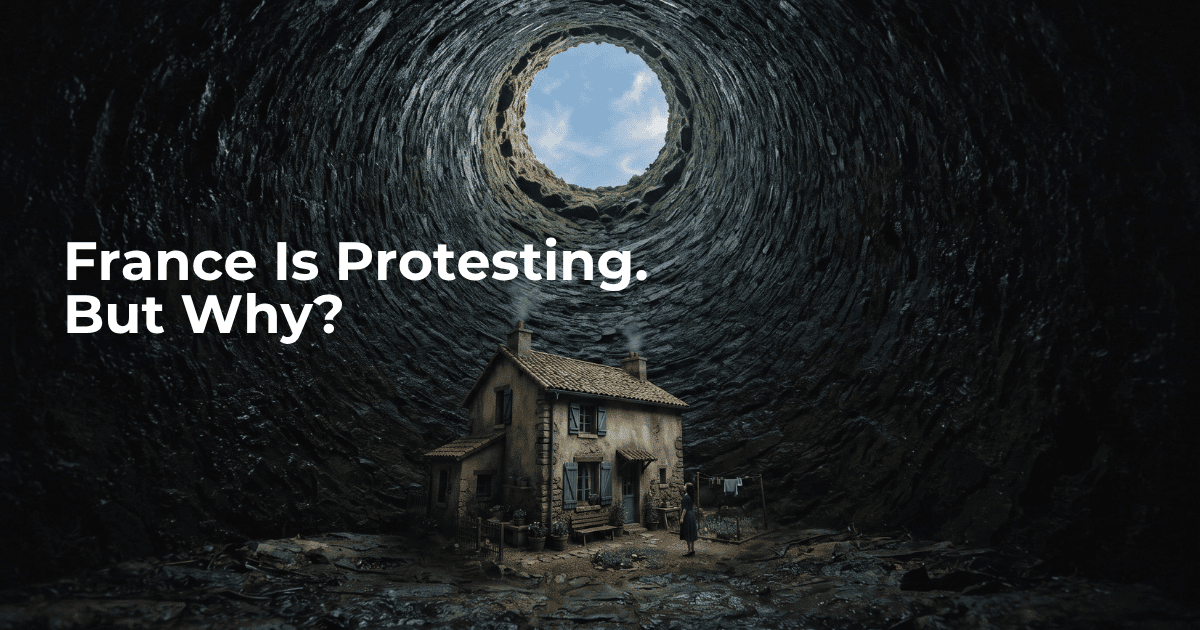
Imagine living at the bottom of a well. You’ve made a home there because you believed someone would eventually provide a ladder. You keep working, paying your bills, and waiting for the chance to climb out.
But the ladder never arrives.
Eventually, you stop asking when it’s coming. You start asking who was supposed to build it.
2. Public Services: What Happened to the Promise?
France’s social contract works differently from America’s.
French citizens pay relatively high taxes, but in return, they receive universal healthcare, public pensions, subsidized education, and other protections intended to provide security throughout their lives.
For generations, that arrangement has been part of what people expect from their government.
But maintaining those promises has become increasingly difficult.
An aging population is straining pensions and healthcare, and schools face staffing and resource challenges. But is this simply a question of not having enough money?
Not necessarily.
Governments also decide where money goes, which programs receive priority, and how effectively public resources are managed. France has faced criticism for failing to act on some recommendations intended to make government spending more efficient.
That leaves French citizens asking a reasonable question: If we’re paying for these services, why are some of them struggling?
And it creates a difficult debate. Should France raise taxes, reduce benefits, reform how services operate, or find another way to pay for its promises?
The answer depends partly on what people believe the government’s responsibilities should be.
3. The Government’s Financial Squeeze
France’s government is facing its own difficult arithmetic.
An aging population means more people collecting pensions and requiring healthcare. Meanwhile, slower economic growth, high public debt, and rising borrowing costs make it harder to pay for everything.
France’s public debt has climbed to roughly 119% of its annual economic output. The government must decide whether to raise taxes, reduce spending, borrow more, or find ways to grow the economy.
Those choices are not abstract. In October, Prime Minister Sébastien Lecornu presented a 2027 budget containing roughly €54 billion in savings and tax measures, including limits on pension increases, a freeze affecting public-sector pay, and changes to sick-leave benefits.
Without such measures, the government estimates the deficit would approach 6.5% of economic output next year. Meanwhile, France’s borrowing costs have climbed to their highest level since 2002, with the country now paying more to borrow than Italy or Greece. Interest payments alone are projected to reach more than €91 billion in 2027.
⚖️ The Budget Dilemma
France needs to pay for its promises. Every option comes with a trade-off.
+ More money for public services
− More pressure on taxpayers
+ Lower government costs
− Services or benefits may shrink
+ Avoid immediate cuts or tax increases
− More debt and interest payments
+ More tax revenue over time
− Takes time; results aren’t guaranteed
And there’s another complication: these are proposals, not settled policy. France’s divided parliament must still decide which measures survive. None of those choices is painless. And they’re political choices, not simply unavoidable mathematical outcomes.
The frustration was already there. It didn’t take much more to make it visible.
Why People See This Differently
France’s problems are complicated. But complicated problems rarely make catchy political headlines.
While French families are asking why their money doesn’t stretch as far as it once did, politicians and commentators are offering very different explanations for who’s responsible.
Is This Socialism Failing?
Some American conservatives have pointed to France’s unrest as a warning about socialism. Fox News has featured arguments connecting the violence to left-wing politics, while House Speaker Mike Johnson described France’s turmoil as a warning about what could happen in America under socialist policies.
But there’s an important distinction: France isn’t a socialist economy.
Like the United States, France has a mixed capitalist economy. Private businesses operate for profit, people own property, and companies compete in the marketplace. The difference is that France relies more heavily on government-funded healthcare, pensions, education, and other social protections.
Those programs cost money. France’s high public spending and growing debt raise legitimate questions about whether its current arrangements are financially sustainable.
But calling the protests proof that socialism has failed doesn’t explain why students began demonstrating over school conditions, why workers are concerned about purchasing power, or why rising fuel prices have added to household expenses.
The more useful question isn’t whether France should have public services. It’s how much those services should cost, who should pay for them, and whether they’re delivering what citizens were promised.
Is Immigration Responsible?
Vice President JD Vance offered another explanation, arguing that France’s unrest reflected failed immigration and assimilation policies.
France does face longstanding debates over immigration, integration, employment, and national identity. Those issues deserve serious examination.
But the protests began with students demanding better schools. They expanded as unions, workers, and other groups raised concerns about living costs and public services. Those documented grievances don’t establish immigration as the cause.
There’s also an economic question often missing from this debate.
France has an aging population. Immigrants who work contribute taxes and social insurance payments that help support public services and pensions. At the same time, some immigrants qualify for public benefits, depending on their legal status, income, and circumstances.
So immigration can affect both sides of the government’s finances. Whether it improves or worsens the overall balance depends on employment, earnings, age, and other factors—not simply how many people enter the country.
Marine Le Pen and her National Rally party have proposed giving French citizens priority for certain benefits, jobs, and public housing. Supporters argue this would protect resources for French citizens. And the idea has broader appeal than you might expect: a September 2026 Ipsos poll found that 64% of respondents agreed with National Rally’s position on giving French citizens priority for certain benefits and rights.
But supporting that general principle isn’t the same as endorsing every proposal. Critics question the fairness, legality, and whether restricting access would meaningfully solve France’s underlying financial problems.
Blaming immigration for the protests is not the same as demonstrating that immigration caused them.
Has Government Failed to Deliver?
There’s another possibility: perhaps the problem isn’t simply how much France spends, but what its citizens are getting in return.
French families pay substantial taxes. They expect functioning schools, healthcare, pensions, and other public services. That’s part of the bargain.
But when classrooms lack teachers and families struggle to get ahead, it’s reasonable to ask whether the government is keeping its side of that bargain.
Some argue that France needs to cut spending, improve efficiency, and encourage economic growth. Others believe cutting services would punish families already struggling and that wealthier households and businesses should contribute more.
Neither approach is painless. Spending cuts can weaken services people depend on. Higher taxes can create additional economic pressures. And improving efficiency sounds easy until someone has to decide which programs should change.
The question isn’t just whether France can afford its promises. It’s whether the government is making the right choices to keep them.
Real-World Impact: Why France Matters to Americans
It’s tempting to look at France and think, That’s their problem. We do things differently here.
And we do. Americans generally rely more heavily on private insurance, personal savings, and employer-provided benefits. France offers broader public protections.
But both countries face a familiar question: What happens when working hard no longer feels like enough to build a secure future?
France’s government must find a way to fund its promises without placing even more pressure on struggling households. Meanwhile, Americans are having their own debates about healthcare, education, retirement, government spending, and the rising cost of everyday life.
The Iran war adds another connection. A conflict thousands of miles away can raise fuel and transportation costs on both sides of the Atlantic. Neither French nor American families have much control over those prices, yet both must find room for them in their budgets.
And when people feel that their concerns are going unanswered, the consequences can extend beyond their wallets. Trust in government can begin to erode.
But they raise a question worth asking in any democracy:
How long can people believe in a system if they no longer feel it’s working for them?
What You Can Do
Look beyond the headline. When someone blames a country’s problems entirely on socialism, immigration, or one political party, ask what the evidence actually shows. Complicated problems rarely have a single cause.
Follow the money. When governments propose cutting programs or raising taxes, ask what those changes would save, who would be affected, and whether the savings would solve the underlying problem. A smaller budget doesn’t automatically mean better services, just as more spending doesn’t guarantee better results.
Pay attention to the promises. Whether it’s healthcare, education, or retirement, ask what your government has promised, how those programs are funded, and whether they’re delivering what people need.
What This Means for You
France’s protests began with students demanding better schools. But they exposed something much larger: years of frustration over what families were paying, what they were receiving, and whether their government was keeping its promises.
The gasoline had been accumulating for years. A distant war had poured more onto the pile. Then students, of all people, struck the match.
France’s problems aren’t identical to America’s. But the questions they raise should sound familiar.
We don’t have to agree on the size of government, how much people should pay in taxes, or which programs deserve funding.
But when people work hard, pay their taxes, and follow the rules, what should they reasonably expect in return?
Join the Discussion
France’s protests began with students asking for better schools. But they opened a much bigger debate about what citizens should expect from their government.
1. When a government promises healthcare, education, and retirement security, what responsibility does it have to deliver—even when money is tight?
2. Some blame socialism, others immigration, and others government mismanagement. Which explanation do you find most convincing, and what evidence would change your mind?
3. Could the same frustrations build in America? What do you think Americans are paying for but not getting in return?
There are no easy answers. We’d love to hear how you see it.
Sources & Further Reading
The Protests and the Iran War
- Reuters — Mass protests in France spiral into worst riots in years (October 17, 2026)
- Euronews — France’s nationwide protests and rising fuel prices (October 17, 2026)
- Fox News — Macron cites the US-Iran war as a factor in France’s unrest (October 19, 2026)
Wages and Purchasing Power
- Le Monde — France faces historic purchasing-power crisis (September 30, 2026)
- Le Monde — How much is the cost of living in France rising? (October 20, 2026)
Government Spending and Debt
- French Ministry of Economy — Presentation of the proposed 2027 budget
- Euronews — French government lays out budget amid record-breaking debt (October 1, 2026)
Immigration and Public Benefits
- OECD — Economic Impact of Migration
- French Government — Eligibility for Minimum-Income Benefits (RSA)
- French Interior Ministry — Immigrant Employment and Labor Force Statistics
Political Reactions


No discussions yet
Be the first to join the discussion and share your thoughts with the community.