
Part 1: The Mystery Behind Government Shutdown
When a government shutdown makes headlines, it can sound as though the entire federal government has stopped working. In reality, a government shutdown affects some agencies while many essential services continue operating. This guide explains why government shutdowns happen, what closes, what stays open, and why they matter
Imagine yourself waking up to breaking news alerts: “Federal Government Shuts Down.”
What comes to mind first? Probably locked doors across the nation. Closed highways. Empty federal buildings. Total chaos.
But then you notice something strange. Your mail still arrives. Your morning flight takes off on time. The military is still on duty. Emergency responders are still a phone call away. Social Security checks still go out.
So wait — if the government “shut down,” how is all of this still running?
That’s the mystery that confuses most people. And it’s exactly the question this article answers.
If the government shuts down, why does your daily life barely change? The answer reveals something fascinating about how American government actually works — and what “shutdown” really means.
Part 2: How Government Shutdown Begins
The Family Budget Analogy
Imagine your family has enough money saved to pay all the bills through September. October arrives. Nobody has sat down to agree on next year’s budget yet.
What happens?
The electricity stays on — it’s essential. The fridge still works — it’s essential. But nobody buys anything extra. No new subscriptions. No impulse purchases. Nothing new gets approved until everyone sits down at the kitchen table and agrees on a spending plan.
That’s remarkably close to how a government shutdown works. The essential functions keep running. Everything else waits.
Now let’s define the formal terms:
Swipe or scroll sideways to view the full table.
| Term | What It Means | Why It Matters |
|---|---|---|
| Fiscal Year | The government’s financial calendar runs from October 1 to September 30—not January 1 to December 31. | Funding expires on September 30. If no new funding is passed by October 1, a shutdown may begin. |
| Appropriations Bills | Official spending laws passed by Congress to fund different parts of the government. | Without these bills, affected agencies may have no legal authority to spend money. |
| Continuing Resolution (CR) | A temporary law that generally keeps current operations funded for a few weeks or months. | It acts as a temporary bandage, buying lawmakers more time to negotiate full-year funding. |
If existing funding expires and Congress fails to pass either new spending bills or a temporary Continuing Resolution, the result is a funding gap. Under federal law (the Anti-Deficiency Act), agencies without approved money must pause non-essential work.
Government Shutdown vs. Debt Ceiling: Two Different Things
Swipe or scroll sideways to view the full comparison.
| Government Shutdown | Debt Ceiling |
|---|---|
| About future spending: Congress has not approved new funding for some federal operations. | About existing obligations: Congress has not authorized additional borrowing to pay bills it already approved. |
| Some agencies close or reduce operations, and certain non-essential services pause. | The government may continue operating but risks being unable to meet financial obligations. |
| An appropriations and funding issue. | A borrowing-limit issue. |
| Resolved by passing and signing funding legislation. | Resolved by raising, suspending, or otherwise changing the borrowing limit. |
One of the most common sources of confusion is mixing up government shutdowns with the debt ceiling. They sound similar, but they’re entirely different:
Both can dominate headline news. Both involve Congress and deadlines. But the rules, consequences, and solutions are completely different.
Part 3: What Happens During a Government Shutdown
When a funding gap occurs, agencies don’t improvise. They follow written contingency plans filed with the Office of Management and Budget (OMB). These plans determine — based on available money and public necessity — what stays open and what closes.
But before we reveal what pauses and what continues, try this quick exercise:
🗳️ Quick Quiz: Which Do You Think Stays Open?
Take a moment to guess. Which of these do you think continues operating during a shutdown?
- ☐ FBI investigations
- ☐ TSA airport security
- ☐ National Parks
- ☐ Smithsonian Museums
- ☐ Social Security payments
- ☐ U.S. Postal Service
- ☐ Active-duty military
- ☐ Passport processing
Ready for the answers? Let’s break it down.
What May Temporarily Pause
These services typically slow or stop during a shutdown because they rely on annual appropriations:
- National Parks & Public Lands: Gates may close, visitor centers shut down, and trash pickup stops. The National Park Service furloughs roughly two-thirds of its employees during a shutdown. (Source: Spotlight PA, Oct. 2025)
- Museums & Monuments: Smithsonian museums and national historic sites usually lock their doors.
- Government Research: Many scientific studies and clinical trials take a temporary break. During the 2025 shutdown, NIH and CDC operations were partially or fully suspended. (Source: ThoughtCo, 2025)
- Permitting & Licenses: Processing for small business loans, gun permits, or environmental reviews often halts.
- Administrative Offices: Most routine regional government offices close to the public.
What May Experience Delays
Some services stay partially open but slow down significantly:
- Passport & Visa Services: Offices may stay open using customer fees, but reduced staff causes long backlogs.
- IRS Taxpayer Help: Phone lines and walk-in centers may close or slow responses. During the 2018–2019 shutdown, at least 26,000 IRS employees were called back during tax season — but more than half didn’t show up without pay. (Source: NBC4 Washington)
- Regulatory Reviews: Non-emergency workplace safety inspections or financial checks slow down.
- Food Safety Inspections: During the 2018–2019 shutdown, the FDA delayed nearly 900 inspections. (Source: NBC4 Washington)
Swipe or scroll sideways to view every answer.
| Service | Stays Open? | Why? |
|---|---|---|
| FBI investigations | ✅ Yes | Law enforcement functions are generally considered essential. |
| TSA airport security | ✅ Yes | Most TSA employees continue working because airport security is considered essential. |
| National Parks | ❌ Mostly closes | Many park employees are furloughed, and visitor services may stop or become limited. |
| Smithsonian Museums | ❌ Usually closes | Smithsonian facilities generally rely on appropriated funds. |
| Social Security payments | ✅ Yes | Payments are supported through mandatory spending laws. |
| U.S. Postal Service | ✅ Yes | The Postal Service receives operating revenue from products and services such as stamps and packages. |
| Active-duty military | ✅ Yes | National defense operations continue. |
| Passport processing | ⚠️ Partially | Passport services may continue using fee revenue, but staffing shortages can cause delays. |
How many did you get right? Most people are surprised by how much of the federal government continues operating.
Part 4: The Human Cost of a Government Shutdown
It’s easy to talk about shutdowns as a political chess game. But behind the headlines are real people and families who bear the brunt — often without knowing when they’ll return to work.
Here’s what happens to the workforce:
Furloughed Workers
Non-essential federal employees are placed on furlough — told not to come to work until the shutdown ends. They don’t get paid during this time. During the 2025 shutdown, approximately 750,000 workers were furloughed each day, costing the government roughly $400 million per day in deferred compensation. (Source: Congressional Budget Office, Oct. 2025)
During the 2018–2019 shutdown, 380,000 workers were furloughed. (Source: NBC4 Washington)
Excepted Workers
Employees classified as “excepted” must report to work every day. They keep the country running. But their paychecks are delayed until Congress resolves the budget.
During the 2025 shutdown, about 1.4 million excepted employees continued working without pay. (Source: Wikipedia / CBO)
During the 2018–2019 shutdown, 420,000 excepted workers were required to work without knowing when they’d be paid. (Source: NBC4 Washington)
The Economic Toll
Key Performance Indicators
2025 Shutdown Duration
43 days
▲Longest in U.S. history
Workers Furloughed Daily (2025)
~750,000
▼$400M/day deferred pay
Excepted Workers Unpaid (2025)
~1.4M
▼Working without paychecks
Permanent GDP Loss (2025)
$7–14B
▼CBO estimate
The Human Impact
The human toll goes beyond federal paychecks:
- Back Pay: Once the government reopens, furloughed and excepted workers receive back pay by law. But during the shutdown, they still have to cover bills, rent, groceries, and childcare with no income.
- Contractors Lose Out: Many government contractors — security guards, custodians, IT support staff — do not receive back pay. When work stops, that income is lost permanently. During the 2025 shutdown, more than 4,000 federal workers faced permanent layoffs. (Source: Wikipedia)
- Local Economies: Small businesses near federal buildings — food trucks, dry cleaners, coffee shops — see their daily customer base vanish overnight. The CBO noted that delayed federal compensation reduced consumer spending broadly, especially among workers missing paychecks. (Source: CBO, Sept. 2025)
- SNAP Benefits at Risk: During the 2025 shutdown, Supplemental Nutrition Assistance Program (SNAP) benefits faced a funding shortage by Day 20, threatening food assistance for millions of Americans. (Source: Wikipedia / NPR)
Real Stories, Real People
Behind every statistic is a family. Imagine:
- A federal employee in Virginia delaying a mortgage payment because the paycheck stopped — and hoping the bank understands.
- A military spouse in Texas waiting for a paycheck that’s weeks late, rationing groceries while their partner serves overseas.
- A government contractor in Washington, D.C. — a janitor, a security guard — who loses a month of income they will never recover, choosing between medication and electricity.
These aren’t political talking points. They’re neighbors, friends, and family members caught in a situation they didn’t create.
The Contractor Gap Warning
Federal employees receive back pay after shutdowns end. But government contractors — janitors, security guards, IT staff — typically do NOT. During the 2025 shutdown, over 4,000 federal workers faced permanent layoffs. For contractors, a shutdown means income lost forever, with no mechanism for recovery.
Part 5: Why Government Shutdowns Are More Common Today
If you’ve lived through the last decade, you might wonder: Did shutdowns always happen this often?
The short answer is no. Shutdowns have become more frequent and more destructive in recent years. Here’s why:
More Political Polarization
Budget negotiations used to be more transactional — lawmakers disagreed on specifics but generally worked toward compromise. Today, spending fights increasingly become proxies for larger cultural and political battles, making compromise harder.
Narrow Congressional Majorities
When the vote count between parties is razor-thin, passing any major legislation requires near-unanimous party support — or rare bipartisan cooperation. A single faction can hold up the entire process. During the 2025 shutdown, the Senate rejected a House-approved funding bill 14 times before a breakthrough. (Source: NPR, Nov. 2025)
Heavy Reliance on Continuing Resolutions
Instead of passing full-year budgets on time, Congress increasingly relies on short-term patches (CRs) that kick the deadline down the road by weeks or months. Each new deadline becomes another opportunity for a standoff — and another chance for a shutdown.
Budget Deadlines as Leverage
In recent years, funding deadlines have been used as leverage in unrelated policy disputes. The 2013 shutdown was driven by efforts to block or delay the Affordable Care Act. The 2018–2019 shutdown centered on border wall funding. The 2025 shutdown involved a dispute over ACA subsidy funding — showing how the same policy issue can recur as a shutdown trigger years later.
24-Hour News and Social Media
Decades ago, budget negotiations happened largely behind closed doors. Today, every twist is live-tweeted, every comment is dissected on cable news, and public pressure builds in real time. This can make compromise politically costly — lawmakers fear looking weak to their base.
Part 6: How a Government Shutdown End — and Can It Be Prevented?
How a Shutdown Ends
Ending a shutdown doesn’t require a special protocol — it follows the same basic legislative process that should have prevented it in the first place. Lawmakers must negotiate, compromise, and vote.
Here’s the path from stalemate to reopening:
- Leaders Negotiate: Congressional leaders meet with the White House to find agreement on spending amounts or disputed policy issues.
- House Vote: The House of Representatives passes a new funding bill or temporary extension.
- Senate Vote: The Senate approves the exact same bill.
- President Signs: The President signs the bill into law.
- Agencies Reopen: Federal employees return to work, and public services resume.
The process is straightforward. The politics are not.
Can Government Shutdowns Be Prevented?
Preventing shutdowns sounds simple in theory — just pass a budget on time. But in practice, the system creates incentives for delay and confrontation. Several reform proposals have been discussed by lawmakers, academics, and good-government groups. Each has supporters and critics:
1. Automatic Continuing Resolutions (The “Safety Net”)
If Congress misses a deadline, funding would automatically continue at current levels until a new budget is agreed upon.
- Supporters say: This eliminates the threat of shutdowns entirely and removes the leverage that comes with funding cliffs.
- Critics say: It reduces urgency to pass a real budget and could normalize perpetually operating on autopilot.
2. Biennial Budgeting (Two-Year Budgets)
Instead of passing a new budget every 12 months, Congress would adopt a two-year budget cycle.
- Supporters say: It reduces the frequency of shutdown threats and allows for more thoughtful planning.
- Critics say: Economic conditions can change rapidly, and a two-year budget may be too rigid to respond to unforeseen needs.
3. “No Budget, No Pay” Proposals
If Congress fails to pass a budget on time, lawmakers’ own pay would be withheld.
- Supporters say: It creates a powerful personal incentive for lawmakers to act.
- Critics say: It may be unconstitutional (the 27th Amendment restricts changes to congressional pay) and could disproportionately affect less wealthy members.
4. Stronger Bipartisan Negotiation Frameworks
Structural changes to how budget negotiations work — such as requiring earlier committee action, mandatory conference committees, or stricter procedural deadlines.
- Supporters say: Process reforms can force collaboration before crises emerge.
- Critics say: Procedural rules can always be waived or circumvented by a determined majority.
Each of these ideas reflects genuine frustration with the status quo. None is a magic fix. But together, they show that the problem is recognized — and that solutions are possible if there’s political will.
Part 7: By the Numbers
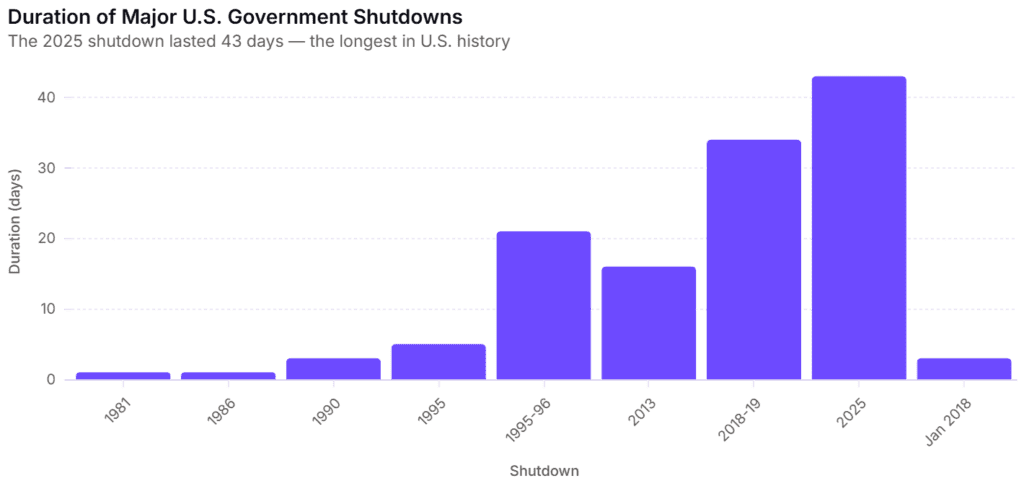
Historical U.S. Government Shutdowns
Here’s a comparison of the most notable federal government shutdowns — their timelines, causes, and the lessons they leave behind:
Swipe or scroll sideways to explore the historical shutdowns.
| Dates and Year | President | Duration | Primary Cause | Lesson |
|---|---|---|---|---|
| November 20–23, 1981 | Ronald Reagan | 1 day | Reagan rejected a spending bill after Congress declined to accept several proposed spending reductions. | Even a brief shutdown can reveal serious disagreements about spending priorities. |
| October 16–18, 1986 | Ronald Reagan | 1 day | Disagreements involved civil-rights measures, welfare programs, and military spending. | Social-policy disputes can spill into government funding negotiations. |
| October 5–9, 1990 | George H. W. Bush | 3 days | The President rejected a budget agreement amid disagreement over taxes and deficit reduction. | Tax-policy disputes can contribute to funding breakdowns. |
| November 13–19, 1995 | Bill Clinton | 5 days | The President and Congress disagreed over Medicare, healthcare, and broader spending priorities. | Healthcare policy has repeatedly become part of federal budget conflicts. |
| December 15, 1995–January 6, 1996 | Bill Clinton | 21 days | A broader budget conflict resulted in hundreds of thousands of federal workers being furloughed. | Extended shutdowns create significant economic and human costs. |
| October 1–16, 2013 | Barack Obama | 16 days | A funding dispute involved efforts to block or delay parts of the Affordable Care Act. | Policy disagreements can become funding disputes when budget deadlines are used as leverage. |
| January 20–22, 2018 | Donald Trump | 3 days | The dispute included immigration policy and protections for Dreamers. | Immigration disagreements can disrupt government funding negotiations. |
| December 22, 2018–January 25, 2019 | Donald Trump | 34 days | The central disagreement involved approximately $5.7 billion in proposed border-wall funding. | Entrenched negotiating positions can prolong a shutdown and increase its economic and human consequences. |
| October 1–November 12, 2025 | Donald Trump | 43 days | The shutdown involved disagreement over Affordable Care Act subsidy funding. | The same policy disagreements can return as shutdown triggers years later. |
Sources listed in the article include the Congressional Research Service, Congressional Budget Office, NPR, Ballotpedia, and other reporting and reference sources.
Visualized: Shutdown Duration Over Time
Economic Impact Comparison
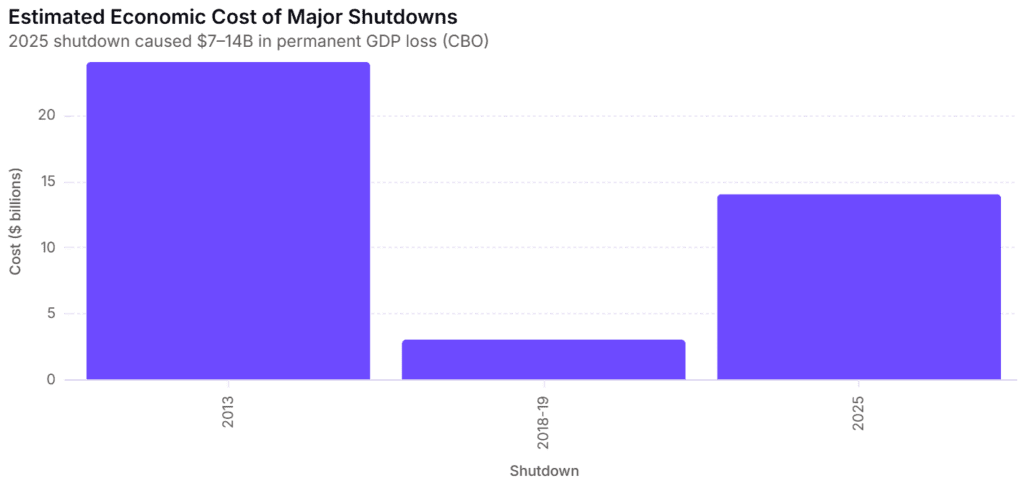
(Note: The 2013 figure is a Standard & Poor’s estimate reported by multiple outlets including Wikipedia. The 2018–19 and 2025 figures are CBO estimates. Estimates use different methodologies and are not directly comparable.)
Part 8: Understanding the Reality of a Government Shutdown
Why Shutdowns Feel Bigger Than They Are
Shutdowns do create real economic disruption and real hardship for federal workers. But the public perception of a shutdown is often dramatically larger than the actual operational impact. Here’s why:
- Countdown Timers: Cable news networks display ticking clocks counting down to midnight deadlines, creating a sense of imminent catastrophe.
- Visual Headlines: Images of locked park gates, dark museum lobbies, and empty federal buildings make for compelling television.
- Personal Stories: Reports of federal workers facing delayed or missing paychecks humanize the story but can amplify the sense of crisis beyond its scope.
- Market Reaction: Financial markets react to uncertainty, adding an economic anxiety layer to the political drama.
The Reality Check
Even during a shutdown, a significant majority of government operations continue. According to the Trump administration’s 2025 contingency plans, only about 23% of the federal workforce was slated for furlough — meaning roughly 77% continued working (though many without pay). (Source: Government Executive, Sept. 2025)
The Constitution remains in effect. Federal courts continue hearing major cases. Congress remains in session. Police and military forces stay on guard. Social Security, Medicare, and the Postal Service keep running.
🏠 Think of It Like…
Imagine a large shopping mall.
One clothing store closes for renovations. Another opens late because of staffing issues. A third store stays open as usual. The food court is still serving lunch, the movie theater is showing films, and security is still patrolling the building.
You probably wouldn’t say, “The entire mall is closed.”
A government shutdown works much the same way. Some federal offices temporarily pause because they depend on annual funding. Others continue operating because they perform essential functions or receive funding through different sources.
The government is still functioning—but not every part of it is operating in the same way.
💼 You Be Congress: A Quick Exercise
Imagine you’re in Congress. Funding expires in one hour. You have four options:
Swipe or scroll sideways to compare all four choices.
| Option | What It Means | Advantage | Disadvantage |
|---|---|---|---|
| Pass a full budget | Approve all 12 appropriations bills for the next fiscal year. | Provides longer-term stability and allows agencies to plan. | Requires lawmakers to agree on hundreds of details under intense time pressure. |
| Pass a Continuing Resolution | Temporarily extend current funding. | Prevents an immediate shutdown and provides more time for negotiations. | Postpones the deadline without necessarily resolving the underlying disagreement. |
| Allow a shutdown | Let funding expire, causing affected non-essential operations to pause. | Applies political pressure and may demonstrate the seriousness of one side’s position. | Workers experience delayed pay, services are disrupted, and economic costs increase. |
| Negotiate longer | Continue negotiations after the funding deadline passes. | Could eventually produce a more durable agreement. | The shutdown continues in the meantime, with no guarantee that a final agreement will be reached quickly. |
There is no perfect choice—which is exactly why government shutdowns happen.
Part 9: Navigating the News
When shutdown headlines flood your feed, here’s how to cut through the noise:
Swipe or scroll sideways to read the full news guide.
| If You Hear… | What to Remember | Why It Matters |
|---|---|---|
| “Congress passed another Continuing Resolution.” | This is a temporary funding patch, not necessarily a full-year agreement. Another deadline may arrive within weeks or months. | Temporary measures prevent immediate shutdowns but may leave the underlying disagreements unresolved. |
| “Government shutdown avoided.” | Lawmakers reached an agreement for now. That does not necessarily mean the broader dispute has ended. | Check whether the agreement provides full-year funding or merely creates another short-term deadline. |
| “National parks are closing.” | Parks are among the most visible parts of a shutdown because many employees and visitor services depend on annual appropriations. | Closures affect visitors, tourism, employees, and nearby businesses, but parks represent only part of the federal government. |
| “Federal workers are being furloughed.” | Furloughed employees are temporarily sent home. Excepted employees may continue working while their pay is delayed. | Federal employees generally receive back pay after reopening, but many contractors do not receive compensation for lost work. |
| “A shutdown could trigger a default.” | A shutdown and the debt ceiling are different issues. A shutdown concerns funding authority; the debt ceiling concerns borrowing to pay existing obligations. | Understanding the distinction helps readers judge whether a headline accurately describes the financial risk. |
| “This is the longest shutdown in history.” | The length matters because disruptions, delayed pay, backlogs, and economic costs generally grow as a shutdown continues. | Record-breaking shutdowns can signal that the political process is becoming more difficult, even though shutdowns eventually end through legislation and negotiation. |
Part 10: What Government Shutdown Teaches Us
Reasons for Hope
Shutdowns can be stressful and frustrating. But there are genuine reasons to stay optimistic:
- Shutdowns are temporary. They end when lawmakers reach an agreement — and they always do, eventually.
- The Constitution works. It’s designed to force competing powers to sit down and negotiate. Frustration is built into the process; so is resolution.
- Safety is never compromised. Even without funding, essential protections for public safety, law enforcement, and national defense continue operating. During the 2025 shutdown, 95% of TSA employees stayed on the job. (Source: NCSL)
- Citizens have a voice. Public feedback and elections remind lawmakers that Americans expect a functioning government. That pressure works.
- Shutdowns demonstrate an important constitutional principle: no single person can spend public money alone. The power of the purse belongs to Congress — and that separation of power is exactly what the Framers intended.
Every shutdown in American history has eventually ended through negotiation—not because one branch gained complete control, but because the constitutional system required compromise.
Final Takeaway
Imagine three roommates sharing a checking account. Every month, they need to agree on a budget before anyone can spend from it.
One roommate wants to save more. Another wants to spend on groceries. The third wants to invest in repairs.
Until they all agree, nobody can buy anything extra from the shared account. But meanwhile:
- The electricity stays on.
- The refrigerator still works.
- The rent gets paid.
That’s remarkably close to how a government shutdown works. It isn’t the Constitution breaking down. It’s the system of shared power forcing the President and Congress to negotiate before anyone gets to spend public money.
Yes, the headline drama is real. Yes, temporarily closed facilities are frustrating. Yes, federal workers face genuine hardship — the 2025 shutdown proved that with 750,000 furloughed workers and billions in economic damage. But understanding the process helps you see government shutdowns for what they really are: a budget negotiation playing out under pressure — not the end of government.
A Few Questions to Think About
- Is it better for Congress to switch to two-year or five-year budgets to avoid annual funding deadlines?
- What are the pros and cons of forcing lawmakers to debate government spending every single year?
- How can citizens follow news about budget deadlines without feeling overwhelmed by political drama?
- Should essential federal workers be guaranteed pay during shutdowns, even before Congress resolves the budget?
- Does the increasing use of shutdowns as political leverage reflect a problem with the system — or with the people elected to operate it?
- Since other democracies don’t experience shutdowns, what can the U.S. learn from their systems?
Continue Learning
If you found this article helpful, you may also enjoy:
- 📊 Understanding the Federal Budget Process — How your tax dollars move from concept to program
- ⚖️ Budget Reconciliation Explained — The legislative shortcut that bypasses the filibuster (coming soon)
- 💰 Why the Debt Ceiling Isn’t the Same Thing as a Shutdown — A deeper dive into borrowing limits vs. funding gaps (coming soon)
- 📜 How a Bill Becomes a Law — From idea to Oval Office, step by step
- 🌍 Why Other Countries Don’t Have Shutdowns — What parliamentary systems do differently (coming soon)
VoteView News — Civic education that empowers without overwhelming. Because democracy works best when citizens understand how it works.
Sources Cited in This Article
Swipe or scroll sideways to view the complete source list.
| Source | What It Contributed | Link |
|---|---|---|
| Congressional Budget Office | Economic-cost estimates, furlough numbers, and gross domestic product analysis. | cbo.gov |
| Congressional Research Service | Historical shutdown dates, durations, federal funding gaps, and shutdown procedures. | CRS reports |
| Government Executive | Federal workforce and furlough information based on agency contingency plans. | govexec.com |
| NPR | Shutdown reporting, congressional negotiations, and Senate voting developments. | npr.org |
| NBC4 Washington | Reporting on federal workers, Internal Revenue Service staffing, and inspection delays. | nbcwashington.com |
| BBC | International comparisons and explanations of how other political systems handle budget disputes. | bbc.com |
| National Conference of State Legislatures | Transportation-security staffing and government contingency information. | ncsl.org |
| Committee for a Responsible Federal Budget | Shutdown explanations and economic analysis. | crfb.org |
| Peter G. Peterson Foundation | Government shutdown history and budget overview. | pgpf.org |
| Ballotpedia | Shutdown timelines, political developments, and records. | ballotpedia.org |
| Wikipedia | General shutdown chronology and supplementary workforce information. | Government shutdown overview |


No discussions yet
Be the first to join the discussion and share your thoughts with the community.