
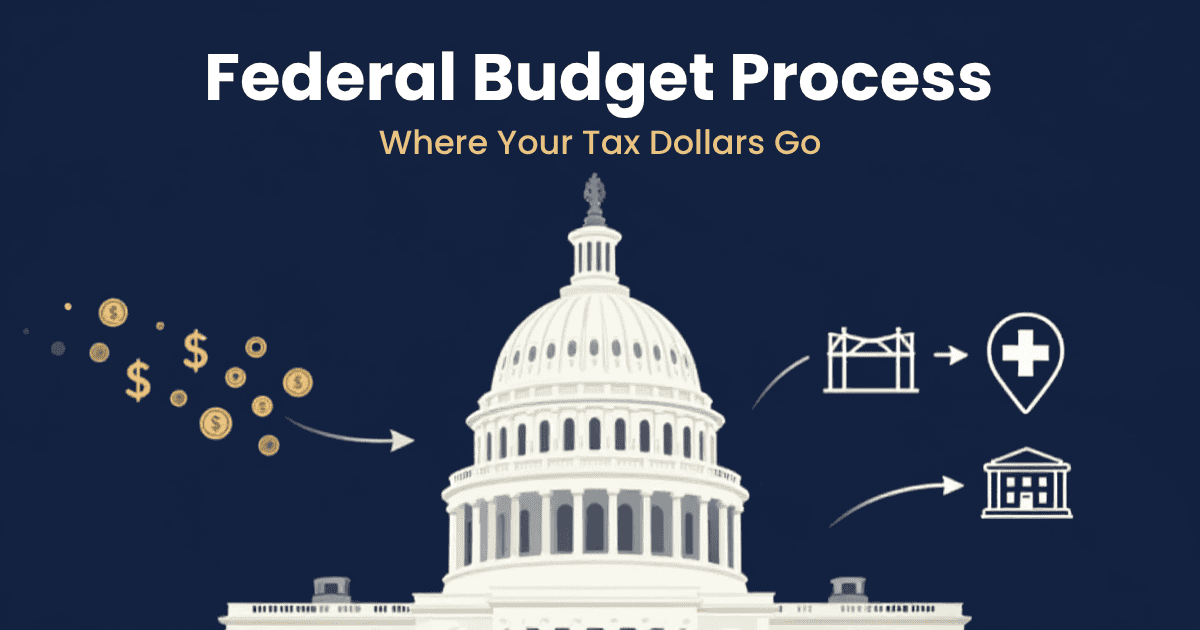
How Congress Decides Where Your Tax Dollars Go
Opening
Every year, the same headlines seem to return: the federal budget process.
Congress is racing to avoid a government shutdown. Lawmakers are arguing over spending. News reporters talk about deadlines, continuing resolutions, and trillion-dollar budgets.
If you’ve ever wondered,
“Didn’t Congress already pass the budget?”
you’re not alone.
Many people imagine the federal budget as one giant document that Congress votes on once a year. In reality, it’s a long process involving the President, both chambers of Congress, federal agencies, and dozens of separate decisions about how taxpayer money will be collected and spent.
Some parts of that process happen every year. Other parts only happen when lawmakers disagree.
Understanding the budget won’t tell you which spending priorities are right or wrong. But it will help you understand why budget debates happen so often—and why they affect almost every issue discussed in Washington.
Follow the Dollar
How federal money moves from taxpayers to public programs and services.
Taxpayers
Individuals and businesses pay taxes, tariffs, fees, and other federal revenue.
U.S. Treasury
The Treasury collects and manages federal revenue.
President’s Budget Proposal
The President recommends spending and tax priorities. The proposal is not law.
Congressional Budget Resolution
Congress sets overall spending and revenue targets.
Authorization Laws
Congress creates, continues, or changes federal programs.
12 Appropriations Bills
Congress provides the actual money for agencies and programs.
Federal Agencies
Agencies use the approved funding to carry out federal programs.
Programs and Services
Funding reaches communities through benefits, grants, services, research, and public projects.
Oversight and Audits
Congress, inspectors general, and the Government Accountability Office monitor how the money is used.
Part I: Where the Money Comes From—and Where It Goes
Before the federal government can spend money, it first has to collect it.
Most of that money comes from taxes paid by individuals and businesses. It also comes from payroll taxes, tariffs, fees, and a few other sources.
Together, all of that money is called revenue.
Once the government collects revenue, Congress and the President decide how much of it will be spent during the year.
That leads to one of the simplest—but most important—ideas in federal budgeting.
🏠 Think of It Like a Household
Imagine your family earns $5,000 this month.
If your family spends $4,500, you have $500 left over.
If you spend exactly $5,000, your budget is balanced.
But if you spend $5,500, you’ve spent $500 more than you brought in.
The federal government works with trillions of dollars instead of thousands, but the basic idea starts the same way.
Money comes in.
Money goes out.
The difference between those two numbers tells us whether the government finished the year with a surplus or a deficit.
Three Budget Words You’ll Hear Again and Again
Revenue
The money the federal government collects through taxes, tariffs, fees, and other sources.
Spending
The money the government uses to pay for programs, salaries, benefits, national defense, infrastructure, scientific research, and many other responsibilities.
Deficit
A deficit happens when the government spends more during the year than it collects.
If the government collects more than it spends, it runs a surplus instead.
Deficit vs. Debt
These two terms are often confused, but they mean different things.
A deficit describes one year’s budget.
The national debt is the total amount the federal government owes after many years of borrowing.
Think of it this way:
- A deficit is this year’s result.
- The national debt is the running total built over many years.
Every year the government runs a deficit, that amount is generally added to the national debt.
💡 Why Does the National Debt Matter?
One of the most common things you’ll hear is:
“The government should balance its budget just like a family.”
That comparison can be helpful because both families and governments have to think about income, spending, and borrowing.
But there are important differences.
Families cannot issue currency or borrow money the same way a national government can. Governments sometimes borrow during wars, recessions, natural disasters, or other national emergencies.
Economists continue to debate how much debt is appropriate and how much borrowing is sustainable.
What almost everyone agrees on is this:
Understanding the difference between an annual deficit and the national debt is one of the first steps toward understanding the federal budget process.
Where Does the Money Come From?
Many people assume the federal government gets almost all of its money from income taxes.
Income taxes are the largest source of revenue—but they’re only part of the picture.
The government also collects payroll taxes that help fund Social Security and Medicare, taxes on businesses, tariffs, excise taxes on certain products, and several smaller sources of revenue.
At its core, the federal budget is an annual financial plan — a roadmap for how the government collects money and where it goes.
Revenue − Spending = Surplus or Deficit
- Revenue: Money the government takes in via taxes, fees, and tariffs.
- Spending: Money the government pays out for programs, salaries, benefits, and debt interest.
- Deficit vs. Debt: A deficit happens when spending exceeds revenue in a single year. The national debt is the total accumulation of all yearly deficits (minus any surpluses) over time.
One Year’s Deficit + Previous National Debt = New National Debt
Where Federal Revenue Comes From
Approximate shares vary from year to year.
| Revenue Source | What It Is | Approximate Share |
|---|---|---|
| Individual Income Taxes | Taxes on wages, salaries, investments, and other individual income. | About 50% |
| Payroll Taxes | Taxes that help fund Social Security and Medicare. | About 36% |
| Corporate Income Taxes | Taxes paid on business profits. | About 6–10% |
| Excise Taxes and Tariffs | Taxes on certain products and imported goods. | About 5% |
| Other Revenue | Estate taxes, customs fees, and other smaller sources. | About 1–3% |
Good to Know: Individual income taxes are the largest source of federal revenue, but they are not the only source.
Why This Section Matters
The federal budget may involve trillions of dollars, but it begins with a simple question:
How much money comes in, and how much goes out?
Once you understand that basic idea, the rest of the budget process becomes much easier to follow.
Mandatory vs. Discretionary Spending
Part II: Federal Budget Process Mandatory vs. Discretionary Spending
Once the government knows how much money it expects to collect, the next question is:
What does it have to pay for?
The answer isn’t as simple as making one long shopping list.
Some government spending happens automatically because existing laws require it. Other spending must be approved by Congress every year.
Understanding the difference is one of the most important parts of understanding the federal budget.
🏠 Think of It Like a Household
Imagine your family sits down at the kitchen table to plan next month’s budget.
Some bills aren’t really optional.
Your mortgage or rent.
The electric bill.
Your car payment.
You might wish they were lower, but you still have to pay them.
Then there are other expenses.
Maybe you’d like to take a vacation.
Maybe you’d like to buy a new television.
Maybe the house could use fresh paint.
Those decisions depend on how much money is available and what your family decides is most important.
The federal government works in a similar way.
Some spending continues automatically because existing laws require it.
Other spending is debated every year.
Mandatory spending is funding that continues from year to year because Congress has already passed laws creating those programs.
Congress doesn’t vote on these programs every year.
Instead, the programs continue unless Congress passes a new law changing them.
Unlike mandatory spending, discretionary spending must be approved through the annual appropriations process.
This is the part of the budget Congress debates every year.
Mandatory vs. Discretionary Spending
Federal spending follows two different sets of rules.
Continues Under Existing Law
Congress has already passed laws that determine who qualifies and how benefits are paid.
Examples
- Social Security
- Medicare
- Medicaid
- Veterans’ benefits
- Interest on the national debt
Congress can change these programs, but it must pass a new law to do so.
Must Be Approved Each Year
Congress decides annual funding levels through the appropriations process.
Examples
- National defense
- Education
- Transportation
- Scientific research
- National parks
- Federal law enforcement
This is the portion of the budget that receives the most attention during annual funding debates.
Why Do Budget Fights Usually Focus on This Part?
If you’ve ever wondered why politicians argue so much about the budget, here’s one big reason:
Most annual budget debates are not about Social Security or Medicare.
Those programs already have funding rules established by law.
Instead, lawmakers usually spend most of their time debating the discretionary portion of the budget because those decisions must be made every year.
That’s why debates over education, defense, scientific research, border security, environmental programs, and transportation often dominate the news.
🧠 Think About It
Imagine Congress receives an unexpected $100 billion in additional revenue.
How would you spend it?
Would you reduce the national debt?
Strengthen the military?
Improve highways and bridges?
Expand healthcare programs?
Invest in scientific research?
There isn’t one “correct” answer.
That’s why budget debates are often some of the most important—and most difficult—decisions Congress makes.
Why This Section Matters
Many people assume Congress debates the entire federal budget every year.
It doesn’t.
A large portion of federal spending continues automatically under existing law.
Most of the annual debate focuses on the smaller discretionary portion of the budget—the part Congress must review and approve each year.
Once you understand that difference, it’s much easier to follow budget negotiations, government shutdown threats, and the spending debates you see in the news.
Part III: How the Budget Becomes Law
Now that we’ve looked at where the money comes from and how federal spending is divided, it’s time to answer another important question:
Who actually decides how that money gets spent?
Many people assume the President creates the federal budget.
Others believe Congress does.
The truth is that both play important—but different—roles.
The budget only becomes law after several steps, each involving different parts of the federal government.
Step 1: The President Makes a Proposal
The federal budget process usually begins early each year when the President submits a proposed budget to Congress.
The proposal is prepared with help from the Office of Management and Budget (OMB) and includes recommendations for how much money should be spent on different programs and agencies.
Despite the attention it receives in the news, the President’s budget is exactly that—a proposal.
It does not become law simply because the President submits it.
💡 Good to Know
Think of the President’s budget as the opening offer in a negotiation.
It helps start the conversation, but Congress decides whether to accept, reject, or change those recommendations.
Step 2: Congress Creates a Budget Resolution
Next, the House and Senate each work on a Budget Resolution.
This document sets overall spending and revenue goals for the upcoming fiscal year.
Unlike most bills, the Budget Resolution is not signed by the President and does not become law.
Instead, it serves as Congress’s internal blueprint for writing the budget.
It helps lawmakers agree on the big picture before deciding how much money individual programs will receive.
The Big Misunderstanding
Authorization vs. Appropriation
Creating a federal program and funding it are two separate decisions.
Authorization
May this program exist?
An authorization law creates, continues, or changes a federal program.
It may recommend a funding level, but it usually does not provide the actual money.
Appropriation
Will the program receive money?
An appropriations law provides the funding needed to operate the program.
Without an appropriation, an authorized program may be unable to operate as intended.
Step 3: Congress Writes the Spending Bills
Once the Budget Resolution is complete, Congress begins writing the bills that actually provide funding.
Instead of one giant spending bill, Congress usually divides this work into 12 separate appropriations bills.
Each bill focuses on a different part of the federal government.
For example, one bill funds the Department of Defense, while another funds transportation, housing, or agriculture.
Breaking the budget into smaller bills allows lawmakers to examine different areas of government separately.
What Happens Next?
After both the House and Senate approve the appropriations bills, they are sent to the President.
The President can:
- Sign the bills into law.
- Veto a bill and send it back to Congress.
- Allow it to become law without a signature in certain circumstances.
Only after this process is complete can federal agencies begin spending the money Congress approved.
Why This Section Matters
When people say, “Congress passed the budget,” they’re often describing only part of the process.
The President proposes a budget.
Congress decides how money will be spent.
The President then signs—or vetoes—the spending bills.
Understanding these separate roles helps explain why budget negotiations can take months and why disagreements between the President and Congress sometimes lead to funding delays or political standoffs.
Part IV: When the Budget Process Doesn’t Go as Planned
By now, you’ve seen how the budget process is supposed to work.
The President submits a proposal.
Congress sets spending goals.
Lawmakers write appropriations bills.
The President signs them into law.
If every step happened on time, the government would begin each fiscal year on October 1 with all of its funding in place.
But that isn’t always what happens.
Sometimes Congress can’t agree on how much to spend, where to spend it, or how to pay for it.
When that happens, lawmakers have several options—some work better than others.
Continuing Resolutions (CRs)
Buying More Time
If Congress hasn’t finished the regular appropriations bills before the new fiscal year begins, it can pass a Continuing Resolution, often called a CR.
A Continuing Resolution is a temporary funding law.
Instead of approving a brand-new budget, Congress keeps most government programs operating at existing funding levels while lawmakers continue negotiating.
Think of it as pressing the “pause” button.
Government agencies can keep operating, but they usually can’t begin major new projects or make significant changes until a full budget is passed.
Omnibus Bills
Putting Everything Together
Sometimes Congress runs out of time to pass all 12 appropriations bills separately.
Instead, lawmakers combine several—or even all—of those bills into one very large package called an omnibus bill.
Rather than voting on each spending bill individually, Congress votes once on the combined package.
Supporters say omnibus bills help prevent government shutdowns and allow Congress to finish its work before important deadlines.
Critics argue that these bills can be thousands of pages long, making them difficult for lawmakers and the public to review before a vote.
What Happens If Congress Can’t Agree?
If Congress does not pass either regular appropriations bills or a Continuing Resolution before funding expires, parts of the federal government may shut down.
This is known as a government shutdown.
During a shutdown:
- Many federal employees are temporarily furloughed.
- Some government services pause or operate on a limited basis.
- Employees whose work is considered essential—such as many military personnel, air traffic controllers, and certain law enforcement officers—continue working, although they may not receive their pay until funding is restored.
Government shutdowns are usually temporary, but they can disrupt public services, delay government work, and create uncertainty for millions of Americans.
📌 The Constitution Is Surprisingly Quiet
Many people assume the Constitution lays out a detailed budget process.
It doesn’t.
The Constitution gives Congress the power of the purse, meaning Congress decides how federal money is raised and spent.
It also requires that money can be drawn from the Treasury only through appropriations made by law.
But the Constitution does not require:
- a Budget Resolution,
- 12 appropriations bills,
- Continuing Resolutions,
- omnibus bills,
- or a specific annual budgeting schedule.
Those procedures were created by Congress over time to help manage an increasingly large and complex federal government.
🤝 Why Budget Debates Are So Difficult
Budget debates are rarely just about numbers.
They’re about priorities.
Should more money go to national defense?
Education?
Healthcare?
Infrastructure?
Should taxes be increased, reduced, or left unchanged?
Should today’s taxpayers pay more now, or should the government borrow and spread some of the costs into the future?
Reasonable people can look at the same facts and reach very different conclusions.
The Constitution doesn’t answer those questions.
Instead, it creates a process where elected representatives debate those choices and try to reach agreement.
When compromise proves difficult, the budget process slows down—and sometimes comes to a temporary standstill.
Why This Section Matters
Understanding the federal budget isn’t just about learning how money moves through government.
It’s about understanding why budget deadlines are sometimes missed, why government shutdowns occur, and why spending debates can last for months.
The process can be frustrating to watch.
But those disagreements often reflect one of the central ideas of American government: major decisions about public money require elected representatives to debate competing priorities before reaching a compromise.
Part V: Why the Federal Budget Matters to You
It’s easy to think of the federal budget as a document filled with numbers, charts, and political arguments.
But the budget isn’t just about dollars.
It’s about the services Americans rely on every day.
Whether you realize it or not, many parts of your daily life are connected to decisions Congress makes during the budget process.
From Washington to Your Community
When Congress approves federal spending, the money doesn’t stay in Washington.
It flows to federal agencies, states, local governments, schools, businesses, nonprofit organizations, and communities across the country.
That funding helps pay for everything from veterans’ healthcare to scientific research.
Some of those programs are easy to see.
Others work quietly in the background until something goes wrong.
Everyday Examples
Here are just a few ways the federal budget affects everyday life.
- Transportation: Maintaining highways, bridges, airports, and public transit systems.
- Education: Supporting Pell Grants, special education, school meal programs, and education research.
- National Defense: Paying military personnel, maintaining equipment, and supporting national security.
- Veterans’ Services: Funding healthcare, disability benefits, and other services for veterans.
- Scientific Research: Supporting medical research, space exploration, weather forecasting, and new technologies.
- Public Safety: Helping fund border security, federal law enforcement, disaster response, and emergency preparedness.
- National Parks: Maintaining parks, historic sites, and public lands enjoyed by millions of visitors each year.
These programs don’t all receive the same type of funding, and they aren’t all debated every year.
But each depends on the federal budget in one way or another.
🏠 Think of It Like a Household
Imagine your family has $5,000 to spend this month.
You can’t spend every dollar on one thing.
Choosing to spend more on home repairs might mean postponing a vacation.
Buying a new car could mean saving less for the future.
The federal budget works in a similar way.
Every dollar spent on one priority is a dollar that cannot be spent somewhere else.
That doesn’t mean one choice is always right and another is always wrong.
It means lawmakers have to balance competing priorities with limited resources.
🌟 Pattern to Notice
Listen carefully during almost any election campaign.
Candidates may focus on different issues, but many of their proposals eventually come back to the same question:
How will we pay for it?
Whether the topic is:
- healthcare,
- taxes,
- national defense,
- immigration,
- education,
- infrastructure,
- disaster relief,
- or scientific research,
the conversation eventually returns to the federal budget.
That’s because the budget is where campaign promises become government policy.
If You Were in Congress…
Imagine the Congressional Budget Committee tells you there is $100 billion available for new spending.
You cannot fund everything. Select the priorities you would fund and watch what happens to your available budget.
You have the full $100 billion available.
Your Budget Decisions
Select at least one priority to begin building your budget.
Questions to Think About
- Which programs did you choose first?
- Which programs did you leave unfunded?
- Did you spend all $100 billion?
- If you wanted to fund everything, would you raise taxes, borrow more, or reduce spending somewhere else?
Why This Section Matters
The federal budget isn’t just a financial plan.
It’s one of the most important ways the government turns ideas into action.
Every budget reflects choices about what the country values, what problems it wants to solve, and where limited resources should be directed.
Understanding the budget won’t tell you which priorities are right.
But it will help you understand why budget debates matter—and why they affect nearly every American, whether they realize it or not.
📰 Navigating the News
Understanding the federal budget makes it easier to look beyond political slogans and focus on how the process actually works.
The next time you hear one of these statements, you’ll have the tools to ask better questions.
| If You Hear… | What to Remember | Why It Matters |
| “Congress still hasn’t passed the budget.” | Congress may still be negotiating the 12 appropriations bills or relying on a Continuing Resolution to keep the government operating. | Missing a budget deadline doesn’t always mean the government immediately shuts down. Temporary funding measures are common. |
| “The President’s budget cuts…” | The President proposes a budget, but Congress decides what spending bills become law. | Budget proposals often change significantly before they are approved. |
| “Congress wants to cut spending.” | Ask which spending. Mandatory and discretionary spending follow different rules. | Many annual budget debates focus on discretionary spending, while most mandatory programs continue under existing law. |
| “The government is running a deficit.” | A deficit describes one year’s spending. The national debt is the total amount borrowed over many years. | Understanding the difference helps make sense of debates about taxes, borrowing, and government spending. |
| “They’re voting on another huge spending bill.” | Congress sometimes combines several appropriations bills into one omnibus bill instead of passing them separately. | Large spending packages are often the result of missed deadlines rather than a completely different budgeting process. |
🌟 Pattern to Notice
Most budget stories aren’t really about math.
They’re about priorities.
Different lawmakers may agree on a problem but disagree on the best way to solve it—or how to pay for the solution.
Understanding the budget process helps you separate disagreements over policy from misunderstandings about how government works.
Final Takeaway
The federal budget is much more than a collection of numbers.
It’s the plan that helps determine how public money is collected, how it is spent, and which national priorities receive funding.
People will continue to disagree about taxes, spending, and the role of government. Those debates are a normal part of representative democracy.
But when you understand the budget process, you can look beyond the headlines and better understand who makes these decisions, how they’re made, and why they sometimes take so long.
Government budgeting isn’t just about dollars.
It’s about making choices.
And understanding those choices is an important part of being an informed citizen.
🧭 What to Read Next
If you enjoyed this article, you might also like:
- Government Shutdowns: Why They Happen and What They Actually Mean
- The Debt Ceiling: Why the Government Borrows After Congress Has Already Spent the Money
- Budget Reconciliation: Why Some Bills Need Only 51 Senate Votes
- How a Bill Becomes a Law
- Congress Explained
Reference Guide & Discussion
📚 Key Terms Glossary
- Fiscal Year (FY): The financial operating year for the federal government, running from October 1 to September 30.
- Budget Resolution: An internal congressional blueprint that sets binding revenue and spending targets but does not carry the force of law.
- Continuing Resolution (CR): A temporary emergency funding measure passed by Congress to keep federal agencies open at prior-year funding levels when a final budget hasn’t been passed.
- Omnibus Bill: A single, massive piece of legislation that packages multiple individual appropriations bills into one comprehensive vote.
- Supplemental Appropriation: An emergency spending bill passed outside the regular budget cycle to fund unexpected events like natural disasters or military crises.
💬 Discussion Prompts
- Do you believe that running a continuous federal deficit is a manageable long-term strategy for an economy, or is it a moral obligation to future generations to balance the budget?
- Given how frequently Congress relies on Omnibus Bills and Continuing Resolutions, should the U.S. shift to a single, unified annual budget bill, or does splitting it into 12 bills protect important scrutiny?
- Should mandatory spending programs like Social Security and Medicare be adjusted by Congress to address the national debt, or should they be completely insulated from regular budget debates?


No discussions yet
Be the first to join the discussion and share your thoughts with the community.