
How Americans Choose the Candidates — and Then Choose Their Leaders
Module: Elections & Voting
Level: Beginner / Foundational
Estimated read time: 9–11 minutes
Wait, Didn’t We Just Vote?
If you’ve ever felt like election season never ends, you’re not wrong. In a typical election year, an American voter might cast a ballot in a primary in the spring and then the general election in November. Some years add caucuses, runoffs, or special elections into the mix.
It can feel overwhelming — but here’s the key that unlocks all of it:
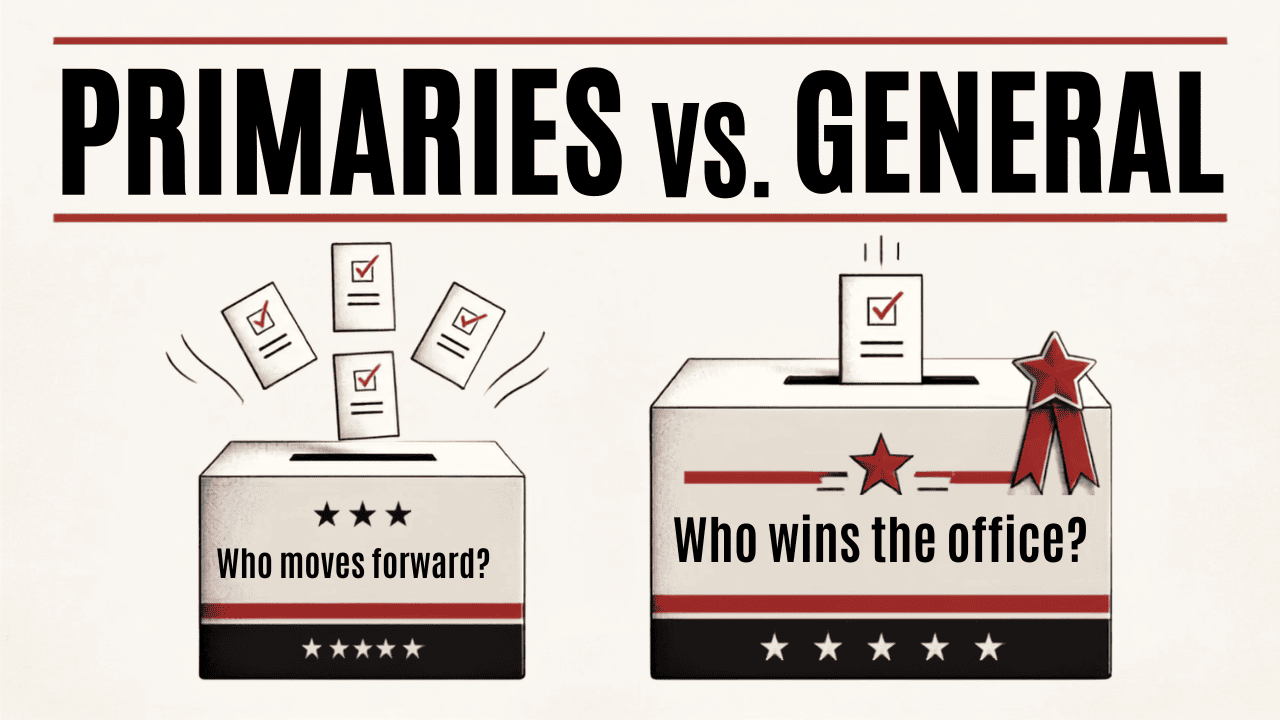
Primaries generally decide who will represent a political party. General elections decide who will hold public office.
That’s the foundation. Everything else flows from that distinction. And as with most things in American elections, the details depend heavily on which state you live in.
Two Elections, Two Questions
| Primary Election | General Election | |
|---|---|---|
| Main Question | Who moves forward? | Who wins the office? |
| Usually Happens | Earlier in the year | Later — typically November |
| Who Competes | Candidates seeking nomination or advancement | Nominees and other qualifying candidates |
| Result | Narrows the field | Chooses the officeholder |
The rest of this article explains the exceptions, the complications, and why this distinction matters more than you might think.
Part I — Why Do We Have Primary Elections?
Political Parties Need Candidates
Imagine five people in the same political party all want to run for governor. The party can’t run all five in November — that would split their voters and practically guarantee a loss. So how does the party choose just one?
Historically, party leaders made that decision behind closed doors at political conventions. Nominees were essentially chosen by party insiders, not voters.
Over time, that system drew criticism. Reformers pushed for primaries — elections that let voters, not just party bosses, have a say in which candidate represents the party. The shift began during the Progressive Era and expanded throughout the 20th century, particularly for presidential nominations.
Today, most states use some form of primary election for most offices. But the rules — who can vote, how winners are determined — vary widely.
💡 Pattern to Notice: The primary and the general election answer two fundamentally different questions:
- Primary: Who should represent the party — or advance to November?
- General: Who should hold the office?
Part II — How Primaries Work
There is no single national primary system. Each state — often in cooperation with political parties — sets its own rules.
Closed Primary
In a closed primary, voters generally participate in the primary of the party with which they are registered. Registered Democrats vote in the Democratic primary; registered Republicans vote in the Republican primary. Unaffiliated voters typically cannot participate.
The logic: Parties argue they should be able to choose their own standard-bearers, and allowing non-members to vote could let outsiders distort the process.
The criticism: Millions of independent voters — one of the fastest-growing segments of the electorate — are shut out of the first stage of choosing who appears on their November ballot.
Open Primary
In an open primary, voters generally do not have to be registered with a party to choose which party’s primary to participate in. A voter may request either party’s ballot.
The logic: Broader participation gives all voters a voice in candidate selection, which may produce more broadly appealing nominees.
The criticism: Some argue open primaries dilute party members’ ability to choose their own representatives, and could allow strategic “raiding” — voters crossing over to select a weaker opponent for November.
Semi-Closed / Semi-Open Systems
Many states fall somewhere in between. In a semi-closed system, registered party members can only vote in their own party’s primary, but unaffiliated voters may choose which party’s ballot to take. In a semi-open system, voters don’t have to declare a party affiliation in advance, but they must publicly choose one party’s ballot at the polling place.
Top-Two and Top-Four Systems
Some states have moved away from traditional partisan primaries entirely. In a top-two system (used in states like California and Washington), all candidates — regardless of party — appear on the same primary ballot. The two highest vote-getters advance to the general election, even if they belong to the same party.
A newer variation, the top-four system (adopted by Alaska), advances four candidates to the general election, where voters use ranked-choice voting to determine the winner.
Supporters argue these systems can encourage candidates to appeal to a broader electorate rather than primarily to their party’s base. Critics question whether they actually achieve that goal and raise concerns about party representation and voter choice.
Part III — Why Presidential Primaries Are Different
Presidential primaries confuse almost everyone, because they work differently from other primaries.
You’re Not Simply Choosing the President
When you vote in a presidential primary, you’re not directly choosing the party’s nominee. You’re helping determine which candidate your state’s delegates will support at the party’s national convention.
Here’s the basic flow:
Cast ballots or participate in a caucus.
Candidate preferences are measured.
Delegates are allocated under party rules.
Delegates formally participate in selecting the nominee.
The party’s candidate advances to the general election.
Each party in each state has its own rules for how delegates are awarded, and Democratic and Republican allocation rules differ significantly. These rules can change between election cycles, so it’s always worth checking current details.
Primaries vs. Caucuses
| Feature | Primary | Caucus |
|---|---|---|
| How It Works | Administered like a regular election, generally using a secret ballot | A party-run meeting where voters gather and express candidate preferences |
| Who Runs It | State or local election officials | Political party |
| Accessibility | Polls are generally open for hours, and other voting options may be available | May require participation at a particular time, potentially limiting participation |
| Privacy | Secret ballot | May involve public grouping or another open expression of preference |
Caucuses have declined significantly over the years. As of recent election cycles, only a handful of states still use them.
The Staggered Calendar
Presidential primaries are staggered across months, not held all at once. Because presidential contests are staggered, states that vote early can receive enormous media attention and influence the direction of the race. Historically, Iowa and New Hampshire have played especially prominent early-state roles, although parties have changed — and continue to debate — the nominating calendar.
Candidates who perform poorly in early states often drop out before most states even vote. Super Tuesday, when a large number of states hold their contests simultaneously, can dramatically reshape the race.
📚 For a deeper dive into presidential delegate allocation, the convention process, and how caucus states work, see our companion article: “Presidential Primaries & Caucuses Explained” (coming soon).
Part IV — What Happens in the General Election?
The general election is what most people picture when they hear the word “election.” Here’s what’s happening:
- Party nominees appear on the ballot, having won their primaries or secured their party’s nomination.
- Independent and third-party candidates may also appear, provided they meet their state’s ballot qualification requirements.
- Voters choose among the candidates on the ballot.
- The winner assumes office after results are certified and any applicable constitutional or legal processes are completed.
For presidential elections, there’s an additional layer: voters participate in a process that determines Electoral College electors rather than directly electing the President through one nationwide popular vote.
📚 For a full breakdown of how the Electoral College works, see our companion article: “The Electoral College Explained.“
Part V — Why Primaries Matter More Than You Might Think
This is the section that changes how you see American politics.
In Some Districts, the Primary Is the Real Contest
Consider a congressional district that overwhelmingly favors one political party — maybe registered Democrats outnumber Republicans three to one, or vice versa.
In a district that strongly favors one party, the general election may be far less competitive than the primary. The dominant party’s nominee may enter November heavily favored to win.
This dynamic extends far beyond Congress. It applies to state legislative seats, county offices, judgeships, and municipal races. Wherever one party dominates, the primary may be the election that truly decides who holds power.
Fewer Voters Can Mean More Influence
Here’s the kicker: primary turnout is typically far lower than general election turnout. General elections receive wall-to-wall media coverage, get-out-the-vote campaigns, and public attention. Primaries often fly under the radar.
The general election may be much less competitive.
Fewer voters participate in choosing the nominee.
A relatively small group of voters may strongly influence who ultimately holds the office.
Do Primaries Contribute to Polarization?
Critics of traditional partisan primaries point to a straightforward incentive problem. In a safe district, the primary is the real contest. Primary voters tend to be more politically engaged and more ideologically committed than the general electorate. This may reward candidates who stake out more ideologically extreme positions.
But research on the relationship between primary systems and polarization tells a more complicated story. District composition, partisan sorting, campaign finance, media, and national politics all contribute. Studies comparing open and closed primary states have produced mixed results.
The honest takeaway:
Primary systems can affect political incentives, but they are one part of a much larger story.
Part VI — The Debate Over Primary Reform
Primary systems are not frozen in place. States continue to experiment, debate, and reform. Current discussions include:
- Nontraditional primary systems — Several states have adopted or considered top-two, top-four, or unified primary models
- Ranked-choice voting — Used in some jurisdictions for primaries and/or general elections, allowing voters to rank candidates by preference
- Open vs. closed primary debates — Reform advocates push for greater inclusivity; party organizations defend their right to limit participation to members
- Efforts to increase participation — Same-day registration, automatic voter registration, mail-in ballots, and other reforms seek to boost turnout
At its core, every primary reform question comes down to:
Who should have the greatest say in choosing candidates — the political party, party members, or the broader electorate?
There are legitimate arguments on each side:
- Party autonomy: Political parties are associations with constitutional interests in determining their membership and choosing their representatives. Supporters of party-controlled primaries argue parties should have substantial freedom to determine who participates in selecting their nominees.
- Democratic participation: Elections are conducted with public resources and determine who holds public power. Excluding voters from any stage undermines democratic legitimacy.
- Pragmatic governance: Systems that produce more broadly acceptable candidates may lead to more functional governance.
None of these perspectives is irrational. The tension between them is what makes primary reform one of the liveliest debates in American democracy today.
Blueprint for Hope: Democracy Happens Before November
If you take one thing from this article, let it be this: political participation isn’t limited to showing up in November every two or four years. The decisions that shape who appears on your ballot — and sometimes who effectively wins — happen earlier and more quietly.
From school boards to state legislatures, many of the elections that most directly affect your daily life are shaped by primary outcomes.
Understanding when candidates are actually being chosen gives voters more opportunities to participate before the choices have already been narrowed.
Democracy isn’t one election every four years. It’s an ongoing process in which different elections answer different questions.
📰 Navigating the News
So the Next Time You Hear…
“Candidate X won the primary.”
Ask: What did they actually win? Usually, the right to represent a party — or advance under that state’s system — in the general election. They likely haven’t won the office yet.
“How competitive is the general election?” In some districts, winning the dominant party’s primary can make that candidate heavily favored in November. In others, the general election could be wide open.
“What kind of primary was it?” Open? Closed? Top-two? The rules shape who participates and, potentially, who wins.
“How many people participated?” Turnout provides essential context. A candidate “winning” a primary with 12% of registered voters casting ballots means something different from a primary with 45% turnout.
Common Misconceptions
❌ “The primary elects someone to office.”
Not usually. A primary typically determines who advances to the general election.
❌ “Every state has the same primary rules.”
States use different systems. A voter in one state might participate in an open primary; that same voter, living one state over, might be barred from participating altogether.
❌ “You have to belong to a political party to vote in every primary.”
That depends on state law and the type of primary. In open primary states, unaffiliated voters can participate. In closed primary states, they generally cannot.
❌ “The presidential primary directly elects the President.”
It helps determine party nominees through a delegate process culminating at the national convention. The actual election of the President happens through the Electoral College in November.
❌ “November is always the only election that really matters.”
In some races, the primary may be the more competitive — and therefore more consequential — contest.
🎯 Final Takeaway
Primary and general elections serve different purposes. Primaries help determine which candidates move forward; general elections determine who will hold office. Because primary rules vary across the country — and because some districts strongly favor one party — understanding the primary process can be just as important as understanding what happens in November.
Frequently Asked Questions
What’s the difference between a primary and general election?
A primary generally determines which candidates will advance to the general election. The general election determines who wins the office.
What’s an open primary?
A primary in which voters don’t have to be registered with a party to participate. Voters can typically choose which party’s primary ballot to take.
What’s a closed primary?
A primary restricted to voters registered with the specific party holding the primary. Unaffiliated voters generally cannot participate.
Can independents vote in primaries?
It depends on the state. In open and semi-closed primary states, yes. In closed primary states, typically no — though some states allow independents to register with a party on Election Day.
What is a caucus?
A party-run meeting where voters gather to discuss candidates, express preferences, and conduct party business. Caucuses differ from primaries, which are administered like regular elections.
What is Super Tuesday?
A date in the presidential primary calendar when a large number of states hold their contests simultaneously. Performing well on Super Tuesday can dramatically reshape the presidential race.
Can someone lose a primary and still run in November?
Generally, if a candidate loses their party’s primary, they cannot represent that party in the general election. However, they may potentially run as an independent or write-in candidate, subject to state ballot access laws — which vary widely and can be quite restrictive.
Glossary
Primary Election — An election in which voters select which candidates will represent a political party or advance to the general election.
General Election — The election that determines who will hold public office.
Open Primary — A primary in which voters do not need to be registered with a party to participate.
Closed Primary — A primary restricted to voters registered with the specific party holding the primary.
Nonpartisan Primary — A primary in which candidates’ party affiliations may not appear on the ballot, and the top finishers advance regardless of party.
Caucus — A party-run meeting process used to express candidate preferences and conduct party business.
Delegate — A representative chosen to attend a party’s national convention and help select the presidential nominee.
Party Convention — A gathering of party delegates to officially nominate candidates and adopt a platform.
Nominee — The candidate selected by a party to represent it in the general election.
Safe District — An electoral district that consistently favors one political party, making the general election predictable and the primary potentially decisive.
Runoff Election — A follow-up election held when no candidate reaches a required threshold (often a majority) in the initial round.
If you only tune in for the general election, you may be arriving after the most important decisions have already been made.
Keep Learning
| Coming Soon | What It Covers |
| Open vs. Closed Primaries Explained | Who should get to choose a party’s candidates? — A deeper dive into primary systems, reform arguments, and the trade-offs of each model. |
| Presidential Primaries & Caucuses Explained | Why your presidential primary vote is really about delegates. — Delegates, conventions, allocation rules, and the staggered calendar explained. |
| Why Do So Few People Vote in Primaries? | The lower-turnout election that can sometimes matter more. — A Why It Matters article exploring safe seats, low turnout, and their consequences. |
| Do Primaries Contribute to Political Polarization? | What the evidence says — and what it doesn’t. — A deeper investigation into the research on primary systems, gerrymandering, and extremism. |
Sources:
- Ballotpedia Open primaries by state
- The National Conference of State Legislatures (NCSL) & The U.S. Library of Congress (Progressive Era Reforms).
- Federal Election Commission (FEC) & The Green Papers (Delegate Selection Rules).
- The Pew Research Center, Bipartisan Policy Center (Primary Turnout Reports), & USC Center for the Political Future.
- Who Runs Elections? (Civics 101)
Who should get to choose a party’s candidates? A deeper look at primary systems, reform arguments, and their trade-offs.
Why your presidential primary vote is really about delegates, conventions, allocation rules, and the staggered calendar.
The lower-turnout election that can sometimes matter more — especially in heavily partisan districts.
What the evidence says — and what it doesn’t — about primaries, safe districts, gerrymandering, and polarization.

No discussions yet
Be the first to join the discussion and share your thoughts with the community.