
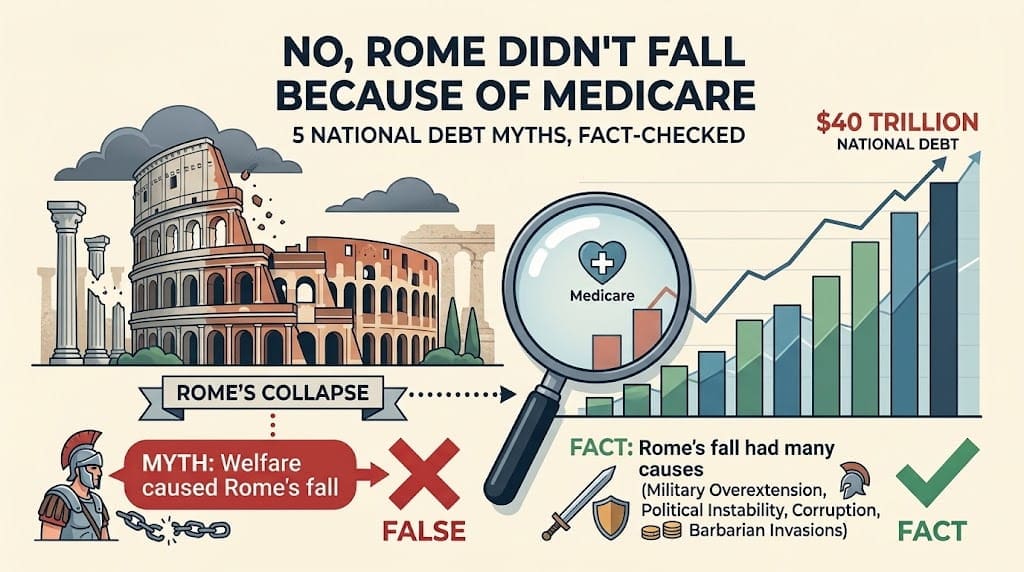
No, Rome Didn’t Fall Because of Medicare: 5 National Debt Myths, Fact-Checked
You heard a claim. Maybe it was from a family member, a coworker, a podcast host, a TikTok creator, or a television commentator. They said it with complete confidence. It sounded plausible—maybe even frightening.
You’re not sure if it’s true. So you looked it up.
Good. That’s exactly what you should do.
This article covers five of the most widely shared claims about the $40 trillion national debt—where each claim came from, what the evidence actually says, and how you can verify it yourself. You don’t have to read all of it. Jump to the claim you’re checking.
Jump to the Claim You’re Checking
People Are Asking
I keep hearing about the “Cambridge study.” What do I do?
Ask for the actual study. They won’t be able to produce it—because it doesn’t exist. What exists is a 1998 theory by a former KGB analyst named Igor Panarin, who predicted a U.S. breakup by 2010. It’s now 2026.
But aren’t we in serious trouble with $40 trillion in debt?
Yes, the trajectory is a genuine concern. CBO calls it unsustainable under current law. But “serious long-term fiscal challenge” and “imminent societal collapse” are vastly different statements. One is accurate. The other sells clicks.
Someone told me Social Security is communism. How do I respond?
Start with definitions. Social Security operates inside a mixed-market economy. Social insurance and communism are not interchangeable concepts.
Didn’t Clinton leave a surplus and Obama cut the deficit in half?
Both statements can be true while the total national debt still rises. Reducing the deficit means borrowing less each year; it does not automatically eliminate accumulated debt.
How do I handle someone who keeps changing the subject?
Don’t chase every new claim. Stay on the original topic. If they say “welfare states collapse” and you show them Germany, and they say “but Hitler,” you can say: “We were talking about whether welfare states collapse. Germany proves they don’t. That’s a different conversation.” You don’t have to win every argument. Sometimes the goal is simply to plant the seed of a fact.
Claim #1: “A Cambridge Study Predicts the U.S. Will Collapse and Split Apart”
The Reality
There is no Cambridge University study predicting that America will collapse. The viral claim traces back to Igor Panarin, a Russian political scientist and former KGB analyst who presented his prediction at Cambridge in 2000. He predicted the United States would break apart by 2010.
It is now 2026. That did not happen.
Why It Spreads
The “Cambridge” label gives it credibility it doesn’t deserve. A lecture at a university is not the same as a university study. And a prediction by a former KGB officer whose deadline passed 16 years ago is not evidence of anything—except how misinformation recycles itself online.
What You Can Do
If someone says “a study says,” ask: What study? Published by whom? In what journal? Can you send me the link? If no one can produce the study, don’t treat the claim as established fact.
Sources: Wall Street Journal (December 2008), NBC News, academic rebuttals documenting Panarin’s failed prediction.
Claim #2: “Democrats Alone Created the $40 Trillion Debt”
What People Say
“The national debt is a Democratic problem. If Republicans were in charge, we wouldn’t be in this situation.”
The Reality
Both parties have contributed substantially to the national debt.
The debt accumulated over decades through tax and spending decisions, economic downturns, wars, emergencies, and other policies under presidents and Congresses controlled by both parties.
The $40 trillion debt cannot truthfully be assigned to one political party.
| Period | Party in White House | What Happened to the Debt |
|---|---|---|
| 1980s | Republican — Reagan | Debt roughly doubled. |
| Early 1990s | Republican — G.H.W. Bush | Debt continued to grow. |
| Late 1990s | Democrat — Clinton | Growth slowed; annual surpluses occurred in the final years. |
| 2000s | Republican — G.W. Bush | Rapid growth amid wars, tax cuts and recession. |
| 2010s | Democrat — Obama | Debt nearly doubled during the Great Recession recovery period. |
| 2017–2021 | Republican — Trump | About $7.8 trillion added amid tax changes and COVID response. |
| 2021–2025 | Democrat — Biden | Debt grew sharply during the post-pandemic period. |
| 2025–present | Republican — Trump | Debt has continued to rise. |
The pattern is clear: the debt has grown under modern administrations of both parties. Presidents sign legislation, but Congress also controls federal tax and spending policy.
To believe one party caused all $40 trillion, you’d need a political time machine capable of traveling back through previous administrations and rewriting decades of tax and spending decisions.
Wait—Didn’t Clinton Run a Surplus? Didn’t Obama Cut the Deficit in Half?
Yes. Both of those things are true. And they’re also why this topic confuses so many people.
Here’s the critical distinction:
Deficit is the yearly gap: how much more the government spends than it collects in a single year.
Debt is the accumulated total: all those yearly gaps stacked together over time.
Treasury makes essentially this same distinction: a deficit occurs when annual spending exceeds revenue, while national debt is accumulated federal borrowing.
Think of the deficit as how much new debt you add to a credit card each month, and the national debt as the total balance already on the card. If you added $1,000 last month but only $400 this month, you’ve made progress—you’ve reduced your monthly deficit. But your total balance still increased by another $400.
Reducing the deficit means you’re borrowing less each year. But unless you run a surplus large enough to pay down principal, the total debt still grows—just more slowly.
All three presidents made real progress on the annual deficit. The total debt still grew under all three because even reduced borrowing is still borrowing.
The honest framing isn’t “Republicans are worse” or “Democrats are better.” It’s that you cannot truthfully assign $40 trillion to one party.
What You Can Do
When someone blames one party for the entire national debt, check the timeline. Look at tax and spending decisions across multiple administrations and Congresses—not just the years that support the argument.
And remember: deficit and debt are not the same thing. A falling deficit means the government is adding debt more slowly; it does not necessarily mean the total debt is falling.
Sources: Investopedia, “U.S. Debt by President: Dollar and Percentage” and “Democrats vs. Republicans: Who Had More National Debt?”, using Treasury Department and Bureau of Labor Statistics data; Reuters (August 2026); Obama White House archives; Committee for a Responsible Federal Budget; Yahoo Finance; Wall Street Journal.
Claim #3: “Social Programs Are Communism”
What People Say
“Social Security, Medicare, Medicaid, food assistance, and public education are socialist or communist programs, and wanting government to fund them makes you a communist.”
The Reality
This confuses three different things that have important differences.
Socialism
A broad family of economic and political systems emphasizing social or collective ownership or control of significant economic resources.
Communism
A revolutionary socialist tradition whose theoretical end-state is a classless society with collective ownership of productive property. Historically, communist governments have generally used extensive state control of the economy.
Mixed Economy
An economy combining private markets and private property with government regulation, taxation and publicly funded services.
The modern United States has always been a mixed economy. We have private businesses, private property, and free markets. We also have government-funded roads, schools, defense, courts, parks, and yes—social insurance programs like Social Security and Medicare.
By the “Socialism” Logic Used in These Claims
- The interstate highway system is socialism
- The military is socialism
- Public schools are socialism
- Police and fire departments are socialism
- Veterans’ benefits are socialism
The real debate isn’t “capitalism versus communism.” It’s:
What should government provide collectively, how generous should those programs be, who should qualify, and how should Americans pay for them?
That’s a legitimate disagreement. Calling it communism shuts down the conversation and replaces it with a label that doesn’t match what the word means.
What You Can Do
When someone calls a government program “socialism” or “communism,” ask what they mean by the term. Then discuss the actual policy: what the program does, who qualifies, what it costs, and how it should be funded.
Claim #4: “Welfare States Always Collapse—Look at Rome”
What People Say
“Throughout history, welfare states collapse under their own weight. Rome fell because of bread and circuses. America is next.”
The Reality
History does not show that welfare states inevitably collapse.
Germany began building modern social insurance in the 1880s and remains a capitalist democracy today. Other countries have maintained large social safety nets for decades. And historians do not identify Roman welfare programs as a primary cause of Rome’s fall.
The Irony Nobody Mentions
Some of the foundations of the modern welfare state weren’t created by socialists or communists. They were created by Otto von Bismarck in the 1880s.
Bismarck served as Chancellor of Imperial Germany from 1871 to 1890. Far from being a left-winger, he was an arch-conservative who championed monarchy, military strength, and aristocratic rule—and, presumably, very large mustaches.
He certainly wasn’t organizing communist rallies.
In the 1880s, he did something that sounds “socialist” by today’s talking points:
Why Did a Conservative Do This?
Bismarck introduced social insurance partly to reduce workers’ attraction to more radical socialist movements. The Social Security Administration notes that Bismarck himself was called a “socialist” for these programs—even though he was trying to undercut socialism.
Germany Today
More than 140 years later, Germany remains a major capitalist democracy and one of the world’s largest economies. Its social-insurance system also became an important predecessor to—and one of the models considered in—the development of American Social Security.
When They Move the Goalposts: “But Hitler!”
This is where conversations often take a turn. You point out that Germany developed modern social insurance in the 1880s and remains a capitalist democracy today. The response becomes: “But Hitler!”
Or World War II. Or immigration. Or refugees.
Those may all be subjects worth discussing. But they don’t answer the original question:
Did Germany’s welfare state cause Germany to collapse?
This is called moving the goalposts: instead of addressing evidence that challenges the original claim, the argument shifts to a new claim.
Here’s what that looks like in practice:
“Welfare states collapse.”
Germany developed modern social insurance beginning in the 1880s and remains a capitalist democracy with a major global economy.
Did any of those prove that social insurance caused Germany to collapse?
Return to the original claim.
What You Can Do
You don’t have to follow the argument wherever it goes. Bring it back to the original claim:
“We can talk about Hitler, immigration, or World War II separately. But the claim we were discussing was that welfare states inevitably collapse. What evidence shows that Germany’s social programs caused Germany to collapse?”
You’re not saying Hitler, immigration, or refugees are irrelevant topics. You’re saying they require their own causal argument.
On Rome
The Western Roman Empire’s collapse involved many factors, including military pressure, political instability, economic disruption, internal conflict, and the division of the empire.
Historians do not identify Rome’s grain distributions or public entertainment as a primary cause of its collapse.
And if we’re going to blame an entire civilization’s fall on grain distributions, we’d also have to account for invasions, political instability, military problems—and the fact that a popular form of entertainment involved watching people fight to the death.
It’s not exactly an apples-to-apples comparison with modern Medicare.
Historians including Peter Heather, Bryan Ward-Perkins, and Adrian Goldsworthy emphasize military, political, economic, and structural causes in explaining Rome’s decline.
On Modern Welfare States
Multiple developed nations have maintained robust social safety nets for decades without collapsing:
| Country | Social Spending | Status | Year it Started |
|---|---|---|---|
| Germany | ~25% of GDP | Major global economy | 1880s |
| France | ~28% | Stable democracy | 1940s–50s |
| Sweden | ~27% | High living standards | 1930s–40s |
| Canada | ~20% | Market democracy | 1940s–60s |
| United Kingdom | ~22% | Stable democracy | 1940s |
| United States | ~16% | World’s largest economy | 1935 — Social Security |
Sources: U.S. Social Security Administration historical archives; Smithsonian Magazine; OECD Social Expenditure Database (2024); Peter Heather (The Fall of the Roman Empire), Bryan Ward-Perkins (The Fall of Rome), Adrian Goldsworthy (How Rome Fell).
Claim #5: “The U.S. Is About to Default and It’s All Over”
What People Say
“The debt is so high that America will default on its obligations imminently, triggering total economic collapse.”
The Reality
The United States has never defaulted because it became unable to finance its debt load. Modern default concerns have instead centered largely on whether Congress would prevent Treasury from borrowing enough to meet obligations already authorized—the debt ceiling.
Here’s the distinction that matters:
| National Debt | Debt Ceiling Crisis |
|---|---|
| Long-term fiscal problem | Short-term political crisis |
| Requires long-term policy changes | Congress must raise or suspend the limit |
| Does not cause default by itself | Can lead to default if Congress does not act |
| Both parties contributed | Both parties have used it as political leverage |
Congress has raised or suspended the debt ceiling dozens of times under presidents of both parties.
But Isn’t the Debt Trajectory Unsustainable?
Yes. And that’s different from saying default is imminent.
A sufficiently unsustainable fiscal situation could eventually undermine U.S. creditworthiness. That’s a real long-term risk. CBO Director Phil Swagel explicitly said in February 2026 that “the fiscal trajectory is not sustainable,” with interest costs projected to rise from about $1 trillion in 2026 to $2.1 trillion by 2036.
But there’s a critical difference between long-term fiscal sustainability risk and immediate debt-ceiling default risk. Conflating them creates unnecessary panic.
“Unsustainable” does not mean “collapse tomorrow.”
Sources: U.S. Treasury, Congressional Budget Office February 2026 Outlook, historical debt ceiling data.
How to Spot Debt and Economy Misinformation
Next time you see a viral claim about the national debt or the economy, ask yourself:
What You Can Actually Do
- Verify before sharing. Check actual sources.
- Know the definitions. Debt and deficit are different. Socialism, communism and a mixed economy are different.
- Look at the right numbers. A president can reduce the annual deficit while the total debt still grows.
- Recognize goalpost-moving. If the original claim changes after evidence appears, bring the conversation back to the original question.
- Read beyond the headline. “Unsustainable” and “imminent collapse” are not the same claim.
Related Articles:
- The National Debt Is $40 Trillion. What Does That Mean for You?
- National Debt vs. Debt Ceiling: What’s the Difference?
- Social Programs, Socialism, and Communism Are Not the Same Thing (coming soon)
Data Sources:
Cambridge/Panarin Theory
- Wall Street Journal (Panarin profile, December 2008)
- NBC News (Panarin prediction)
Debt by President / Bipartisan Growth
- Investopedia, “U.S. Debt by President: Dollar and Percentage
- Investopedia, “Democrats vs. Republicans: Who Had More National Debt?”
- Committee for a Responsible Federal Budget (CBO February 2026 outlook summary)
- Obama White House Archives (deficit cut by half)
Social Programs / Communism Definitions
Welfare States / Bismarck / Rome
- U.S. Social Security Administration, “Otto von Bismarck” historical page
- Smithsonian Magazine, “Bismarck Tried to End Socialism’s Grip—By Offering Government Healthcare“
- OECD Social Expenditure Database (same link as Claim #3, for the country comparison table)
Books on Rome:
- Peter Heather, The Fall of the Roman Empire: A New History of Rome and the Barbarians (Oxford University Press)
- Bryan Ward-Perkins, The Fall of Rome: And the End of Civilization (Oxford University Press)
- Adrian Goldsworthy, How Rome Fell: Death of a Superpower (Yale University Press)
Default / Debt Ceiling
- Congressional Budget Office, “The Budget and Economic Outlook: 2026 to 2036”
- CBO Director’s Statement on the Budget and Economic Outlook
- U.S. Treasury Department (main data page)



No discussions yet
Be the first to join the discussion and share your thoughts with the community.