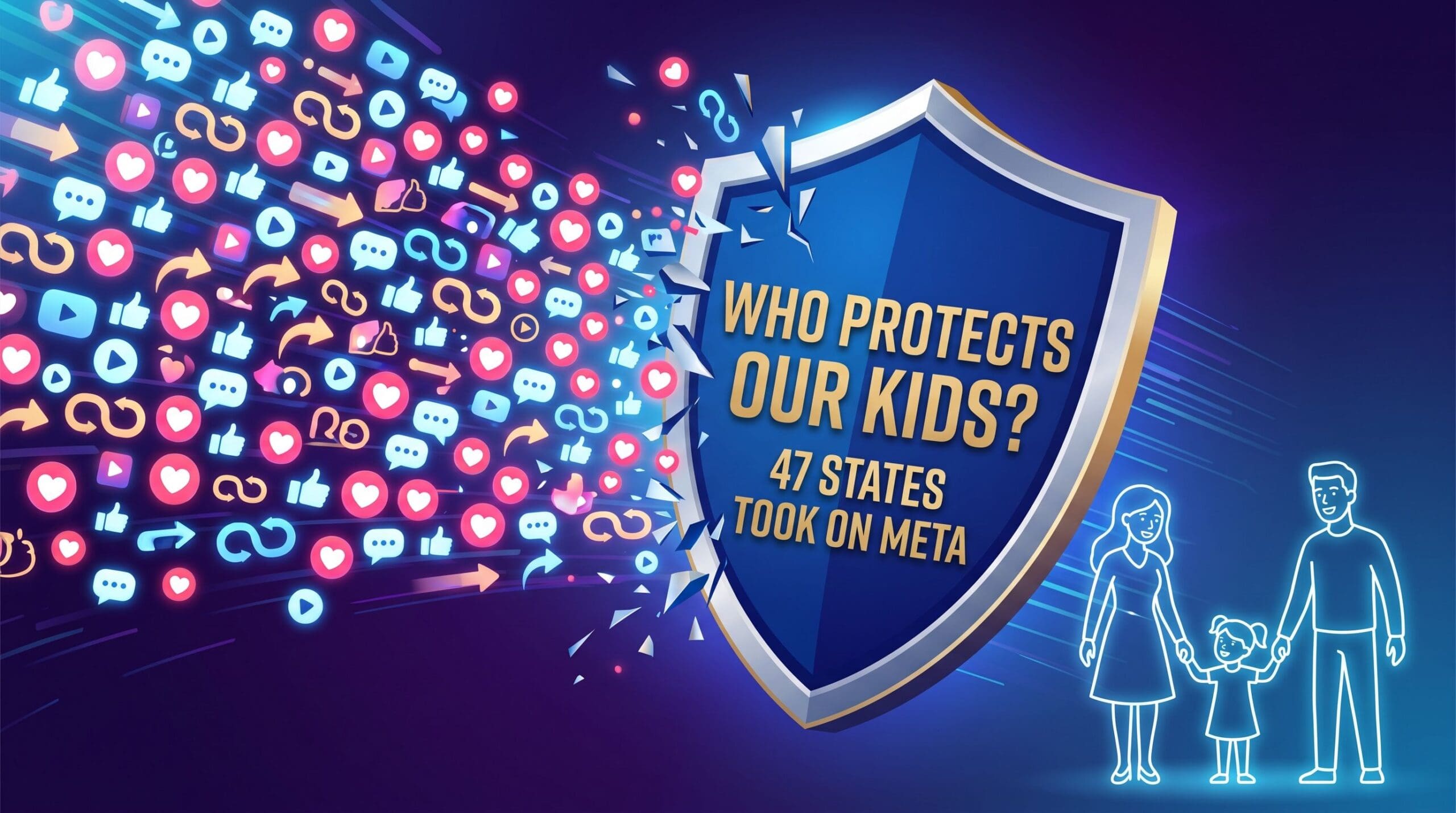
The Meta settlement is about far more than one company or one lawsuit.
Why It Matters
For years, we put much of the responsibility on parents.
Set screen-time limits. Take away the phone. Monitor what your children are doing. Tell them to log off.
Parents absolutely have responsibilities.
But this lawsuit forces us to confront an uncomfortable question:
What happens when a parent sitting at the kitchen table is competing against one of the richest corporations in the world, thousands of engineers, enormous amounts of behavioral data, and algorithms designed to keep a child coming back?
At some point, this stops being only a parenting question. It becomes a question of corporate responsibility — and government.
The U.S. Surgeon General issued a stark advisory warning that children and teens who spend more than three hours a day on social media face double the risk of experiencing mental-health problems, including symptoms of depression and anxiety.
Behind the statistics are families like Victoria Hinks of California, who sat in the courtroom during recent proceedings against Meta. She is among those who argue that social-media products and their addictive features contributed to catastrophic mental-health harms, including the deaths of children.
These families aren’t talking about abstract numbers. They are asking whether companies knew their products could harm young users, what those companies did with that knowledge, and who should be held responsible.
Evidence from inside Meta raises a more troubling possibility.
Arturo Béjar, a former Meta engineering director who worked on protecting young users, became a whistleblower after leaving the company. In October 2021, he sent an email directly to Mark Zuckerberg, Sheryl Sandberg and other senior executives warning them about Meta’s own internal research into harmful experiences reported by young users.
Béjar later testified before Congress about what Meta knew internally and what the company was telling the public about platform safety.
That distinction matters.
There is a difference between discovering that a product has unintended consequences and being warned about serious harms while continuing to operate the product.
This week, Meta — the parent company of Instagram and Facebook — agreed to a settlement worth roughly $17 billion with 47 states. The states alleged that Meta deliberately designed features that encouraged compulsive use by children while failing to adequately disclose known risks.
Meta disputes allegations that its platforms were intentionally designed to harm children and has pointed to safety tools and changes it has made over the years.
The size of the settlement isn’t the most important civic lesson in this story. Because when Washington struggled to act, something else happened.
Forty-seven states acted together.
But to understand why state-level action mattered, you first need to understand why federal action didn’t.
PBS NewsHourThe Federal Roadblock
When Americans confront a national problem like child safety online, the natural instinct is to look to Washington, D.C.
Congress holds hearings. Lawmakers question executives. Bills are introduced. Proposals are debated. And sometimes, nothing becomes law.
There are legitimate reasons federal legislation can be difficult to pass. The Constitution intentionally created a legislative process requiring agreement between the House, Senate and president. Political parties disagree about regulation, free speech, parental responsibility, privacy and the appropriate role of government.
But there is another part of the system that is impossible to ignore.
Money.
Meta and other major technology companies spend millions of dollars lobbying the federal government on legislation and regulations that could affect their businesses.
Lobbying itself is legal. Individuals, nonprofit organizations, unions, corporations and advocacy groups all lobby government. And lobbying is not the same thing as bribery.
But organizations with enormous financial resources can maintain something most ordinary citizens cannot:
a permanent presence in Washington.
They can employ professional lobbyists. Hire former congressional staff and government officials. Fund advocacy campaigns. Finance litigation. Meet with policymakers. Track legislation every day. And spend years attempting to influence how government regulates their industries.
A parent worried about her child’s Instagram account can call a member of Congress. Meta can call Congress too. But they do not arrive with the same resources.
The Elephant in the Room: Money and Political Power
Every American citizen gets one vote.
But that does not mean every American has equal political influence.
An ordinary voter can contact a member of Congress, attend a town hall, volunteer for a campaign, organize with others, donate money, protest — and, most importantly, vote.
Wealthy individuals and corporations can participate in the political system too. But they can deploy financial resources on a scale most Americans could never approach.
And this isn’t theoretical. By August 2026, corporations had already spent approximately *$646 million attempting* to influence the federal midterm elections — more than three times what corporations spent during the entire 2022 midterm cycle.
Some of the industries spending heavily have enormous financial stakes in decisions being made by government, including technology, artificial intelligence, cryptocurrency and online betting.
Billionaires and wealthy donors can spend extraordinary amounts attempting to influence which candidates win elections, which issues receive attention and which political organizations have the resources to operate.
None of this automatically means a politician has been bought. A campaign contribution is not proof of corruption. A photograph of a CEO standing beside a president is not proof of corruption. A meeting between a corporate executive and a government official is not proof of corruption.
But access and influence matter.
And when some participants in democracy can spend millions — or even hundreds of millions — trying to shape elections and government policy, while most citizens possess nothing remotely comparable, we have to acknowledge an uncomfortable reality:
The political playing field is not financially level.
This raises a larger democratic question:
How do citizens hold government accountable when the industries government regulates can also spend enormous amounts of money trying to influence the people who write those regulations?
📌 The political playing field is not financially level.
A parent concerned about her child’s safety and a corporation worth hundreds of billions of dollars both have the right to petition their government.
The Civic Mechanism: Federalism in Action
That can sound hopeless.
But the Meta settlement demonstrates something important about American government:
Washington is not the only place where political power exists.
The United States operates under a system of federalism, meaning governmental power is divided between the national government and the states.
States do not simply wait for permission from Washington to act. They have their own constitutions, legislatures, courts, laws and enforcement powers.
And when Congress does not act, those independent sources of state power can become enormously important.
In this case, the officials challenging Meta weren’t senators or the president.
They were state attorneys general.
The attorney general is the chief legal officer of a state and is sometimes called the “People’s Lawyer.” In most states, voters elect the attorney general directly.
Among their responsibilities, state attorneys general enforce consumer-protection laws — laws designed to protect people from unfair or deceptive business practices.
That gave the states something individual parents did not have:
Rather than waiting for Congress to pass a new national law regulating social media, a bipartisan coalition of states used laws already on their books.
Their case alleged that Meta designed features that encouraged compulsive use by children while misleading consumers about risks the company knew about.
In other words, the states didn’t need to solve the entire national debate over social media.
They needed to ask whether Meta had violated laws they already had the authority to enforce.
This is federalism in action.
Federalism is sometimes described as an abstract division of power between Washington and the states.
This is what it looks like in real life.
Parents raised concerns. States investigated. Attorneys general joined forces. And one of the most powerful corporations in the world had to answer to another center of power.
That doesn’t make the political playing field perfectly level.
But it creates a counterweight.
National Association of Attorneys GeneralThe Civic Connection: Why Your Ballot Matters
That counterweight exists because of the people voters elect closer to home — not just in Washington.
We devote enormous amounts of political attention — and anxiety — to presidential elections and control of Congress.
Those elections matter.
But the Meta settlement is a powerful reminder that Washington is not the only place where citizens choose the people who exercise government power.
You may not be able to control how someone in another state votes for senator. You cannot personally match the lobbying budget of a multibillion-dollar corporation.
But you can vote for the people who represent your state.
And those down-ballot races — the offices listed beneath the presidential, Senate and congressional candidates — can carry enormous power.
State attorneys general enforce consumer-protection laws.
State legislators write laws governing everything from privacy and public health to education and corporate regulation.
Governors sign or veto those laws and appoint officials who may enforce them.
And state courts decide cases that can affect millions of people.
These races don’t usually receive presidential-level television coverage.
They don’t dominate social media.
Many voters reach that portion of the ballot without knowing much about the candidates.
But corporations know who these officials are.
Lobbyists know.
Industry groups know.
Political organizations know.
And citizens should know too.
What Can You Actually Do?
Voting is the most obvious answer.
But it isn’t the only one.
Before the next election, look beyond the candidates at the top of your ballot.
Find out:
- Who is your state attorney general?
- Is that position elected or appointed in your state?
- Who is running for your state legislature?
- Who is funding the candidates and political groups trying to influence those races?
- What have those officials actually done on consumer protection, technology, privacy and campaign-finance laws?
And when you hear that a company or wealthy individual has spent millions of dollars influencing an election, don’t stop at the headline.
Ask:
Where did the money go?
What policies does the donor have a financial interest in?
Which candidates or political organizations benefited?
What happened after the election?
A political contribution does not prove corruption.
But citizens have every right to follow the money and ask whether government decisions serve the public interest.
That’s not cynicism.
That’s civic oversight.
And What About Money in Politics?
The imbalance we’ve discussed throughout this article raises an even larger question:
Should wealthy individuals and corporations have this much financial influence over American politics in the first place?
Americans disagree about the answer — and about what government can constitutionally do about it.
Some argue that political spending is closely connected to protected political speech and that government should not decide who may spend money advocating for political ideas.
Others argue that when a small number of extremely wealthy individuals, corporations and outside organizations can spend amounts ordinary citizens could never approach, political equality suffers even though everyone still technically receives one vote.
That debate has produced proposals ranging from stronger disclosure laws and public financing of campaigns to tighter campaign-finance rules and efforts to change the legal framework governing political spending.
Those proposals deserve their own article.
But you don’t have to understand every campaign-finance law to understand the fundamental problem:
One person, one vote does not mean one person, one level of political influence.
And that’s precisely why knowing how the rest of government works matters.
Our civic power doesn’t begin and end with the White House.
Sometimes, it is strongest much closer to home.
And this week, 47 states reminded us what that power can look like.
Appendix: Civic Glossary
To help navigate the legal and structural concepts in this article, here is a quick breakdown of key terms:
- Federalism: A system of government where power is divided and shared between a central national government and regional state governments. It allows states to enact their own laws when the federal government does not.
- State Attorney General: The top legal officer of a state. They represent the state in legal proceedings and are responsible for enforcing state laws, particularly those protecting consumers and the public interest.
- Consumer Protection Laws: State and federal laws designed to ensure fair competition and the free flow of truthful information in the marketplace. They are used to prevent businesses from engaging in fraud or specified unfair or deceptive practices.
- Multistate Litigation: A legal action where multiple states join together to sue a single defendant (usually a large corporation), allowing them to pool resources and exert massive legal and financial pressure.
- Down-ballot races: Elections for offices listed below the top-of-ticket contests (like president or senator). These often include state and local positions such as attorney general, state legislators, and governors — offices that can carry significant power over consumer protection, privacy, and corporate regulation.

No discussions yet
Be the first to join the discussion and share your thoughts with the community.