
Read It Your Way
This is a longer article because the Venezuela oil agreement touches several different questions — oil markets, Venezuela’s history, U.S. energy security, private investment, and geopolitics.
You don’t have to read it all at once. Jump to the topic that interests you, or use this guide to pick up where you left off.
Part I — The 65-Billion-Barrel Promise
The January 2026 launch of Operation Absolute Resolve didn’t just upend Latin American geopolitics — it fundamentally changed the relationship between the United States and Venezuela.
Following the unprecedented U.S. military raid on Caracas and the capture and removal of Nicolás Maduro, the Trump administration leveraged its new position to secure what it calls the “biggest oil deal in world history.”
That word — geopolitical — comes up frequently in stories about oil, wars, trade, and international relations. It describes the way geography, natural resources, economics, and political power shape relationships between countries. Venezuela is a perfect example: what happens there matters beyond its borders in large part because the country sits on one of the largest known oil reserves in the world.
And now the United States has a significant new stake in what happens to some of that oil.
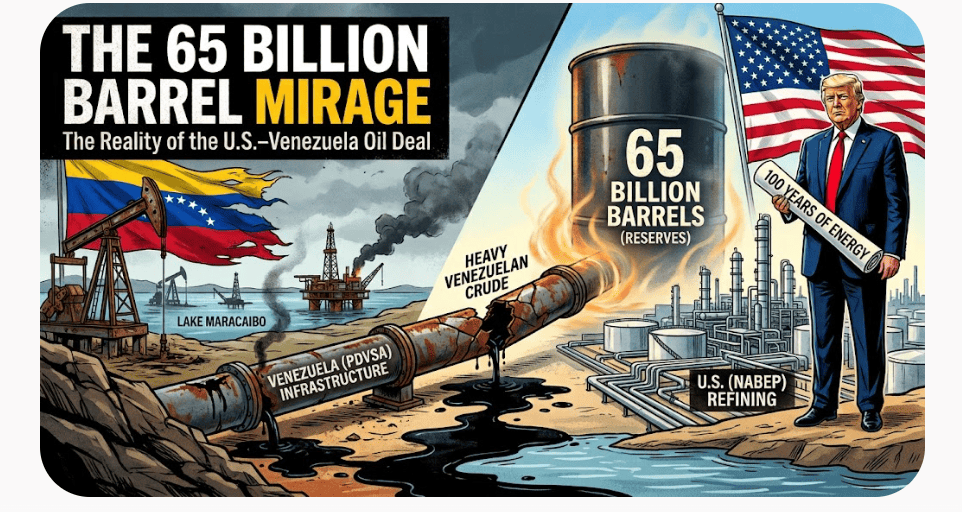
At the center of the agreement is North American Blue Energy Partners, or NABEP, a private company involved in developing Venezuelan oil fields containing an estimated 65 billion barrels of proven reserves. Under the agreement announced by the White House, the U.S. government is also receiving a 35% equity stake in NABEP’s corporate parent and preferential access to a portion of future oil production. (We’ll unpack what each of those pieces actually means — and what they don’t — in Part IV.)
The headline number is staggering: 65 billion barrels.
It is also easy to misunderstand.
When most of us hear that the United States has secured access to billions of barrels of oil, the conclusion seems almost automatic. America has more oil. More oil means greater energy independence. Greater supply should mean lower gasoline prices. And if we have enough oil of our own — or control access to enough elsewhere — perhaps events in the Middle East or decisions made by OPEC will matter less.
That is largely how the deal is being presented. The White House says it will strengthen American energy security, help lower gasoline prices, and support U.S. “energy dominance” for the next century.
But there is a vast difference between oil trapped thousands of feet underground and refined gasoline ready for transport.
A proven reserve does not mean billions of barrels are sitting in tanks waiting to be shipped to American refineries. It means there is oil underground that geological and engineering evidence indicates can be recovered under existing economic and operating conditions.
And turning a proven reserve into gasoline at an American pump has to clear two hurdles that no signing ceremony can eliminate.
The first hurdle is inside Venezuela. Getting the oil out requires functioning infrastructure, skilled workers, and enormous investment — and the industry that would provide them has been deteriorating for decades. (That story — how Venezuela got here — is Part III.)
The second hurdle is outside Venezuela. Even oil the United States controls can’t fully shield American drivers from the price of gasoline, because oil is a global commodity. (That reality — and what it does to the promise of “energy independence” — is Part II.)
None of this makes the Venezuela agreement meaningless. Over time, additional production could strengthen U.S. energy security, provide another source of crude, and shift Venezuela’s relationships with other major oil-producing countries.
But those are long-term strategic possibilities. They are not the same as suddenly having 65 billion barrels of usable oil, and they are not the same as controlling the price of gasoline.
Before we can understand what this agreement actually means for American energy, we first have to separate the enormous number being advertised from the oil that could realistically reach the market.
Because 65 billion barrels underground and 65 billion barrels available for use are two very different things.
Source: White House Historic Oil Agreement
Part II — The Illusion of Immediate Energy Independence
One of the biggest promises surrounding the Venezuela deal is greater American energy independence. The logic sounds straightforward: if the United States produces enormous amounts of oil at home and gains access to billions of additional barrels abroad, we should be less vulnerable to foreign suppliers — and perhaps less vulnerable to rising oil prices.
The first part has some truth to it. Having access to more sources of oil can strengthen U.S. energy security and provide greater flexibility when supplies are disrupted.
But producing more oil is not the same as controlling its price.
Crude oil is a globally traded commodity. Prices rise and fall according to supply, demand, geopolitical instability, production decisions, transportation disruptions, and expectations about what may happen next. The United States participates in that market; it does not operate outside of it.
Consider the Strait of Hormuz, the narrow waterway connecting the Persian Gulf to the Arabian Sea and one of the world’s most important oil transit routes. When conflict threatens the movement of petroleum through the strait, global markets react because traders anticipate that a major source of supply could be disrupted.
That vulnerability helps explain why producing large amounts of oil does not insulate American consumers from events overseas.
There is another complication: not all crude oil is the same.
American refineries are built to process different types of crude, which helps explain something that can sound contradictory at first. The United States can produce enormous quantities of oil, export some of it, and still import oil from other countries. Depending on the type of crude, the refinery designed to process it, transportation costs, and market prices, importing oil can make economic sense even when the United States is producing large amounts of its own.
This is why energy independence and energy security should not be treated as interchangeable terms.
Energy security is about having reliable access to the energy a country needs and being able to withstand disruptions. Adding another major source of crude could strengthen that security over time.
Energy independence is often used politically to suggest something much broader: that the United States can produce enough oil to stop depending on other countries or insulate American consumers from events overseas.
In a global oil market, that is a much harder promise to make.
The Venezuela agreement may eventually give the United States another valuable source of crude and greater flexibility when global supplies are strained. But it cannot make international oil markets disappear, and it cannot guarantee that events elsewhere in the world will stop affecting the price Americans pay for gasoline.
That brings us back to Venezuela itself.
Source: US Energy Information Administration
Before its enormous petroleum reserves can strengthen American energy security, lower prices, or change the balance of the global oil market, they have to become something more than a resource on paper.
Someone still has to get the oil out of the ground.
Part III — The 65-Billion-Barrel Reality
Venezuela’s problem is not a lack of oil. It is what has happened to the industry responsible for producing it.
Decades of chronic underinvestment, corruption, mismanagement, and brain drain under the Chávez and Maduro governments have hollowed out much of Venezuela’s state oil apparatus.
Reversing that decline will require enormous investment. NABEP says it plans to invest up to $100 billion in new oil infrastructure in Venezuela, an indication of the scale of reconstruction and development the company believes will be necessary. Bringing substantial new production to market will also take time.
How Did Venezuela Get Here?
Venezuela nationalized its oil industry in 1976, creating the state-controlled petroleum company PDVSA. During the 1990s, the country reopened parts of the industry to private investment, helping production reach roughly 3.4 million barrels per day by 1998.
But Venezuela’s enormous petroleum wealth had not eliminated inequality, corruption, or growing distrust of the country’s political establishment. Many Venezuelans believed that a relatively small and well-connected segment of society had benefited disproportionately from the country’s oil wealth.
Those frustrations helped create fertile ground for a political outsider promising to change who benefited from Venezuela’s most valuable resource.
Hugo Chávez assumed the presidency promising a “Bolivarian Revolution” that would challenge Venezuela’s traditional political and economic establishment and direct more of the country’s oil wealth toward ordinary Venezuelans.
That message had enormous appeal.
Chávez expanded social programs and subsidies, particularly during years of high oil prices. But he also sought much greater political control over PDVSA, challenging the commercial autonomy and professional management that had previously characterized much of the state oil company.
That conflict would fundamentally change Venezuela’s oil industry.
During a nationwide strike that severely disrupted petroleum production, approximately 18,000 of PDVSA’s nearly 40,000 employees were dismissed, including many experienced technical and professional workers. Political control increased while the company lost substantial specialized expertise.
High oil prices funded expanding social programs and subsidies. But Venezuela also became increasingly dependent on petroleum revenue, borrowed against future income, and directed substantial PDVSA resources toward government spending rather than reinvestment in the oil industry.
After Nicolás Maduro took power, falling oil prices exposed deeper weaknesses. Economic mismanagement, corruption, deteriorating infrastructure, declining investment, U.S. sanctions, and continued loss of skilled workers all contributed to the industry’s decline.
A U.S. military operation in Caracas resulted in the capture and removal of Nicolás Maduro and dramatically changed the political relationship between Washington and Caracas.
The Trump administration announced an agreement involving 17 Venezuelan oil fields containing roughly 65 billion barrels of proven reserves. NABEP received development rights, while the U.S. government obtained rights to a 35% equity stake in NABEP’s corporate parent and preferential access to future production.
The agreement represents a remarkable reversal.
Half a century after Venezuela nationalized its petroleum industry in an effort to assert greater control over its oil wealth, private investment — now intertwined with direct U.S. government financial and strategic interests — is being presented as the path toward rebuilding it.
That timeline matters.
Oil markets respond to supply that is available — or expected to become available — not simply to the amount of petroleum believed to exist underground. A reserve can be extraordinarily valuable over the long term without having much effect on the amount of oil available next month, next year, or even several years from now.
And Venezuela faces another complication — one that Part II introduced when we looked at why not all crude oil is the same, and which pushes that problem to an extreme.
The Heavy Cost of “Heavy Crude”
Much of Venezuela’s enormous petroleum wealth is concentrated in the Orinoco Belt, which contains extra-heavy crude. Unlike the lighter crude produced in places such as the Permian Basin in Texas, Venezuelan crude can be exceptionally dense and contains higher levels of sulfur and other impurities.
In the petroleum industry, crude with relatively low sulfur content is called “sweet,” while crude with more sulfur is called “sour.” Those descriptions may sound harmless, but the difference has major consequences for extraction, transportation, refining, cost, and the environment.
Extraction and transport: Extra-heavy Venezuelan crude can be extremely thick. Moving it through pipelines often requires blending it with lighter hydrocarbons, known as diluents, so that it can flow more easily. That adds another step — and another cost — before the oil ever reaches a refinery.
Refining bottlenecks: Heavy, sour crude requires more complex refining than lighter grades. Some U.S. Gulf Coast refineries are particularly well equipped to process heavier crude, which is one reason Venezuelan oil could eventually be valuable to the United States. But refinery capacity is not unlimited, and gaining access to billions of barrels underground does not instantly create the infrastructure needed to process them.
Environmental toll: Heavy crude also carries environmental costs. Extracting and processing it generally requires more energy than producing lighter crude, while refining high-sulfur petroleum can generate greater emissions and byproducts such as petroleum coke. In Venezuela itself, aging pipelines and deteriorating infrastructure have already contributed to serious pollution problems, making any large-scale effort to restart or expand production an environmental challenge as well as an economic one.
None of these obstacles means Venezuela’s reserves have no value. Quite the opposite: the sheer size of the resource helps explain why governments, oil companies, and investors have remained interested in Venezuela despite years of political instability and economic decline.
But the distinction between reserves and production is crucial.
Sixty-five billion barrels may exist beneath Venezuelan soil. Turning those reserves into a reliable stream of crude requires investment, functioning infrastructure, skilled workers, transportation, refining capacity, and years of sustained political and economic stability.
That is why the number 65 billion can be both impressive and misleading at the same time.
The oil is real.
The assumption that all of it is readily available is not.
Sources: Reuters and The Dispatch: A Venezuelan Oil Deal With Many Layers by Gil Guerra
Part IV — So What Did the United States Actually Get?
If the headline number does not represent oil immediately available to the United States, what did the agreement actually provide?
Quite a lot — but in a more complicated form.
Under the agreement announced by the White House, the U.S. government receives a 35% equity stake in the corporate parent of North American Blue Energy Partners (NABEP). The deal also gives the United States preferential access to 20% of future production at cost, according to the terms described publicly.
There is another important distinction: Venezuela still owns the petroleum beneath its territory. NABEP has received contractual rights to develop and produce oil from the fields. The U.S. government’s financial stake is in NABEP’s corporate parent, while its preferential purchasing rights apply to oil that is actually produced.
That second provision may prove particularly important.
If production eventually increases, purchasing a portion of the oil at production cost could give the United States access to crude on terms different from simply buying it on the open market. Depending on how the provision operates, that could provide a useful strategic buffer during periods of tight supply or help replenish government petroleum reserves.
“The United States now owns 65 billion barrels of Venezuelan oil.”
The agreement contains several layers — ownership interests, development rights, access to future production, investment commitments, and agreements with the Venezuelan government. Compressing all of that into a single enormous number makes the deal easier to sell politically, but much harder to understand accurately.
The Claim and the Reality
The dispute over the length of the agreement deserves particular attention.
The duration described publicly by the White House.
The duration described publicly by Delcy Rodríguez.
About That “100 Years”…
A century is an extraordinary amount of time for any government to describe an international energy arrangement as settled.
A 100-year agreement beginning in 2026 would extend to 2126.
For perspective, look backward the same distance.
In 1926, Calvin Coolidge was president. Commercial television did not yet exist. Nuclear power had not been developed. Humans had not reached the Moon. The modern interstate highway system did not exist, and the petroleum industry operated in a world almost unrecognizable compared with today’s global energy market.
Now imagine predicting from 1926 what American energy policy, technology, international alliances, environmental priorities, or transportation would look like in 2026.
That is the distance we are being asked to look forward.
Over the next century, administrations will change. Venezuelan governments will change. Laws may change. Technology will change. New generations will inherit political decisions they did not make, armed with information and technologies that do not yet exist. The role of oil itself in the global economy may look very different decades from now.
None of that automatically makes a long-term concession invalid or meaningless. Governments and companies routinely enter long-term agreements precisely because major energy projects require enormous investments that may take decades to recover.
But it does make certainty difficult.
And in this case, there is an even more immediate problem: the two governments do not appear to be publicly describing the duration of the agreement the same way.
The White House says 100 years.
Rodríguez says 25.
That discrepancy does not tell us, by itself, which description will ultimately govern the arrangement. It does tell us that Americans should be cautious about treating “100 years” as an unquestioned fact until the underlying terms are clear.
Before celebrating a century of guaranteed American energy access, it would help to establish whether there is actually a century-long guarantee.
There is also another question hiding behind all of these numbers.
The agreement is being presented as a major achievement for the United States, but governments do not drill wells, repair pipelines, operate refineries, or negotiate complex commercial ventures by themselves. Companies and individuals do.
And the private company at the center of this particular agreement brings its own complicated history.
So who, exactly, is North American Blue Energy Partners — and who is the man behind it?
Part V — The Man in the Middle
For an agreement being promoted as a historic victory for American energy, there is an unusual figure at its center: Alejandro Betancourt, a Venezuelan businessman whose rise began not in the United States, but during the government of Hugo Chávez.
Betancourt rose to prominence during Venezuela’s electricity crisis in the 2010s, when his company, Derwick Associates, and its partners received government contracts to build power plants. Betancourt and a group of young businessmen who prospered during Chávez’s Bolivarian Revolution became known in Venezuela as the “bolichicos,” or “Bolivarian boys.”
Now he controls North American Blue Energy Partners, the private company positioned at the center of the Trump administration’s Venezuela oil strategy.
That alone does not establish corruption or wrongdoing.
But Betancourt’s history is complicated enough to make the choice of NABEP worth examining.
Betancourt has faced scrutiny in Europe over allegations involving money laundering and funds connected to Venezuela’s state oil company, PDVSA. In Spain, investigators examined whether he and several associates participated in a scheme involving billions of dollars that moved from Venezuela into European investments.
The legal history requires an important distinction.
In March 2026, a Spanish judge closed the investigation involving Betancourt, concluding that the evidence had not established that a crime had been committed. Spain’s anticorruption prosecutors appealed that decision, arguing that the investigation remained incomplete.
In the United States, Secretary of State Marco Rubio has defended the government’s decision to work with Betancourt, saying there was no investigation of him within the U.S. system.
That statement leaves out important context.
The Washington Post reported that U.S. federal investigators and prosecutors had previously gathered and shared evidence involving Betancourt with Swiss authorities. According to the Post, Betancourt had been considered as an unnamed conspirator in a U.S.-connected investigation, although prosecutors ultimately did not charge him.
Betancourt has denied wrongdoing and has not been charged with a crime in connection with these investigations.
So why does his background matter?
Because the United States is not simply purchasing oil from an established supplier.
As we saw in Part IV, the federal government is taking rights to a 35% equity stake in NABEP’s corporate parent. The company has also been granted extraordinary access to Venezuelan oil fields, while the U.S. government will receive preferential access to future production and significant influence over the venture.
When governments and private companies become financially intertwined like this, transparency about how it all came together becomes a matter of public interest — not a partisan attack.
The Trump administration argues that U.S. oversight will provide the stability and financial confidence needed to attract investment back into Venezuela after years of nationalization, sanctions, political upheaval, and deteriorating infrastructure. Energy Secretary Chris Wright has said the United States will closely oversee the flow of funds associated with the arrangement.
That may help explain why the government believes this structure is necessary.
But it does not eliminate the questions surrounding it.
A deal of this size deserves scrutiny regardless of who occupies the White House. When the federal government acquires a financial interest in a private company while simultaneously using its diplomatic power to reshape another country’s energy industry, Americans should understand the full picture before deciding what to make of it.
Betancourt’s past does not prove that this deal is corrupt.
It does make transparency about the deal considerably more important.
Questions That Still Matter
- How was NABEP selected?
- What due diligence was conducted?
- What financial risks does the U.S. government assume?
- Who ultimately profits if the venture succeeds?
- What protections exist if Venezuela’s political leadership changes again?
Source: The New York Times | El Pais | The Washington Post
Part VI — If This Deal Is So Enormous, Why Is the World Shrugging?
The political announcement was enormous.
The reaction from global oil markets was considerably more restrained.
That difference is revealing.
Financial markets are not always right, and traders certainly do not have perfect knowledge. But oil markets have one advantage over political messaging: eventually, they have to put a price on what they believe.
A barrel that might be produced years from now is not worth the same thing to today’s market as a barrel that can be delivered next month.
Rather than treating Venezuela’s enormous reserves as an immediate transformation of global supply, markets remained focused on oil available now and on geopolitical events capable of disrupting it in the near future.
They are not necessarily dismissing the agreement.
65 billion barrels, a historic agreement, and potential energy benefits extending for decades.
Clocks
How many additional barrels can actually reach buyers — and how soon?
What the Market Is Watching Instead
Oil prices are extraordinarily sensitive to events that can affect production or transportation quickly.
A war that threatens a major producing region, sanctions that remove barrels from international trade, an OPEC production decision, a hurricane approaching Gulf Coast infrastructure, or a disruption along a major shipping route can affect expectations almost immediately.
Venezuelan fields that may produce substantially more oil years from now belong to a different category of risk and opportunity.
For the Trump administration, the agreement can be presented today as a historic acquisition of energy resources. For an oil company, however, the relevant questions are more concrete: How much capital must be invested? How quickly can production increase? What condition are the fields and pipelines in? Will the political agreement survive future governments? What return can investors expect?
And for an oil trader, perhaps the most important question is simpler:
How many additional barrels will actually reach the market — and when?
But the Long-Term Geopolitical Shift Could Be Much Bigger
This is where it would be a mistake to look at the market’s restrained reaction and conclude that the Venezuela agreement does not matter.
Its greatest significance may not be today’s oil price at all.
For decades, Venezuela has been a member of OPEC and has developed important economic and political relationships with countries that frequently compete with the United States for global influence, including Russia and China. Some Venezuelan oil projects have involved Chinese and Russian interests, and those relationships became particularly important as U.S.-Venezuelan relations deteriorated.
The new agreement begins shifting that alignment.
Some oil fields previously associated with Chinese and Russian operators are moving toward a venture tied directly to the United States. American companies are again considering significant investments in Venezuela. And the U.S. government itself now has a financial interest in a private company involved in developing Venezuelan petroleum.
That is not simply an oil story.
It is a geopolitical realignment.
If Venezuela ultimately moves closer to the United States economically, reduces its dependence on Russia and China, or attracts substantial Western investment, the consequences could extend well beyond the price of gasoline.
Those changes would unfold over years, not weeks.
And that may be the central paradox of the entire agreement.
The White House is promoting something with potentially significant long-term geopolitical value by attaching it to benefits Americans understandably want right now: cheaper gasoline, greater energy independence, and protection from instability overseas.
The first possibility deserves serious attention.
The second deserves considerably more caution.
The world is not necessarily pooh-poohing Venezuela’s enormous oil reserves.
It is waiting to see how many of those barrels actually become oil the world can buy.
Source: Trump’s oil deal with Venezuela raises red flags for some major producers, sources say
Part VII — So Is This a Good Deal?
After separating the headlines from the mechanics of the agreement, we arrive at the question that matters most:
Is this actually a good deal for the United States?
The most accurate answer right now is frustratingly unsatisfying: it could be.
There are legitimate reasons for the United States to want greater access to Venezuelan oil. Venezuela possesses extraordinary petroleum resources, its heavy crude is compatible with many sophisticated U.S. Gulf Coast refineries, and rebuilding its oil industry could eventually add another significant source of supply to the Western Hemisphere.
The geopolitical benefits could be just as important.
A Venezuela that is economically more connected to the United States could become less dependent on Russia and China. Greater American involvement could also give the United States more influence over an energy-producing country that has spent years outside Washington’s orbit.
And preferential access to a portion of future Venezuelan production could have strategic value during periods of global disruption.
Those are not trivial benefits.
But nearly every one of them comes with an important qualifier:
They depend on what happens next.
The oil industry has to attract enormous amounts of capital. Infrastructure has to be repaired or rebuilt. Production has to increase. Investors need confidence that contracts will survive political changes. The arrangement itself must withstand future American and Venezuelan governments, and the rules governing the partnership need to be clear enough for companies to commit billions of dollars over many years.
Then there is the unusual role of the U.S. government itself.
Washington is not merely encouraging American companies to invest in Venezuela. The federal government is acquiring a financial interest in the corporate structure involved in developing these fields while simultaneously exercising diplomatic and political influence over the environment in which that company operates.
That may give the United States greater control over how the arrangement develops.
It also means the government has more than one role to play.
It is simultaneously acting as a government pursuing foreign-policy objectives, a strategic partner seeking reliable energy supplies, and a financial participant with an interest in the venture’s success.
Those interests may frequently align.
They may not always.
That makes transparency particularly important. Americans should be able to determine how the company was selected, what obligations the government has assumed, where revenues will go, how profits and losses will be distributed, what oversight exists, and what happens if the political arrangement begins to unravel.
A Deal Can Be Valuable Without Delivering Everything Promised
Perhaps the most important distinction is between the agreement itself and the political promises being attached to it.
The deal does not have to deliver immediate gasoline savings to have value.
It does not have to make the United States completely energy independent to improve energy security.
And it does not have to transform Venezuela’s oil industry overnight to alter the geopolitical balance between the United States, Venezuela, Russia, China, and other oil-producing countries.
Those are different standards.
Political messaging often collapses them into one enormous claim: more oil, lower prices, greater independence, stronger national security, and a historic victory for the United States.
Reality is usually less tidy.
The agreement could become a successful long-term strategic investment while having very little effect on what an American driver pays for gasoline next month.
It could increase U.S. influence in Venezuela while creating legitimate questions about government involvement in private enterprise.
It could weaken Russian and Chinese influence while exposing American investors to the same political instability that has complicated investment in Venezuela for decades.
And it could eventually increase global oil supplies while falling far short of the extraordinary expectations created when the agreement was announced.
None of those possibilities contradict one another.
That is what makes evaluating this deal more complicated than deciding whether the administration’s announcement was “true” or “false.”
Some of the underlying facts are real. The reserves are real. The agreement is real. The American government’s financial interest is real. The potential geopolitical benefits are real.
The uncertainty lies in what those facts will ultimately produce.
And that distinction matters far beyond Venezuela.
Because one of the most effective forms of political persuasion does not require inventing a fact. Sometimes it simply requires taking a true fact and allowing the audience to assume that it proves much more than it actually does.
Part VIII — Why It Matters
The most important lesson from the Venezuela oil agreement may have very little to do with oil.
It is about how political claims are constructed — and how we evaluate them.
We often approach political information as though there are only two possibilities: true or false. Did the politician tell the truth? Is the statistic accurate? Did the event actually happen?
Those questions matter. But they are only the beginning.
A political claim can contain a completely accurate statistic and still create a misleading impression.
The better habit is to separate the fact from the conclusion.
When you hear an enormous number, ask what the number actually measures.
When a government announces that it has “secured” a resource, ask what secured means. Ownership? Development rights? Preferred purchasing rights? Access under certain conditions?
When a long-term agreement is connected to an immediate economic promise, ask about the timeline between the two.
When someone says a policy will lower prices, ask what else determines those prices.
And when a government describes an agreement as historic, ask what remains uncertain.
None of those questions require you to oppose the policy.
They do not require you to support it either.
They simply require you to understand it before deciding.
That distinction has become increasingly important in a political environment where information moves quickly and complicated policies are often reduced to slogans, statistics, headlines, and social-media posts. The largest number usually receives the most attention. The strongest promise becomes the headline. The conditions and uncertainties arrive several paragraphs later — if they arrive at all.
What Should Americans Watch Next?
The Venezuela agreement should not be judged only by what was announced in 2026. Its real significance will become clearer through what happens afterward.
Does Venezuelan oil production actually increase — and how quickly?
Does the promised private investment actually materialize?
How much oil does the United States ultimately receive under its preferential purchasing rights?
Does the agreement survive political changes in both countries?
How is the U.S. government’s financial stake managed, and what oversight accompanies it?
Do Venezuela’s relationships with Russia, China, and OPEC begin to change?
What happens to gasoline prices — while remembering that forces far beyond Venezuela will continue to influence them?
Those developments will tell us considerably more about the success of this agreement than the size of the number used to announce it.
The Venezuela deal may ultimately prove to be an important strategic achievement for the United States. It may help rebuild an oil industry that has deteriorated for decades, strengthen American energy security, and reshape political relationships across the Western Hemisphere.
It may also prove more difficult, expensive, politically fragile, or economically limited than its architects expect.
We do not know yet.
And perhaps that is the most important thing to understand.
Citizens do not have to decide immediately that every new policy is either a historic triumph or a disastrous failure. Sometimes the responsible conclusion is simply:
The claim is significant. The possibilities are real.
Now show us what happens.
Source: Reuters: Only democratic government can provide stability for oil investors
Discussion Questions for Members
- After reading the article, do you think the Venezuela oil agreement is a good deal for the United States? Why or why not?
What potential benefit—or potential risk—weighs most heavily in your answer? - How involved should the federal government be in private energy ventures?
Does the government’s financial stake in NABEP give the United States useful strategic influence, or does it create a conflict between its role as regulator, foreign-policy actor, and financial participant? - How much does Alejandro Betancourt’s history matter when evaluating the agreement?
He has faced investigations and scrutiny but has not been charged with a crime. What level of due diligence and public disclosure should be expected when the federal government enters a partnership involving someone with that history? - If the agreement strengthens U.S. energy security and reduces Russian or Chinese influence in Venezuela—but has little effect on gasoline prices—would you still consider it successful?
In other words, how should Americans measure whether this deal ultimately worked? - Where is the line between political persuasion and misleading political messaging?
The 65 billion barrels are real. The agreement is real. But many of the conclusions a listener might draw from those facts are much less certain. At what point does emphasizing a true fact while minimizing its limitations become misleading?



No discussions yet
Be the first to join the discussion and share your thoughts with the community.