
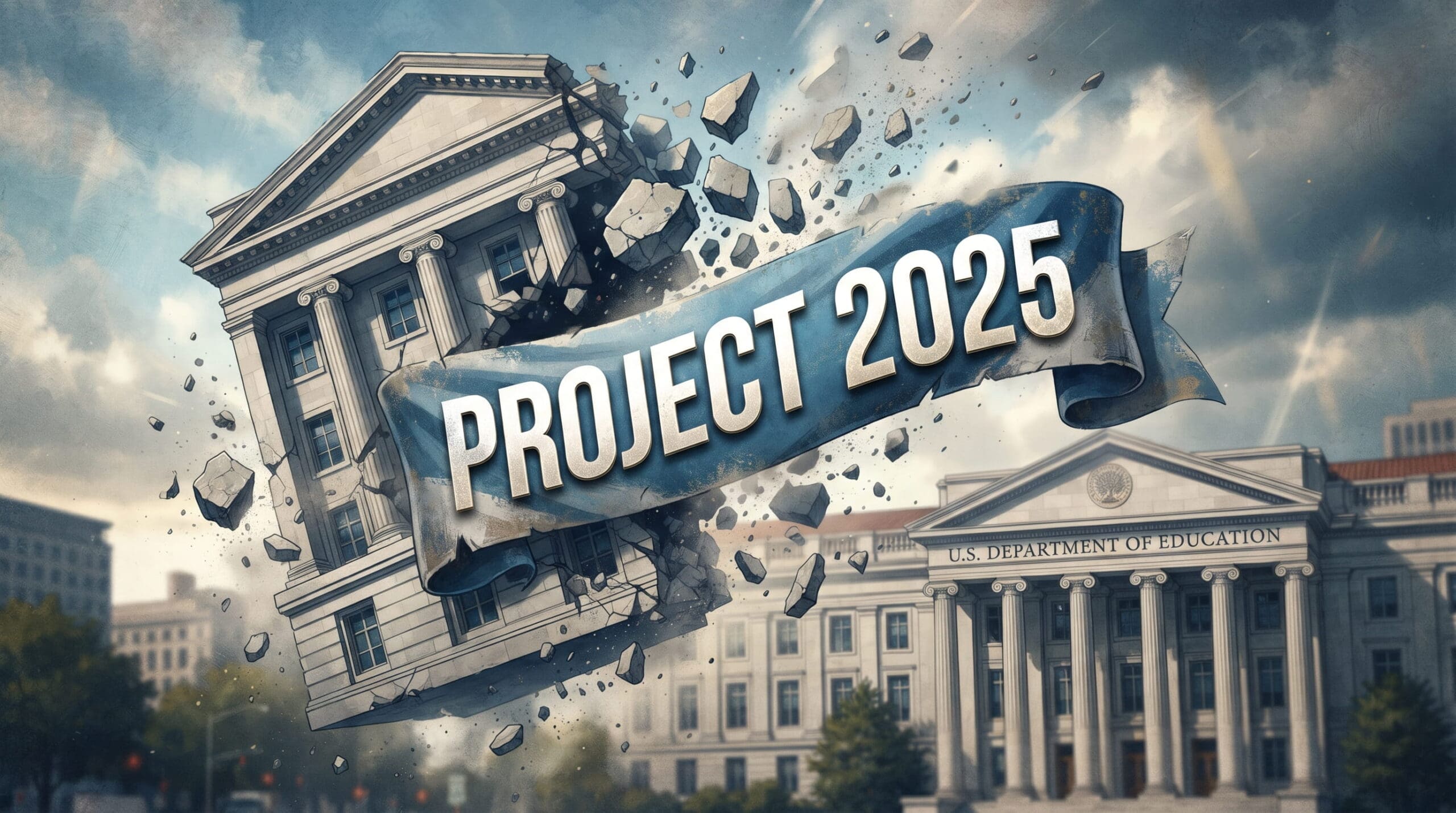
Project 2025 and Public Education: Promises Meet Reality
You may have heard on the news or a podcast that the federal Department of Education is being dismantled. But we’re not quite there. The department still exists, even as the Trump administration reduces its workforce and moves some responsibilities to other federal agencies. Closing it entirely would require Congress.
But before we get into that fight, let’s clear up a few misconceptions.
The Department of Education does not run your local public school. It doesn’t hire or fire teachers, choose textbooks, set graduation requirements, or decide what your children learn in class. Those responsibilities belong primarily to state governments and local school districts.
And no, the department doesn’t ban religion from public schools Students can pray, discuss their faith, and join voluntary religious clubs. What public schools can’t do is sponsor worship or pressure students to participate. Those rules come from the Constitution and court decisions—not from the Department of Education.
To be clear, the Department of Education helps distribute federal education funding, supports programs for students with disabilities and children from low-income families, collects education data, and enforces federal civil-rights protections.
And that last responsibility brings us to the heart of this story.
How We Got Here: From Civil Rights to Project 2025
To understand why some politicians have wanted to eliminate the Department of Education for decades, we need to go back before Ronald Reagan, before Jimmy Carter, and all the way to the civil-rights movement.
In 1954, the Supreme Court ruled in Brown v. Board of Education that racial segregation in public schools was unconstitutional. But a Supreme Court ruling didn’t mean everyone was willing to follow it. Many Southern states resisted integration, and the federal government had to step in to enforce the law.
The Civil Rights Act of 1964 gave Washington stronger tools to challenge discrimination. A year later, President Lyndon Johnson signed legislation that expanded federal education funding, including Title I, which directed additional resources toward schools serving children from low-income families.
And this is where the argument over who controls education becomes more complicated.
For families whose children had been denied equal opportunities, federal intervention wasn’t simply another layer of government. It was a way to protect rights their own state or local officials had refused to honor.
But federal involvement also faced opposition. Some Southern politicians had resisted desegregation for years, often defending their position in the language of states’ rights and local control. Others objected more broadly to Washington’s growing influence over schools.
The debate wasn’t just about who should run schools. It was also about what should happen when the people running them failed to protect children’s rights.
Enter Jimmy Carter
By the 1970s, federal education programs and civil-rights responsibilities were scattered across government agencies.
President Jimmy Carter believed education deserved its own Cabinet-level department. Congress approved it in 1979, and the Department of Education began operating in 1980.
Its job was to coordinate federal programs, distribute funding, collect education data, and help protect equal educational opportunities.
But here’s an important distinction: Carter didn’t create federal civil-rights protections. Those laws already existed. The new department brought many of those responsibilities together under one roof.
Not everyone welcomed the change.
Reagan Wanted It Gone
Ronald Reagan opposed the department from the beginning. He argued that education belonged primarily to states, local communities, and parents—not federal bureaucrats. He also promoted school choice and reducing Washington’s role in education.
But in 1983, a national commission established during his presidency released A Nation at Risk, warning that American schools were falling behind. Reagan embraced its findings while continuing to argue that Washington should have less authority over education.
The department survived his presidency. The movement to eliminate it did not.
The Presidents Who Followed
Presidents from both parties continued searching for ways to improve American schools.
George H. W. Bush promoted national education goals, while Bill Clinton supported stronger academic standards. In 2002, George W. Bush signed No Child Left Behind, expanding federal accountability requirements. Supporters believed it would expose achievement gaps; critics argued it encouraged teaching to the test.
Barack Obama’s Race to the Top encouraged state reforms through federal funding. But in 2015, he also signed the bipartisan Every Student Succeeds Act, returning more flexibility to states.
Here’s the interesting part: Reagan wanted to eliminate the department, while fellow Republican George W. Bush expanded federal oversight. Even within the same party, presidents disagreed about Washington’s role in education.
From Reagan to Project 2025
The movement to reduce Washington’s role in education continued long after Reagan left office. Conservative advocates promoted school choice, vouchers, and education savings accounts, arguing that parents shouldn’t be trapped in schools that weren’t serving their children.
The Heritage Foundation’s Project 2025 brought these long-standing ideas together into a detailed plan to eliminate the Department of Education, transfer its responsibilities to other agencies, and give states and families greater control over education funding.
Project 2025 didn’t invent the movement. It offered a roadmap for putting decades of proposals into practice.
In March 2025, President Donald Trump signed an executive order directing Education Secretary Linda McMahon to take steps toward closing the department as far as the law allowed. Eliminating it entirely, however, would require Congress.
Instead, the administration began reducing its workforce and transferring responsibilities to other federal agencies.
After decades of debating what would happen if Washington stepped back, we’re now watching parts of that experiment unfold.
Five Promises, Five Scorecards
Project 2025 wasn’t vague. It listed specific changes. And because the administration has already acted on several, we can now set each promise beside what its supporters hoped, what critics feared, and what has actually happened since.
1. Eliminate the Department of Education
The proposal: Close the department or distribute its functions across other federal agencies.
Supporters say: Every layer between taxpayers and classrooms takes a cut and adds rules. America educated generations of students before the Department of Education existed, and states already fund most public schooling. If states ran schools before 1980, why shouldn’t they be able to do so now?
The historical catch: America had schools long before the department existed, but access to education was far from equal. In 1900, roughly one in ten Americans couldn’t read or write, and only about 6% of the nation’s 17-year-old population graduated from high school.
Critics say: Distributing responsibilities across several agencies doesn’t necessarily eliminate bureaucracy. It could make federal programs harder to coordinate and leave families unsure where to turn when something goes wrong.
What’s happened: Congress hasn’t abolished the department. Instead, the administration has arranged 14 interagency agreements to move roughly 150 programs to six other agencies. Its workforce has fallen from approximately 3,900 to 2,300 employees. Secretary McMahon has described the transfers as a “proof of concept” for Congress.
The complication: A GAO review found that the department spent up to $38 million paying civil-rights investigators who couldn’t work during the 2025 restructuring and related court challenges.
The administration argues these changes demonstrate that education programs can operate outside the department. Whether they produce lasting savings and better services remains an open question.
2. Phase Out Title I Funding for Low-Income Schools
The proposal: Convert Title I into more flexible state grants, then phase out the additional federal funding over ten years.
Supporters say: Title I has directed money toward schools serving low-income children since 1965. After six decades, it’s fair to ask whether it’s working. Achievement gaps persist, and supporters argue that states could get better results if they spent the money according to local needs instead of following Washington’s rules.
Critics say: This is the money that follows poor children, and “flexible” has historically been a polite word for “divertible.” Large states may lose more dollars overall, but smaller and rural districts can depend on those dollars far more heavily. Lose a grant in New York, and programs may shrink. Lose one in a rural county, and programs could disappear.
What’s happened: In 2026, the Department of Education suspended its most comprehensive monitoring of federal K–12 education programs. A September GAO report found that 32 of 51 states and jurisdictions had not undergone this type of review since the current monitoring strategy began in 2019.
The complication: The GAO warned that nearly $27 billion in federal education funding, including more than $18 billion for Title I, faced a higher risk of undetected waste, fraud, or abuse without comprehensive oversight. That doesn’t mean the money was lost or misused. It means the federal government has fewer ways to verify how it is being spent
And here’s the irony: supporters want states to demonstrate better results with fewer federal restrictions. But without effective monitoring, how will taxpayers know whether those changes are actually working?
3. Turn special-education funding into flexible grants and parent-directed accounts
The proposal: Give families more control over how special-education dollars follow their child.
Supporters say: Parents of children with disabilities often know the system better than administrators do. But rigid rules and endless paperwork can make getting services feel like a battle. Letting funding follow the child could give families more freedom to choose a specialized school, therapy provider, or learning environment that actually meets their needs. For parents who’ve spent years in IEP meetings, flexibility sounds like freedom.
Critics say: Freedom to choose means little if no nearby school offers what your child needs. Private schools generally aren’t required to provide the same individualized services as public schools, and state protections vary. Families could end up paying out of pocket for essential support—or discovering that no school within driving distance offers it. IDEA was written as a promise, not a coupon.
What’s happened: In September 2025, the Department of Education discontinued approximately 25 previously awarded special-education grants supporting teacher training, technical assistance, and family resources. The administration said the funds would be redirected to other special-education programs, while hundreds of other grants continued.
In June 2026, the department also announced a partnership with Health and Human Services to help administer special-education programs. The administration says the arrangement will improve coordination and reduce bureaucracy. IDEA remains law, although questions remain about how oversight and services will work under the new arrangement.
The complication: Those grants helped train the teachers and specialists families depend on. Without that support, communities already struggling with staffing shortages could have an even harder time finding qualified professionals.
And even if your child never needs special-education services, federal protections establish a minimum standard for children with disabilities, regardless of where they live.
4. Expand school choice
The proposal: Let public education dollars follow students to the school their parents choose.
Supporters say: This is the proposal with the most moral force behind it. Wealthy families have always had school choice. They can buy homes in desirable school districts or pay private-school tuition. Families without those resources often have fewer options. Supporters argue that vouchers and education savings accounts give parents more power to leave schools that aren’t serving their children, rather than waiting for those schools to improve.
Critics say: Choice only works if families can afford to use it. In states with universal voucher programs, wealthy families may qualify for the same assistance as poor families, including those already attending private schools. But a voucher doesn’t necessarily cover full tuition, let alone transportation, uniforms, or fees. And in rural communities, where the nearest alternative school may be an hour away, having a voucher doesn’t guarantee having a choice.
What’s happened: Choice programs have expanded in many states, moving the debate from theory to results, and the first large-scale results are now in.
The complication: Studies of voucher programs in Louisiana, Indiana, and Ohio found that some students who transferred to private schools performed worse on standardized tests than comparable public-school peers. Other studies has found benefits in college enrollment and graduation. Private doesn’t automatically mean better, but test scores aren’t the whole story.
Meanwhile, when students leave public schools, funding may follow them, but expenses don’t disappear overnight. Schools still need teachers, buildings, and services for the children who remain. That can leave districts struggling to do more with less—especially when the families with the fewest alternatives are the ones still depending on them.
5. Narrow federal civil-rights enforcement
The proposal: Shift civil-rights enforcement away from the Department of Education and focus on intentional discrimination.
Supporters say: A school shouldn’t be accused of discrimination simply because students of different races have different outcomes. Unequal results don’t automatically mean unfair treatment. Supporters argue that investigators should look for evidence that a school actually discriminated, rather than require schools to change policies that were applied equally to everyone. They believe civil-rights enforcement should focus on intentional discrimination, not unequal results alone.
Critics say: Most discrimination in modern America doesn’t announce itself. Schools rarely write “no Black students” into policy; instead, practices like discipline and tracking produce unequal outcomes while everyone denies intent. Disparate-impact rules were one tool for catching that.
And here’s the concern: discrimination laws vary by state. Some states offer stronger protections than others, including protections related to race and gender. If federal enforcement weakens, families in states with fewer protections may have nowhere else to turn when local schools fail to act.
Imagine a school where Native American students are suspended much more often than white students. The school insists it treats everyone fairly.
There are three possibilities:
- Different punishment for the same behavior. A Native American student receives a suspension for something that earns a white student a warning. That could be evidence of discrimination.
- The same rules, but different results. The school gives every student the same punishment for the same offense, but Native American students are suspended more often. Does that mean discrimination? Not necessarily. Investigators need to understand why the difference exists, including whether the rule itself unfairly harms certain students.
- No evidence of discrimination. An investigation finds that the school treated students fairly and that the evidence doesn’t support the complaint. The Department of Education can close the case without finding a violation.
Here’s what people often misunderstand: Filing a discrimination complaint doesn’t mean the government automatically believes the parent or child. Investigators examine school records, interview people, and consider evidence from both sides. Sometimes they find discrimination. Sometimes they don’t.
A real example: In 2024, federal investigators found that Native American students in South Dakota’s Rapid City schools were disciplined more harshly than white students in comparable situations. They also uncovered stereotypes about Native American families among school administrators. The district agreed to make changes.
But in 2025, the federal government withdrew from that agreement, arguing that parts of it improperly required racial balancing. The district said it would continue some reforms without federal oversight.
What’s happened: In July 2026, the Department of Education removed disparate-impact provisions from its Title VI regulations. Intentional discrimination remains prohibited. Meanwhile, restructuring closed seven of the department’s 12 regional civil-rights offices in 2025.
The complication: From March through September 2025, the Office for Civil Rights resolved more than 7,000 discrimination complaints, dismissing about 90%. That doesn’t mean those complaints were necessarily valid or improperly dismissed. But with fewer regional offices and changes to enforcement, questions remain about whether families can get their concerns investigated effectively.
And that brings us back to 1964, when Congress strengthened federal civil-rights protections because states and local institutions had failed to protect equal rights. The question today is whether states can protect those rights without the same level of federal oversight.
Where This Leaves Us
Notice what has changed. For fifty years, this was an argument about what would happen if Washington stepped back. Now we’re watching it happen, and the early returns don’t fit neatly into either camp’s talking points.
Supporters are right that the money is still reaching schools, and that federal bureaucracy carries real costs. Critics are right that oversight is thinning, that the transitions have been expensive and messy, and that the students who depended most on federal protection are the ones most exposed when it wobbles.
Which raises the question Part 2 takes up: what does any of this actually mean for you, whether you have kids in school right now, or haven’t set foot in one in forty years?
Because public education is the one public system every American has a stake in, whether or not they ever use it.
➜ COMING NEXT · PART 2
What This Means for You
We’ve explored the promises and the changes. Next, we’ll look at what they could mean for families, students, taxpayers, and communities.
Who should have the final say in public education: parents, local school districts, states, or the federal government?
And when a school fails to protect a child’s rights, who should step in?
There’s no simple answer. We’d love to hear how you see it.
Sources & Further Reading
Government Actions & Oversight
White House — Executive Order on the Department of Education (March 2025)
GAO — Costs and Savings of Civil Rights Restructuring (January 2026)
GAO — Federal K–12 Education Oversight (September 2026)
Special Education & Disability Rights
Education Week — Special-Education Grant Cancellations (September 2025)
U.S. Department of Education — Special Education and HHS Partnership (June 2026)
U.S. Department of Education — Individuals with Disabilities Education Act (IDEA)
School Choice & Vouchers
Brookings Institution — School Vouchers and Test Scores
Urban Institute — The Effects of Ohio’s Voucher Program
Civil Rights & Federal Oversight
Federal Register — Changes to Title VI Disparate-Impact Regulations (July 2026)
U.S. Department of Education — 2024 Office for Civil Rights Report
Associated Press — Federal Withdrawal From Rapid City Civil Rights Agreement
Historical Background & Project 2025
Heritage Foundation — Project 2025, Chapter 11: Department of Education
Related Articles



No discussions yet
Be the first to join the discussion and share your thoughts with the community.