
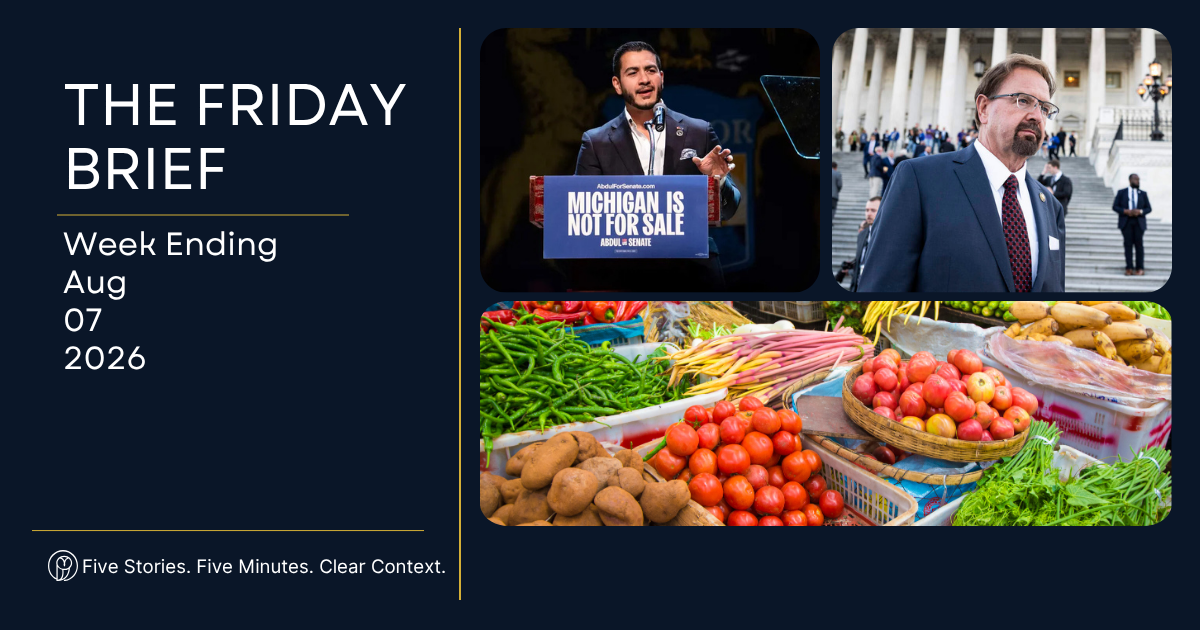
Friday Brief | August 1–7, 2026
This Week in the News: What Happened, Why It Matters & What the Noise Really Means
Some weeks, understanding the news requires more than knowing what happened. It requires understanding the words being used to describe it.
This week, a closely watched Senate primary reignited arguments over socialism, communism and Medicare for All. A fight over groundwater in New Mexico raised questions about federal and state power. Diplomats moved closer to an agreement involving one of the world’s most important shipping routes. And a congressional ethics investigation showed how Congress can discipline its own members.
Here are five stories worth understanding this week — without all the noise.
1. Abdul El-Sayed Wins Michigan’s Democratic Senate Primary
What Happened
Abdul El-Sayed won Michigan’s Democratic primary for U.S. Senate on August 4, defeating U.S. Rep. Haley Stevens in one of the most closely watched Democratic primaries of the year.
El-Sayed, a physician and former Detroit health director, ran as a progressive and supports policies including Medicare for All. The race also attracted tens of millions of dollars in outside political spending. He will face Republican Mike Rogers in November for the seat being vacated by retiring Sen. Gary Peters.
Why It Matters
The Michigan race was about more than choosing a Senate candidate. It became part of a larger debate inside the Democratic Party over what kinds of candidates and policies can win nationally — particularly on healthcare, corporate power and the role of government.
Republicans are already arguing that progressive candidates are too far left, and political rhetoric surrounding candidates like El-Sayed has included words such as socialist and communist.
Those words carry strong political meaning, but they do not mean the same thing. Understanding that distinction makes it easier to evaluate the actual policy debate rather than simply reacting to the label.
Civics Connection
The Constitution originally allowed state legislatures to choose U.S. senators. That changed with the 17th Amendment, ratified in 1913, which established the direct election of senators by voters.
Today, political parties generally use primary elections to determine which candidate will represent them in the general election. Michigan voters have now chosen El-Sayed as the Democratic nominee; voters will make the final choice between the major-party candidates in November.
Take Action
When you hear a political label applied to a candidate, go one step further: look for the actual policy being discussed. Nonpartisan voter guides such as Vote411 and Ballotpedia can help you compare candidates’ positions rather than relying only on campaign advertisements or social media descriptions.
2. Border Wall Construction Raises Groundwater Concerns in New Mexico
What Happened
U.S. Customs and Border Protection ordered contractors working on border wall construction in drought-stricken New Mexico to stop drilling new groundwater wells after ranchers and state officials raised concerns about the effect of pumping on already-limited water supplies.
Water from the wells has been used for construction needs including concrete production, road work and dust suppression. New Mexico officials have also raised questions about wells that were drilled without state permits.
Why It Matters
This is not simply an environmental story or an immigration story. It is also a dispute over what happens when a major federal project affects a natural resource that local residents and businesses depend on.
Ranchers in the region rely on groundwater for livestock, while the federal government argues that water is necessary to complete a national border-security project.
Both concerns can exist at the same time: the federal government has responsibilities involving border security, while communities have a legitimate interest in protecting limited water supplies.
Civics Connection
This is a real-world example of federalism — the division of power between the federal government and the states.
The federal government controls immigration and border enforcement, while states traditionally regulate many aspects of water use and environmental management. Conflicts occur when those responsibilities overlap.
The question is not simply, “Who is in charge?” It is often: Which level of government has authority over this particular part of the project?
Take Action
Water decisions are often made much closer to home than national political debates suggest. Check your state environmental agency, local water authority or county meeting agendas to see how groundwater use and conservation are managed where you live.
3. Iran and Oman Move Closer to a Strait of Hormuz Agreement
What Happened
Iran and Oman reported progress this week toward an agreement involving commercial shipping through the Strait of Hormuz, one of the world’s most important energy routes.
Negotiations are still underway, and significant disagreements remain over control of shipping lanes, possible fees and the conditions necessary to fully reopen the strait. In other words: there is progress, but there is not yet a final deal.
Why It Matters
A large share of the world’s petroleum trade normally moves through the Strait of Hormuz. When ships cannot move freely through the region, transportation costs, insurance costs and energy prices can rise.
That is how a diplomatic dispute thousands of miles away can eventually reach an American household through gasoline prices, transportation costs and the price of goods moved around the world.
It is also why negotiations over a relatively narrow stretch of water can become a major international economic story.
Civics Connection
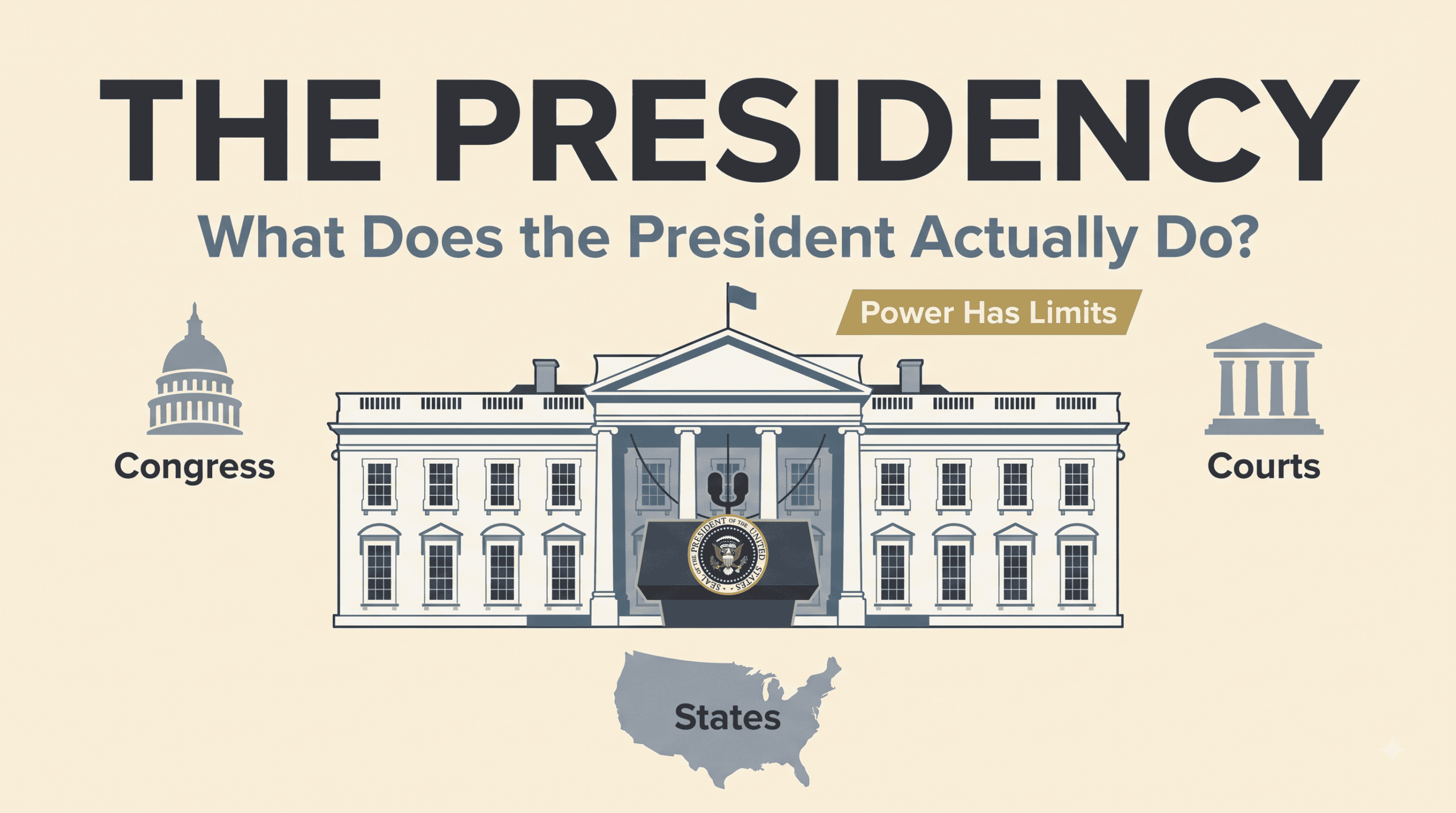
The executive branch plays the leading role in American foreign policy and diplomacy, but presidential authority is not unlimited.
Congress controls federal spending, regulates international commerce, oversees sanctions through federal law and has constitutional authority over declarations of war. Formal treaties negotiated by a president require approval from two-thirds of senators present before they can be ratified.
Foreign policy therefore frequently involves both presidential power and congressional authority.
Take Action
When a geopolitical crisis is blamed for changing gasoline or energy prices, check actual price and supply data from the U.S. Energy Information Administration. It can help separate measurable market changes from political claims about why prices are moving.
4. House Ethics Committee Recommends Censure of Rep. Chuck Edwards
What Happened
On August 3, the bipartisan House Committee on Ethics released a report recommending that Rep. Chuck Edwards, a Republican from North Carolina, be formally censured following an investigation into his conduct toward two female staff members.
The committee found substantial evidence of persistent inappropriate and unprofessional workplace behavior. Edwards has disputed the committee’s conclusions.
On August 5, Edwards announced that he would complete his current term but end his campaign for reelection.
Why It Matters
Congress writes laws that affect workplaces across the country, but Congress also has rules governing the conduct of its own members and offices.
The Ethics Committee is evenly divided between Republicans and Democrats, making its recommendation an example of bipartisan congressional oversight.
The investigation also has an immediate political consequence: Edwards’ decision not to seek reelection changes the race for North Carolina’s 11th Congressional District.
Civics Connection
Article I, Section 5 of the Constitution gives each chamber of Congress the authority to establish its own rules and discipline its members.
The House can impose several forms of discipline, including reprimand and censure. Expulsion is the most severe punishment and requires approval by two-thirds of the chamber.
The process here is important: investigation → committee findings → recommendation → possible action by the full House.
Take Action
Congressional ethics investigations do not have to remain something you only hear about through political commentary. The House Committee on Ethics publishes reports and other investigative materials for the public, while Congress.gov allows you to follow congressional proceedings and votes.
5. Story of Hope: National Farmers Market Week Celebrates Local Food
What Happened
Communities across the country are celebrating National Farmers Market Week from August 2–8, highlighting the thousands of farmers markets that connect consumers directly with farmers, ranchers and other local food producers.
Farmers markets can also participate in federal nutrition programs, including SNAP and programs serving seniors and families receiving WIC benefits.
Why It Matters
Farmers markets are small examples of how national policy and local communities can intersect.
Money spent at local markets can support farmers and small businesses, while nutrition programs can make fresh food more accessible to families who might otherwise struggle to afford it.
They also provide something that can be easy to overlook in national politics: a place where government programs, local businesses and neighbors can work together in a very practical way.
Civics Connection
Local zoning rules help determine where markets can operate. County agricultural extension programs support farmers and communities. Federal agriculture and nutrition programs determine how benefits such as SNAP and farmers market nutrition assistance can be used.
It is a reminder that public policy does not exist only in Washington. Sometimes you can see it operating at a folding table covered in tomatoes, peaches and sweet corn.
Take Action
Visit a farmers market in your community this weekend. The USDA maintains a national farmers market directory that can help you find markets and identify locations that participate in nutrition assistance programs.
☕ Almost Made It This Week
🌒 A Solar Eclipse Is Coming August 12
A total solar eclipse will cross Greenland, Iceland, northern Russia, Spain and a small portion of Portugal next Wednesday. Parts of the United States will see a partial eclipse — not totality.
NASA says viewers watching a partial eclipse must use proper solar-viewing protection. In New York City, for example, only about 9% of the Sun will be covered at the maximum point of the eclipse.
🏛️ Senate Leaders Reach Deal to Head Off a Fall Government Shutdown
Senate leaders reached a bipartisan agreement this week on short-term government funding designed to keep federal agencies operating beyond the September 30 end of the fiscal year and through December 11.
The agreement still has to move through the legislative process, but the timing is notable: lawmakers are trying to address the funding deadline before leaving Washington for the August recess instead of waiting until the final days before a possible shutdown.
Why watch it: A funding agreement can prevent a shutdown, but it does not complete the regular federal budget process. Congress will still have longer-term spending decisions waiting for it.
📺 Worth Watching
PBS NewsHour: Michigan’s Senate Primary and the Direction of the Democratic Party
PBS NewsHour examined the Michigan Senate primary before Election Day, focusing on the differences between Abdul El-Sayed and Haley Stevens and what the race could reveal about the direction Democratic voters want their party to take.
It is especially useful after this week’s result because it provides more context than a simple election-night headline.
One Last Thought
Political news is filled with labels: socialist, communist, conservative, progressive, radical, establishment, far-left and far-right.
Sometimes those descriptions are useful. Sometimes they are accurate. Sometimes they are exaggerated. And sometimes they are designed primarily to make us react before we understand what is actually being proposed.
That is why understanding the news means going one step beyond the headline.
What is the policy? What does the term actually mean? What are the arguments for and against it? And which part is fact versus political persuasion?
We do not have to agree on the answer.
But we should understand the question.
Sources & Further Reading
- Associated Press — Michigan Democratic Senate primary and Abdul El-Sayed
- Reuters — Progressive movement and 2026 Democratic primary results
- OECD — Health at a Glance 2025: Population Coverage for Healthcare
- Associated Press — New Mexico border wall groundwater drilling
- Associated Press — Iran-Oman negotiations over the Strait of Hormuz
- U.S. House Committee on Ethics — Report concerning Rep. Chuck Edwards
- Associated Press — Chuck Edwards ends reelection campaign
- USDA Food and Nutrition Administration — Farmers Market Programs
- NASA — August 12, 2026 Total Solar Eclipse
- Associated Press — Senate government funding agreement
- PBS NewsHour — Michigan Democratic Senate primary
No discussions yet
Be the first to join the discussion and share your thoughts with the community.