
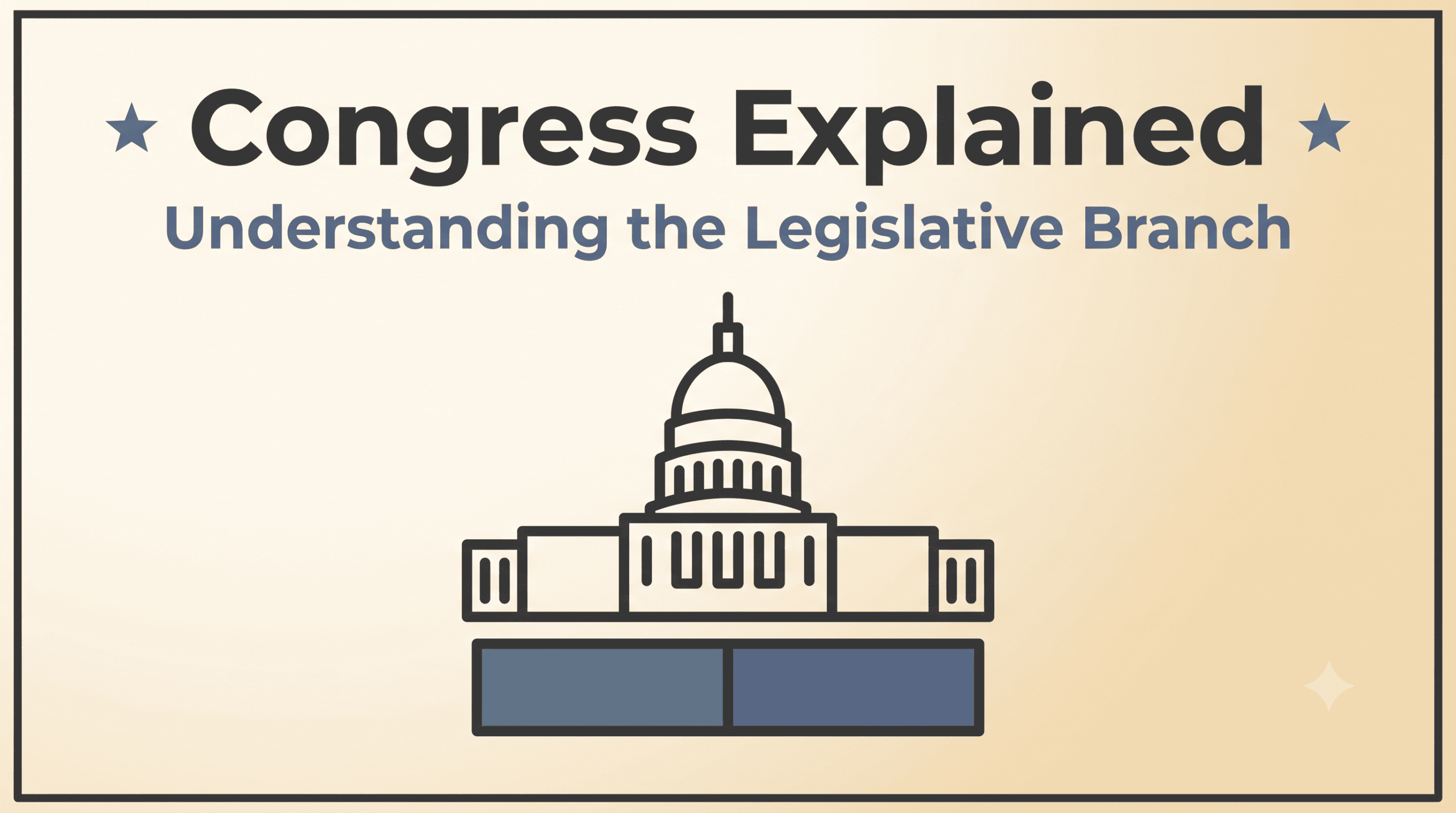
Civics 101: Who Makes America’s Laws and Why It Takes So Long
Opening
Have you ever heard stories about massive national problems — pothole-filled highways, skyrocketing healthcare costs, or infrastructure failures — and found yourself asking a simple question: “Why doesn’t Congress just fix this?”
It is a completely fair question. When we ask it, we usually treat “Congress” as if it were a single person sitting in an office, stubbornly refusing to sign a piece of paper to make things better.
But that is where the confusion starts. In reality, there is no single office and no single person holding the pen. Congress is a massive, complex machine made up of two distinct chambers, each with its own rules, leadership, and responsibilities. Understanding how these gears turn reveals why passing a seemingly simple law can take months, or even years.
🔑Key Takeaway
Unlike a monarchy where a single leader holds absolute power, Congress is not one person making decisions. It is a legislature of 535 elected lawmakers divided into two chambers, each with different responsibilities, rules, and incentives. Its primary jobs are to write federal laws, manage public spending, and keep watch over the executive branch.
Why Does Congress Exist?
The constitutional Framers had just escaped the rule of a king and deeply feared concentrating power in one person’s hands. They deliberately designed a legislative branch that would force debate and representation. If the public disagrees with the laws being made, they hold the power to vote the lawmakers out.
Establishing this system wasn’t a one-night decision:
|
Year |
Event |
Significance |
|
1776 |
Declaration of Independence |
The colonies broke free from British rule. |
|
1777–1787 |
Articles of Confederation |
America’s first attempt at government failed due to weak central rules. |
|
1787 |
Constitutional Convention |
Delegates met in Philadelphia to build a balanced federal system. |
|
1789 |
Article I Creates Congress |
The Constitution took effect, placing a two-chamber Congress at the forefront of government. |
Part I: The Two Chambers (The Great Compromise)
Imagine trying to get a group of 50 friends to agree on a single restaurant for dinner. It is almost impossible. Now imagine trying to do that with an entire country.
During the Constitutional Convention, a massive disagreement emerged over how states should be represented in the new government:
- Large States (like Virginia): Wanted representation based strictly on population, giving them more votes and more power.
- Small States (like New Jersey): Feared being entirely ignored by larger neighbors, demanding that every state get the exact same number of votes regardless of size.
To keep the country from fracturing before it even started, they agreed to the Great Compromise: splitting Congress into two separate bodies. Neither side got everything it wanted—which is exactly why the agreement worked.
Key Differences Between the House and Senate
|
Feature |
House of Representatives |
Senate |
|
Total Members |
435 representatives |
100 senators |
|
Representation Basis |
Based on population (larger state = more votes) |
Equal (every state gets exactly 2) |
|
Who They Speak For |
Local districts within their state |
Their entire state |
|
Term Length |
2 years (constantly running for reelection) |
6 years (staggered to offer stability) |
|
Unique Powers |
Starts tax bills, initiates the impeachment process |
Confirms judicial/cabinet appointments, ratifies treaties, holds impeachment trials |
Part II: The Lawmaking Machine
Many assume passing laws is Congress’s only responsibility, but their official job description covers a wide range of national oversight:
- Make Federal Laws: Translating ideas into national policy.
- Power of the Purse: Managing public expenses and funding federal agencies.
- Oversight & Investigations: Holding public hearings to hold corporations, the military, and executive agencies accountable.
The Strict Rulebook: Enumerated vs. Elastic Powers
Think of the Constitution as a strict rulebook for a Condominium Association — the committee can only do what the rulebook explicitly allows. For Congress, these are called enumerated powers (Article I, Section 8), which include collecting taxes, borrowing money, managing trade, and running the military.
But how does a document written in the 1700s handle modern issues like the internet, smartphones, or aviation? Congress relies on the Necessary and Proper Clause (or the Elastic Clause). This allows them to stretch their powers to pass laws on modern issues, provided the laws tie back to their core constitutional responsibilities.
📜 How a Bill Moves Through Congress
A bill cannot become law overnight. It must survive a legislative obstacle course involving committees, debates, two separate chambers, and the President.
Introduction
A member of the House or Senate formally introduces a proposed bill.
Committee Review
A specialized committee studies the proposal, holds hearings, debates its details, and may rewrite it.
Floor Debate and Vote
The full House or Senate debates and votes.
Cross-Over
The bill repeats the committee and floor process in the other chamber.
Resolve the Differences
If the House and Senate pass different versions, lawmakers negotiate until both chambers approve the same final text.
Presidential Action
The President may sign the bill into law or veto it and return it to Congress.
ـــــــــﮩ٨ـ Where Bills Go to Die
Because 535 members cannot realistically read and debate all 10,000-plus bills introduced every year, Congress divides the work among smaller groups called standing committees. These committees focus on areas such as Agriculture, Finance, or Foreign Affairs, hold hearings, and edit bills line by line. The Hard Truth: Most bills never make it out of committee. Some lack support, some never receive a hearing, and others are replaced by broader legislation. A committee chair can also refuse to schedule a bill, effectively ending its chances.
📢 Patterns to Notice
Passing one chamber is not the same as passing Congress. The House and Senate must approve the same final text before a bill can reach the President. That is why headlines saying "The House passed a bill" describe an important milestone—but not the end of the legislative process.
Part III: Why Does It Take So Long?
It can be incredibly frustrating to watch, but Congress was intentionally designed to be slow.
🏠 The Apartment Analogy
Imagine living in an apartment complex, and one morning a few neighbors decide that everyone must paint their front doors bright orange within 48 hours. If it only took a quick, emotional vote to pass that rule, you would be stuck painting your door whether it made sense or not.
At the national level, the system builds in structural speed bumps to force politicians to calm down, debate, gather facts, and find compromise before creating rules that affect millions of lives.
Built-In Legislative Speed Bumps
- The Two-Chamber Gridlock: A bill must pass both the House and the Senate in the exact same format before going to the President. Even if one chamber passes a bill unanimously, the other chamber is free to reject, rewrite, or ignore it entirely.
- The Senate Filibuster: Most legislation can pass with a simple majority once it reaches a final vote. However, senators can prolong debate, and ending a filibuster generally requires 60 votes. As a result, controversial bills often need broader support before the Senate can vote on them.
- The Veto Threat: If a President vetoes a bill, Congress must secure a heavy 2/3 majority vote in both chambers to override it and pass the law anyway.
Efficiency vs. Deliberation: The Core Debate
Public frustration with Congress usually splits into two distinct perspectives:
- 🔵 The Need for Speed: When an economic crisis or natural disaster hits, people want swift, decisive action. Watching politicians argue over minor details while people suffer can feel like organizational failure.
- 🔴 The Need for Caution: Opponents of fast lawmaking point out that rushing a massive bill through in 48 hours often leads to unintended consequences, poorly drafted rules, and legal loopholes. They view slowness as a critical safety feature that protects the country from erratic policy shifts.
🏛️ Why Congress Feels Different Today
When citizens watch Washington today, it is easy to feel like the entire legislative branch is collapsing. Headlines constantly declare that the system is “broken.” However, political scientists draw a crucial distinction that often gets missed in the noise: Some of this frustration is constitutional friction, and some of it is modern political dysfunction.
- Constitutional Friction (The Intentional Design)
As we explored above, the Framers deliberately made it difficult to pass laws. They required two completely different chambers to agree, gave the President a veto, and set a high bar for overrides.
The system was designed so that major changes require broad agreement. When the country is deeply divided on an issue, the system slows to a crawl — not necessarily because lawmakers are incompetent, but because the constitutional brakes are forcing compromise before a big rule applies to everyone.
- Modern Dysfunction (The Accidental Glitches)
While the Framers wanted a slow Congress, they did not intend to design a paralyzed Congress. Modern political incentives have introduced new forms of dysfunction that are not found in the Constitution:
- The Primary Election Trap: Due to partisan gerrymandering, the vast majority of congressional seats are completely “safe” for one party. This means the real election happens in the low-turnout party primary, which is heavily dominated by the most ideologically extreme voters. Lawmakers are often terrified of compromising with the other side because they fear being replaced by a more radical candidate in their next primary.
- The Brain-Drain & Shrinking Staff: Over the last few decades, Congress has systematically cut its own internal funding. Committees have fewer nonpartisan policy experts and researchers than they did in the 1980s, despite the United States population growing by over 100 million people. Without independent expertise, Congress struggles to draft highly complex modern laws, leaving them heavily reliant on outside special interest groups and backroom political deals.
- Party Leadership Control: Power has become highly centralized in the hands of top leadership (like the Speaker of the House). Orderly committee steps have occasionally devolved into top-down demands, where rank-and-file members may be asked to vote on massive omnibus spending bills—sometimes thousands of pages long—with less than 48 hours’ notice to avoid a government shutdown.
A Historic Pattern, Not a New Problem
While modern polarization is intense, deep gridlock is a repeating cycle in American history. Congress looked severely broken during Reconstruction, the New Deal debates of the 1930s, and the civil rights era of the 1960s.
Why That Gives Hope
Periods of intense disagreement are not new in American history. The nation has experienced constitutional crises, economic depressions, wars, and fierce debates over civil rights. Each era looked different, and none were resolved quickly.
What history shows is that institutions can weaken, adapt, and reform over time. Elections change leadership. Congress rewrites laws. Courts revisit earlier decisions. Citizens organize, vote, advocate, and shape future policy.
Understanding how Congress works doesn’t guarantee agreement about what it should do—but it gives citizens the tools to recognize problems, evaluate proposed solutions, and participate in improving the system.
⚖️ The Difference Constitutional Friction forces opposing sides to sit at the table and talk until they reach a compromise. Modern Dysfunction creates a system where lawmakers are rewarded by their political base for walking away from the table entirely.
🏀 An Everyday Analogy: Changing the Rules of the Game
To understand the difference between constitutional friction and modern political dysfunction, think of a game of basketball where the basic layout has been altered over time.
If you suddenly shrink the court, move the three-point line, and lay off half of the referees, the players are naturally going to play a much more aggressive, disorganized, and messy game. The players aren’t a “different species of human” than the athletes of the past — but the incentives of the game have completely changed.
- Constitutional Friction is the rulebook itself. It requires players from opposing teams to sit at the table, look each other in the eye, and negotiate until they hammer out a compromise to pass a sustainable law.
- Modern Dysfunction is an accidental glitch in the rules. It creates a closed environment where lawmakers are actively rewarded by partisan primary maps and media channels for walking away from the table entirely, fundraising off the drama, and blocking the other side.
The Constitution didn’t create these incentives. Over time, elections, political parties, media, campaign financing, and institutional practices have reshaped how Congress operates within the same constitutional framework.
Part IV: Navigating the News
When the legislative branch dominates the nightly news, rumors and misconceptions travel fast. Understanding the structural boundaries of Congress helps clear up the noise.
|
If You Hear This or if Someone Asks… |
Consider Explaining… |
Why It Matters |
|
“Congress is completely broken because they only pass a tiny fraction of bills.” |
Out of thousands of bills introduced every year, only about 1% to 4% ever become official law. Most die quietly in committees because they were either poorly drafted, lacked bipartisan support, or were introduced purely for political show. |
A low passage rate doesn’t mean the system is failing; it means the built-in quality filters and committee screenings are doing exactly what they were designed to do. |
|
“Why can’t Congress just pass a law to completely take over local election rules?” |
Congress cannot simply take over every state and local election. However, the Constitution gives Congress authority to regulate many aspects of federal elections, while states retain substantial responsibility for administering elections and setting rules for state and local contests. |
Congress is not an all-powerful entity; they are strictly bound to the “enumerated powers” listed in Article I of the Constitution. In essence, election authority is shared. The exact balance depends on whether the rule concerns federal, state, or local elections and whether constitutional voting protections are involved. |
|
“The House passed a bill, so why hasn’t the law changed yet?” |
Passing a bill in the House of Representatives is only the halfway mark. It must cross over to the Senate, survive their committee process, clear the 60-vote filibuster hurdle, and be signed by the President before a single rule changes. |
Media headlines often shout that a bill has “passed,” when it has actually only cleared one chamber’s internal hurdle. |
Final Takeaway
The shouting and arguing we see on TV or YouTube can feel like pure political drama. But that tension is a feature, not a bug. Congress was designed to slow change just enough to force debate, compromise, and public accountability before national laws affect every American.
It forces opposing sides to sit at the table, voice the concerns of their local communities, and hammer out compromises before creating massive national laws that impact your wallet, your school, and your daily life.
This article is part of VoteView’s Civics 101 Series — evergreen educational content designed to help you understand how government actually works.
Related Articles (Coming Soon):
- The Filibuster Explained: Why the Senate Requires 60 Votes
- Committees 101: Where the Real Power Lies in Washington
Reference & Discussion
📚 Key Terms Glossary
Bicameral: A legislature made up of two distinct chambers or houses (the House of Representatives and the Senate).
The Great Compromise: The 1787 constitutional agreement that created a dual-system of representation, balancing the needs of large and small states.
Enumerated Powers: The specific list of responsibilities explicitly granted to Congress by the Constitution.
Elastic Clause: A constitutional provision allowing Congress to pass laws deemed “necessary and proper” to execute its enumerated responsibilities, helping the law adapt to modern times.
Filibuster: A procedural tactic used in the Senate to prolong debate and delay or prevent a vote on a bill.
Standing Committee: A permanent, specialized legislative panel that reviews, edits, and investigates bills within a specific policy area.
No discussions yet
Be the first to join the discussion and share your thoughts with the community.