
Who Gets to Help Choose a Political Party’s Candidates?
Module: Elections & Voting
Level: Beginner / Intermediate
Companion article: Primaries vs. General Elections Explained
Estimated read time: 8–10 minutes
Who Gets to Choose a Party’s Candidate?
Imagine two voters.
One is a registered Democrat. The other is an independent. Both want to vote in the Democratic primary.
Depending on where they live, both may be able to participate — or only one of them may be allowed to cast a ballot.
Why? Because the United States does not have one national system for primary elections. Some states use closed primaries, others use open primaries, and still others use systems that fall somewhere in between.
Part I — First, What Is a Primary?
A quick refresher for anyone who hasn’t read our companion piece:
- Primary election: generally determines which candidates advance or become party nominees.
- General election: determines who wins the office.
That’s it. Primaries narrow the field; general elections choose the winner. For the full explanation — including why primaries exist, how different types work, and why they sometimes matter more than the general election — see Primaries vs. General Elections Explained.
Now let’s focus on the question this article tackles: who gets to participate in that first round?
Part II — What Is a Closed Primary?
In a closed primary, voters generally must be registered with a political party to participate in that party’s primary. Registered Republicans vote in the Republican primary; registered Democrats vote in the Democratic primary. Unaffiliated voters generally cannot participate in either.
Why Use a Closed Primary?
The underlying argument is straightforward: political parties should be able to choose their own nominees. A party is a voluntary organization; its members — not outsiders — should decide who carries the party banner.
Supporters argue closed primaries:
- Protect political parties’ ability to select their candidates.
- Prevent members of opposing parties from influencing nominations. Without a registration requirement, rival voters could cross over to select a weaker opponent for the general election.
- Encourage party membership. If you want a say in who the party nominates, join the party.
- Ensure nominees reflect the preferences of party voters.
The Criticism
The main critique is that closed primaries exclude independent and unaffiliated voters — a rapidly growing segment of the electorate. In some states, voters who don’t formally register with a party have no voice at all in narrowing the field of candidates who will appear on their November ballot. Critics argue that when the primary is effectively the decisive election (more on that below), shutting out a large portion of the electorate raises real questions about democratic representation.
Part III — What Is an Open Primary?
In an open primary, voters generally don’t have to be formally registered with a party in advance to participate in its primary. Typically, a voter chooses one party’s primary — not both.
The competing principle: more voters should have an opportunity to participate in choosing candidates who may eventually represent everyone.
Why Use an Open Primary?
Supporters argue open primaries:
- Allow independents greater participation. The growing number of voters who don’t identify with either major party shouldn’t be locked out of candidate selection.
- Give more voters a voice. Broader participation may produce nominees who reflect a wider range of perspectives.
- Recognize that the eventual winner represents everyone. An officeholder governs all constituents, not just party members.
The Criticism
Critics argue open primaries:
- Dilute party members’ ability to choose their own representatives. If anyone can vote in a party’s primary, the party’s distinct identity may be undermined.
- Enable strategic “raiding.” Voters affiliated with Party A could cross over to vote in Party B’s primary, intentionally selecting a weaker candidate.
- Reduce party accountability. Members may feel less invested in candidates chosen with significant non-member input.
It’s worth noting that while strategic raiding is a persistent theoretical concern, evidence about how often it actually happens — and whether it changes outcomes — is limited and contested.
Part IV — What About Independent Voters?
Remember the two voters from the opening — the registered Democrat and the independent? Here’s where their stories diverge.
An unaffiliated voter — someone not registered with any political party — faces very different realities depending on where they live:
| Primary System | Can an Independent Participate? |
|---|---|
| Closed | Generally no |
| Semi-Closed | Yes — may choose one party’s primary |
| Open | Yes — may choose which party’s primary to participate in |
| Top-Two / Top-Four | Yes — all voters participate on the same ballot |
Why This Matters
The number of voters who identify as independent or unaffiliated has grown significantly in recent decades. In many states, independents now make up a substantial share — sometimes a plurality — of registered voters.
That growth has pushed the question of independent participation from a niche procedural debate into a central issue in election reform. When millions of voters are excluded from the first stage of candidate selection, that raises a fundamental question about whose voices shape the choices on the November ballot.
Part V — It’s Not Actually Just Open vs. Closed
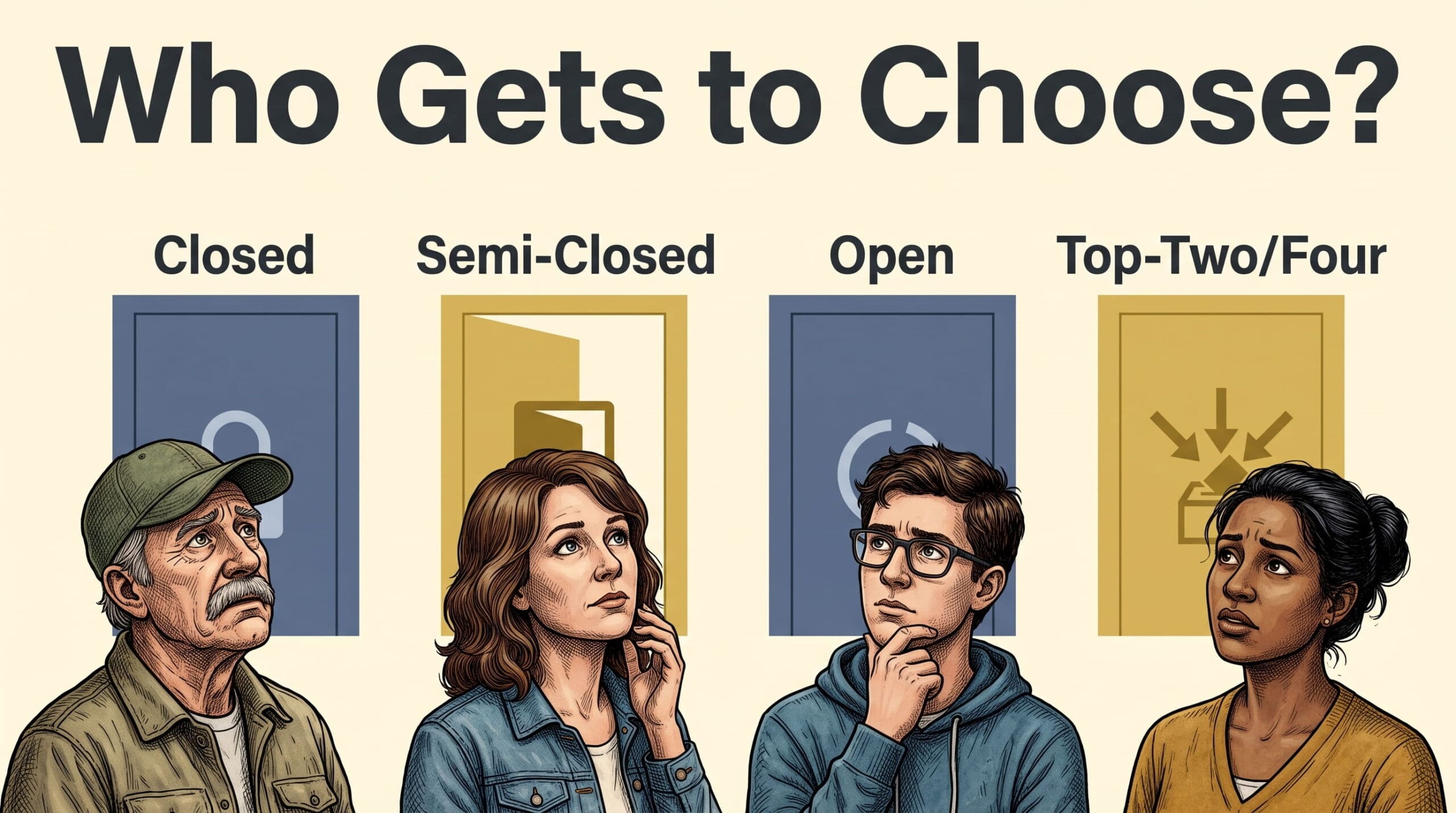
“Open” and “closed” make the system sound binary. It isn’t. There’s a spectrum:
Closed
Registered party members
Semi-Closed
Party members + unaffiliated voters
Open
Voters choose one party’s primary
Top-Two / Top-Four
All candidates share one ballot
Participation generally widens as you move across the spectrum. Exact rules vary by state.
As you move along that spectrum, participation progressively widens — from only registered party members, to party members plus independents, to any voter who chooses a party’s primary, to all candidates competing on a single ballot regardless of party.
Top-Two / Top-Four — All candidates appear on a common primary ballot regardless of party. The top finishers advance to the general election — in a top-two system, the two highest vote-getters; in a top-four system, four advance, often paired with ranked-choice voting in November. These systems reframe the question entirely: instead of asking which party’s nominee you prefer, they ask which candidates should advance to the final round.
Part VI — Why Does This Matter So Much?
Here’s where this article stops being about election terminology and starts being about power.
Sometimes the Primary Is the Most Competitive Election
Remember this concept from Primaries vs. General Elections: in a district that heavily favors one party, the general election may be a foregone conclusion. The dominant party’s nominee will almost certainly win in November.
That means the primary is where the real competition happens. It’s where the eventual officeholder is effectively chosen.
Now ask the critical question:
Who was allowed to participate in choosing that candidate?
If the primary is closed, the answer is: only registered members of the dominant party. If the primary is open, the answer includes independents and anyone else who chooses to participate.
In a district where, say, 70% of voters typically support Party A and 30% support Party B:
A District That Strongly Favors One Party
Imagine a district where voters typically divide this way:
- Under a closed primary, only registered Party A members choose the candidate who will almost certainly represent the entire district — including the 30% who support Party B and any independents who live there.
- Under an open primary, a broader swath of the district’s voters has a chance to weigh in on who that candidate will be.
This doesn’t make one system obviously right and the other obviously wrong. But it does make the choice between open and closed primaries far more consequential than a simple rule about who gets a ballot.
When the primary is effectively the decisive contest, the rules governing primary participation can determine which voters have the greatest influence over who ultimately holds office.
Part VII — Do Open Primaries Produce More Moderate Candidates?
There’s a popular argument that goes something like this:
Open primaries bring in independents and moderates, so candidates have to appeal beyond their party’s base. Therefore, open primaries produce more moderate candidates.
It’s a compelling theory. The evidence is more complicated.
What the Argument Gets Right
It’s true that closed primaries tend to have smaller, more ideologically committed electorates. Primary voters in closed-primary states are, on average, more partisan than the general electorate. Opening the primary to independents could, in theory, broaden the pool of voters and change the incentives candidates face.
Why the Evidence Is Mixed
Whether open primaries actually produce more moderate candidates depends on a host of other factors:
- District partisanship — In a heavily Republican district, the Republican primary is likely to attract conservative voters regardless of whether it’s open or closed.
- Who actually turns out — An open primary allows independents to participate, but it doesn’t guarantee they will.
- Campaign funding — Incumbents and well-funded candidates have advantages that can outweigh the effects of primary rules.
- Incumbency — Sitting legislators rarely lose primaries, regardless of the system.
- National political environment — A wave election year can override local primary dynamics.
- Candidate recruitment — Whether moderate candidates even choose to run is influenced by party infrastructure, donor networks, and perceived viability — factors largely independent of primary rules.
Part VIII — The Debate: Who Should Get to Choose?
Here’s the heart of the article. Both sides are arguing in good faith about a genuine democratic question.
| Arguments for Closed Primaries | Arguments for Open Primaries |
|---|---|
| Parties should choose their own nominees | More voters should participate |
| Protects party association and identity | Gives independents a voice |
| Reduces outside interference | Nominees ultimately represent everyone |
| Strengthens party membership | May broaden the electorate |
Is a primary primarily an internal party decision — or part of the broader democratic election process?
If you believe a political party is fundamentally a private, voluntary organization — like a club or an advocacy group — then it makes sense that the party’s members should decide who represents it. The party exists to advance a particular platform, and its members are the people who signed up for that mission. Outsiders don’t get to choose the Rotary Club’s president or the Sierra Club’s endorsed candidates.
If you believe that primary elections are fundamentally a public process — funded by taxpayers, administered by election officials, and producing candidates who will wield public power over everyone — then limiting participation to party members looks like an exclusion from a democratic process, not a protection of private associational rights.
Both of these perspectives have merit. The tension between them is what drives the ongoing debate over primary reform.
Part IX — What’s Happening Now?
Primary systems are not frozen in place. States continue to experiment, and the debate over who should participate is active across the country.
States Are Testing Different Answers
Here are a few examples of how states have taken different approaches:
- California and Washington use top-two primaries, where all candidates appear on the same ballot regardless of party and the two highest vote-getters advance to November.
- Alaska adopted a top-four primary paired with ranked-choice voting in the general election — a newer approach that expands the field voters consider in November.
- Florida and New York use closed primaries, where only registered party members can participate in that party’s primary.
- Colorado and North Carolina use semi-closed systems, where unaffiliated voters can choose a party’s primary ballot.
Other developments include ranked-choice voting being adopted or considered in additional jurisdictions, ballot initiatives in some states allowing citizens to put primary-system changes directly before voters, and court cases challenging or defending various primary rules on constitutional grounds.
Note: Ballot initiatives, and current litigation may change the list above. FO
The Bigger Picture
There isn’t a national consensus about the best primary system. Different states are effectively testing different answers to the same question:
How should voters choose the candidates who appear in general elections?
And because election administration is decentralized — a feature of American federalism — states can learn from each other’s experiences.
Part X — Blueprint for Hope: Democracy Can Experiment
States Can Try Different Approaches
America’s decentralized election system allows states to serve as laboratories of democracy. One state’s experiment with a new primary system provides lessons for every other state watching.
Citizens Can Evaluate the Results
Do different systems increase participation? Produce more competitive races? Increase voter satisfaction? Change candidate behavior? These are answerable questions — and the answers can inform future reforms.
Rules Aren’t Permanent
Primary systems can — and do — change through state laws, party rules, ballot measures where available, and court decisions. What your state does today isn’t what it has to do forever.
Understanding Starts With Knowing the Rules
People who understand their state’s primary system are better equipped to participate in it — and to advocate for changes if they believe the current system isn’t working.
There may not be one perfect primary system. The democratic opportunity lies in being able to evaluate different systems, debate their tradeoffs, and change them through established processes.
📰 Navigating the News
So the Next Time You Hear…
“Independents can’t vote in the primary.”
Don’t assume that’s true everywhere. Ask:
- Which state? Primary rules vary enormously.
- Which party? Party rules can sometimes matter in addition to state law.
- Is the voter actually independent or simply unaffiliated? Those terms can have different legal meanings depending on the state — some states register voters as “independent” as if it were a party, while others simply leave party affiliation blank.
- What type of primary is being used? Open? Closed? Semi-closed? Top-two? The answer determines everything.
Common Misconceptions
❌ “Every state uses either a completely open or completely closed primary.”
✔ There are several variations — semi-closed, semi-open, top-two, top-four, and others. The open/closed binary oversimplifies a much more varied landscape.
❌ “Open primaries mean you can vote in both parties’ primaries.”
✔ Generally, voters still participate in only one party’s nomination process for a given election.
❌ “Independents can never vote in primaries.”
✔ It depends entirely on the state’s system. In open and semi-closed states, independents often can participate.
❌ “Closed primaries are required by political parties.”
✔ Primary rules can be shaped by state election law, political party rules, and constitutional limits. The balance varies by state and by the type of primary.
❌ “Open primaries automatically elect moderates.”
✔ The evidence is considerably more complicated. Primary rules are one factor among many that shape who wins nominations.
🎯 Final Takeaway
Open and closed primaries represent different answers to the same democratic question: who should have a voice in choosing a political party’s candidates? Closed systems emphasize the rights and role of political parties and their members, while open systems emphasize broader voter participation. Neither system eliminates political tradeoffs, and because election rules vary by state, understanding how your own primary works is an important part of understanding how American elections work.
Frequently Asked Questions
What is an open primary?
A primary in which voters don’t need to be registered with a party in advance to participate. Voters typically choose one party’s primary ballot at the polling place.
What is a closed primary?
A primary in which only voters registered with the specific party holding the primary can participate. Unaffiliated voters generally cannot take part.
Can independents vote in primaries?
It depends on the state. In open and semi-closed primary states, often yes. In closed primary states, generally no.
Can I vote in both parties’ primaries?
In virtually all systems, no. Even in open primaries, voters participate in only one party’s primary for a given election.
Do I have to register with a party?
In closed-primary states, generally yes if you want to participate in a party’s primary. Other systems may allow unaffiliated voters to participate without formally joining a party.
Can I change my party registration before a primary?
Yes, in most states — but deadlines vary. Some states require registration changes weeks or months before the primary; others allow same-day changes. Check your state’s rules.
What is a semi-closed primary?
A system in which registered party members can only vote in their own party’s primary, but unaffiliated voters may choose which party’s primary to participate in.
What is a top-two primary?
A system in which all candidates — regardless of party — appear on the same primary ballot, and the two highest vote-getters advance to the general election.
Who determines primary rules?
Primary rules can be shaped by state election law, political party rules, and constitutional limits. The balance varies by state and by the type of primary.
Does every state hold primaries?
Most do, but a small number of states use caucuses for some or all nominating contests. The trend has been away from caucuses and toward primaries.
Glossary
Primary Election — An election in which voters select which candidates will represent a political party or advance to the general election.
Open Primary — A primary in which voters do not need to be registered with a party in advance to participate.
Closed Primary — A primary restricted to voters registered with the specific party holding the primary.
Semi-Closed Primary — A primary in which registered party members vote in their own party’s contest, but unaffiliated voters may choose which party’s primary to participate in.
Unaffiliated Voter — A voter not registered with any political party. Sometimes called “independent,” though the term “independent” can carry different meanings in different states.
Political Party — An organized group that seeks to elect candidates to public office under a shared platform or set of principles.
Nominee — The candidate selected by a party to represent it in the general election.
Top-Two Primary — A primary in which all candidates appear on the same ballot regardless of party, and the two highest vote-getters advance to the general election.
Top-Four Primary — A variation in which the top four candidates advance, often paired with ranked-choice voting in the general election.
Ranked-Choice Voting — An electoral system in which voters rank candidates by preference rather than selecting only one. Used in some jurisdictions for primaries and/or general elections.
Keep Learning
| Article | What It Covers |
| Primaries vs. General Elections Explained | What each one does and why the difference matters. — Start here for the foundational overview. |
| Presidential Primaries & Caucuses Explained (coming soon) | Why your presidential primary vote is really about delegates. |
| Why Do So Few People Vote in Primaries? (coming soon) | The lower-turnout election that can sometimes matter more. |
| Do Primaries Contribute to Political Polarization? (coming soon) | What the evidence says — and what it doesn’t. |


No discussions yet
Be the first to join the discussion and share your thoughts with the community.