
Three Branches of Government: How Power Is Divided in America
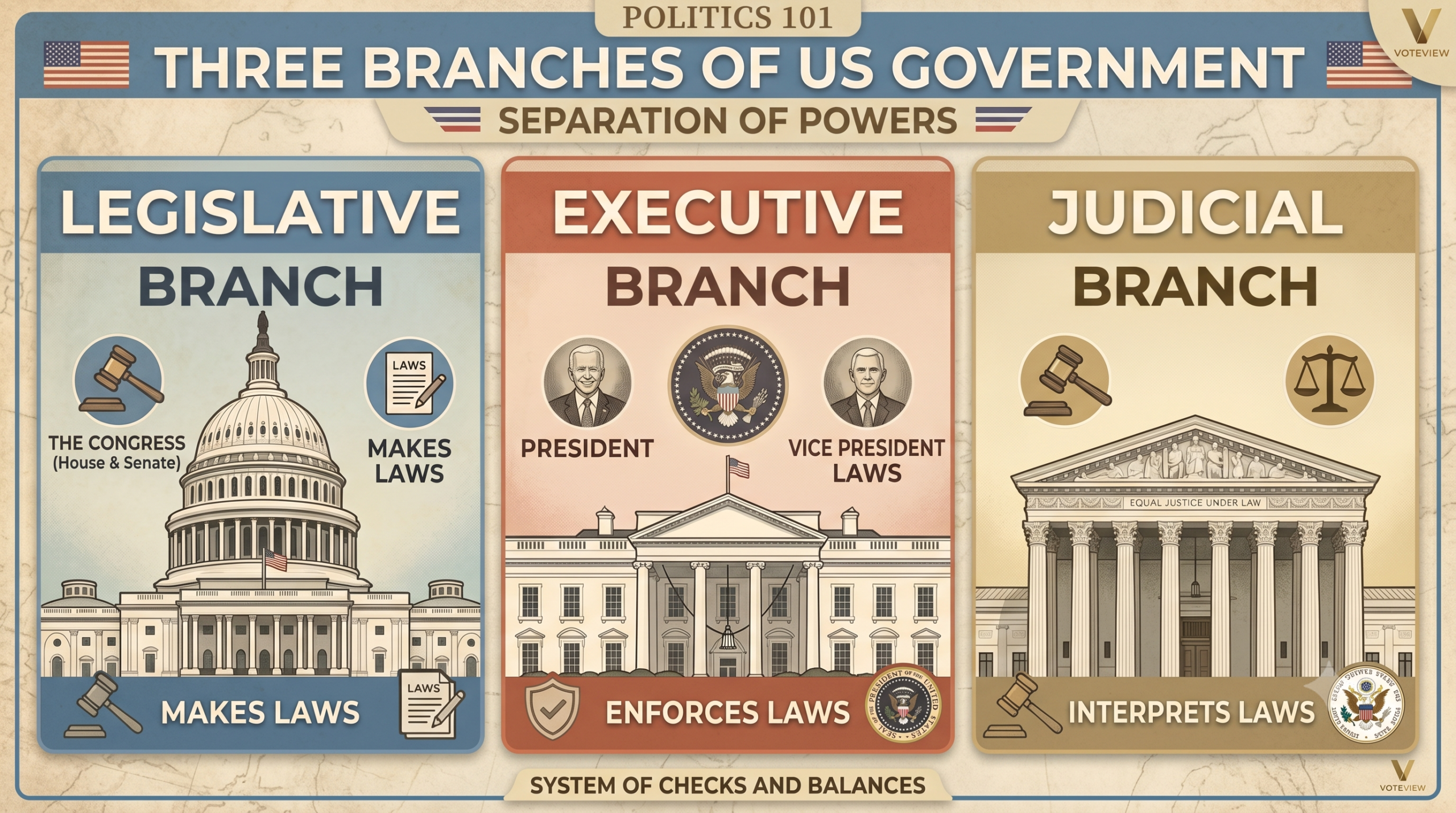
One of the most important ideas in the United States government is that no single person, group, or branch should have total power. That is why the Constitution divides the federal government into three branches: the legislative branch, the executive branch, and the judicial branch.
Understanding the three branches of government helps explain how laws are made, how power is checked, and why political disagreements often happen even when everyone is working within the same system.
The three branches of government were designed to share power, limit abuse, and force different parts of government to work together.
The Three Branches of Government at a Glance
1. Legislative Branch
Main job: Makes laws.
The legislative branch is Congress. Congress is made up of two parts: the House of Representatives and the Senate.
2. Executive Branch
Main job: Carries out laws.
The executive branch includes the president, vice president, cabinet departments, and federal agencies.
3. Judicial Branch
Main job: Interprets laws.
The judicial branch includes the Supreme Court and the federal court system. Courts decide whether laws and government actions follow the Constitution.
Why the Founders Divided Power
The framers of the Constitution were concerned about concentrated power. They did not want a king, a president, Congress, or the courts to control the entire government alone.
Instead, they created a system where each branch has its own responsibilities, but each branch can also limit the power of the others. This is called checks and balances.
Checks and Balances: How the Branches Limit Each Other
| Branch | Power | Example of a Check |
|---|---|---|
| Legislative | Passes laws | Can override a presidential veto with enough votes |
| Executive | Enforces laws | President can veto bills passed by Congress |
| Judicial | Reviews laws | Courts can rule laws or actions unconstitutional |
Where Congress Fits In: The Great Compromise
When the Constitution was written in 1787, one major debate was representation. Should states with larger populations have more power, or should every state have equal power?
The solution became known as the Great Compromise. It created a two-part Congress: the House of Representatives and the Senate.
The House of Representatives
Representation is based on population.
States with more people get more representatives. This gives larger states more influence in the House.
Example: New York has far more representatives than a smaller state like North Dakota because New York has a much larger population.
The Senate
Every state gets two senators.
Population does not matter in the Senate. California, New York, North Dakota, and Wyoming each get two senators.
This gives smaller states equal power in one chamber of Congress.
Why People Disagree About Representation
The Great Compromise helped bring the states together, but it still creates debate today. Some people believe the system protects smaller states from being ignored. Others argue that it gives voters in smaller states more influence than voters in larger states.
The Modern Representation Gap
The House is designed to reflect population differences. The Senate is not. That means a state with hundreds of thousands of people receives the same number of senators as a state with tens of millions of people.
| State | Estimated Population | House Seats | Senate Seats |
|---|---|---|---|
| California | About 39 million | 52 | 2 |
| New York | About 19.5 million | 26 | 2 |
| North Dakota | About 780,000 | 1 | 2 |
| Wyoming | About 580,000 | 1 | 2 |
In the House, population matters. In the Senate, state equality matters. That difference affects which bills pass, which judges are confirmed, and how national power is shared.
Why This Matters in Everyday Life
The three branches of government are not just a civics lesson. They affect real life in ways people experience every day.
- Healthcare: Congress may pass healthcare laws, the president’s agencies may enforce them, and courts may decide whether parts of those laws are constitutional.
- Taxes: Congress writes tax laws, the executive branch administers them, and courts settle legal disputes.
- Education: Congress can fund programs, federal agencies can create rules, and courts can decide whether policies violate rights.
- Immigration: Congress creates immigration law, the executive branch enforces it, and courts review whether enforcement follows the Constitution.
- Civil rights: Courts often play a major role in deciding whether government actions protect or violate constitutional rights.
Why People Disagree Politically
Many political disagreements come down to how people think power should be used.
Some people want the federal government to act quickly and strongly on national problems. Others worry that too much federal power can ignore local needs or individual freedom.
The three branches of government slow the process down on purpose. That can be frustrating, especially during a crisis. But the system was designed that way to prevent one person or one branch from having unchecked control.
Common Questions About the Three Branches of Government
Which branch is the most powerful?
No branch is supposed to be the most powerful. Each branch has different powers, and each branch can check the others.
Why does Congress have two chambers?
Congress has two chambers because of the Great Compromise. The House represents people based on population, while the Senate gives every state equal representation.
Can the president make laws?
The president cannot make laws alone. Congress passes laws. The president can sign or veto them, and the executive branch carries them out.
Why do courts have so much power?
Courts have the power to interpret the Constitution. That means they can decide whether laws or government actions are allowed under the Constitution.
Bottom Line
The three branches of government were created to divide power, protect against abuse, and make sure major decisions go through more than one part of government.
The system can feel slow and frustrating, but that is part of its design. The real debate is whether the balance still works fairly today, especially when population, representation, and political power do not always line up neatly.

No discussions yet
Be the first to join the discussion and share your thoughts with the community.