
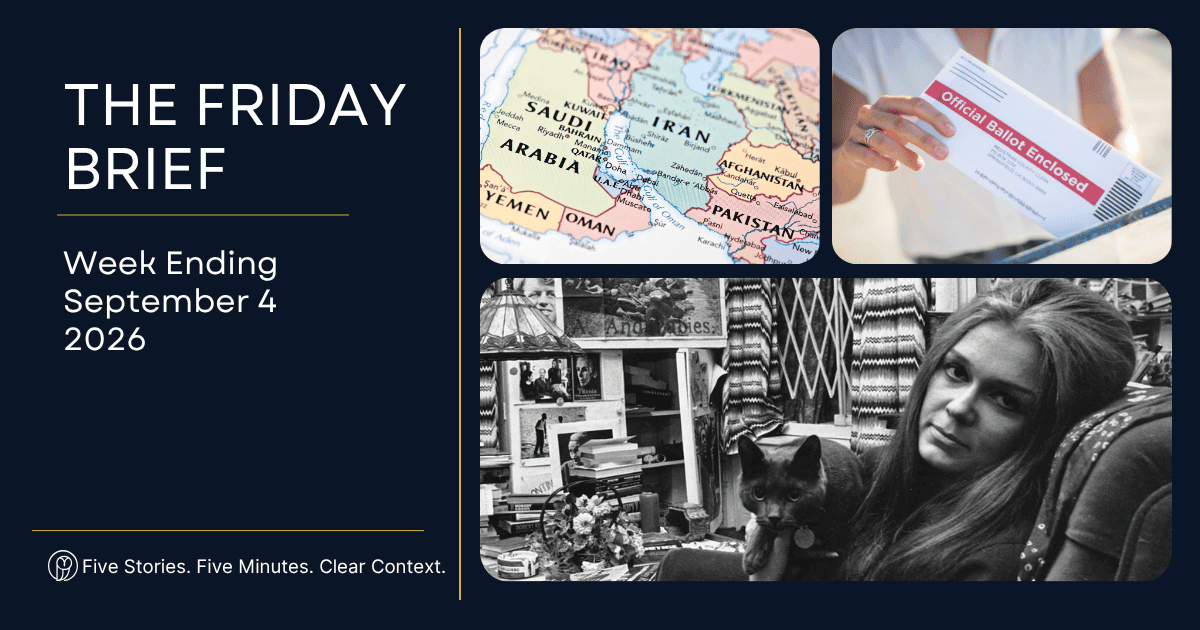
Friday Brief | August 29-September 4
War in the Middle East. More than 1,000 lives lost in a catastrophic disaster in Nepal. A Supreme Court fight over how Americans vote. Dangerous flooding in Texas. And the death of a woman who spent more than six decades fighting to change American society.
Some of this week’s news can feel overwhelming.
It can also leave us wondering what any one person can possibly do about problems this large.
But look a little closer, and another story emerges.
Governments make decisions. Courts determine the limits of those decisions. Communities prepare for disasters. Citizens organize, vote, speak, donate, protest, plant trees, build institutions and sometimes spend decades pushing society to change.
We may not control everything happening around us.
Here are five stories worth understanding this week.
1. U.S.–Iran Conflict Escalates as Fight Over the Strait of Hormuz Continues
The News
Fighting between the United States and Iran intensified again this week after a month-long lull.
U.S. forces initially struck Iranian rocket launchers near the Strait of Hormuz, saying Iran planned to use them to launch mines into the critical shipping route. The United States later carried out additional strikes against Iranian military targets, while Iran retaliated with missiles and drones aimed at U.S. forces and American allies across the region.
The conflict has since widened. Kuwait, Bahrain and Jordan have reported intercepting Iranian attacks, while the United States continues military operations against Iran.
Why It Matters
The Strait of Hormuz is one of the world’s most important energy routes. Before the conflict, roughly one-fifth of global oil shipments passed through the narrow waterway.
The renewed fighting is already affecting energy markets. Oil prices climbed this week as traders worried that continued attacks could further restrict shipping through the Strait.
That matters far beyond the Middle East.
Higher oil prices can eventually contribute to higher gasoline, transportation and shipping costs — which can ripple through the prices Americans pay for everyday goods.
There is also a larger concern: what began as fighting between the United States and Iran increasingly involves other countries in the region. Every additional attack creates another opportunity for the conflict to widen.
Civilian casualties can make de-escalation even more difficult.
Iranian officials say a U.S. strike hit a home where a wedding was taking place, killing five people. U.S. officials say the incident is under investigation.
Civic Connection
Foreign policy can sometimes feel far removed from everyday American life. The Strait of Hormuz shows how quickly that can change.
Decisions made by the president and the military overseas can affect energy markets, American troops, international alliances and eventually household costs at home.
Congress also has constitutional responsibilities involving war, military funding and oversight of the executive branch.
As the conflict continues, Americans may hear renewed debate over how long U.S. military operations can continue, what the administration’s goals are, and what role Congress should play.
What You Can Do
When you hear that oil or gasoline prices are rising because of events in the Middle East, look beyond the price at the pump.
Ask what happened to oil production and shipping, whether the Strait of Hormuz is operating normally, and what the United States is trying to accomplish militarily.
2. Catastrophic Flooding in Nepal Leaves More Than 1,000 Dead
The News
Catastrophic flooding has devastated communities across Nepal, killing more than 1,000 people and leaving thousands more displaced or missing.
Rescue crews have struggled to reach remote areas as damaged roads, bridges and other infrastructure complicate relief efforts.
The disaster began after the collapse of glacial ice and debris triggered enormous flooding through mountain valleys, overwhelming communities downstream.
Why It Matters
The immediate story is a humanitarian catastrophe.
Families have lost homes, communities have been destroyed, and Nepal now faces the enormous challenge of rescue, recovery and rebuilding.
But there is also a longer-term concern.
The Himalayan region contains thousands of glaciers and glacial lakes. As temperatures rise, melting glaciers can cause some lakes to grow, increasing the risk that natural barriers holding the water back can fail.
Scientists have warned that communities downstream from these lakes face growing risks.
Geography, geology, infrastructure and the specific collapse that triggered the flooding all matter.
But a warming climate can increase some of the conditions that make these disasters more dangerous.
Civic Connection
Disasters like this demonstrate why governments invest in emergency preparedness before a catastrophe happens.
Early-warning systems, evacuation plans, resilient roads and bridges, land-use rules and emergency-response agencies may receive little attention when everything is functioning normally.
During a disaster, they can determine how quickly people receive warnings, whether communities can evacuate and how rapidly rescuers can reach survivors.
The disaster also raises questions about international humanitarian aid.
When catastrophes overwhelm a country’s ability to respond, governments and international organizations often provide rescue assistance, food, medical supplies and rebuilding support.
What You Can Do
A disaster thousands of miles away can make individual action seem insignificant.
But there are meaningful ways to help.
If you want to help immediately, look for established humanitarian organizations providing disaster relief in Nepal and verify where your donation will go before giving.
Longer term, environmental action can happen at many levels.
Supporting conservation and reforestation projects, reducing unnecessary energy use, participating in local environmental programs, and paying attention to candidates’ policies on climate resilience and disaster preparedness are all ways individuals can participate.
And yes — planting a tree counts.
One tree will not stop a Himalayan flood. But protecting forests, restoring ecosystems and supporting larger reforestation efforts are part of environmental conservation.
3. Trump Administration Takes Mail-Voting Fight to Supreme Court as Whistleblower Warns of Ballot Problems
The News
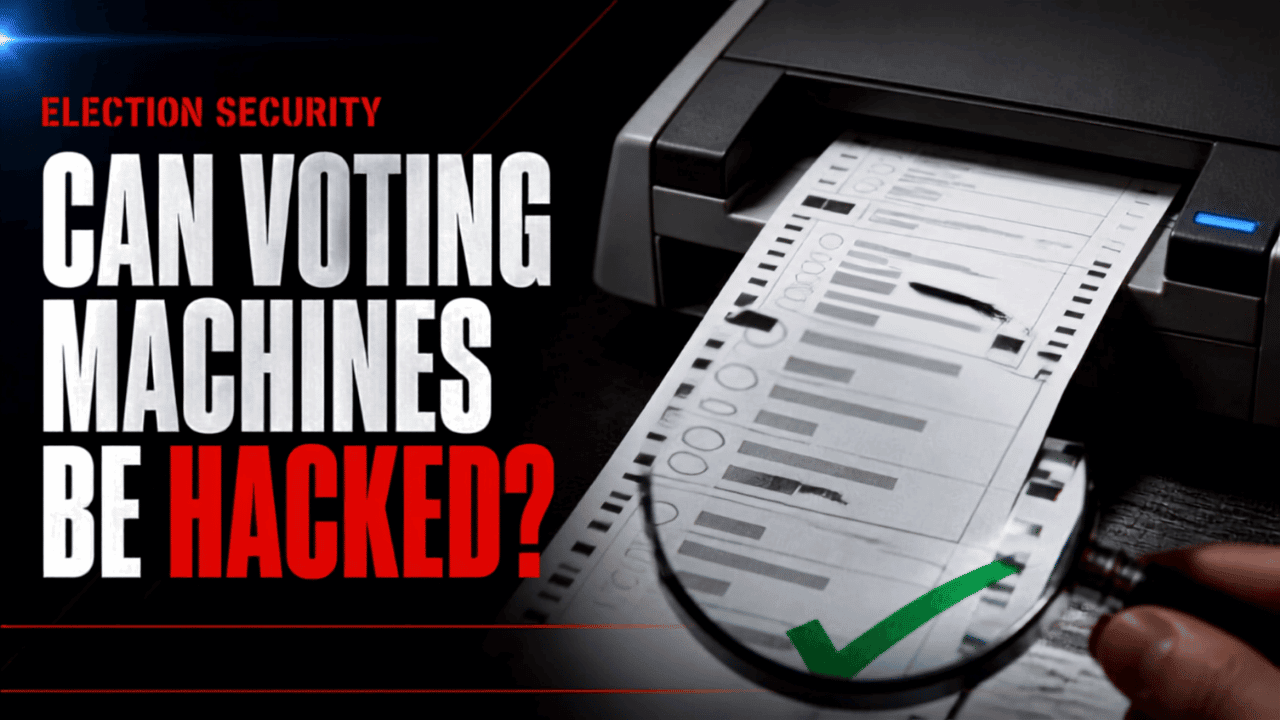
The Trump administration asked the Supreme Court Thursday to allow the U.S. Postal Service to implement new mail-voting requirements before the November midterm elections.
The rules would require states to provide voter information to the Postal Service and use federally specified ballot-envelope designs and barcodes.
A federal judge has temporarily blocked the requirements while litigation continues.
At the same time, a Postal Service whistleblower has warned Congress that the computer system being developed to carry out the changes was rushed and insufficiently tested.
According to the whistleblower disclosure, an internal “zero-percent failure” policy could cause an entire batch of ballot envelopes to be rejected if a sampled barcode cannot be scanned or matched correctly.
The Postal Service has said it is reviewing the allegations.
Associated Press: Whistleblower Report
Why It Matters
This isn’t simply a disagreement over whether mail voting should have tighter safeguards.
Some states are already beginning the process of sending ballots, while the new Postal Service system is still being developed.
If the Supreme Court allows the requirements to take effect, election officials could have only weeks to adjust their systems before millions of Americans vote.
The potential impact is serious, but it is important not to get ahead of the evidence.
The whistleblower is warning that technical errors could prevent legitimate voters from receiving ballots or cause batches of election mail to be rejected.
That does not mean thousands of ballots have already been rejected or that the midterm election has been compromised.
The requirements remain tied up in court, and their ultimate effect is not yet known.
What Could This Mean for Your Ballot?
| If the new system takes effect | What it could mean |
|---|---|
| States submit voter information | USPS checks election-mail information against the new system. |
| Ballot envelopes use required barcodes | Election officials may need to change existing procedures. |
| A barcode or data doesn’t match | According to the whistleblower, batches could fail the Postal Service’s verification process. |
| Courts keep the rules blocked | States continue operating without the mandatory new USPS requirements while litigation proceeds. |
Civic Connection
The dispute raises a fundamental question about American elections:
The Constitution gives states primary responsibility for administering elections, while Congress has authority to regulate federal elections.
The Trump administration argues the Postal Service has authority to impose these requirements.
Challengers argue that the executive branch is effectively creating election rules that belong to states and Congress.
Now the Supreme Court is being asked to decide whether the administration can move forward while that constitutional dispute continues.
4. Tropical Storm Edouard Brings Dangerous Flooding to Texas
The News
Former Tropical Storm Edouard brought torrential rain and dangerous flash flooding to parts of Texas this week, flooding roads and neighborhoods, disrupting travel and leaving thousands without power.
Although Edouard weakened from a tropical storm, its remaining moisture continued to produce heavy rainfall — a reminder that a storm does not have to remain a hurricane or tropical storm to be dangerous.
Why It Matters
Slow-moving tropical systems can produce enormous amounts of rain over a relatively small area.
The resulting flooding can damage homes and businesses, close roads, interrupt power and transportation, and create costly infrastructure repairs long after the storm itself has passed.
Flooding can also expose weaknesses that existed before the storm:
- inadequate drainage systems,
- development in flood-prone areas,
- aging infrastructure,
- and communities that may not have the resources to recover quickly.
Civic Connection
Disaster preparedness is not only a federal responsibility.
Local governments make decisions about zoning, drainage systems, building codes and where development can occur.
State governments coordinate emergency responses and infrastructure planning.
The federal government can provide disaster assistance and funding when an event overwhelms state and local resources.
What You Can Do
Know whether your home or community is in a flood-risk area and learn your local evacuation routes.
Pay attention to emergency alerts, and never drive through flooded roads.
You can also look beyond the immediate disaster.
Ask local candidates and elected officials how your community is preparing for heavier rainfall and flooding, whether infrastructure is keeping pace with development, and how emergency plans protect vulnerable residents.
Disaster preparedness begins long before the storm arrives.
Also Worth Knowing
Not every important story can make the Top Five. Here are three more developments worth keeping on your radar.
Federal Judge Blocks Trump’s New Attempt to Restrict Birthright Citizenship
A federal judge issued a preliminary injunction against the Trump administration’s latest attempt to restrict birthright citizenship, citing the Constitution’s 14th Amendment and existing Supreme Court precedent.
Civic Connection: This is another example of civics happening in real time: presidential power, constitutional rights and judicial review all intersect in the same dispute.
If you want help understanding how those pieces fit together, visit the VoteView News Civics 101 library for explainers on the Constitution, executive orders, judicial review and checks and balances.
Military Action in the Pacific
U.S. forces, working with Ecuador, boarded and sank a vessel that U.S. officials say was being used as a floating refueling station for drug trafficking linked to Los Choneros.
Civic Connection: Operations against transnational criminal organizations can involve the military, foreign governments, law enforcement and questions about when national-security powers should be used against criminal networks.
AI’s Growing Demand for Power
The AI boom isn’t just benefiting chipmakers.
Companies making transformers, electrical equipment and cooling systems are expanding rapidly to meet enormous demand from new data centers.
McKinsey projects nearly $7 trillion in global data-center investment through 2030.
The global AI data-center boom is driving enormous investment in electricity and cooling infrastructure. Companies are racing to build the transformers, power systems and cooling equipment AI facilities require.
That growth also raises larger questions about electricity demand, infrastructure planning and the environmental costs of AI.
Worth Watching
PBS NewsHour
Several of this week’s biggest stories are still developing, particularly the fighting between the United States and Iran and the legal battle over mail voting.
This week’s PBS NewsHour coverage can provide additional reporting and context as those stories continue to change.
A full evening newscast can also help put individual headlines into perspective by showing how foreign policy, courts, elections, the economy and events around the world connect.
5. Feminist Pioneer Gloria Steinem Dies at 92
The News
Gloria Steinem, the journalist, author and activist who became one of the most recognizable leaders of the modern American women’s movement, has died at 92.
She died Wednesday at her home in New York City.
For more than six decades, Steinem wrote, organized, traveled and spoke about equality for women, becoming one of the defining voices of the feminist movement.
Why It Matters
Steinem’s influence extended far beyond cultural commentary.
She co-founded Ms. Magazine, which brought issues including sexism, equal pay, domestic violence and reproductive rights into mainstream public discussion.
She also became an outspoken advocate for reproductive freedom.
Before the Supreme Court’s landmark 1973 Roe v. Wade decision, Steinem and other women publicly acknowledged having abortions and called for abortion to be legalized.
Her activism continued for decades.
She traveled extensively, speaking at college campuses, community centers, rallies and marches, while encouraging new generations of women to participate in the movement for equality.
In 2013, President Barack Obama awarded Steinem the Presidential Medal of Freedom, the nation’s highest civilian honor.
Civic Connection
Steinem’s legacy demonstrates how grassroots organizing, journalism and political participation can work together to produce societal change.
In 1971, she co-founded the National Women’s Political Caucus with other prominent women’s rights leaders, including Shirley Chisholm, Bella Abzug and Betty Friedan.
The organization was created to increase women’s participation and representation throughout American political life.
Steinem understood that changing public attitudes was only part of the work.
Her life illustrates something fundamental about civic participation:
Long-lasting change rarely comes from one election, one protest or one person.
It often takes years of organizing, speaking, writing, voting and building institutions capable of carrying a movement forward.
A Personal Note
I first learned about Gloria Steinem in high school history classes. By the time I was in college, she was still on the speaking circuit, carrying forward a movement that had already changed what women could expect from their lives.
For my generation, feminism wasn’t simply something we studied in a history book.
We were living with the changes women before us had fought to achieve — while watching the fight for equality continue.
I was proud to call myself a feminist then, and I am proud to call myself one today.
Gloria Steinem is one of countless people who taught me that change does not simply happen.
People organize for it, speak up for it, vote for it, write about it, and sometimes spend their entire lives fighting for it.
No discussions yet
Be the first to join the discussion and share your thoughts with the community.