
What Trade Deficits Actually Tell Us — and What They Don’t
We Buy More From Them. Are We Losing?
The United States buys more goods from some countries than those countries buy from us. In 2025, the United States imported about $1.24 trillion more in goods than it exported — a record. Politicians point to numbers like that and say, “We’re getting ripped off.”
Short answer: Not necessarily.
Here’s the basic distinction:
A trade deficit tells us there is an imbalance in the value of imports and exports. It does not, by itself, tell us whether the trade relationship is good, bad, fair, or unfair.
That’s not spin. That’s not defending any country. That’s just what the math actually measures.
Over the next few minutes, we’ll answer five questions:
- What exactly is a trade deficit?
- Where does the money go?
- Why do countries run deficits?
- When should we actually worry about one?
- And does buying more from Canada than Canada buys from us mean Canada is taking advantage of the United States?
Part I — What Is a Trade Deficit?
Imports — Things Americans buy from another country.
Exports — Things Americans sell to another country.
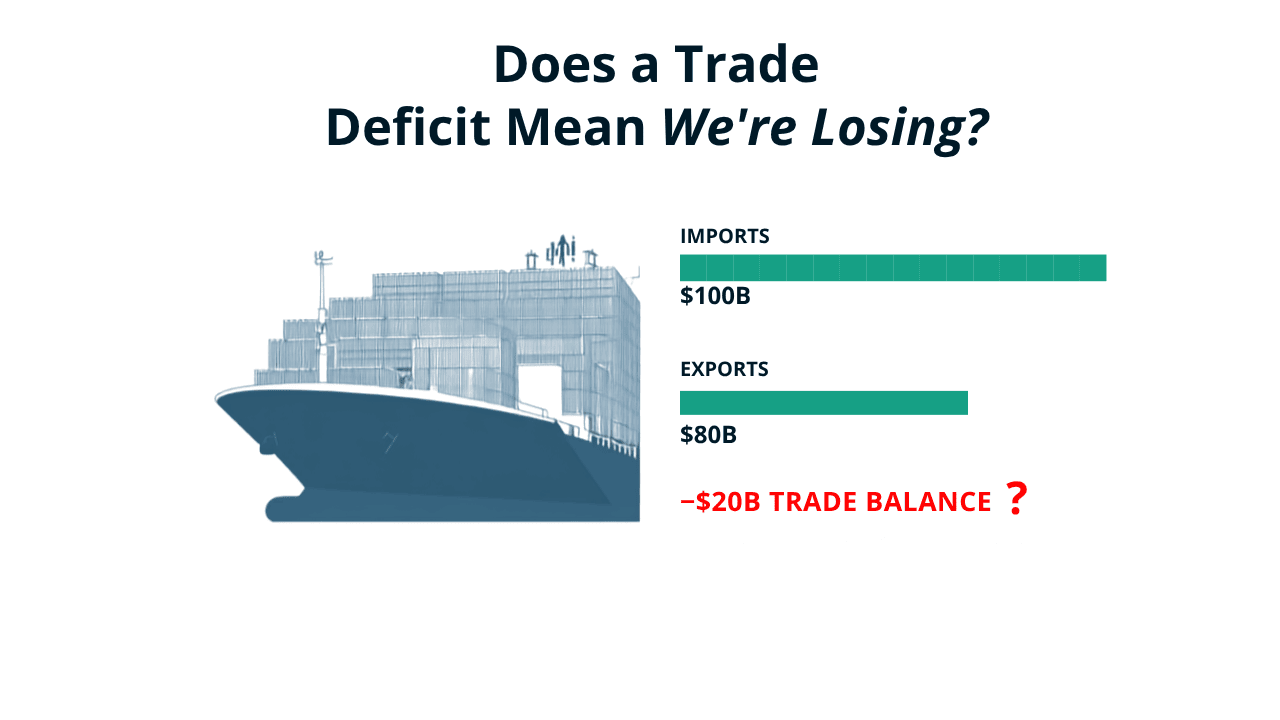
Exports – Imports = Trade Balance
Here’s how it works with a hypothetical example:
| United States & Country A | Amount |
|---|---|
| U.S. exports to Country A | $80 billion |
| U.S. imports from Country A | $100 billion |
| Trade balance | −$20 billion |
The United States has a $20 billion trade deficit with Country A. If exports were greater than imports, we’d have a trade surplus.
Now here’s the part a lot of people miss:
🔑 A trade deficit measures trade. It is not a bill another country owes us.
That single sentence clears up much of the confusion.
Part II — The Grocery Store Example
Imagine your household spends $10,000 at a grocery store this year.
The grocery store buys $0 from your household.
Your household has a $10,000 “trade deficit” with the grocery store.
Did you lose $10,000?
No.
You received groceries. The store received money. Both sides received something of value in the exchange.
Now, countries are not households, and international trade is much more complicated. But the example illustrates something important:
Buying more from someone than they buy from you does not automatically mean you were cheated.
Part III — So Where Does the Money Go?
This is the piece most people never hear about. A lot of Americans picture their money simply vanishing overseas — gone forever.
Here’s what actually happens.
Americans import goods and services into the United States. Foreign sellers receive dollars in return. Those dollars don’t vanish into a black hole.
Foreign businesses and governments can use those dollars to:
- Buy American products
- Invest in American companies
- Purchase U.S. stocks or bonds
- Buy U.S. government debt
- Invest in American property or businesses
Dollars used to buy imports don’t simply disappear.
U.S. buyers send dollars to foreign sellers.
In exchange, U.S. buyers receive something of value.
Those dollars can be spent, invested, or held.
Through U.S. goods, services, businesses, stocks, bonds, Treasury securities, property, and other assets.
That’s the connection between trade flows and financial flows. A trade deficit tells us that more money is flowing out through purchases than coming in through exports. But that is not the end of the economic story: dollars held abroad can also flow into U.S. investments and assets.
The U.S. dollar’s global role helps make those financial flows possible.
Federal Reserve — The International Role of the U.S. Dollar, 2025 Edition
Part IV — Why Would America Import More Than It Exports?
Not every deficit has the same cause. Here are five common reasons:
1. Americans have a massive consumer economy.
The U.S. economy is the largest in the world. Americans buy a lot of things — from everywhere.
2. Some countries produce certain products more cheaply.
Clothing, electronics, auto components — these are often manufactured overseas at lower costs.
3. We don’t have enough of certain resources.
Specific oil grades, critical minerals, raw materials, and manufacturing inputs are things the United States simply doesn’t produce in sufficient quantities.
4. Companies have international supply chains.
A product labeled “Made in America” may contain parts that crossed borders several times before final assembly. Modern manufacturing is deeply interconnected.
5. The U.S. dollar plays an unusual global role.
The dollar is widely used around the world for trade, investment, borrowing, and foreign reserves. That creates strong international demand for dollars and dollar-denominated assets.
When that demand contributes to a stronger dollar, American exports become relatively more expensive for foreign buyers while imported goods become relatively cheaper for Americans. All else equal, that can contribute to a larger U.S. trade deficit.
None of these reasons, on their own, means anyone is cheating.
Part V — Canada: A Perfect Example
Now let’s bring in the real-world debate everyone’s talking about.
The argument goes like this: The United States buys more goods from Canada than Canada buys from the United States. Therefore, Canada has a trade surplus. The United States has a trade deficit. Canada is “winning.”
Here’s what the actual 2025 data shows:
| U.S.–Canada Trade, 2025 | Amount |
|---|---|
| U.S. goods deficit with Canada | $46.4 billion |
| U.S. energy imports from Canada | $111 billion |
| U.S. energy exports to Canada | $26 billion |
Sources: U.S. Bureau of Economic Analysis; U.S. Energy Information Administration.
(Sources: U.S. Energy Information Administration, Canada Energy Regulator, Forbes analysis of Census Bureau data)
Now ask the question that matters: What are we buying?
A significant portion of what the United States buys from Canada is energy — including crude oil, natural gas, and petroleum products.
In 2025, Canada remained the dominant foreign source of crude oil for the United States.
There’s a practical reason for this relationship. Existing pipelines connect Canadian oil producers with American markets, and many complex U.S. refineries are well suited to processing the heavier crude oil Canada produces.
That changes the framing. The question isn’t:
“Why are we giving Canada all this money?”
It’s:
“What are Americans receiving in exchange for that money, and why are American businesses choosing to buy it?”
In this case, much of the answer is energy. That’s not a transfer of money with nothing received in return. It’s a purchase.
But here’s the wrinkle politicians rarely mention:
⚠️ Goods aren’t the entire trade relationship.
Politicians frequently cite the goods trade deficit. But countries also trade services — finance, travel, technology, professional consulting, intellectual property, and more.
The answer can change depending on what’s being counted.
The United States buys more goods from Canada than Canada buys from the United States.
The United States runs a services surplus with Canada, which offsets part of the goods deficit.
Part VI — But Trade Deficits CAN Be a Problem
Trade deficits aren’t automatically harmful — but that doesn’t mean they should be ignored. The better question is why the deficit exists.
Loss of strategic industries. If America becomes heavily dependent on another country for semiconductors, medicines, energy, defense components, or critical minerals, that dependence can become a national-security problem.
Unfair trade practices. Government subsidies, dumping (selling imported products below fair value), intellectual-property violations, or restrictions on American companies can distort trade. These can be legitimate trade grievances.
Entire communities losing industries. Cheap imports may benefit consumers overall while devastating workers and towns that depend on a particular industry. Telling someone who lost their factory job that trade is “good for the economy overall” is cold comfort.
Dangerous dependence. Even inexpensive imports can create vulnerabilities if the United States cannot obtain essential goods during a war, pandemic, or major supply disruption. The COVID-19 pandemic exposed how vulnerable international supply chains can become during a global emergency.
Part VII — Trade Deficit ≠ Unfair Trade
| What the Number Tells Us | What It Doesn’t Tell Us |
|---|---|
| We import more than we export | Whether the relationship is unfair |
| We spent more on imports than foreigners spent on our exports | Whether those purchases benefited or harmed the U.S. economy |
| One country has a surplus | Whether the other country is being exploited |
| The deficit increased | Why it increased |
A deficit driven partly by American demand for Canadian energy is different from a deficit influenced by foreign subsidies or products being dumped into the U.S. market below fair value.
People Are Asking
Does a trade deficit mean America is losing money?
No. A trade deficit means Americans bought more from other countries than those countries bought from us. Americans still received goods and services in exchange.
Is a trade surplus always good?
No. A surplus simply means a country exports more than it imports. Like a deficit, whether that’s beneficial depends on why it exists and what effects it has on the economy.
Does the United States have to eliminate its trade deficit?
Not necessarily. The more important questions involve why the deficit exists and whether it creates economic or strategic problems.
Can another country genuinely take advantage of the United States in trade?
Yes. Unfair subsidies, trade barriers, dumping, intellectual-property violations, and restrictions on American companies can create legitimate trade disputes. A trade deficit alone, however, doesn’t prove that any of those practices are occurring.
So why do politicians focus so much on the trade deficit?
Because it’s an easy number to communicate: we bought X from them; they bought Y from us. But that comparison alone doesn’t explain why the imbalance exists or whether it is harmful.
Does the U.S. trade deficit with Canada prove Canada is treating America unfairly?
No. The trade balance alone cannot answer that question. Determining whether trade is unfair requires looking at what is being traded, why the imbalance exists, and whether actual unfair trade practices are occurring.
How to Listen to Trade Claims Differently
Next time a politician or pundit says:
“Country X has a $100 billion trade surplus with us.”
Don’t jump to: “We’re losing $100 billion.”
The number changes depending on what’s counted.
Energy? Electronics? Raw materials?
Price? Availability? Quality?
Subsidies? Dumping? Tariffs? Blocked market access? Currency manipulation? Intellectual-property violations?
Are critical industries or supply chains at risk?
Consider the consequences as well as the proposed solution.
The Number Is the Beginning of the Question
A trade deficit isn’t a scoreboard.
It doesn’t mean one country won and another country lost.
It tells us that one country bought more from another than it sold to it.
Whether that’s beneficial, harmful, sustainable, or unfair requires a much bigger question:
Why?
That’s the question worth asking the next time you hear a trade deficit described as proof that the U.S. is “winning” or “losing.”
Related: What Are Tariffs? How Trade Taxes Affect Prices, Jobs, and National Strategy
Next: The U.S.–Canada Trade Fight: What Happens When Your Biggest Customer Starts Looking Elsewhere? (coming soon)

No discussions yet
Be the first to join the discussion and share your thoughts with the community.