
Why There Isn’t One National Election Office
Opening
If someone asked you who runs American elections, what would you say?
The President?
Congress?
The Supreme Court?
A national election office in Washington?
Most Americans are surprised by the answer.
Unlike many democracies, the United States does not have one national agency responsible for conducting elections. Instead, election administration is shared among thousands of state and local officials operating under both state and federal law. That decentralized system is one of the defining features of American government — and one of the reasons election procedures can vary so much from one state to another.
This question became especially relevant in July 2026. On July 16, President Donald Trump delivered a primetime address focused on what he described as ensuring “free and fair elections.” In the days leading up to the speech, he dismissed key leaders of the Election Assistance Commission (EAC) — the federal agency that helps states improve election administration — and continued urging Congress to pass the SAVE America Act, legislation that would establish new national requirements such as proof of citizenship for federal voter registration and additional voting standards. These events prompted many Americans to ask an important civics question:
Who actually runs elections in the United States?
The answer is more complicated — and more interesting — than many people realize.
🏠 Think of It Like…
Imagine asking: “Who runs America’s schools?”
There isn’t one national principal.
There are local school districts, state education departments, and a federal Department of Education — all with different responsibilities.
Election administration works in a similar way. Different levels of government share different responsibilities instead of one office doing everything.
Why Americans Sometimes Get Confused
People often assume there is one national election office because:
- Presidential elections receive wall-to-wall national media coverage
- Candidates campaign nationwide
- Results appear on a single television map, state by state, all at once
But behind the scenes, thousands of local jurisdictions are running their own elections simultaneously — each with its own ballots, equipment, procedures, and personnel. What looks like one national event is actually thousands of separate local ones happening at the same time.
Understanding that distinction is the first step toward making sense of how elections actually work — and why news about voting rules can seem so confusing.
Part I: The Roots of a Decentralized System
It starts with the Constitution.
The Elections Clause (Article I, Section 4) gives states the primary authority to manage the “times, places, and manner” of congressional elections — while giving Congress the power to “make or alter” those rules. In practice, states have historically handled the day-to-day work of running elections, and Congress has stepped in only periodically to set national standards.
This reflects a core American principle: federalism — the division of power between a central government and smaller units (states). The founders designed it this way deliberately. States were seen as closer to the people, more responsive to local conditions, and better positioned to manage something as complex as an election.
How the Layers Work
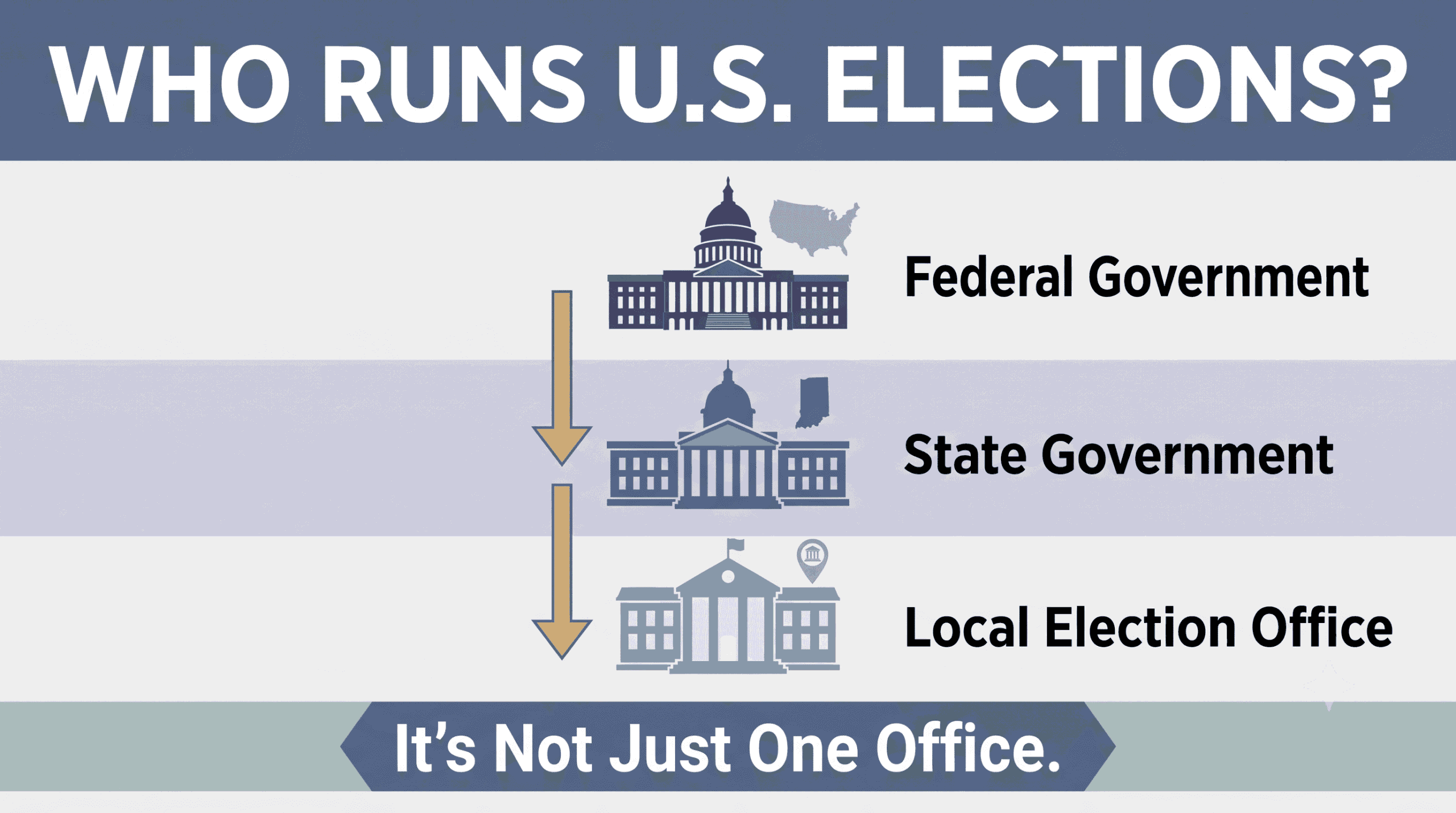
Federal Government → Provides laws & support State Government → Creates election rules County Government → Runs elections Poll Workers → Help voters cast ballots
Each layer plays a different role — and understanding what each one does is the key to following election news without feeling lost.
Why This Section Matters
Understanding why elections are decentralized helps explain why voting rules differ from state to state. Those differences are not necessarily mistakes — they reflect constitutional choices about how power is divided. Knowing this framework gives you a mental map for interpreting virtually any election news story.
Part II: Who Does What? (The Three Layers)
Although these responsibilities often overlap, each level of government has a primary role. Thinking of elections as a team effort rather than a single office helps explain why responsibilities are divided.
| Level | Primary Responsibilities | Examples |
|---|---|---|
| Congress | Passes federal election laws within its constitutional authority. | The Voting Rights Act and the Help America Vote Act. |
| Federal Agencies | Provide limited support, guidance, enforcement, cybersecurity assistance, and administration of specific federal responsibilities. | The Department of Justice, Election Assistance Commission, and CISA. |
| States | Establish many election rules, oversee statewide elections, conduct recounts, and certify statewide results. | Voter registration rules, mail voting, early voting, ballot design, and recount procedures. |
| Counties and Municipalities | Carry out most of the day-to-day work required to conduct elections. | Operating polling places, maintaining equipment, recruiting workers, counting ballots, and reporting local results. |
| Poll Workers | Help voters complete the in-person voting process at local polling places. | Checking in voters, issuing ballots, explaining procedures, and reporting problems to election officials. |
The Heavyweight: The Role of the States
States decide many of the rules that directly affect voters, including voter registration procedures, ballot design, early voting availability, mail-in rules, and recount procedures. Because states set their own rules within constitutional limits, the voting experience can look quite different depending on where you live:
| Feature | Oregon | Texas | Florida |
|---|---|---|---|
| Mail Voting | All elections are conducted primarily by mail. | Mail ballots are generally available to voters who meet qualifying conditions. | Mail ballots are available to registered voters upon request. |
| Voter Identification | Identification requirements differ from in-person voting systems. | Photo identification or an approved alternative is generally required. | Photo identification is generally required for in-person voting. |
| Early In-Person Voting | Traditional early voting is less central because elections are conducted by mail. | Available during a designated early-voting period. | Available during a designated early-voting period. |
The Front Lines: Local Election Officials
When you vote, the people you interact with — the poll worker who hands you your ballot, the clerk who checks your registration — are almost always your neighbors.
- County Clerks & Commissioners: Oversee regional election operations, train poll workers, and set up equipment.
- Poll Workers: Temporary staff (often volunteers or paid day-workers) who staff locations on Election Day and report local counts up to the county.
Many poll workers are retirees, teachers, veterans, college students, and community volunteers — ordinary people from your own town who take a day out of their lives to help their neighbors vote. That’s worth remembering when election security becomes a national headline: the people running your polling place are people you see at the grocery store.
What Does a Poll Worker Do?
Poll workers help voters move through the local voting process while following procedures established by election officials.
Prepare the Polling Place
Workers arrange materials, check equipment, post required notices, and prepare the location before voting begins.
Check In Voters
Workers locate voters in the registration system and follow the identification and check-in rules required by the state.
Issue the Correct Ballot
Each voter receives the ballot assigned to the correct precinct, district, or voting location.
Provide Assistance
Workers may explain voting procedures and provide accessibility assistance, but they cannot tell voters how to vote.
Protect Ballots and Records
Workers follow local procedures for securing ballots, documenting activity, and reporting equipment or registration problems.
Close the Polling Place
After voting ends, workers complete closing procedures and transfer ballots, records, and equipment according to local rules.
The Support Network: What the Federal Government Does
The federal role is limited but important, divided across four main areas:
- Congress: Passes overarching baseline laws like the Voting Rights Act of 1965 or the Help America Vote Act (HAVA) of 2002.
- The Department of Justice (DOJ): Enforces federal voting rights laws, investigating voter intimidation or discrimination.
- The Election Assistance Commission (EAC): A support and standards agency. It certifies voting systems and distributes grants, but does not run elections.
Why this matters right now: President Trump’s July 9, 2026 firing of key EAC commissioners has placed this support agency at the center of a national debate over federal oversight.
- Cybersecurity & Courts: Agencies like CISA provide infrastructure protection against foreign interference, while federal courts step in to resolve constitutional disputes.
Why This Section Matters
Knowing which level of government handles which responsibility lets you cut through political rhetoric. When a politician promises to “fix elections,” you can ask: Which part? The answer determines whether they’re talking about something they actually have the power to change — or something they don’t.
Part III: Logistics, Funding, and Election Day
Who Pays for Elections?
Elections are expensive — and chronically underfunded.
| Institution | Primary Role | What It Does Not Do |
|---|---|---|
| Congress | Passes federal election laws within the powers granted by the Constitution. | It does not directly operate local polling places or count individual ballots. |
| Department of Justice | Enforces federal voting-rights laws and investigates certain forms of discrimination, intimidation, or unlawful interference. | It does not manage ordinary state and local election operations. |
| Election Assistance Commission | Provides guidance, administers grants, develops voluntary standards, and supports voting-system testing and certification. | It does not conduct elections or certify state election results. |
| CISA | Provides voluntary cybersecurity support and information to election officials. | It does not determine voter eligibility or count ballots. |
| Federal Courts | Resolve constitutional and federal legal disputes involving elections. | They do not perform the routine administrative work of running elections. |
Why This Section Matters
Knowing which level of government handles which responsibility lets you cut through political rhetoric. When a politician promises to “fix elections,” you can ask: Which part? The answer determines whether they’re talking about something they actually have the power to change — or something they don’t.
Why this matters right now: President Trump’s July 9, 2026 firing of key EAC commissioners has placed this support agency at the center of a national debate over federal oversight.
Part III: Logistics, Funding, and Election Day
Who Pays for Elections?
Elections are expensive — and chronically underfunded.
| Funding Source | What It Generally Supports | Why It Matters |
|---|---|---|
| Local Budgets | Polling places, poll workers, ballot printing, equipment maintenance, storage, and routine election operations. | Local governments carry much of the day-to-day financial burden of conducting elections. |
| State Funding | Statewide registration systems, training, oversight, statewide ballots, and some equipment or administrative costs. | The amount and type of support vary considerably from state to state. |
| Federal Grants | Security improvements, accessibility upgrades, cybersecurity, equipment modernization, and other targeted needs. | Federal grants can help modernize local systems but are not the primary source of routine election funding. |
Because the burden falls mostly on local governments, many counties rely on aging machines and tight operational budgets. When federal grants face delays, it impacts the polling place directly. And because elections are funded mostly by state and local governments, wealthier jurisdictions often have more resources than smaller communities — meaning the quality of your voting experience can depend in part on your local tax base.
What Happens on Election Day?
From your perspective as a voter to the official certification:
From Casting a Ballot to Certified Results
Election night reporting is only one part of a longer process. Official results are reviewed and verified before they are certified.
Voter Check-In
Local poll workers confirm that the voter is eligible to receive the appropriate ballot under state and local procedures.
Ballot Cast
The voter completes and submits an in-person, mail, absentee, or provisional ballot according to the rules of the jurisdiction.
Ballot Secured and Handled
Election workers follow documented procedures for securing, transporting, and tracking ballots and election materials.
Votes Tabulated
Local election offices use approved procedures and equipment to count eligible ballots.
Unofficial Results Reported
Local totals are reported to the state and may be shared with news organizations and the public. These totals are not yet final.
Canvass and Verification
Officials review election returns, reconcile records, account for eligible provisional or outstanding ballots, and verify totals.
Results Certified
The appropriate local or state authority formally approves the final, verified election results.
Why This Section Matters
Election Day looks simple from the voter’s side of the table — show up, cast a ballot, see results on TV. But behind that simplicity is an enormous logistical operation involving thousands of offices, millions of dollars, and a chain of custody that runs from your precinct to your state capital. Understanding the machinery helps you evaluate claims about delays, recounts, and results reporting with a clearer eye.
Part IV: The Modern Debate & Common Myths
Myth vs. Fact
| Myth | Fact |
|---|---|
| There is one national election office that runs every election. | Elections are primarily administered by thousands of state and local jurisdictions operating under state and federal law. |
| The President controls how ballots are cast and counted. | The President may influence federal policy, appointments, and legislation, but does not administer state or local elections. |
| Election results shown on television are the final certified results. | Election-night totals are generally unofficial. Results become official only after required review, canvassing, and certification. |
| All states use the same voting procedures. | States establish many of their own rules for registration, early voting, mail voting, identification, recounts, and ballot administration. |
Why Americans Debate Election Administration
The current political tension comes down to two distinct, competing approaches:
🔵 Arguments for Greater State Control: Proponents argue that states understand local populations best, flexibility allows for localized innovation, and decentralized systems prevent a single point of national failure.
🔴 Arguments for More National Standards: Proponents argue that equal access shouldn’t depend on your zip code, uniform rules reduce systemic confusion, and federal resources are more effective at scaling cybersecurity defenses.
⚖️ The Core Tension
Both arguments have merit. The ultimate challenge of American election administration is finding the right balance: ensuring every eligible citizen can vote easily and securely, while fully respecting the constitutional authority delegated to the states.
Why This Section Matters
The debate over election administration isn’t just a policy disagreement — it’s a constitutional tug-of-war that has existed since 1787. Recognizing that both sides have legitimate principles at stake (state autonomy vs. equal access) helps you follow the news without defaulting to “my side is obviously right.” Both arguments trace back to genuine constitutional values.
🌱 Reasons for Hope
Amid the noise, it’s easy to lose sight of what’s actually working:
- Election administration has improved significantly over the past several decades, with better equipment, expanded access, and stronger cybersecurity protocols.
- States regularly learn from one another and adopt successful practices pioneered elsewhere — Oregon’s all-mail system, for example, inspired other states to expand mail voting.
- Thousands of local officials from both political parties work together on election boards and commissions across the country, committed to fair processes regardless of political outcomes.
- Despite political disagreements, peaceful transfers of power have remained a defining feature of American democracy for over two centuries.
- Civic engagement is growing — more Americans than ever are paying attention to how elections work and asking smart questions about the process.
The system isn’t perfect. But the people running it, at every level, are your fellow citizens — and many of them are working hard to make it better.
💼 Who Would You Call?
Match the problem with the level of government most likely to handle it.
- A broken voting machine at your polling place
- A statewide recount after a close race
- A new federal voting rights law
- Election cybersecurity guidance for local officials
Answers:
- County election office — Local officials operate and maintain voting equipment.
- State election office — States oversee recounts and certify statewide results.
- Congress — Federal election legislation is passed by Congress and signed by the President.
- CISA (federal) — Cybersecurity support for election infrastructure is provided at the federal level.
Part V: Navigating the News
When election security and voting rules dominate national headlines, it can be difficult to separate political rhetoric from constitutional reality. Understanding who holds the power helps clear up common points of confusion.
| If You Hear This… | Consider Explaining… | Why It Matters |
|---|---|---|
| “Why doesn’t the President just standardize the voting rules?” | The President does not directly administer state or local elections. States possess primary authority over many election procedures, while Congress may establish certain federal rules under its constitutional powers. | Understanding the division of authority prevents people from expecting the executive branch to make changes it cannot make on its own. |
| “Why can’t Congress simply create one national election system?” | Congress has meaningful authority over federal elections, but election administration also involves state constitutions, state laws, local offices, and the broader constitutional system of federalism. | National election standards involve a continuing debate between consistency across states and state control over local administration. |
| “The television networks called the race, so the result is official.” | News organizations make projections using reported data and statistical analysis. Government officials determine the official result through canvassing and certification. | A media projection and a legally certified election result are not the same thing. |
| “Every voting problem must be handled by the federal government.” | The correct office depends on the problem. Equipment failures may be handled locally, recounts usually follow state law, and federal agencies become involved when federal laws or security responsibilities apply. | Asking who has jurisdiction is often the fastest way to understand an election controversy. |
Why This Section Matters
These are the kinds of questions you’ll hear at family dinners, on social media, and in the comments section of any election news story. Having clear, factual answers ready — rooted in constitutional structure, not political preference — is exactly what civic education is for.
Final Takeaway
The next time you hear a politician promise to “fix American elections,” you’ll know to ask an important question:
Which part of the system are they talking about?
Congress?
The states?
Local election officials?
Or the federal agencies that support election administration?
Because there isn’t just one election system in the United States.
There are thousands of election offices working together within a constitutional framework that divides responsibility across local, state, and federal governments. That decentralized structure can sometimes create differences from one state to another, but it also reflects one of the Constitution’s central principles: federalism — the sharing of power between the national government and the states.
Understanding who does what won’t settle every debate about election policy. Americans will continue to disagree about issues such as voter identification, mail-in voting, federal oversight, and election security. But those discussions become far more productive when we begin with a shared understanding of how elections are actually administered.
An informed citizen doesn’t have to memorize every election law.
They simply need to know who has the authority to make which decisions.
That’s the first step toward separating political rhetoric from constitutional reality.
Continue Learning
This article is part of the VoteView Civics 101 series. To keep building your understanding of how American government works, explore:
- The Electoral College — How the President is actually elected
- Primaries vs. General Elections — How candidates make it onto the ballot (coming soon)
- How Congress Counts Electoral Votes — The final step in a presidential election (coming soon)
- Redistricting & Gerrymandering — How district lines shape representation (coming soon)
- The Senate — How the upper chamber operates
- The Federal Budget Process — How government spending decisions are made
- Government Shutdowns — What happens when Congress can’t agree on funding
Each article is written to stand on its own — so you can read them in any order.
📚 Want to Verify This?
Curious about the details? These authoritative sources back up the facts in this article:
Who Runs Elections? — National Conference of State Legislatures (nonpartisan overview)
Election Assistance Commission — Official U.S. EAC website (.gov)
Mail Voting Research — MIT Election Lab (peer-reviewed studies)
SAVE America Act Text — Original bill text from Congress.gov (.gov)
Each link goes to a credible source you can trust — no opinion pieces, just facts.
*This article draws on research from the Congressional Research Service, NCSL, the U.S. EAC, MIT Election Lab, and the Bipartisan Policy Center. All sources are publicly available and nonpartisan.*
Recap & Discussion
Election Administration Timeline
The Elections Clause
The Constitution gives states primary responsibility for setting the times, places, and manner of congressional elections while allowing Congress to make or alter certain rules.
Voting Rights Act
Congress strengthens federal protections against racial discrimination in voting.
Help America Vote Act
HAVA establishes new federal election-administration requirements, supports system modernization, and creates the Election Assistance Commission.
Renewed Debate Over Election Authority
National debates over federal standards, state authority, cybersecurity, voter eligibility, and the role of federal support agencies continue to test the balance built into the American election system.
Key Terms Glossary
- Federalism: The constitutional division of power between the central federal government and the individual state governments.
- The Elections Clause: The provision in Article I, Section 4 of the U.S. Constitution that gives states the primary authority to set the times, places, and manner of congressional elections, while allowing Congress to alter those rules.
- Election Jurisdiction: A specific geographic area responsible for administering its own elections. There are over 10,000 unique local jurisdictions across the country.
- County Clerk (or Local Election Commissioner): The chief local official responsible for the day-to-day operations of an election at the county or municipal level, including managing voter rolls and prepping equipment.
- Poll Worker: A temporary or volunteer staff member from the local community who staffs polling places on Election Day, checks in voters, and assists with ballot logistics.
- Canvass: The local process of reviewing, tallying, and verifying every single ballot cast to ensure the accuracy of the vote totals before results are formalized.
- Certification: The formal, legal process by which state and local officials officially declare the final, verified election results to be true and conclusive.
- Voting Rights Act (1965): A landmark federal law enacted by Congress to prohibit racial discrimination in voting and ensure equal ballot access across all states.
- Help America Vote Act / HAVA (2002): A federal law passed to upgrade outdated voting systems, establish minimum national election administration standards, and provide funding for local improvements.
- Election Assistance Commission / EAC: An independent federal support agency created by HAVA that tests and certifies voting equipment and provides voluntary resources to state and local election offices.
- Cybersecurity and Infrastructure Security Agency / CISA: A federal agency under the Department of Homeland Security that provides voluntary cyber-defense support and threat intelligence to protect local election infrastructure.
- SAVE America Act: A federal bill introduced in Congress aimed at requiring strict government-issued photo ID to vote and mandating in-person proof of U.S. citizenship (such as a passport or birth certificate) to register for federal elections.
💬 Discussion Prompts
- Do you prefer having your election rules decided at the local level, or do you think standardizing rules nationwide would make voting easier?
- Given that most poll workers are older retirees, what steps could your local community take to encourage younger generations to volunteer?
- When you see news stories about election rules changing in other states, does it change how you view the security or accessibility of your own local elections?
- Were you surprised to learn that the President doesn’t directly run elections? How does knowing this change how you interpret political promises about “fixing” elections?


No discussions yet
Be the first to join the discussion and share your thoughts with the community.