
CIVICS 101
Why Does the Supreme Court Hear So Few Cases?
Understanding the Rule of Four, Certiorari, and Why Most Appeals End Before Washington
In Plain English
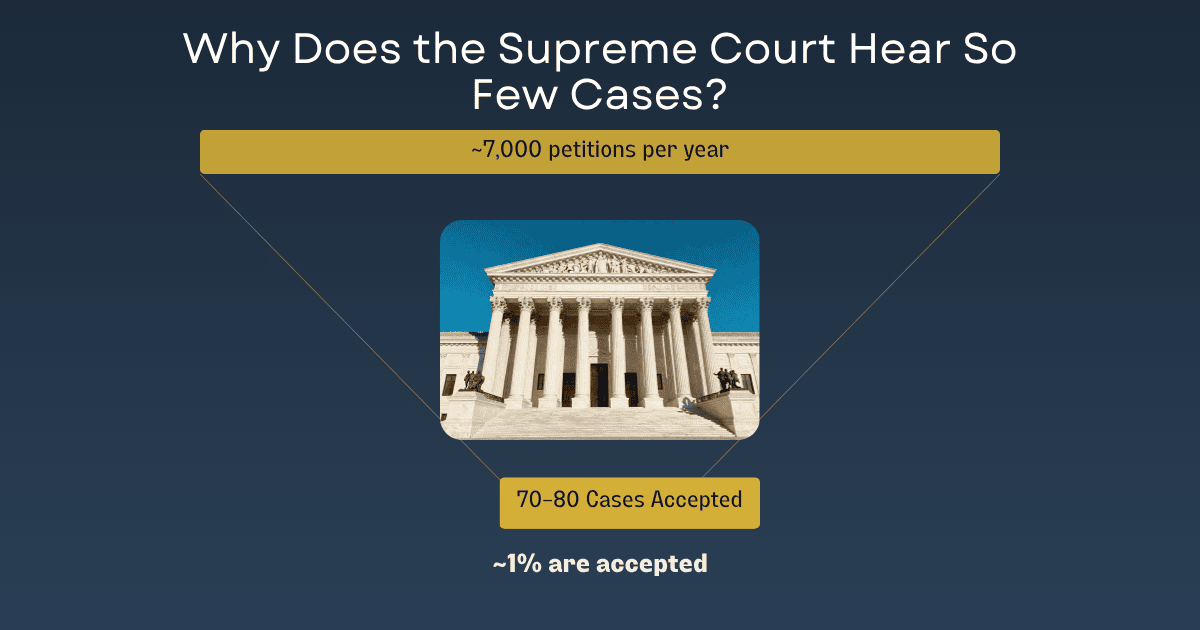
Every year, thousands of people ask the Supreme Court to hear their case. Most are turned away — not because their case is unimportant, but because the Court’s job is to resolve national constitutional questions, not correct every legal mistake. Understanding how the Court chooses cases helps explain why only a handful of disputes become landmark decisions.
Supreme Court Cases at a Glance
- The Supreme Court receives thousands of petitions each year.
- It usually hears only about 70 to 80 cases.
- Four justices must vote to hear a case.
- Most appeals end in the Courts of Appeals.
- The Court focuses on issues with national significance.
Imagine you’ve just lost the biggest court case of your life.
Maybe it’s about your business. Your property. Your constitutional rights.
Your lawyer says, “We can appeal.”
You lose again.
So you think: “Fine. I’ll take it all the way to the Supreme Court.”
But here’s the surprise.
The Supreme Court receives thousands of requests every year. It agrees to hear only about 70 to 80 of them.
That means more than 99% of appeals are declined.
Why?
If the Supreme Court is America’s highest court, shouldn’t it hear every important case?
The answer reveals something surprising about how our judicial system was designed.
The Supreme Court Was Never Meant to Correct Every Mistake
Most people believe the Supreme Court exists to fix every wrong decision in the legal system.
That’s not how it works.
| What People Think | How It Actually Works |
|---|---|
| Supreme Court = highest court, so it hears every appeal | The Court resolves national constitutional questions, not individual disputes |
| If you lose, you can always appeal higher | Most cases end permanently at the Court of Appeals level |
| The Court is a referee for every legal disagreement | The Court is a referee for disagreements between courts and about the Constitution |
The Court’s job is not to determine whether one trial reached the right outcome. It exists to answer questions that affect the entire country.
Key Takeaway
The Supreme Court is not a super-appeals court. It is a constitutional referee. If your case does not raise a national question, the Court probably will not touch it.
The Judicial Ladder
Before understanding why the Court hears so few cases, you need to see how a case travels through the system.
Local Trial Court
↓
Appeals Court
↓
State Supreme Court
for state cases
OR
Federal Court of Appeals
for federal cases
↓
United States Supreme Court
Most cases end long before reaching Washington. If a state supreme court or a federal Court of Appeals rules on your case, that ruling is usually final.
The next stop — Supreme Court review — is not automatic. It is a privilege, not a right.
Fun Fact
There are 94 federal district courts, 13 federal circuit courts, and 50 state supreme court systems. That means thousands of cases are decided every year by courts most Americans have never heard of. The Supreme Court reviews only a small fraction of them.
What Is a Petition for Certiorari?
Certiorari is pronounced: “sir-shee-oh-RAR-ee.”
When you ask the Supreme Court to hear your case, you file a petition for certiorari. This is not an appeal in the traditional sense. You are not saying, “I demand a new trial.”
You are asking: “Will you please hear my case?”
| The Court Says | What It Means |
|---|---|
| Cert Granted | Yes, we will review this case |
| Cert Denied | No, we will not. The lower court’s ruling stands |
That’s it. No explanation required.
Fun Fact
When the Supreme Court declines a case, it almost never explains why. The order may simply read: “The petition for a writ of certiorari is denied.” That single sentence can end years of litigation — and the parties may never learn why.
Key Takeaway
You do not have a right to Supreme Court review. You have the right to ask. The Court decides whether your question matters enough for the entire nation.
The Rule of Four
Here is where the system gets fascinating.
The Supreme Court has nine justices. But it only takes four to agree to hear a case. This is called the Rule of Four.
| How It Works | Why It Matters |
|---|---|
| If 4 of 9 justices vote to hear a case, the case is accepted | A simple majority of 5 is not required to grant review |
| If fewer than 4 vote to hear it, the case is declined | The Court does not have to explain why |
Why four instead of five?
The Rule of Four protects minority viewpoints. If a bare majority of five justices could control which cases the Court hears, one ideological bloc could completely control the docket by blocking cases that might threaten its preferred outcomes.
By requiring only four votes, the system ensures that even the minority faction of the Court can force important constitutional questions onto the agenda.
Key Takeaway
The Rule of Four is a structural safeguard. It prevents whichever side has five justices from burying inconvenient cases before they are ever heard.
What Makes a Case Important Enough?
The Court does not pick cases randomly. It looks for specific signals that a case has national significance.
| The Court Is More Likely to Hear a Case When… | The Court Is Less Likely to Hear a Case When… |
|---|---|
| Lower courts disagree with each other, creating a “circuit split” | It is a single factual dispute between two parties |
| A constitutional right is at stake | It is a small monetary disagreement |
| Federal law is being interpreted differently across the country | A jury reached a verdict the loser does not like |
| The issue affects millions of Americans | It involves only state law with no federal question |
| The issue has national importance | The lower court’s ruling has not created widespread confusion |
Key Takeaway
The Court is not looking for the most dramatic case. It is looking for the case that, once decided, will answer a question for the entire nation at once.
Circuit Splits: When Americans Have Different Rights in Different States
This is one of the most powerful reasons the Supreme Court steps in.
Imagine this scenario:
| Federal Court | Ruling |
|---|---|
| 9th Circuit, West Coast | A federal law is constitutional |
| 5th Circuit, South | The same federal law is unconstitutional |
Now Americans have different rights depending on where they live. A person in California has one set of protections. A person in Texas has another.
This is called a circuit split, and it is one of the strongest signals to the Supreme Court that it needs to act.
When circuit courts disagree, the Supreme Court is the only institution that can restore uniformity. Without it, the Constitution could mean different things in different regions — and that is exactly what the Court exists to prevent.
Constitution Connection
The Constitution created one Supreme Court, but Congress later created the lower federal courts. Because different federal circuit courts can interpret the law differently, the Supreme Court’s role is to ensure that federal law and the Constitution are applied consistently across the country.
Fun Fact
There are currently 13 federal circuit courts. The Supreme Court’s job is to make sure the Constitution does not mean 13 different things at once.
Why Doesn’t the Court Just Add More Cases?
If thousands of petitions arrive each year and the Court hears only a small number, why not hear hundreds more?
Because the Court is not designed for volume. It is designed for precedent.
Each accepted case requires a massive amount of work.
| Step | What’s Involved |
|---|---|
| Briefs | Thousands of pages of written arguments from both sides, plus amicus briefs |
| Oral Arguments | Intense questioning by the justices |
| Conference | Private deliberation among all nine justices |
| Research | Justices and clerks examine precedent, history, and constitutional text |
| Opinion Writing | A majority opinion, often joined by concurring and dissenting opinions |
Multiply that by dozens of cases per term. The Court is already operating under a heavy workload. Adding more cases would mean less time per case, less thorough reasoning, and less reliable precedent.
Key Takeaway
Quality over quantity. The Court’s value comes from the depth of its rulings, not the number of cases it hears. One landmark decision can reshape American law for decades. A rushed decision can create chaos.
Famous Cases the Court Refused to Hear
When the Court declines a case, people often assume the justices agreed with the lower court’s ruling.
That is not necessarily true.
Editor’s Note
The examples below illustrate different reasons the Supreme Court may decline review. Because the Court’s docket changes over time, future terms may revisit similar legal questions.
| Denied Case | What It Was About | What the Denial Shows |
|---|---|---|
| Second Amendment cases, 1939–2008 | For decades, the Court refused to hear cases asking whether the Second Amendment protects an individual right to own firearms. | The Court may wait until the legal groundwork is stronger. The issue was later addressed in District of Columbia v. Heller in 2008. |
| Tingley v. Ferguson, denied 2023 | A challenge to Washington state’s ban on conversion therapy for minors. | The Court may let a lower court ruling stand without deciding the broader national issue. |
| Census citizenship question, 2019 | A dispute over adding a citizenship question to the 2020 Census. | Sometimes the Court allows a lower court ruling to remain in place, preventing immediate policy change. |
| Voting rights challenge, denied June 2026 | A challenge seeking to reinstate voting rights protections that had been narrowed by earlier rulings. | The Court may decline review when it believes the issue is not ready, not nationally urgent enough, or better suited for another case. |
Key Takeaway
When the Court says “no,” it does not mean “you are wrong.” It often means “not now” or “not us.” The distinction matters because a denial leaves the lower court’s ruling in place, which can shape rights for millions of people.
Why This Matters
If the Supreme Court hears only a tiny fraction of cases, then the Courts of Appeals often have the final word for millions of Americans.
That means some of the most important legal decisions in the country are made by judges most people have never heard of.
| What This Means | Why It Matters |
|---|---|
| The Court of Appeals is usually the real final answer | 13 circuit courts shape law for their entire regions |
| Who sits on those courts matters enormously | Federal appellate judges are appointed for life |
| Supreme Court cases get the headlines | But appellate courts shape your daily rights |
| The Supreme Court’s docket choices determine which issues reach national attention | If the Court will not hear your issue, it stays regional |
Why This Matters to You
The Supreme Court may hear only a small number of cases each year, but the issues it chooses often shape constitutional rights for generations. Understanding why the Court selects some disputes — and declines others — helps explain why many important legal questions are settled long before they ever reach Washington.
Frequently Asked Questions
Does the Supreme Court have to hear my appeal?
No. There is no constitutional right to Supreme Court review. You have the right to ask. The Court decides whether your question matters enough for the entire nation.
What is certiorari?
Certiorari is permission to have your case heard. You file a petition for certiorari asking the Court to review a lower court’s decision. The Court can grant or deny it.
Why only four votes to accept a case?
The Rule of Four protects minority viewpoints among the justices. If a bare majority controlled the docket, one ideological bloc could block cases that might threaten its preferred outcomes.
Does refusing a case mean the Court agrees with the lower court?
No. It often means only: “We’re not taking it.” The Court may agree, disagree, or simply believe the issue is not ready for national resolution.
How Cases Reach the Supreme Court
Case begins → Trial Court → Appeal → Court of Appeals → Petition for Certiorari → Rule of Four → Supreme Court hears the case. Most cases stop before the final step.
Bottom Line
The Supreme Court is not designed to hear every case. It is designed to answer the questions that shape the nation.
By choosing only a handful of disputes each year, the Court focuses on decisions that establish constitutional principles for everyone — not just the people in one courtroom.
But this system has a cost. When the Court declines review, lower court rulings stand. Those rulings can vary from region to region, meaning one American’s constitutional rights may depend on which circuit they happen to live in.
Final Thought
The Supreme Court’s power is not measured by how many cases it hears. It is measured by the constitutional principles it establishes. Sometimes, the Court’s most important decision is not the case it takes — but the thousands of cases it leaves to the lower courts.
Continue Learning
This Civics 101 lesson connects to several other VoteView topics:
- Understanding the Supreme Court
- What Is Judicial Review?
- What Is the Shadow Docket?
- What Is an Executive Order?
- Checks and Balances
Further Reading
Coming Next in Civics 101
The Supreme Court agrees to hear your case. Now what happens behind those closed doors?
Inside private conferences. Behind oral arguments. Through majority opinions, concurring opinions, and dissents.
Next: How Does the Supreme Court Actually Decide a Case?

No discussions yet
Be the first to join the discussion and share your thoughts with the community.