
Is Equal State Voice Fair — or Fatally Flawed?
Opening
In our foundational article, Civics 101: The United States Senate — Why Every State Has an Equal Voice, we explored how the Senate was engineered — two senators per state, six-year terms, staggered elections, and exclusive powers over nominations, treaties, and trials.
But that leaves a bigger question: Is the Senate’s design still fair?
Not simply whether it was a smart compromise in 1787, but whether it still works fairly today — when the population gap between states is much larger than anything the Framers experienced.
This is one of the biggest debates about how American government should work. It is not simply a disagreement between the political left and right. At its heart, the debate is about what fairness means — and whether a constitutional rule written more than two centuries ago still works for a modern nation.
🔗 Why You’re Hearing About This Now
Questions about Senate representation don’t surface randomly. They tend to dominate headlines during moments when the Senate’s structure most visibly shapes national outcomes — Supreme Court confirmations, closely divided Senate margins, filibuster reform debates, statehood proposals for D.C. or Puerto Rico, and national elections where a handful of small-state races tip the balance of power. If you’ve heard someone argue recently that the Senate is “undemocratic,” or conversely that it “protects small states,” you’re already inside this debate. This article gives you the framework to evaluate both claims.
🏠 Think of It Like…
Imagine a homeowners association where every neighborhood gets one vote — regardless of whether it has 20 homes or 2,000 homes.
Some residents would argue every homeowner should count equally. Others would argue each neighborhood deserves an equal voice to protect its unique interests.
That’s essentially the debate over Senate representation. The Constitution chose the neighborhood model. The question is whether that choice still serves the country today.
Part I: The Data (1787 vs. Today)
To understand this debate, you have to look at the math. Today’s conflict is largely driven by one measurable change: the population gap between large and small states has grown dramatically.
Virginia
≈ 747,000 people
13 : 1
Delaware
≈ 59,000 people
California
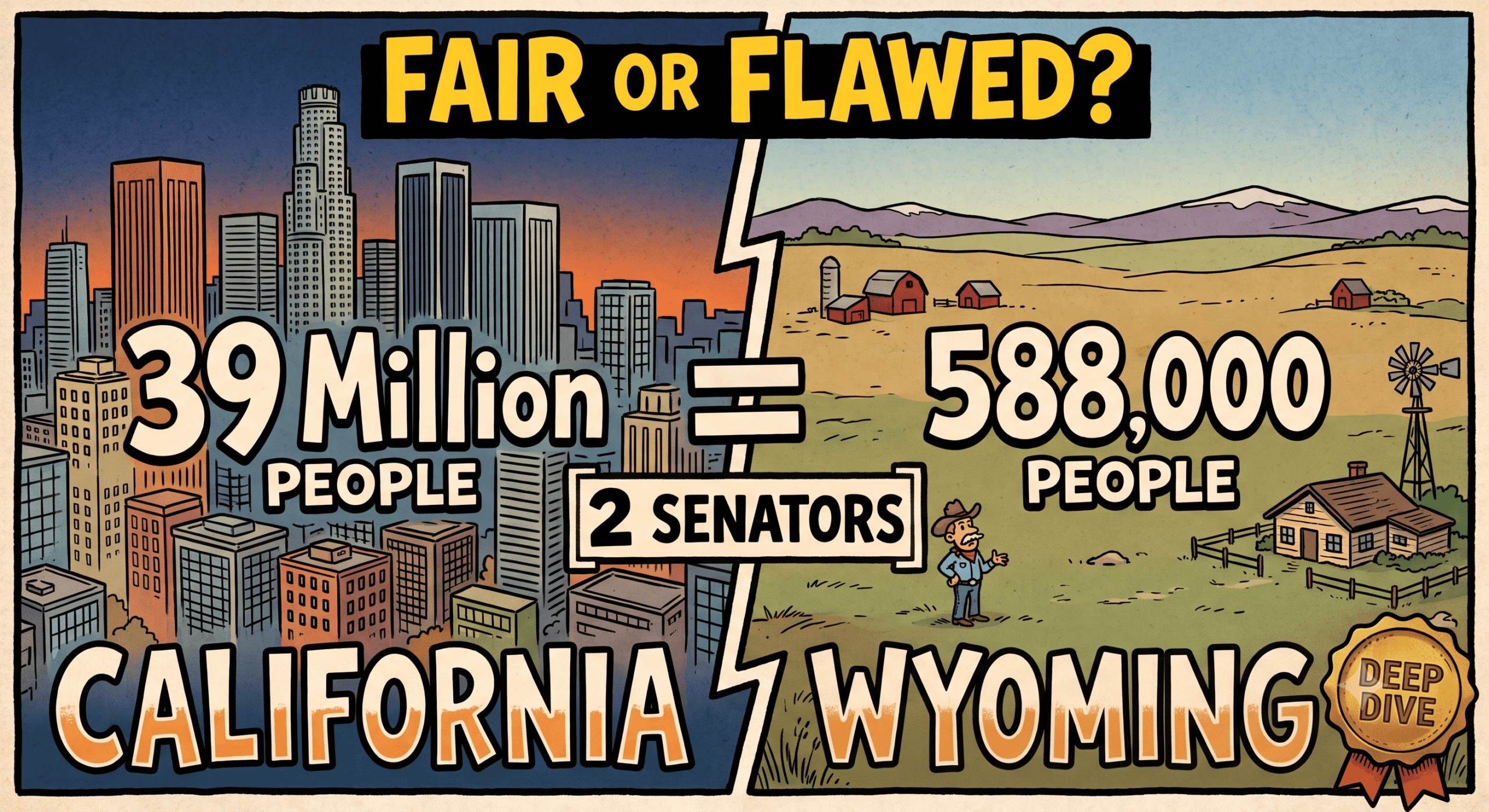
≈ 39.5 million people
67 : 1
Wyoming
≈ 600,000 people
The Representational Disparity
Because Senate seats are based on states rather than population, the numbers can produce surprising results:
- The 26 Smallest States: Together, the 26 least-populous states hold a 52-seat majority in the Senate, yet they represent roughly 30% of the total U.S. population.
- The Blocking Minority: The 25 least-populous states represent roughly 16% of the U.S. population. Their 50 senators hold enough collective voting power to filibuster legislation or block constitutional amendments.
- The Difference Per Voter: In Senate representation, one Wyoming resident has roughly 60 to 70 times as much numerical weight as one California resident.
Why This Section Matters
The debate over Senate representation isn’t just philosophical — it begins with measurable demographic changes. Understanding how dramatically state populations have diverged helps explain why this constitutional debate has become more prominent in recent decades. The Framers designed the Senate in a world where the largest state was about 13 times bigger than the smallest. They did not anticipate a world where that ratio would exceed 67-to-1 and continue growing. Without this data, the rest of the debate is abstract. With it, the stakes become tangible.
Part II: Two Different Ideas of Fairness
Both sides of this debate begin with a different idea of fairness. One focuses on equal power for individual voters. The other focuses on equal power for the states. Understanding both perspectives is essential to seeing why this issue remains so intensely contested.
Democratic Equality (One Person, One Vote) ◄────────► Federalism (Equal Voice for States)
Argument A: The Principle of Democratic Equality
Proponents of reform argue that in a representative democracy, every citizen’s voice should carry roughly equal weight.
- Diluted Citizenship: Giving residents of smaller states more Senate representation per person reduces the relative voice of people living in larger states.
- Government-Wide Ripple Effects: Because the Senate confirms lifetime federal judges, ratifies treaties, and approves Cabinet secretaries, the small-state representational advantage ripples across the entire executive and judicial branches.
- The “One Person, One Vote” Standard: In Reynolds v. Sims (1964), the Supreme Court ruled that state legislative districts must be drawn with roughly equal populations. Critics argue that the Senate violates the spirit of this principle because voters in different states do not have equal representation per person.
This is one of the easiest places to get confused, because Americans often hear the phrase “one person, one vote” without realizing that the Constitution intentionally treats the House and Senate differently. The Reynolds ruling applied to state legislatures — not to the U.S. Senate. The Senate’s equal-state structure is written into the Constitution and separately protected by Article V.
Argument B: The Principle of Federalism & Minority Protection
Defenders of the Senate’s design argue that America was deliberately built as a federal republic of states, not a direct national democracy.
- States as Constitutional Entities: The United States is a union of 50 sovereign states. The Senate was explicitly engineered to represent state identity, ensuring that regional interests are protected.
- Preventing Geographic Domination: Defenders worry that without equal state representation, heavily populated regions could gain greater control over policies affecting rural states, including agriculture, energy, and public land.
- Protection from Majority Rule: Defenders argue that a national majority should not always be able to override smaller regions with different needs. In Federalist No. 10, James Madison warned against the danger of majorities overriding minority interests. Equal Senate representation forces lawmakers to build broad geographic consensus across regions rather than relying on narrow population majorities.
| Feature | Democratic Equality | Federalism |
|---|---|---|
| Core Value | Equal voting power for every citizen. | Equal representation for every state. |
| Primary Concern | Minority rule and unequal voting power. | Large states dominating smaller states. |
| How Representation Works | The Senate should reflect population. | The House reflects population; the Senate balances state interests. |
🕰️ A Debate That Never Really Ended
The question of whether equal representation in the Senate is “fair” is almost as old as the Senate itself. Delegates argued fiercely over the issue during the Constitutional Convention, with some insisting that representation should follow population while others refused to join the new union unless every state received an equal voice.
The Great Compromise settled that dispute — for a time. But the debate never truly disappeared. As the nation’s population shifted and the gap between large and small states widened, scholars, judges, lawmakers, and citizens returned to the same question:
Should the Senate primarily represent people, or should it continue representing states?
What has changed over the past two centuries is not the constitutional rule itself. What has changed is the size of the gap between the largest and smallest states.
Why This Section Matters
The core reason this debate feels unresolved isn’t bad faith or political gamesmanship. It’s that two legitimate constitutional values — democratic equality and federalism — point in opposite directions. There is no formula that maximizes both simultaneously. Recognizing this tension helps readers move past the common instinct to dismiss one side as simply wrong. Both arguments have deep roots in American constitutional thinking.
Part III: Why Changing the Senate Is So Difficult (Article V)
Changing the Senate’s basic structure would be extraordinarily difficult because Article V places a special lock around equal state representation.
To pass a standard constitutional amendment under Article V, a proposal requires:
- A two-thirds vote in both the House and Senate.
- Ratification by three-fourths of the states (38 out of 50).
The Equal Suffrage Clause: The Lock Within the Lock
However, Article V contains a unique exception known as the Equal Suffrage Clause:
“No State, without its Consent, shall be deprived of its equal Suffrage in the Senate.”
This special constitutional protection means that no state can lose its equal representation in the Senate without its own consent.
In other words, even if Congress proposed an amendment and most states approved it, any state that would lose its equal voice could refuse to agree.
Because small states are unlikely to voluntarily reduce their own constitutional power, legal scholars generally consider equal Senate representation to be one of the Constitution’s most strongly protected features.
Why This Section Matters
When readers learn that the Senate’s structure can produce outcomes they see as unfair, their first instinct is often: “Then change it.” This section explains why that instinct runs into a constitutional wall. The Equal Suffrage Clause isn’t just another procedural hurdle — it’s a nearly impossible barrier by design. Understanding this helps shift the conversation from frustration toward the more productive question in Part V: “If we can’t change the Senate directly, what can we do within the system we have?”
Part IV: Navigating the News
When political commentary debates Senate fairness, understanding the underlying legal rules helps separate partisan talking points from constitutional realities.
| If You Hear… | Consider Explaining… | Why It Matters |
|---|---|---|
| “The Senate is fundamentally undemocratic.” | Critics point out that a minority of Americans can elect a majority of senators. Supporters respond that the Senate was designed to represent states, while the House represents population. | Understanding whether someone values equal representation for citizens or equal representation for states helps explain the disagreement. |
| “Why not just amend the Constitution?” | Article V protects every state’s equal representation in the Senate through the Equal Suffrage Clause, making reform extraordinarily difficult. | The Constitution intentionally makes changes to Senate representation extremely difficult. |
Why This Section Matters
This section exists because most Americans encounter the Senate debate through headlines and commentary, not through constitutional text. “Navigating the News” gives readers a mental filter: when they hear a politician or pundit make a claim about Senate fairness, they can ask, “Is this a constitutional reality or a political opinion?” That distinction is the difference between being informed and being persuaded. It’s also one of the most practical civic skills VoteView teaches.
🤔 Think About It
If two states each receive two senators…
Should senators represent:
☐ States equally
☐ Citizens equally
☐ A combination of both
There isn’t a single correct answer. The Constitution chose one approach. The debate continues over whether it remains the best one.
Part V: Constitutional Paths Forward
When people discover how difficult it would be to change the Senate’s structure, a natural question follows:
“If equal state representation is effectively permanent, is there anything that can be done?”
The answer is yes — but probably not by changing the Constitution itself.
Rather than trying to eliminate equal state representation, many scholars, lawmakers, and civic organizations focus on other ways to improve representation within the existing constitutional system. Some proposals seek to strengthen the House of Representatives, others focus on election rules, and still others explore statehood for places whose residents currently lack full congressional representation.
Like all major constitutional debates, these proposals have supporters, critics, and important trade-offs. Understanding them doesn’t tell us which path is best — it helps us evaluate the ideas thoughtfully.
Some of the ideas most discussed include:
- Admitting New States: Under Article IV, Section 3 (the Admissions Clause), Congress can admit new states through standard legislation. Debates over statehood for Washington, D.C., or Puerto Rico focus on whether Congress should use this power to give millions of U.S. citizens full representation in Congress, including representation in the Senate.
- Expanding the House of Representatives: The 435-seat cap on the House was set by federal law in 1929, not by the Constitution. Expanding the House would give larger states additional representatives and Electoral College votes without changing the Senate. Supporters from across the political spectrum have backed this idea for different reasons, including improving representation and giving constituents more direct access to their representatives.
- Electoral & Primary Reforms: Some scholars argue that reforms such as ranked-choice voting or open primaries could encourage candidates to appeal to a broader range of voters rather than only their party’s base. Supporters believe this could encourage compromise, while critics question whether it would reduce polarization or simply change campaign strategy.
The Senate’s constitutional structure is unlikely to change directly. But the debate over representation is not over.
Understanding how the Senate works does not tell us which reforms are right. It gives us the knowledge to compare those ideas, recognize their trade-offs, and participate in one of the oldest constitutional debates in American history.
The Senate has been debated since it was created in 1787, and that conversation continues today. Whether future reforms happen through Congress, the states, or changes in election laws, understanding the issues is the first step toward participating in the discussion.
Why This Section Matters
After four sections explaining why the problem exists and why it’s so hard to fix, readers can feel stuck. This section exists to remind them that constitutional systems are not all-or-nothing. Even when one structural feature is locked in place, there are other levers — new states, a larger House, different voting systems — that can shift representation without rewriting the Constitution. That’s not just civics education. It’s civic hope.
VoteView’s goal isn’t to tell you which solution is right. It’s to give you the knowledge to evaluate the evidence, understand the trade-offs, and make up your own mind.
Continue Learning
Recommended next articles:
- The United States Senate
- Congress Explained
- The House of Representatives (coming soon)
- How a Bill Becomes a Law
- Checks and Balances
- Gerrymandering & The House: How Population Districting Works (coming soon)
- National Archives — U.S. Constitution (Article I & Article V)
- Library of Congress- The Great Compromise
- United States Senate
- US Census Bureau
Reference Guide & Discussion
📚 Key Terms Glossary
- Equal Suffrage Clause: The provision in Article V of the U.S. Constitution stipulating that no state can lose its equal vote in the Senate without its own consent.
- Great Compromise: The 1787 agreement establishing population-based representation in the House and equal state representation in the Senate.
- One Person, One Vote: The legal principle established in Reynolds v. Sims (1964) requiring legislative districts to hold roughly equal populations.
- Federalism: A system of governance where power is constitutionally divided between a central national government and individual regional state governments.
- Admissions Clause: Article IV, Section 3 of the Constitution, granting Congress the power to admit new states into the Union via standard legislation.
💬 Discussion Prompts
- If you live in a low-population state, how does equal Senate representation protect your community’s economic interests? If you live in a high-population state, how does it affect your sense of voting equality?
- Should Congress expand the total number of seats in the House of Representatives to better reflect population growth, even if the Senate’s structure remains unchanged?
- Is the Article V Equal Suffrage Clause a vital safeguard that protects small states from being overrun, or is it an outdated rule that prevents necessary democratic evolution?




No discussions yet
Be the first to join the discussion and share your thoughts with the community.