
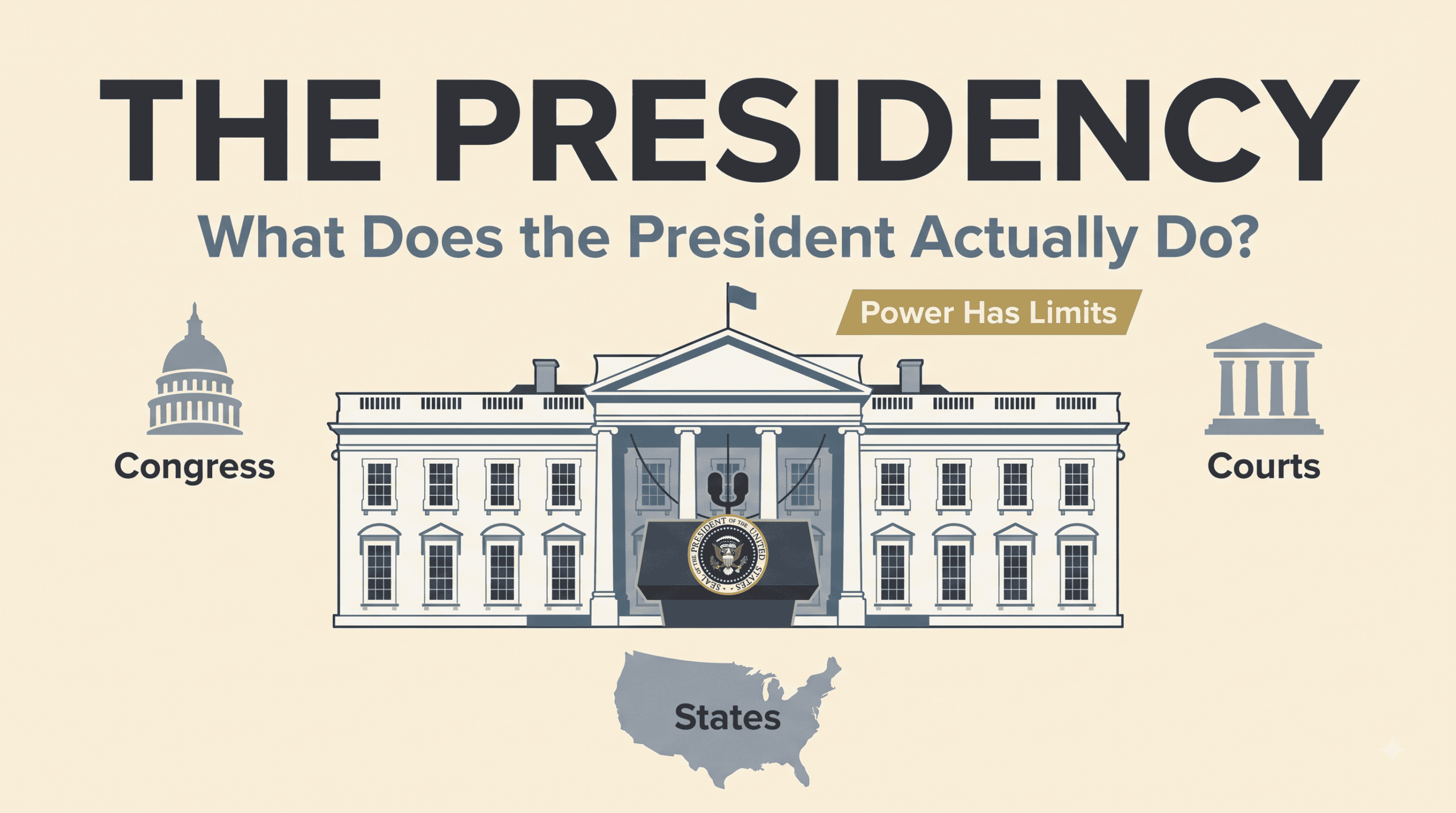
The Powers, Responsibilities, and Limits of America’s Chief Executive
Introduction
The President is the most visible person in American government, but presidential power is often misunderstood. When the economy booms, the President gets the credit. When gas prices spike, the President gets the blame. When a natural disaster strikes, people ask why the President didn’t stop it.
But here’s the thing: the President doesn’t control most of that.
The President of the United States is undeniably powerful — but that power has limits built into the system from day one. The Constitution, Congress, the courts, federal law, and the states all constrain what any one person in the Oval Office can actually do.
This article breaks down what the President can do, what the President can’t do, and why Americans tend to give one person credit or blame for things far beyond their control.
Part I — Why We Have a President
The United States didn’t always have a strong president. Under the Articles of Confederation — the country’s first governing document, adopted during the Revolutionary War — there was no national executive at all. Congress ran everything, and it didn’t work well. The federal government couldn’t collect taxes reliably, couldn’t enforce laws, and couldn’t respond effectively to crises like Shays’ Rebellion in 1786.
When the Framers gathered at the Constitutional Convention in 1787, they knew the country needed an executive who could act quickly and decisively. But they’d just fought a revolution against a king. The idea of giving one person too much power terrified them.
Article II of the Constitution was the result — a presidency with real authority, but hemmed in by checks and balances at every turn.
Part II — What Does the President Actually Do?
The President wears several hats — sometimes all in the same day.
Chief Executive
The President’s most fundamental job is to “take Care that the Laws be faithfully executed” (Article II, Section 3 of the Constitution). That phrase sounds simple, but it’s enormous. The President oversees the entire executive branch — 15 Cabinet departments, dozens of independent agencies, and roughly 2.68 million civilian federal employees as of mid-2026.
The President sets priorities for how laws are enforced, directs agencies through executive orders and policy memos, and manages the day-to-day operations of the federal government. But the President doesn’t personally write the regulations, inspect the food, deliver the mail, or process tax returns. Career civil servants do that work — and they stay in their jobs across multiple administrations.
Commander in Chief
The President leads the armed forces. This means the President can deploy troops, respond to military threats, and direct military strategy. But here’s the catch: only Congress can declare war (Article I, Section 8), and Congress controls military funding.
This tension between presidential command and congressional authority over war has shaped American history. The last formally declared war was World War II. Since then, presidents have used their Commander in Chief powers to send troops into Korea, Vietnam, Iraq, Afghanistan, and elsewhere — with Congress authorizing (or not) through different mechanisms.
Chief Diplomat
The President sets foreign policy, negotiates treaties (which require Senate ratification by a two-thirds vote), recognizes foreign governments, and represents the United States on the world stage. The President also appoints ambassadors — again, with Senate confirmation.
Legislative Role
The President is part of the legislative process in a way no other executive in the world quite is. The President can:
- Sign a bill into law
- Veto a bill (Congress can override with a two-thirds vote in both chambers)
- Recommend legislation to Congress (the President’s annual budget proposal is a prime example)
The President can’t write or pass laws on their own. But the veto is a powerful tool — and the threat of a veto shapes what Congress even tries to pass.
Appointments
The President nominates:
- Federal judges (including Supreme Court justices)
- Cabinet secretaries
- Ambassadors
- Heads of federal agencies
- U.S. Attorneys
But the Senate must confirm most of these appointments. There are over 1,300 executive branch positions requiring Senate confirmation. The President also appoints federal judges for lifetime terms — one of the most consequential and lasting powers of the office.
Clemency
The President can grant pardons (forgiving a federal crime) and commutations (reducing a sentence) for federal offenses. This power is broad — the Constitution gives it with almost no strings attached. The President cannot pardon someone for state crimes, and cannot pardon in cases of impeachment.
Here’s how executive order counts compare across recent presidencies:
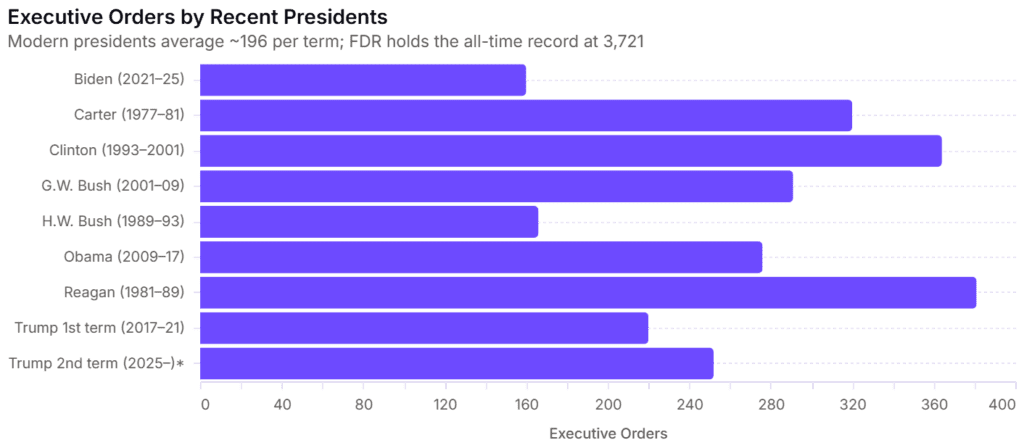
*Trump’s second-term count reflects orders signed through early 2026; the term is ongoing. Sources: American Presidency Project, Federal Register, USAFacts, Pew Research Center.
Part III — The President Doesn’t Govern Alone
The President is one person. The executive branch is enormous.
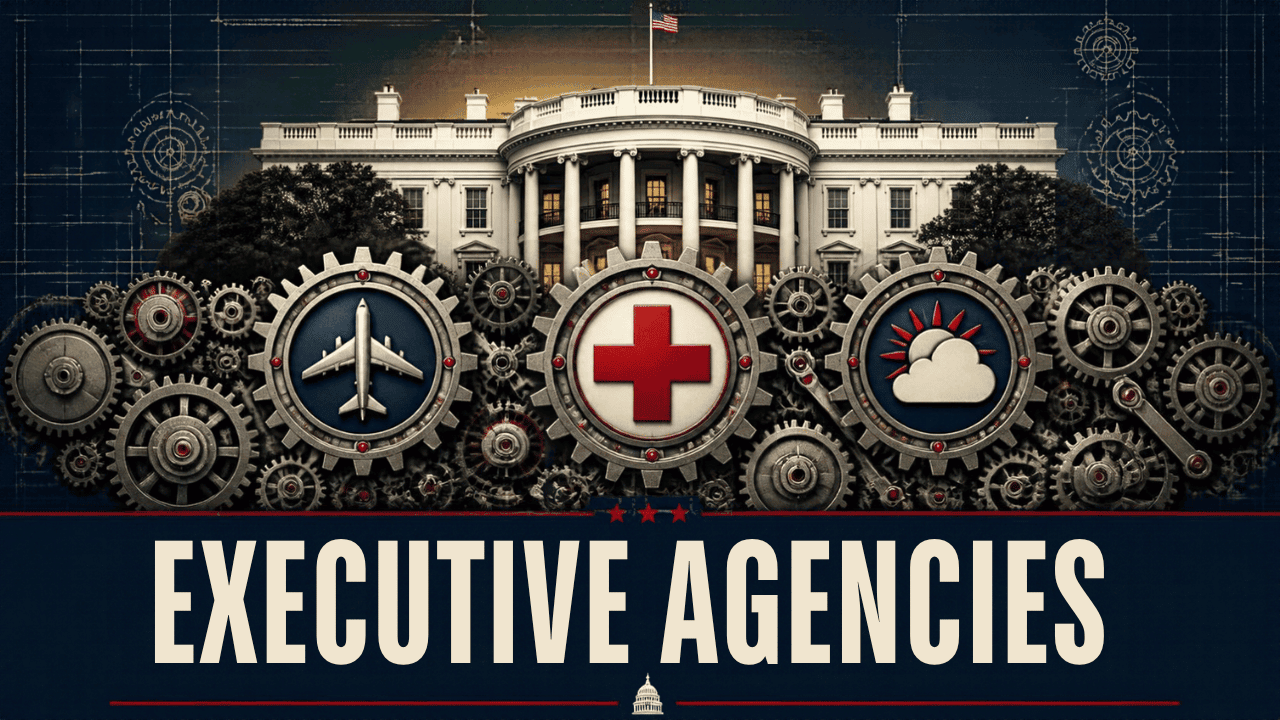
The Cabinet includes the Vice President and the heads of 15 executive departments — Agriculture, Commerce, Defense, Education, Energy, Health and Human Services, Homeland Security, Housing and Urban Development, Interior, Justice, Labor, State, Transportation, Treasury, and Veterans Affairs. Each Cabinet secretary leads a massive organization, staffed by career professionals who were there before the President arrived and will be there after the President leaves.
Those career employees are the people who actually do the work of government: FDA inspectors checking food safety, air traffic controllers guiding planes, Social Security employees processing benefits, IRS agents handling taxes, park rangers maintaining national parks, scientists researching diseases.
Part IV — The Limits of Presidential Power: What Can’t the President Do?
This is probably the most important section in this article:
| Power Belongs To… | What the President Can’t Do |
|---|---|
| Congress | Pass laws. The President can sign or veto legislation, but Congress writes and passes it. |
| Congress | Appropriate federal money. The President proposes a budget; Congress decides what actually gets funded. |
| States | Control state governments. States run elections, manage most education systems, operate state courts, and maintain their own laws. |
| The People / Amendment Process | Rewrite the Constitution. Amending it requires Congress and the states — not the President. |
| The Courts | Ignore valid court orders. Federal courts can block presidential actions they find unlawful or unconstitutional. |
| The Federal Reserve | Set interest rates. The Federal Reserve is an independent central bank. The President appoints the Chair, but doesn’t set monetary policy. |
| The Market | Control every aspect of the economy. Businesses, consumers, global markets, and economic cycles all play enormous roles. |
Two Kinds of Limits
The limits above fall into two categories — and understanding the difference matters.
Hard limits are enforced by law. Congress controls the purse strings. Courts can issue injunctions. The Constitution can only be amended through a specific, difficult process. These limits have procedures behind them.
Soft limits are enforced by norms, tradition, and the expectation that a president simply won’t do certain things — not because they’re legally barred, but because it isn’t done. Releasing tax returns. Placing assets in a blind trust. Avoiding conflicts of interest. Refraining from directing prosecutions. These aren’t in the Constitution. They depend on the person.
When a president tests those unwritten limits, the system’s response depends on whether other branches push back — and how quickly. Courts can rule, but they rely on the executive branch to comply. Congress can investigate, legislate, or impeach, but those are slow, blunt tools. The Founders assumed that elections, institutional checks, and public accountability would be enough to restrain a president who chose to test the boundaries. They didn’t build a mechanical safeguard against it, because they believed character and institutional pressure would fill the gap.
That assumption is being tested in real time, right now — and not for the first time in American history. Every generation faces moments where the balance between presidential power and institutional restraint gets stress-tested.
Checks and Balances in Action
- Congress controls legislation and spending. If the President won’t sign a bill, Congress can try to override the veto (requires two-thirds of both chambers). If the President spends money Congress didn’t authorize, courts can stop it.
- Courts can review and block presidential actions. If the President issues an executive order that exceeds legal authority, a federal judge can issue an injunction. The Supreme Court can permanently strike it down.
- States retain substantial authority under the Tenth Amendment. The federal government has specific powers; everything else is reserved to the states.
Part V — Why Presidents Get Too Much Credit — and Too Much Blame
Understanding presidential power is only half the battle. The other half is understanding why the public keeps assigning the President credit and blame for things far beyond their control.
Three familiar examples:
1. “The President controls the economy.”
Presidential policies absolutely matter. Tax cuts, stimulus spending, trade tariffs, deregulation, and infrastructure investment all affect economic health. But the President is one player among many.
Who else influences the economy?
- Congress — passes the laws, sets tax rates, and appropriates spending
- The Federal Reserve — sets interest rates and manages monetary policy independently
- Businesses — make investment, hiring, and pricing decisions
- Consumers — drive demand through spending choices
- Global markets — oil shocks, supply chain disruptions, foreign recessions, and global health crises cross borders with no regard for who sits in the Oval Office
- Economic cycles — expansions and recessions have a rhythm that predates and outlasts any single presidency
The President can influence the economy, but cannot control it.
2. “The President controls gas prices.”
Federal policies can influence energy markets — drilling permits, pipeline approvals, strategic petroleum reserve releases, and environmental regulations. But the President doesn’t set the price at the pump.
Gas prices are driven by global crude oil markets, OPEC production decisions, refinery capacity, seasonal demand, weather disruptions, and market speculation. A sitting President has limited levers, and even those take time to produce measurable effects.
3. “The President controls federal spending.”
This one is straightforward and gets to the heart of how the system works:
- The President proposes a budget. The President submits a budget request to Congress outlining spending priorities.
- Congress controls appropriations. The House and Senate write the actual spending bills, vote on them, and send them to the President to sign. Congress can accept the President’s proposal, modify it heavily, or ignore it entirely.
So when someone says “the President is spending too much” or “the President is cutting too much,” the honest follow-up question is: What did Congress actually appropriate?
Part VI — Presidential Power: What’s Happening Now?
Americans have debated presidential power throughout the country’s history. How much authority should one person have? Where’s the line between effective leadership and dangerous concentration of power?
These debates aren’t new. They go back to the founding generation. But they feel especially urgent right now.
Current debates include:
- Executive orders — How much can a President accomplish through executive action alone, without Congress?
- Emergency powers — The President can declare national emergencies that unlock special authorities. When should those expire? Who decides the emergency is over?
- Presidential control over federal agencies — How much authority does the President have to fire career civil servants, reorganize agencies, or redirect funds already appropriated by Congress?
- Congressional authority — Is Congress asserting its role as a co-equal branch, or deferring too much to the executive?
- Court challenges to executive actions — When courts block presidential actions, what happens if the President resists or delays compliance?
These aren’t hypothetical questions right now. As of early 2026, the current administration’s actions have been challenged in more than 550 lawsuits nationwide, with plaintiffs prevailing in 195 cases and the government prevailing in 109, according to Just Security’s litigation tracker. Both Republican and Democratic judicial appointees have ruled against the administration. The Supreme Court struck down the president’s attempt to end birthright citizenship in June 2026, only for the president to issue new orders attempting similar restrictions weeks later.
The Tension
Some argue that presidents need sufficient authority to carry out the agenda voters elected them to pursue. If a president can’t act because of endless procedural hurdles, democracy itself feels broken — the people voted for change and nothing changes.
Others warn that concentrating too much authority in one office undermines the checks and balances that protect against tyranny. If a president can govern by decree, elections become higher-stakes and institutions grow weaker.
Both arguments have merit. The tension between them is baked into the Constitution. The Framers didn’t resolve it — they designed a system that forces us to keep wrestling with it.
The deeper lesson is that this debate is permanent — and that’s by design.
Here’s the reassuring part. And it’s not reassuring because everything is fine. It’s reassuring because power is distributed.
- Congress matters.
- Courts matter.
- States matter.
- Elections matter.
- Institutions matter.
- Citizens matter.
The strength of American democracy has never depended on having a perfect president. It depends on having institutions strong enough to function regardless of who occupies the Oval Office — and citizens informed enough to hold all of those institutions accountable.
📰 Navigating the News
So the Next Time You Hear…
“Why doesn’t the President just do something?”
Ask: Does the President actually have the authority to do it alone?
Then look for:
- 🔲 Does Congress need to pass a law?
- 🔲 Does Congress control the money?
- 🔲 Is this actually a state responsibility?
- 🔲 Could the courts review the action?
- 🔲 Does an existing law limit what the President can do?
If the answer to any of those is yes — and it usually is — then the question isn’t really “Why won’t the President act?” It’s “Why hasn’t the whole system acted?”
Think About It
- Why do we expect presidents to solve problems they don’t fully control?
- When does strong presidential leadership become too much presidential power?
- Why did the Constitution deliberately make governing difficult?
- What’s the difference between a limit enforced by law and a limit enforced by norms?
FAQ
Q: Can the President create new laws?
No. Only Congress can pass laws. The President can sign or veto bills Congress sends, recommend legislation, and issue executive orders — but executive orders direct the executive branch and can be overturned by Congress or the courts.
Q: Can the President fire anyone in the government?
It’s complicated. The President can remove Cabinet secretaries and most political appointees fairly easily. But career civil servants have employment protections designed to prevent politicizing the government workforce. The extent of presidential removal power over various positions has been the subject of Supreme Court cases for over a century.
Q: Can the President go to war without Congress?
The President can deploy troops as Commander in Chief, but only Congress can formally declare war. The War Powers Resolution of 1973 requires the President to notify Congress within 48 hours of deploying troops and withdraw them within 60 days unless Congress authorizes the action. Whether presidents have fully complied with this law has been disputed ever since it passed.
Q: What happens if the President ignores a court order?
If a federal court orders the President to do or stop doing something and the President refuses, the situation escalates into a constitutional crisis. Courts rely on the executive branch to enforce their orders, so defiance creates a direct collision between branches. Historically, presidents have complied with court orders even when they disagreed with them — though the speed and completeness of compliance varies.
Q: Can the President be removed from office?
Yes — through impeachment by the House and conviction by the Senate for “Treason, Bribery, or other high Crimes and Misdemeanors.” The 25th Amendment also provides a process for removing a president who is unable to discharge the duties of the office.
Glossary
Executive Order
A directive from the President managing the operations of the federal government. When grounded in constitutional or statutory authority, can affect people and organizations beyond the executive branch. Can be overturned by Congress or the courts.
Cabinet
The group of senior officials, including the Vice President and the heads of 15 executive departments, who advise the President.
Appropriation
Money authorized by Congress for a specific purpose. The President cannot spend money Congress hasn’t appropriated.
Commander in Chief
The President’s role as head of the U.S. armed forces.
Clemency
The President’s power to pardon (forgive) or commute (reduce sentences for) federal crimes.
Checks and Balances
The system in which each branch of government can limit the power of the other branches.
Veto
The President’s power to reject a bill passed by Congress. Congress can override a veto with a two-thirds vote in both chambers.
Federal Reserve
The independent central bank of the United States. Sets interest rates and manages monetary policy, separate from presidential control.
Impeachment
A charge of misconduct brought by the House of Representatives. If impeached, the official faces trial in the Senate.
25th Amendment
The constitutional provision for replacing a president who is unable to serve, either temporarily or permanently.
Norms (Soft Limits)
Unwritten expectations and traditions that constrain presidential behavior — not legally enforceable, but traditionally respected.
🔗 Related Articles
- Checks and Balances
- Executive Orders Explained
- How the Supreme Court Works
- The Federal Budget: How Spending Actually Works
For your verification process
I’d recommend bookmarking these for your own fact-checking:
- Just Security Litigation Tracker — This is the single best source for the lawsuit count. It’s updated regularly and links to actual court documents.
- NPR’s coverage (August 6, 2026) — The birthright citizenship story.
- The White House’s own page — The executive order text itself is published on whitehouse.gov.
- For the Supreme Court case — The ruling is Trump v. Barbara, 609 U.S. ___ (2026), 146 S. Ct. 2438. You can find it on the Supreme Court’s website at supremecourt.gov.


No discussions yet
Be the first to join the discussion and share your thoughts with the community.