
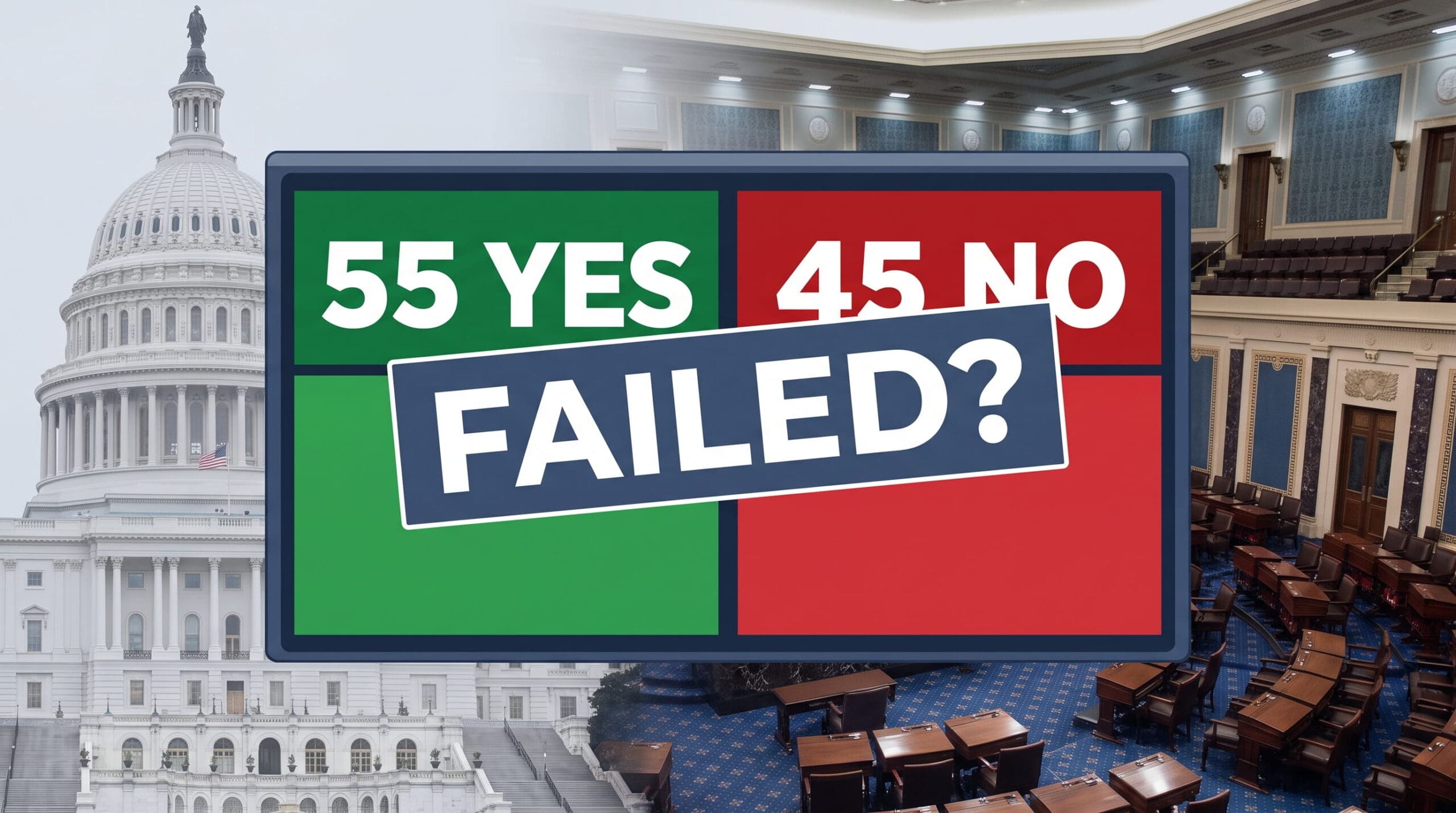
Why 51 Votes Sometimes Isn’t Enough
Opening
Imagine ten friends trying to pick a movie. Nine want a horror film. One person insists on action — and refuses to budge. They keep arguing, restating their case, stalling the group until everyone either compromises or gives up and goes home.
The horror movie had 90% of the group behind it. But that one person’s refusal to stop debating was enough to block the whole thing.
That, in essence, is the idea behind the filibuster in the U.S. Senate: a minority of senators can delay or block legislation by preventing debate from ending — even when a majority supports the bill.
You’ve probably heard something like this on the news: “The bill had majority support, but it failed because it couldn’t get 60 votes.”
If the Senate has 100 members, how does 60 become the majority when 51 should be enough? Is the Senate bad at math?
Not quite. The answer lies in one of the most famous — and most misunderstood — concepts in American politics: the filibuster.
The Bigger Picture
The filibuster sits at the center of a fundamental question about American democracy: Should the majority be able to govern, or should the minority always have a voice powerful enough to slow things down?
The Founding Fathers debated this exact tension — how to balance majority rule against minority protections — and the filibuster has evolved over more than two centuries as a living, imperfect expression of that debate.
What’s Actually Happening
Hollywood vs. Reality
When most people hear “filibuster,” they picture the classic 1939 film Mr. Smith Goes to Washington — a passionate senator standing on the Senate floor for hours, speaking without food, water, or rest, refusing to sit down until collapsing from exhaustion.
In Senate terminology, this is called a “talking filibuster.” It still happens occasionally, but it’s rare today.
In the modern Senate, a senator doesn’t need to speak for hours. Instead, a senator simply signals their intent to object to moving forward on a bill. Since Senate leadership knows there aren’t enough votes to force debate to close, the bill gets set aside — often without a single speech being delivered.
Modern filibusters rarely look like dramatic floor speeches. They look like administrative gridlock.
How the Filibuster Developed
A common myth is that the Framers of the Constitution created the 60-vote filibuster to protect democracy.
They didn’t. In fact, the word “filibuster” doesn’t appear anywhere in the Constitution.
The Constitution Doesn’t Require 60 Votes
The Constitution generally allows each chamber to act by a simple majority unless it specifies a different threshold. They reserved supermajorities for a few specific, extraordinary situations:
- Overriding a presidential veto (two-thirds of both chambers)
- Ratifying international treaties (two-thirds of the Senate)
- Convicting an impeached official (two-thirds of the Senate)
- Proposing amendments to the Constitution (two-thirds of both chambers)
Everything else? Simple majority. The 60-vote threshold for ending Senate debate didn’t come from the Framers — it came from the Senate making its own rules.
Accidental Origins
A Procedural Door Opens
The Senate eliminated the “previous question” motion after Vice President Aaron Burr recommended simplifying its rules. The change was not intended to create the modern filibuster, but it helped leave the Senate without a straightforward way to cut off debate.
Cloture Is Born
After filibusters delayed wartime legislation, the Senate adopted Rule XXII, creating a formal procedure for ending debate. Cloture originally required two-thirds of senators voting.
The 60-Vote Standard
The Senate lowered the cloture threshold to three-fifths of the full Senate — normally 60 senators. That remains the standard for most legislation today.
What Is Cloture?
People often mix up “filibuster” and “cloture,” but they’re opposites:
- A filibuster is the act of extending debate to block a vote.
- Cloture is the procedure to end debate and force a vote.
Think of a filibuster as a faucet running endlessly. Cloture is the valve that shuts it off.
How It Works, Step by Step
Step 1: Senate Takes Up Legislation — A bill is introduced and debate begins.
Step 2: Extended Debate (The Filibuster) — Opposing senators signal they won’t allow debate to end, preventing the bill from advancing.
Step 3: Leadership Files for Cloture — A senator (usually the Majority Leader) files a motion for cloture to end debate.
Step 4: The 60-Vote Test — The Senate votes on cloture. If 60 or more senators agree, debate ends after a maximum of 30 additional hours, and the bill proceeds to a final vote (which only needs 51). If even one vote short of 60, the filibuster continues and the bill stalls.
How Can 55 Votes Lose?
This is the question that confuses most people. Here’s the simplest way to see it:
A bill has support from a Senate majority
But debate must end before the Senate can reach final passage.
Can 60 senators agree to end debate?
Cloture succeeds.
Debate ends after the permitted post-cloture period.
Final vote can occur.
A simple majority can pass the bill.
Cloture fails.
Debate does not end and the bill stalls.
No final vote yet.
Unless enough senators later agree to end debate, the bill may never reach final passage.
That’s the filibuster in one picture.
Does Everything Need 60 Votes?
A common misconception is that the Senate can’t pass anything without 60 votes. In reality, Congress has created several pathways that only require a simple 51-vote majority:
| Senate Action | Typical Threshold | Why the Filibuster Doesn’t Apply |
|---|---|---|
| Budget Reconciliation | Simple majority | Debate time is limited under the reconciliation process. |
| Executive Branch Nominations | Simple majority | The Senate ended the filibuster for most executive nominations in 2013. |
| Federal Judicial Nominations | Simple majority | The filibuster was removed for lower-court nominees in 2013 and Supreme Court nominees in 2017. |
1. Budget Reconciliation
This is the biggest exception to the filibuster. Budget reconciliation allows the Senate to pass tax, spending, and debt-limit legislation with just 51 votes. Debate is capped at 20 hours, meaning a filibuster can’t run out the clock.
Major legislation passed through reconciliation includes:
- The Affordable Care Act’s fiscal provisions (2010)
- The Tax Cuts and Jobs Act (2017)
- The American Rescue Plan (2021)
Reconciliation is limited to budget-related provisions, so it can’t be used for broader policy changes — but it’s become one of the primary ways Congress passes major economic legislation.
2. Executive Branch Nominations
Federal agency directors, ambassadors, and Cabinet secretaries can be confirmed with 51 votes.
3. Judicial Nominations (Including Supreme Court)
All federal judges — including Supreme Court justices — can now be confirmed with a simple 51-vote majority. This is a relatively recent change, and it came through the “nuclear option” (explained below).
The “Nuclear Option”: How the Rules Changed
The phrase “nuclear option” sounds dramatic, but it’s political shorthand for a powerful maneuver: a Senate majority establishing or changing a precedent interpreting Senate procedure, effectively changing how the rules operate without formally rewriting them through the ordinary rule-change process.
Here’s how it has played out:
2013 — Democrats (Obama Era) Then-Majority Leader Harry Reid used the nuclear option to end filibusters on most executive branch nominees and federal judicial nominees (excluding the Supreme Court). This meant those confirmations only needed 51 votes.
2017 — Republicans (Trump Era) Majority Leader Mitch McConnell extended the nuclear option to include Supreme Court nominees, allowing Justice Neil Gorsuch’s confirmation to proceed with 51 votes. Since then, all Supreme Court confirmations have only required a simple majority.
The Filibuster and Civil Rights
This is where the filibuster’s history gets uncomfortable — and why an honest conversation about it can’t ignore the past.
Supporters of the filibuster argue it forces lawmakers to compromise. But historically, the most prominent use of the filibuster wasn’t about encouraging bipartisanship — it was about blocking civil rights legislation.
Anti-Lynching Legislation (1920s–1950s): The House of Representatives repeatedly passed bills to make lynching a federal crime. Southern senators used the filibuster to kill these bills before they could reach a final vote in the Senate.
Strom Thurmond’s Record Filibuster (1957): Senator Strom Thurmond of South Carolina spoke on the Senate floor for 24 hours and 18 minutes in an attempt to block the Civil Rights Act of 1957 — the longest solo filibuster in Senate history.
The Civil Rights Act of 1964: A coalition of Southern senators filibustered the landmark Civil Rights Act for 57 days. It took a bipartisan group of senators to finally gather enough votes for cloture — the first time cloture was successfully invoked on a civil rights bill. The bill then passed.
Supporters of the filibuster acknowledge this history but argue the tool itself is neutral — any senator can use it for any purpose. Critics respond that the pattern speaks for itself: the filibuster has disproportionately been used to block progress on civil rights and social legislation.
This is worth wrestling with honestly. The same mechanism that protects minority party interests today was once the primary weapon against equal rights.
Why People See This Differently
The filibuster isn’t just a procedural rule. It reflects a deep philosophical divide over how American government should work.
| Arguments for Keeping It | Arguments for Eliminating It |
|---|---|
|
Encourages compromise Requiring broader support can pressure parties to negotiate. |
Can block majority rule A minority can prevent legislation supported by a Senate majority from advancing. |
|
Promotes stability Laws with broader support may be less vulnerable to reversal when political power changes. |
Can contribute to gridlock Legislation can stall even when more senators support advancing it than oppose it. |
|
Protects minority participation The minority party retains leverage in the legislative process. |
Can shift power toward presidents Legislative gridlock may encourage greater reliance on executive action. |
The Core Tension
Deliberation & Consensus
Should major changes require broader agreement so the minority has meaningful influence?
Majority Rule & Accountability
Should the party that wins elections be able to govern and be judged by voters on the results?
The filibuster debate is ultimately about how the Senate should balance both democratic values.
Real-World Impact
The filibuster’s practical effect has grown dramatically over the past several decades. The clearest way to measure this is by tracking cloture motions — the formal filings to end a filibuster. When cloture motions increase, it means the filibuster is being used more often.

*2020s data covers 2021 through mid-2026. Source: U.S. Senate official records (Senate.gov) and Brennan Center for Justice.
As the filibuster has become more routinely used, the practical threshold for advancing significant legislation has increasingly shifted from a simple majority to 60 votes — even though final passage of most bills still requires only a simple majority.
What’s Happening Now
Public awareness of the filibuster has grown alongside frustration with congressional gridlock. Several reform proposals have been debated in recent years:
1. Bring Back the “Talking Filibuster” Require senators who want to block a bill to actually stand on the floor and speak — like the classic image, not the silent objection system used today. This would make obstruction publicly visible and physically demanding rather than invisible and cost-free.
2. Create More Exceptions Lawmakers could carve out additional topics that bypass the 60-vote rule, similar to how budget reconciliation and judicial nominees already work. Proposals have included exceptions for voting rights legislation, debt ceiling increases, and government funding bills.
3. Lower the Threshold Gradually Some proposals suggest starting at 60 votes, then gradually reducing the requirement (to 57, then 55, then 51) over successive cloture attempts on the same bill — rewarding persistence and eventually allowing a final vote.
4. Eliminate the Filibuster Entirely The most straightforward option: remove the 60-vote requirement and return to simple majority rule for all legislation.
People Are Asking
Is the filibuster in the Constitution? No. The Constitution specifies supermajorities for certain actions, but the legislative filibuster comes from Senate procedure.
Has it always required 60 votes? No. The cloture rule was created in 1917 and changed to the current three-fifths threshold in 1975.
Do both parties use it? Yes. Both parties have used the filibuster when in the minority and criticized it when in the majority.
Can a bill pass with 51 votes? Yes. Final passage generally requires a simple majority, but legislation subject to a filibuster may first need 60 votes to end debate.
What You Can Do
- Pay attention to whether a “failed” vote was a cloture vote or a final vote. When the news reports a bill “failed,” check whether it was the cloture vote (needing 60) or the actual vote on the bill itself (needing 51). This distinction is crucial and often goes unreported.
- Contact your senators about filibuster reform. Whether you support keeping, modifying, or eliminating the filibuster, your senators represent your state and set the Senate’s rules. They need to hear from constituents.
- Follow the actual legislation, not just the headlines. Many bills that “fail” in the Senate actually had majority support. Understanding why they failed — the 60-vote threshold — makes you a more informed voter and a harder target for misleading media coverage.
What This Means for You
The next time you hear, “The bill failed in the Senate because it couldn’t get 60 votes,” ask yourself these three questions:
1. Did the bill actually receive a final vote? Sometimes the vote being reported is a cloture vote, not a vote on the bill itself. The bill may never have reached a final up-or-down vote.
2. Did a majority of senators actually support it? A bill can have 55 supporters — a clear majority of 100 senators — and still fail because it didn’t reach 60. Majority support doesn’t guarantee passage under current rules.
3. Could it pass with 51 votes? If the bill involves budget reconciliation, an executive appointment, or a judicial confirmation, it only needs a simple majority. Regular legislation needs 60.
The media often reports that a bill “failed in the Senate” without explaining that your representatives may have voted for it. It simply couldn’t overcome the 60-vote debate threshold.
Discussion
The real question isn’t simply whether the filibuster is good or bad. It’s whether the version that exists today — where obstruction can be silent, relatively easy, and routine — creates the right balance between protecting minority participation and allowing a governing majority to act.
That is ultimately a judgment Americans and their elected senators have to make.
But whatever your political views, understanding the distinction between majority support, cloture, and final passage makes it much easier to understand what is actually happening when legislation succeeds — or fails — in the Senate.
🎯 FINAL TAKEAWAY
The Constitution does not generally require 60 votes to pass legislation. The 60-vote threshold comes from Senate procedure governing when debate can be brought to an end. Whether the filibuster protects minority participation or allows a minority to obstruct majority rule depends on your perspective — and the Senate itself determines how its procedures operate.
Related Articles
Sources referenced in this article:
- U.S. Senate official cloture statistics (Senate.gov)
- Brennan Center for Justice, “The Case Against the Filibuster”
- Pew Research Center, Senate cloture analysis (2022)
- Govinfo.gov, Senate Rules Committee hearings on the filibuster
Found this helpful? Share it with someone who’s ever been confused by “60 votes.”



No discussions yet
Be the first to join the discussion and share your thoughts with the community.