
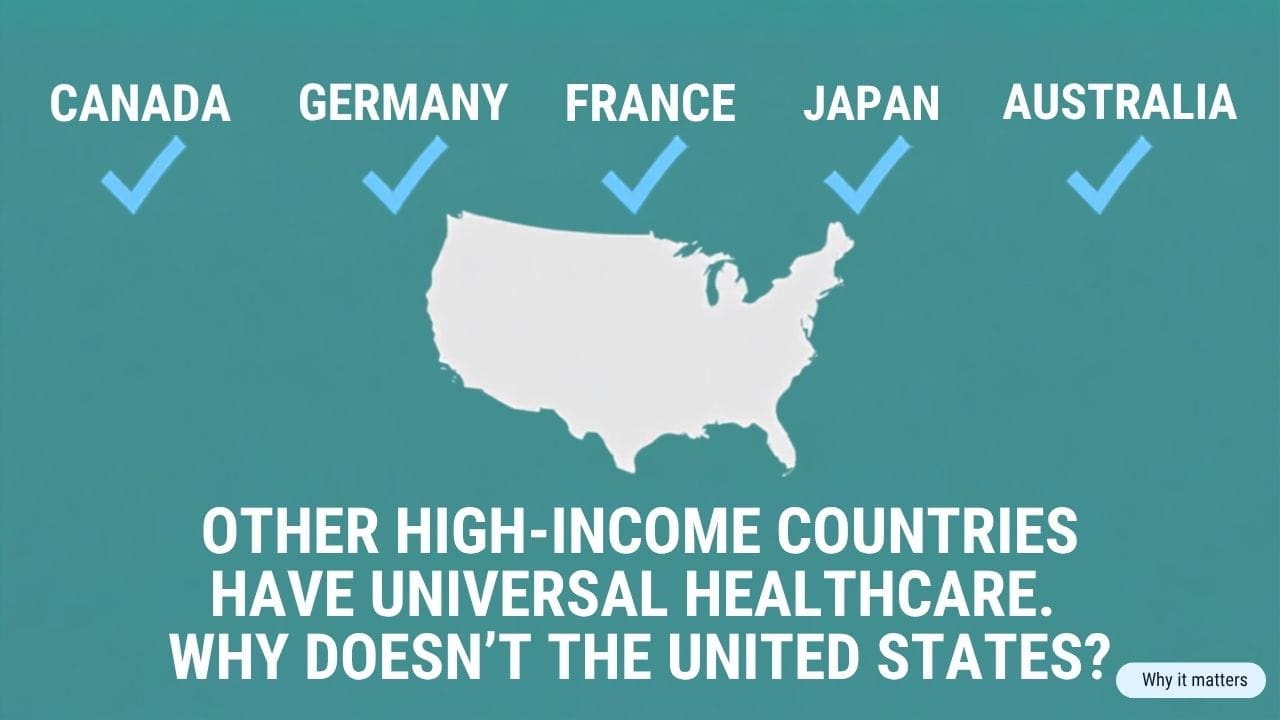
Yes. It can.
The harder questions are which model, how we would pay for it, what happens to private insurance, how doctors and hospitals get paid, and how we would change a healthcare system where powerful industries already have a major financial stake.
The Congressional Budget Office (CBO) has studied multiple ways the United States could reach near-universal coverage. They range from keeping much of today’s private system and adding automatic or public coverage to creating a single government payer. (CBO: Policies to Achieve Near-Universal Health Insurance Coverage)
And this gives us an opportunity to correct a misconception from the very beginning:
Universal healthcare is a goal, not a specific healthcare system.
Countries can reach that goal in very different ways.
People Are Asking
These are some of the questions Americans ask most often about universal healthcare. Short answers first — then we’ll unpack them throughout the article.
| Question | Short Answer |
| Would I lose my private insurance? | It depends on the model. Under some plans, yes. Under others, private insurance stays. |
| Would my taxes go up? | Under some models, yes — but premiums, deductibles, and other costs could fall or disappear. A better comparison is total cost, not taxes alone. |
| Would my doctor work for the government? | Not necessarily. Doctors could remain private while the government pays the bill — that’s already how traditional Medicare works. |
| Could I still choose my doctor? | It depends on the model. Your choices could also depend on which doctors participate in the system. |
| Would there be waiting lists? | Possibly for some services under some models. If more people seek care, some systems could face longer waits. |
| Would hospitals still be private? | They could be. Single-payer insurance does not require government-owned hospitals. |
| Is universal healthcare socialism? | No. Universal coverage describes who is insured, not who owns the economy. Capitalist democracies across the globe provide it. In fact, the United States is the only high-income developed country that does not have universal health coverage. |
| Could America actually do it? | Yes. The difficult question is which system Americans would accept and finance. |
THE BIGGER PICTURE
Before we go any further, let’s address something you may already be thinking:
“Sure, Canada and countries in Europe have universal healthcare. But everything is expensive there because their taxes are so high.”
It’s true that universal healthcare has to be paid for. In countries such as Canada and the United Kingdom, taxes help finance the healthcare system.
But that doesn’t mean universal healthcare is the reason housing, groceries, electricity, gasoline, or other everyday expenses are expensive.
Those countries have their own cost-of-living problems, just as the United States does.
And comparing taxes alone misses something important:
Americans are already paying for healthcare. We just pay for it in many different places.
We pay through taxes. We pay insurance premiums. Employers contribute to premiums. We pay deductibles and copays. We pay prescription costs and other medical bills.
So the real comparison isn’t:
Higher taxes vs. lower taxes.
It’s:
What does a society spend in total to provide healthcare to its population — and what does it get in return?
That comparison changes the picture.
According to the OECD’s latest comparable data, the United States spends about $14,885 per person on healthcare. Canada spends about $7,301 per person.
That’s roughly twice as much per person in the United States.
And Canada isn’t the only comparison.
Countries including Germany, Japan, Canada, France, Australia, and the Netherlands provide universal or near-universal coverage while spending less per person than the United States.
Yet millions of Americans remain uninsured.
Universal healthcare doesn’t make healthcare free.
It changes how the cost is collected, shared, negotiated, and paid.
That doesn’t automatically mean every universal healthcare system is cheaper, or that every American would personally pay less under every proposal.
It means that when someone says, “Look how high their taxes are,” the next question should be:
“Okay. Now show me what they pay for healthcare in total — and compare it with what we pay.”
That’s the kind of comparison this article is going to make.
Part I — First: What Does “Universal Healthcare” Mean?
This needs to be crystal clear.
Universal healthcare means essentially everyone can access needed healthcare services without facing financial hardship.
It does not automatically mean:
- ❌ Government owns every hospital
- ❌ Doctors become federal employees
- ❌ Private insurance disappears
- ❌ Everyone gets exactly the same healthcare
- ❌ Communism
Countries achieve universal coverage in different ways — and we’ll look at four possible models for the United States in Part III.
The United States already provides health insurance to most of its population. According to the CBO’s July 2026 projections, about 30 million Americans — roughly 9% of the population — are expected to be uninsured in 2026.
And that number is expected to grow.
The CBO projects that about 37 million Americans will be uninsured by 2036, largely because of provisions in the 2025 reconciliation law that are expected to reduce enrollment in Medicaid and CHIP and, to a lesser extent, ACA Marketplace coverage.
📌 Key Takeaway:
Most Americans have health insurance. But instead of closing the remaining coverage gap, current projections show that gap getting larger.
That raises a question:
Americans are already paying for healthcare in many different ways. So what would it take to cover everyone?
Part II — America Doesn’t Actually Have One Healthcare System
Right now, the United States doesn’t operate under one healthcare system. It operates several at the same time.
| System | How It Works | Who It Mainly Covers |
|---|---|---|
| Medicare | Federal health insurance | Adults 65+, plus some younger people with disabilities |
| Medicaid / CHIP | Federal-state public insurance programs | Eligible low-income adults, children, pregnant people, and others |
| VA | Government-run healthcare system | Eligible veterans |
| Employer-sponsored insurance | Employers and workers pay premiums, usually to private insurers | Workers and their families |
| ACA Marketplace | Mostly private insurance, often with federal subsidies | People buying their own coverage |
| Uninsured | No health insurance; care may be paid out of pocket or become uncompensated care | About 30 million Americans in 2026 |
And there’s an extraordinary fact underneath this table:
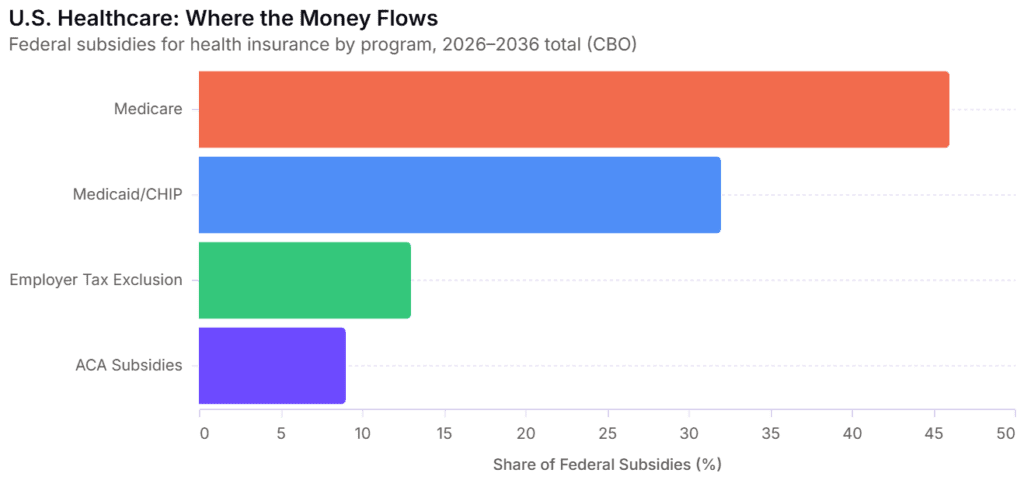
The federal government already spends trillions of dollars each year subsidizing health insurance through Medicare, Medicaid and CHIP, ACA subsidies, and tax benefits for employer-sponsored insurance.
So, the debate isn’t really:
Government involvement vs. no government involvement.
The government is already deeply involved in American healthcare.
The debate is about what that involvement should look like
Part III — There Isn’t Just One Way to Do Universal Healthcare
There are several ways the United States could move toward universal or near-universal coverage. The CBO has examined policies ranging from expanding today’s system to creating a single government payer. (CBO: Policies to Achieve Near-Universal Coverage)
Build on the ACA
Keep today’s public and private system, then expand subsidies, enrollment, and coverage.
Public Option
Keep private insurance while adding a government insurance plan people can choose.
Universal Hybrid
Guarantee coverage while private insurers and providers continue operating under stronger rules.
Single Payer
Use one public insurance system as the primary payer. Often called Medicare for All in U.S. politics.
Let’s look at four broad approaches.
OPTION A — Build on Obamacare
Keep private insurance, employer insurance, Medicare, and Medicaid. Then expand subsidies, automatically enroll uninsured people, close Medicaid gaps, and simplify enrollment.
The CBO has modeled combinations of policies like these that could bring the United States close to universal coverage.
| Possible Advantages | Possible Trade-offs |
|---|---|
| Least disruptive to the current system | Much of the complicated existing system remains |
| Preserves employer coverage | Expanding coverage alone would not necessarily control healthcare prices |
| Builds on existing infrastructure | Administrative complexity persists |
Bottom line: This is the most familiar path. It’s essentially what the ACA was designed to do, scaled up.
OPTION B — Public Option
Keep private insurance. But create a government insurance plan people can choose instead.
So, your menu looks like this:
Private insurance | Public insurance → You choose.
(CBO: A Public Option for Health Insurance in the Nongroup Market)
That’s important because:
A public option does not eliminate private insurance. It adds a public competitor.
Studies suggest a public option could reduce premiums by about 7–8%, according to research cited by the National Institutes of Health. (NIH: Options for Dialing Down From Single Payer)
| Possible Advantages | Possible Trade-offs |
|---|---|
| Preserves private insurance | Savings depend heavily on how the public plan is designed |
| Gives consumers another choice | Insurers and providers may oppose lower payment rates |
| Could create price competition | A public option alone would not guarantee everyone is insured |
| Allows a more gradual transition | Would still operate alongside much of the existing healthcare system |
Bottom line: This approach adds a government insurance option without eliminating private insurance. It changes less of the existing system than single payer would.
OPTION C — Universal Hybrid System
This is the model many Americans don’t realize exists.
Government guarantees coverage. But private insurers and/or private providers can remain involved. The CBO describes potential systems where people could choose between publicly administered coverage and private plans operating under common rules.
This is where we explain one of the most important distinctions in the entire healthcare debate:
🔑 Key Concept: Who pays for healthcare and who provides healthcare are two different questions.
Government, private insurer, employer, patient — or some combination.
Private doctors, hospitals, clinics, public facilities — or some combination.
A doctor can work for a private medical practice while the government pays the bill.
That’s already essentially what happens when a private physician treats a traditional Medicare patient.
Countries like Germany and the Netherlands use hybrid systems — heavily regulated private insurers operating under government rules, with mandatory coverage and income-based subsidies. Both are capitalist economies with universal healthcare.
| Possible Advantages | Possible Trade-offs |
|---|---|
| Balances a public guarantee with private flexibility | Can be complex to design and regulate |
| Used successfully in other capitalist democracies | Requires a strong regulatory framework |
| Preserves a major role for private providers and insurers | The transition could be disruptive |
Bottom line: This is the “both/and” model. Government ensures everyone is covered; private actors still operate.
OPTION D — Single Payer (Also sometimes called Medicare for All)
Note: “Medicare for All” is the name commonly used for single-payer proposals in American political debate, although specific Medicare for All proposals can differ in how they are designed.
This is the largest structural change.
Everyone gets coverage through one public insurance system. Taxes largely replace premiums, and the role of private insurance becomes much smaller or, depending on the proposal, disappears for covered services.
But — and this distinction is essential:
Single-payer insurance does not necessarily mean government-owned hospitals.
Doctors and hospitals could remain private while the government becomes the primary payer — exactly as it does for Medicare patients today.
The CBO says such a transition would be “enormously complex” and would require “substantial new federal revenues,” although premiums and much existing private health spending would simultaneously change or disappear. (CBO: Key Design Components and Considerations for a Single-Payer System; CBO: How CBO Analyzes the Costs of Proposals for Single-Payer Health Care).
So when you hear:
“Medicare for All would cost $X trillion.”
there’s another question worth asking:
Compared with what Americans currently pay in premiums, deductibles, employer contributions, taxes, and out-of-pocket expenses?
Looking at the government price tag without looking at the costs it would replace gives you only part of the picture.
| Approach | Private Insurance? | Government Role | Size of Change |
|---|---|---|---|
| Build on ACA | Yes | Expands subsidies and enrollment | Smaller |
| Public Option | Yes | Adds a public insurance choice | Moderate |
| Universal Hybrid | Yes, under stronger rules | Guarantees coverage and regulates the system | Larger |
| Single Payer | Limited or replaced for covered services | Becomes the primary insurer | Largest |
Universal healthcare tells us the goal: cover everyone. It does not tell us which system a country has to use.
Part IV — Then Why Doesn’t America Already Have It?
One reason is market concentration.
American healthcare isn’t one giant monopoly. But in many parts of the country, a small number of insurers, hospital systems, pharmacy benefit managers, and other companies control large shares of their markets.
That matters because when there are fewer competitors, the companies that remain can have more power over prices, contracts, and how the system operates.
Insurance Market Concentration
According to the American Medical Association’s 2025 analysis of health insurance markets:
- 97% of metropolitan commercial health insurance markets were highly concentrated in 2024.
- In 91% of metropolitan areas, at least one insurer controlled 30% or more of the market.
- In 47% of metropolitan areas, a single insurer controlled at least half of the market.
(AMA: Competition in Health Insurance Report; Becker’s: AMA 97% Finding; AHA News: AMA Report)
Pharmacy Benefit Managers
Pharmacy benefit managers, or PBMs, are companies that work between insurers, drug manufacturers, and pharmacies to negotiate drug prices and determine which medications insurance plans will cover.
This market is also highly concentrated. The three largest PBMs — Caremark Rx, Express Scripts, and OptumRx — control roughly 80% of the market.
The Federal Trade Commission has investigated their business practices and accused the three companies of using rebate practices that increased insulin costs for some patients. In 2026, the FTC reached settlements with Express Scripts and Caremark requiring changes intended to lower patient costs and increase transparency.
(FTC: Press Release on PBM Lawsuit; FTC: PBM Page; Healthcare Dive: PBM Case Update)
And Then There’s Politics
Corporate power is part of the story. But it isn’t the entire story.
Healthcare reform can change how trillions of dollars move through the economy. Insurers, hospitals, drug companies, doctors, employers, states, taxpayers, and patients can all be affected — and they don’t always want the same things.
Americans also disagree about taxes, the role of government, private insurance, how much doctors and hospitals should be paid, and how much disruption they are willing to accept in exchange for covering everyone.
That creates a difficult political reality:
The United States knows how to design a system that covers everyone. The harder part is agreeing on who pays, who gives something up, and how much of the current system we are willing to change.
Part V — Why Can One Hospital Charge $5,000 and Another $12,000?
Yes, this can happen. And the price differences can be enormous.
A RAND study compared what private health plans paid more than 4,000 hospitals with what Medicare would have paid for the same services. Using 2022 data, researchers found enormous differences.
- Private health plans paid hospitals an average of 254% of Medicare rates for the same services.
- Prices varied substantially by state, ranging from under 170% of Medicare rates in Arkansas to more than 380% in Florida.
- Individual hospital systems varied even more, from around 150% to more than 400% of Medicare rates.
(RAND: Private Health Plans Paid Hospitals 254% of Medicare; RAND: Round 5 Results)
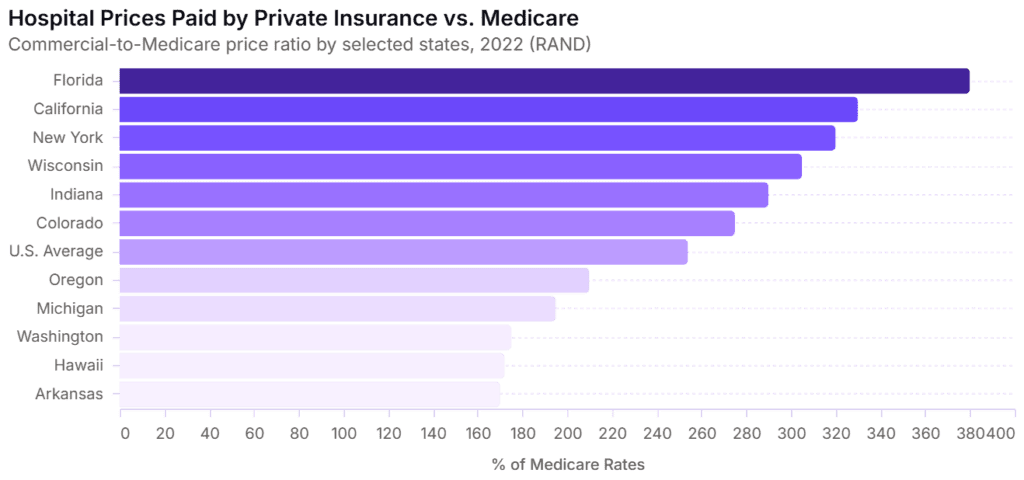
Same procedure. Same country. Dramatically different prices depending on where you receive care and who is paying the bill.
How Did The Price Gap Get So Wide?
- Hospital market power — When one or two hospital systems dominate an area, they may have more power to demand higher prices.
- Insurer negotiations — Different insurers have different bargaining power when negotiating hospital prices.
- Local competition — When patients and insurers have fewer hospitals to choose from, there may be less pressure to keep prices down.
- Provider consolidation — When hospital systems buy physician practices or merge with other hospitals, they can gain negotiating power.
- Different contracts — Insurers and hospitals negotiate their own contracts, which means the price for the same service can vary.
- Medicare vs. private insurance — Medicare generally sets payment rates using federal rules. Private insurers negotiate prices with hospitals.
This is why high healthcare prices can’t be explained simply by saying “corporations are greedy.” The structure of the market matters.
Part VI — Would Universal Healthcare Fix Those Prices?
Potentially some of them. But not automatically.
Here’s why:
- ✅ A single government payer could have enormous negotiating power. Medicare already pays hospitals substantially less than private insurance for many of the same services.
- ✅ A regulated multipayer system could set or limit prices while keeping multiple insurers.
- ✅ Congress could regulate some healthcare prices without creating universal healthcare.
- ✅ Antitrust policy could address hospital, insurer, or other healthcare-market consolidation.
- ✅ The government can negotiate some drug prices without creating universal healthcare. Medicare already negotiates prices for certain drugs under current law.
But here’s the crucial distinction:
Coverage
Who is insured?
Universal coverage primarily addresses this problem.
Prices
What can healthcare cost?
Price regulation, competition, and bargaining rules address this problem.
Those are two separate problems. A country could have universal coverage and still struggle with pricing. A country could have aggressive price regulation and still leave people uninsured.
They’re related. But they’re not the same.
Imagine every uninsured American received an insurance card tomorrow.
That would dramatically change who has coverage. But if hospitals, insurers, and drug companies continued using the same pricing system, giving everyone insurance would not automatically make those prices lower.
Coverage and cost are connected problems. They are not the same problem.
Part VII — Who Would Pay for It?
We can’t dodge this.
Universal healthcare isn’t free. Someone always pays.
Currently, Americans pay through a fragmented mix:
| How We Pay Now | Who Pays? |
|---|---|
| Employer-sponsored premiums | Employers and workers |
| Deductibles and copays | Patients |
| Other out-of-pocket costs | Patients |
| Federal and state taxes | Taxpayers |
| Government health programs | Funded largely through taxes and dedicated revenue |
And even when your employer pays part of your insurance premium, that healthcare benefit is still part of the cost of employing you.
Under another system, the mix changes — but the total doesn’t disappear:
- A single-payer system might mean higher taxes but lower or zero premiums and deductibles.
- A public-option system might preserve premiums while adding a cheaper alternative.
- A hybrid could use taxes plus regulated insurance premiums, and government subsidies.
So the useful question isn’t:
“Would taxes go up?”
Under some universal healthcare systems, they would.
But it’s only half of the question.
For example:
A proposal can sound enormously expensive if we count the new taxes but ignore thepremiums, deductibles, employer contributions, and other healthcare spending those taxes could replace.
The reverse is also true. A proposal shouldn’t be called a bargain unless the savings actually outweigh its new costs.
Neither side should get to show you only the number that helps its argument.
The useful question is:
“What would the average household pay in total — compared with what it pays today?”
And what would the United States spend as a whole compared with what it spends today?
That’s a much more intellectually honest comparison.
Part VIII — What Would We Gain — and What Could We Give Up?
There is no healthcare system without trade-offs.
Universal healthcare could solve some problems in the current system. It could also create new challenges, depending on how the system is designed.
✓ Possible Benefits
- Coverage for essentially everyone
- Less medical debt and financial hardship
- Simpler administration under some models
- Greater bargaining power
- Coverage that isn’t tied to a job
⚠ Possible Trade-offs
- Higher taxes under some models
- Lower payments to some doctors and hospitals
- Disruption during a major transition
- Less private insurance choice under some models
- Possible longer waits for some services
- Greater pressure on government budgets
The CBO has identified exactly this kind of trade-off in its analysis of single-payer systems: more people would receive healthcare, but the increase in demand could also lead to longer waits for some services if the supply of care did not keep pace.
And this is where the debate becomes bigger than whether one person pays more or less.
A universal healthcare system could ask some Americans to contribute more toward a system they personally use less. Others could receive more healthcare than they could afford on their own.
That’s true of many things Americans pay for together. Not everyone has children in public schools. Not everyone calls the fire department. Not everyone drives on every highway.
The policy question is whether ensuring access to healthcare is something Americans want to finance collectively — and, if so, which system offers the best balance of coverage, cost, choice, and access.
Reality Check
You may have heard: “Medical debt is the number one cause of bankruptcy in America.”
Reality: That claim is widely used, including by public officials, but researchers disagree about how to measure a “medical bankruptcy.” What is well established is that medical bills and serious illness contribute to financial hardship and bankruptcy for many American families — including some who have health insurance.
Part IX — Is Universal Healthcare Communism?
No.
Universal healthcare describes how a country ensures people have access to healthcare. Communism describes an economic and political system.
They are not the same thing.
The United States is the only high-income developed country without universal health coverage. The countries that provide it have not all become communist.
Germany, France, Canada, Australia, Japan, Switzerland, and the Netherlands all provide universal healthcare while maintaining market-based economies and private businesses.
A government helping ensure that everyone can access healthcare does not make an economy communist any more than publicly financed schools, fire departments, roads, Medicare, or Social Security make the United States communist.
This is where political language can muddy the debate.
Social programs, socialism, and communism are often used interchangeably in American politics. They do not mean the same thing.
Social Programs, Socialism, and Communism Are Not the Same Thing
Part X — Could It Actually Pass in America?
The Affordable Care Act showed that major healthcare reform is possible in the United States. It also showed how politically difficult it can be.
The law passed Congress in 2010 after a bitter political fight. Republicans strongly opposed it, it became a major issue in the 2010 midterm elections, and efforts to repeal or change it continued for years.
Yet the core law survived.
Healthcare policy can also move in the opposite direction.
In its July 2026 projections, the CBO estimated that about 30 million Americans will be uninsured in 2026, rising to about 37 million by 2036. Provisions of the 2025 reconciliation law are expected to contribute to that increase by reducing enrollment in Medicaid, CHIP, and ACA Marketplace coverage. (KFF: How Will the 2025 Reconciliation Law Affect the Uninsured?; CBPP: By the Numbers)
That illustrates something important: healthcare coverage isn’t settled permanently. Congress can expand it, reduce it, or redesign it.
Why Is Changing It So Difficult?
Changing healthcare means changing a system through which trillions of dollars move. Many groups have something at stake.
| Stakeholder | What’s at Stake? |
|---|---|
| Patients | Access, affordability, and choice |
| Employers | Healthcare costs and employee benefits |
| Doctors | Payment, autonomy, and administrative burden |
| Hospitals | Revenue and payment rates |
| Drug companies | Prices and patent protections |
| Insurance companies | Market share and revenue |
| PBMs | Fees, rebates, and business models |
| States | Medicaid costs and flexibility |
| Federal government | Spending and system oversight |
| Taxpayers | Taxes and value received |
That’s why healthcare reform becomes so difficult.
The problem isn’t that the United States doesn’t know how universal healthcare could work. We’ve already looked at several ways to do it.
The problem is that changing the system also changes who pays, who gets paid, who has negotiating power, and who gives something up.
Some companies could lose revenue. Some doctors and hospitals could receive lower payments. Some taxpayers could pay more. Some employers could pay less. Some families could spend less. Millions of people could gain coverage.
Those aren’t abstract policy changes. They create winners, losers, supporters, opponents — and a lot of political pressure.
So, could universal healthcare actually pass in the United States?
Yes.
There is no constitutional or economic rule that prevents the United States from creating universal coverage. Other high-income capitalist democracies have chosen different ways to do it, and the United States already operates several public and private healthcare systems of its own.
But passing it would require something harder than designing the policy:
Americans would have to agree on what they are willing to pay, what they are willing to change, and what they believe everyone in the country should be guaranteed.
That’s why reform becomes so difficult.
Not because Americans can’t design universal healthcare.
Because changing the system creates winners, losers, and enormous political resistance from those who benefit from the current arrangement.
Quick Healthcare Glossary
Healthcare has its own language. Here are the terms used in this article in plain English.
ACA (Affordable Care Act)
The 2010 federal healthcare law often called Obamacare. It expanded insurance coverage through marketplaces, subsidies, Medicaid expansion, and insurance rules.
Coinsurance
The percentage of a covered healthcare bill you pay after meeting your deductible.
Copay
A set amount you pay for a healthcare service or prescription, such as $30 for a doctor’s visit.
Deductible
The amount you generally pay for covered healthcare before your insurance begins paying its share.
Employer-Sponsored Insurance
Health insurance offered through a person’s job. The employer and worker often share the cost of the premium.
Medicare for All
A term commonly used in U.S. politics for proposals that would create a national single-payer healthcare system.
PBM (Pharmacy Benefit Manager)
A company that helps manage prescription-drug benefits for insurers, employers, and other health plans.
Premium
The amount paid regularly to maintain health insurance coverage.
Public Option
A government-run health insurance plan that would exist alongside private insurance.
Single Payer
A healthcare financing system in which one public program is the primary payer for covered healthcare services.
Universal Healthcare / Universal Health Coverage
A system designed to ensure that everyone can obtain needed healthcare without severe financial hardship. It does not require one specific type of insurance system.
Discussion
- Which of the four models appeals to you most, and why? What trade-off worries you the most?
- The U.S. already spends more per person on healthcare than any country on Earth. If we spent less per person — as most universal-coverage nations do — where would the savings come from? Insurer profits? Hospital prices? Drug costs? Administrative overhead?
- If the government already subsidizes healthcare by trillions annually, does the label “government healthcare vs. private healthcare” even make sense anymore?
- The 2025 OBBBA is projected to increase uninsured Americans by 10 million by 2034. Does that change the urgency of this conversation?
Continue Reading


No discussions yet
Be the first to join the discussion and share your thoughts with the community.