
Are Not the Same Thing
What these words actually mean — and why the difference matters when we debate government programs.
Before diving in, here is a helpful framework to keep in mind:
Part I — Is a Government Program “Socialism”?
Quick question: Is Social Security socialism?
What about Medicare? Public schools? Food assistance? The fire department?
If you’ve spent any time watching political commentary — or arguing with relatives at Thanksgiving — you’ve heard someone call a government program “socialism” or “communism.” Maybe you’ve wondered if they’re right.
Short answer: Not simply because the government funds or administers it.
Here’s what this article is not going to do: It’s not going to tell you whether Social Security is good or bad. It’s not going to argue for or against Medicare, public education, or food assistance programs.
Instead, we’re going to figure out what these words actually mean — socialism, communism, social program — so that when you hear them thrown around in a political debate, you can tell whether they’re being used accurately — and what they actually tell you about the policy being discussed.
That distinction matters. Because if we can’t agree on what words mean, we can’t actually have the policy debate.
Part II — Start with the Definitions
Let’s get the basics on the table. Clean, simple, no spin.
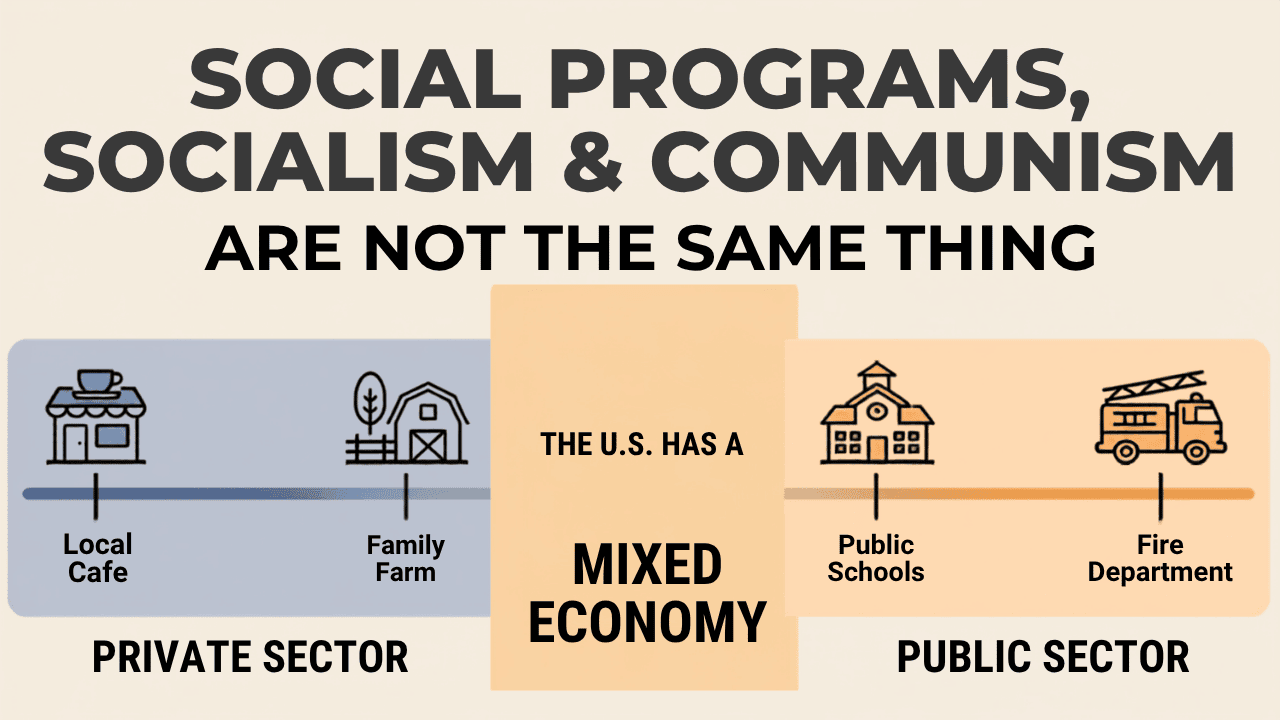
The United States has a mixed economy.
So does the United Kingdom. So does Germany. So does Japan. So do most modern democracies.
No modern economy operates with completely unregulated private markets or with all economic activity under collective ownership. In practice, countries combine private markets and government involvement in different ways. The United States is one of those mixed economies.
Here’s a simple way to visualize it:
Most Americans interact with both sides of this economy every day. You buy coffee from a privately owned café and drive to work on a publicly funded road. You work for a private company and pay taxes that fund public services.
Private markets and public services exist side by side. That’s a mixed economy.
Part III — So What Is Social Security?
Now let’s test these definitions against a real program.
What Social Security actually does:
That’s the system in a nutshell.
Now the question:
Does that make Social Security communism?
No. The government isn’t restructuring the economy around collective ownership. Workers aren’t being assigned to collective farms. Private property remains intact. The economic system hasn’t changed.
Does that mean nobody can reasonably criticize Social Security?
Also no. People legitimately debate:
- Whether benefit levels are too high or too low
- Whether the retirement age should change
- Whether payroll taxes are structured fairly
- Whether the program is financially sustainable over the long term
- Who should be eligible
- How the program should be designed
Those are policy debates. They’re healthy. They’re necessary.
Part IV — What About Medicare, Medicaid, and Other Programs?
Let’s run the same test across several major U.S. programs. A table does this better than paragraphs:
| Program | What It Does | Why This Alone Isn’t Socialism |
|---|---|---|
| Social Security | Social insurance funded by payroll taxes | It does not replace private ownership of the economy |
| Medicare | Government-administered health insurance | Most healthcare providers remain privately owned |
| Medicaid | Public health coverage jointly funded by federal and state governments | It pays for care within a mixed healthcare system |
| SNAP | Food assistance for eligible households | Grocery stores and farms remain largely privately owned |
| Public Schools | Government-funded education | A public service does not determine the country’s economic system |
| Veterans’ Benefits | Healthcare, education, housing, and disability benefits for eligible veterans | Providing public benefits does not determine the country’s economic system |
Notice the pattern: every one of these programs involves the government funding or administering a service. None of them, by themselves, transform the economic system into socialism.
And here’s a wrinkle worth noting: governments sometimes directly own and operate services — including municipal utilities, public transit, the Postal Service, and public hospitals. Government ownership of some services can exist within a mixed economy without making the entire economy socialist.
Part V — “But the Government Is Taking My Money and Giving It to Someone Else”
This is usually where the real disagreement surfaces. So, let’s address it directly.
Yes, taxation involves the government collecting money from individuals and businesses. And yes, some of that money goes to programs that benefit other people — sometimes people you’ll never meet.
Here’s the thing: that’s what taxation has always done.
Taxes fund things Americans use collectively:
- National defense
- Roads and highways
- Courts and the justice system
- Public schools
- Social Security
- Medicare
- Disaster response
- Scientific and medical research
You probably use publicly funded services every day without thinking about the ideology behind them. Nobody calls the fire department “socialism” when their house is burning or the highway system “communism” when they’re driving to work.
Not every taxpayer uses every service. You might not have children in public school. You might never need FEMA assistance. You might not be old enough for Medicare. But our system uses taxes to fund some services collectively rather than requiring each person to pay for them individually.
Those are legitimate political disagreements. A fiscal conservative might argue for lower taxes and fewer programs. A progressive might argue for a stronger safety net funded by higher taxes on wealthy earners. Someone in the middle might support some programs and oppose others.
Those are policy positions. They’re worth debating.
But here’s the critical point: taxation and redistribution existing does not, by itself, determine whether an economy is socialist or communist.
Capitalist democracies collect taxes and use some of that revenue to fund public services and benefits. Taxation and public spending are not unique to socialist or communist systems. They also exist in capitalist mixed economies.
Part VI — The Bismarck Surprise
Here’s a name you probably don’t associate with socialism: Otto von Bismarck.
Bismarck was the chancellor who unified Germany in the late 1800s. He was a conservative — a monarchist, a militarist, and about as far from a socialist revolutionary as you could get.
And yet, in the 1880s, he created some of the world’s first modern social insurance programs:
Why would a conservative do that?
Bismarck saw that working-class Germans were becoming attracted to socialist movements. His strategy had two parts. He created social protections that gave workers a stake in the existing system. At the same time, his government used anti-socialist laws to suppress socialist political organizations.
He wasn’t trying to create socialism. He was trying, in part, to reduce its political appeal by giving workers greater protection within the existing system.
And because we’ve already established his facial-hair credentials in a previous article: he was also, admittedly, very committed to the mustache.
😂 Moving on.
Part VII — Why These Labels Are So Powerful
This is where the article shifts from “what do these words mean?” to “why are they so often misused?”
Words like socialist, communist, and capitalist carry emotional and historical weight. They invoke the Cold War, the Soviet Union, the Berlin Wall, nuclear standoffs, and decades of fear.
Why does “socialism” scare Americans more than “government program”?
Because the word carries historical associations far beyond its dictionary definition.
During the Red Scare and McCarthy era, accusations of communist ties could destroy careers and reputations and bring government investigation. The fear spread beyond suspected communists. During the related Lavender Scare, thousands of gay federal workers lost their jobs or were forced out because they were considered security risks — an idea tied closely to Cold War fears about communism. Some faced financial ruin and severe emotional distress. Some died by suicide.
The Cold War kept these fears alive for decades. For generations of Americans, words like socialist and communist weren’t just political or economic terms. They were associated with threats to the country, disloyalty, and fear.
If you can attach the label “communist” to a policy proposal, you don’t have to engage with the policy itself. The label does the work for you.
Read more: National Archives: Eisenhower and McCarthy, National Archives: Eisenhower and the Red Menace, and National Archives: “These People Are Frightened to Death”.
Here’s what happens when labels replace arguments:
That’s a completely different conversation — and it tells us very little about the policy.
This isn’t limited to one side of the political spectrum. “Capitalist” can be used as an insult on the left, just as “socialist” can be used as a weapon on the right. Neither helps us understand the policy being debated.
Part VIII — The Debate We Should Actually Be Having
Here’s the heart of the matter.
When Americans debate social programs, the most useful question usually isn’t:
❌ Capitalism vs. Communism
Instead, ask:
These are hard questions, and Americans disagree about the answers. That’s why we have elections, legislatures, and public debate.
Reasonable people can answer these questions differently — and do.
- A fiscal conservative may favor fewer government programs, lower spending, and more reliance on private markets.
- A progressive may favor a larger social safety net and more government spending on public programs.
- A moderate may support some programs and oppose others, weighing each on its merits.
- A libertarian may want government involvement minimized across the board.
Those are policy positions. Each can be debated with evidence and judged on its merits.
What doesn’t advance the conversation is dismissing a food-assistance program as “communism” or dismissing someone’s concerns about government spending as proof that they “don’t care about poor people.”
Labels shut down thinking. Questions open it up.
Part IX — People Are Asking
Short answers to the questions people are actually searching for.
Part X — What This Means for You
Here’s the practical takeaway.
The next time someone calls a policy “socialist” or “communist,” you don’t have to argue about the label. You don’t have to defend or attack the word.
Ask what they mean.
Then steer the conversation back to the actual policy:
Those questions will tell you more about a policy than any political label ever will.
Words matter. Definitions matter. But understanding the label is only the beginning. The next question is whether the policy itself works.
That’s a debate worth having.
Related Articles
- Coming soon: The Manufacturing of Culture Wars — how labels like “socialism” became political weapons
- Checks and Balances
- Can the US Have Universal Healthcare
- Debunked: 5 Viral Claims About the $40 Trillion Debt That Aren’t True


No discussions yet
Be the first to join the discussion and share your thoughts with the community.