
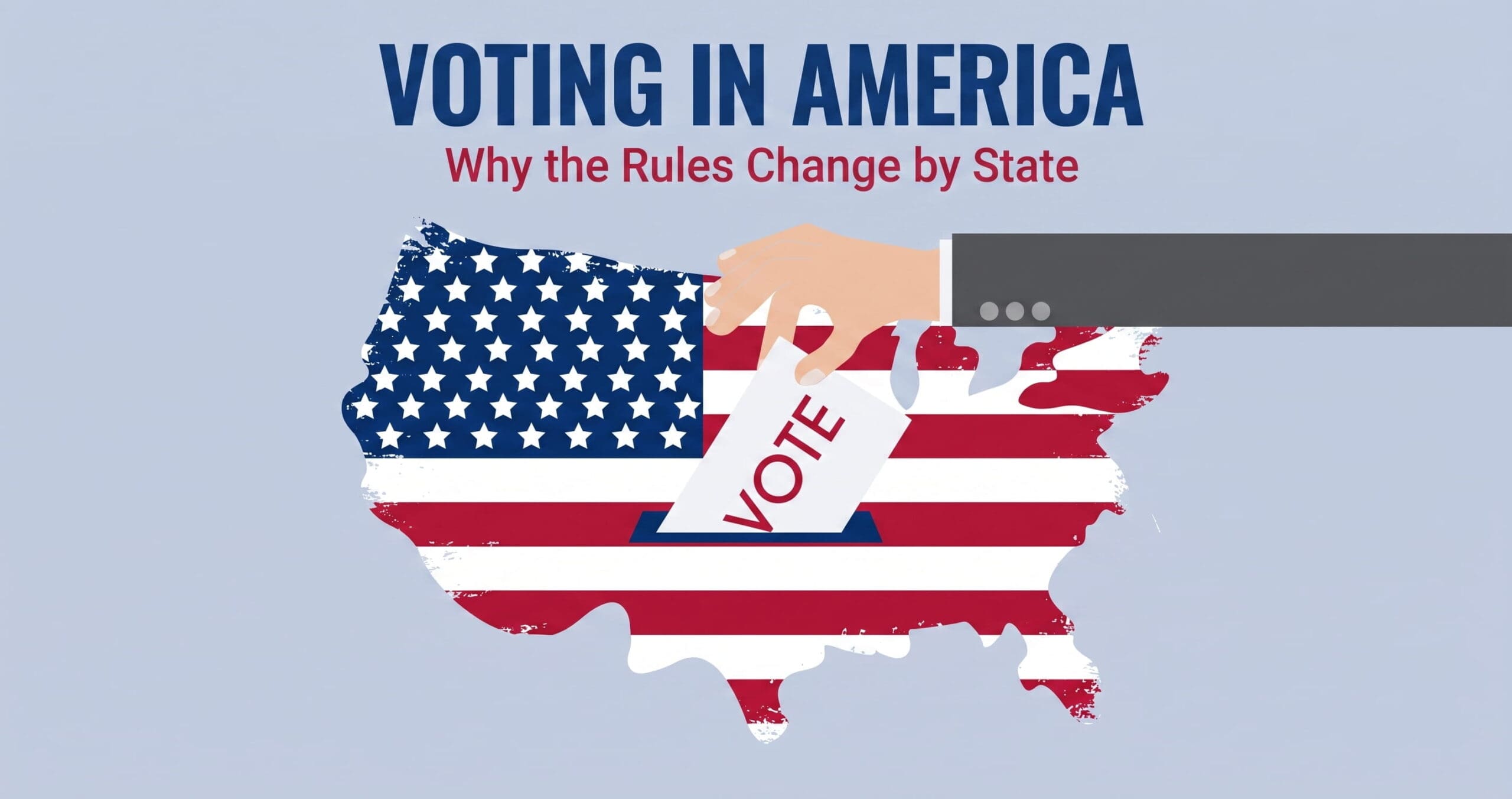
Who Can Vote, How Registration Works, and Why Every State Plays by Different Rules
Part 1: What You Can Do Right Now
Ever wonder why voting rules in America can make voting feel effortless for one person and like an obstacle course for another?
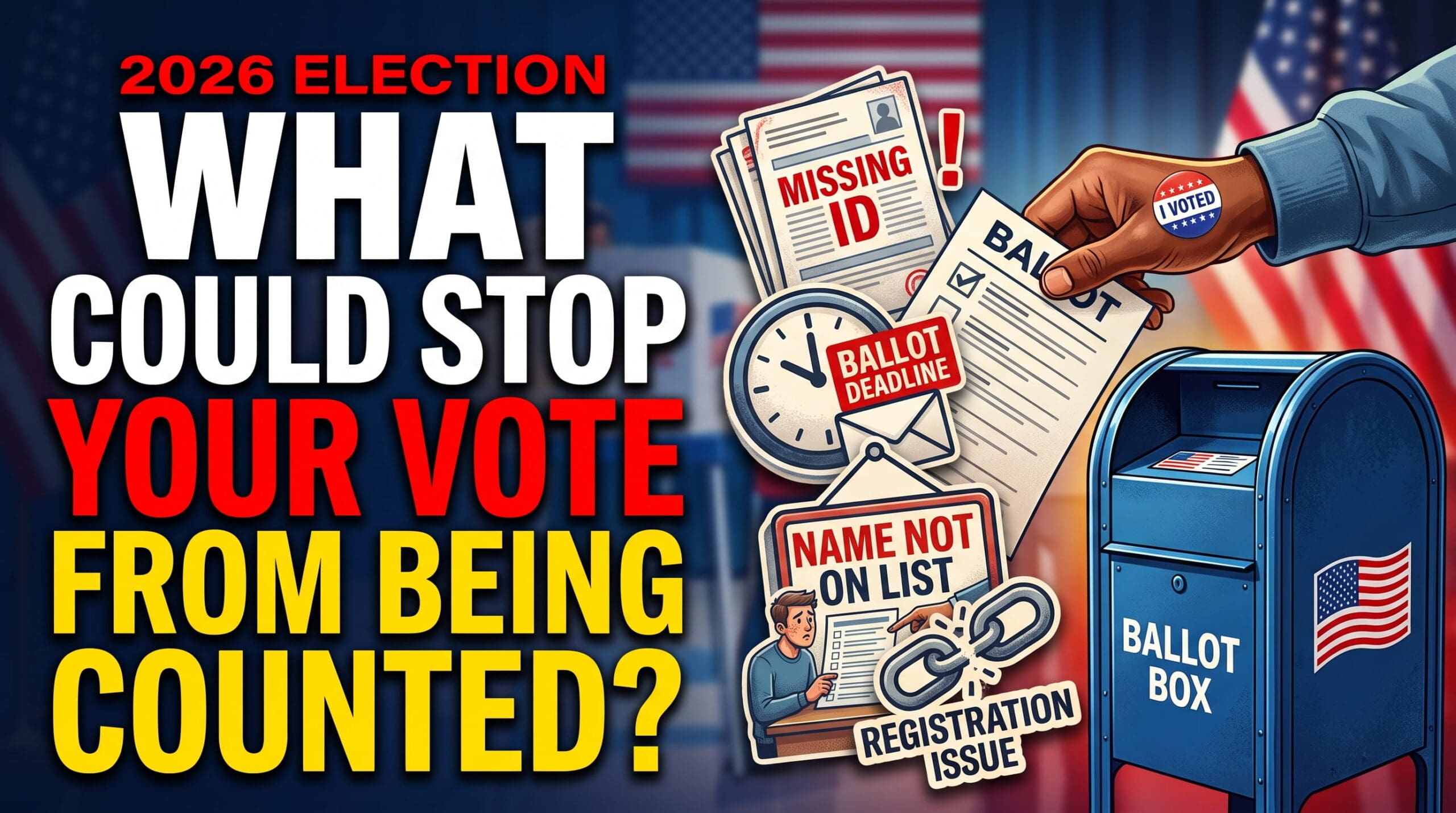
You don’t need to memorize 50 state legal codes. A few minutes of preparation can prevent many of the most common Election Day problems.
Your Pre-Election Checklist
- Check your registration status at Vote.gov — the official federal portal that directs you to your state’s election website.
- Confirm your address is current, especially if you’ve moved. Your address determines important details — your districts, your ballot, and your polling place.
- Learn your state’s ID requirements before Election Day. Start with your state election website. VoteRiders also offers free, nonpartisan help understanding what identification your state accepts.
- Find your deadlines. Check registration deadlines, mail ballot request deadlines, and ballot return deadlines through your state or local election office. Vote.org also provides a state-by-state deadline tracker.
- Save your local election office’s phone number. Your county clerk, board of elections, or other local election office can answer questions about the rules in your jurisdiction.
If you believe you are registered and eligible to vote in a federal election but your name does not appear on the voter list, ask about casting a provisional ballot. The Help America Vote Act of 2002 established provisional-ballot protections for voters whose eligibility cannot immediately be confirmed.
Casting a provisional ballot does not automatically mean it will be counted. Election officials review the ballot afterward and determine whether the voter was eligible under applicable law.
If you’re told you’re not on the voter list, ask a poll worker what options are available before leaving the polling place.
Elections in America are run locally, under state law, within guardrails set by federal law and the Constitution. Knowing your state’s specific rules is the single most important thing you can do before Election Day.
Part 2: Who Can Vote?
For federal elections, the basic eligibility requirements generally include:
- U.S. citizenship
- Being 18 by Election Day
- Meeting your state’s residency requirements
- Registration — required everywhere except North Dakota, the only state without voter registration
States may have additional eligibility rules, which is why checking the requirements where you live matters.
How the Vote Expanded Over Time
The electorate at the nation’s founding would barely recognize the electorate today. The Constitution largely left voter qualifications to the states, where voting was generally restricted to white men and often further limited by property, taxpaying, or other requirements.
Over time, constitutional amendments and federal laws dramatically expanded access to the ballot.
Black men gained constitutional protection for their right to vote.
Women gained constitutional protection for their right to vote.
People could no longer be charged a poll tax to vote in federal elections.
The federal government gained stronger tools to fight racial discrimination in voting.
The voting age dropped from 21 to 18.
The 15th Amendment promised Black men the vote on paper in 1870 — but for nearly a century, many states, particularly across the South, undermined that promise through poll taxes, literacy tests, grandfather clauses, and outright intimidation.
It took the Voting Rights Act of 1965 to give the 15th Amendment real teeth.
Constitutional rights often arrive on paper long before they arrive in practice.
The 26th Amendment is the fastest-ratified constitutional amendment in U.S. history — ratified in about three months in 1971, driven in part by Vietnam-era pressure: “old enough to fight, old enough to vote.”
The pattern to notice: Voting rights in America weren’t established all at once. Amendments, federal laws, court decisions, and state laws have reshaped who can participate over more than two centuries.
But even as the country established national protections for the right to vote, states retained substantial authority over how elections are actually run.
Part 3: What Voter Registration Actually Is
Think of voter registration as getting on the official guest list. It puts you on your state’s voter rolls and gives election officials the information they need to confirm who you are, whether you’re eligible, and where you should vote.
Registration doesn’t decide who you’re allowed to vote for politically. Your address determines which congressional, state, and local districts you live in — and therefore which races appear on your ballot.
Why Your Address Decides Everything
Your home address determines:
- Your U.S. House district
- Your state senate and state house districts
- Your county commission and municipal wards
- Your school board district
- Your polling location
- Which contests appear on your ballot
Move a few blocks, and you may cross a district line — same city, different representatives, different ballot.
How Americans Register
Because states write their own rules, there’s no single doorway. The most common ways include:
- Online registration — available in most states through a state registration portal.
- Mail registration — including the National Mail Voter Registration Form, which can be used in most states.
- In-person registration — through local election offices or other designated government agencies.
- Automatic Voter Registration (AVR) — in states that use it, eligible people can be registered or have their registration updated through participating government agencies, such as the DMV. The exact process varies by state.
- Same-Day Registration (SDR) — allows eligible voters to register and vote during the same trip, including on Election Day in some states.
Registration deadlines vary widely. Some states require voters to register before Election Day, while others offer same-day registration.
Never assume you know the deadline — check your state’s official election website.
Part 4: Why Every State Plays by Different Rules
This is the question behind everything else: why can your cousin in Tennessee and your neighbor in Oregon have such different experiences?
The Constitution Divides the Power
The Constitution gives states a major role in running elections. Article I, Section 4 — known as the Elections Clause — gives state legislatures authority over the “Times, Places and Manner” of congressional elections.
That division of power helps explain why registration deadlines, early voting, mail ballot rules, and other election procedures can look so different from one state to another.
But states don’t have unlimited authority. The same clause gives Congress power to make or change rules governing congressional elections, and other parts of the Constitution and federal law protect voting rights nationwide.
Congress has used its authority to establish important national protections and election requirements:
- Voting Rights Act (1965) — strengthened federal protections against racial discrimination in voting.
- National Voter Registration Act (1993) — made voter registration available through places such as motor vehicle agencies and certain public assistance offices. That’s why you may hear it called the “Motor Voter” law.
- Help America Vote Act (2002) — established new federal election-administration requirements after problems exposed during the 2000 presidential election, including requirements involving provisional ballots and statewide voter-registration databases.
- Uniformed and Overseas Citizens Absentee Voting Act (1986) — protects absentee-voting access in federal elections for eligible military members and U.S. citizens living overseas.
🎯 The Mental Model
Think of American elections as having two layers of rules:
Part 5: The Ways You Can Cast a Ballot
Depending on where you live, Election Day may be only one of several opportunities to cast your ballot.
- Election Day voting — the traditional trip to your assigned polling place.
- Early in-person voting — many states allow voters to cast a ballot in person before Election Day. The dates, locations, and rules vary by state.
- Absentee or mail voting — voters receive a paper ballot before Election Day and return it according to their state’s rules. Some states require voters to request a ballot, while others automatically mail ballots to registered voters.
- Vote-by-mail states — some states automatically send ballots to active registered voters for elections. Voters can then return them using methods allowed by state law, which may include mail, official drop boxes, or designated voting locations.
The important distinction isn’t which method is “normal.” It’s which options your state offers and what deadlines apply to each one.
Part 6: Voter ID — The Policy Debate, Honestly Presented
Voter ID rules vary significantly by state. Some states require photo identification, others accept non-photo documents, and some generally allow voters to verify their identity in other ways. In certain states, a voter who doesn’t have the required identification at the polls may need to take additional steps for the ballot to count.
That’s where a straightforward idea — prove that you are who you say you are — turns into a much larger policy debate about election security and access to the ballot.
Identification strengthens verification.
- Helps confirm that the person casting a ballot is the registered voter they claim to be.
- Creates a clear identity-verification requirement.
- Can strengthen public confidence in election security.
Strict requirements can create barriers.
- In-person voter impersonation is rare.
- Obtaining the required ID can involve documents, travel, related costs, or time away from work.
- Those burdens may affect some eligible voters more than others.
The open civic question: How do you build security requirements that protect elections without filtering out eligible voters?
🔑 KEY MESSAGE: Voter Fraud Exists — But It Is Rare
Cases of voter fraud do happen, and when they are discovered they can be investigated and prosecuted. But documented fraud represents a tiny fraction of the enormous number of ballots Americans cast.
That distinction matters. “Voter fraud has happened” and “voter fraud is widespread” are two very different claims.
Mail ballots also have vulnerabilities that election officials have to guard against, but research has found documented mail-ballot fraud to be rare. Election systems use measures such as voter records, signature verification, ballot tracking, identification requirements in some states, audits, and criminal penalties to detect or deter improper voting.
The goal isn’t to pretend fraud never happens. It’s to measure the problem accurately and build safeguards proportional to the actual risk.
What Does “Rare” Actually Look Like?
Why This Question Became So Prominent
Claims of widespread voter fraud became especially prominent after the 2020 presidential election. Donald Trump and his allies challenged election results through numerous lawsuits and publicly alleged that fraud and other irregularities had affected the outcome.
The court record is more complicated than the shorthand that “more than 60 courts found no fraud.” Some cases were withdrawn or dismissed for procedural reasons without judges deciding the underlying claims. But courts that did consider substantive challenges did not establish widespread fraud sufficient to overturn the election results. In several cases, judges specifically found that the evidence presented did not support allegations of fraud or illegal votes.
That distinction matters. Individual cases of voter fraud can occur without voter fraud being widespread enough to determine an election. Both claims require evidence.
Source: Brennan Center for Justice, Mail Ballot Security Features: A Primer, citing a Washington Post analysis of mail ballots in Colorado, Oregon, and Washington during the 2016 and 2018 general elections. and Campaign Legal Center, Results of Lawsuits Regarding the 2020 Elections.
Part 7: Moving, Voter Rolls, and Felony Convictions
If You Move
Moved to another state? Check the registration requirements in your new state. Your old registration does not simply follow you across state lines.
Moved within your state? Update your address with your election office. Even a short move can change your districts, polling place, or ballot.
Why Voter Rolls Change
Election officials regularly update voter rolls because people move, die, change names, become eligible, or otherwise change status. Accurate voter lists help election officials prevent duplicate records and keep voter information current.
But list maintenance also has safeguards for a reason: removing the wrong person can prevent an eligible voter from casting a regular ballot. That’s another reason to check your registration before an election rather than discovering a problem at the polling place.
What About Felony Convictions?
A felony conviction does not affect voting rights the same way everywhere. Once again, where you live matters.
States have very different rules governing when — or whether — voting rights are lost and when they are restored.
| Rule | What It Means |
|---|---|
| Voting rights retained | In a small number of jurisdictions, a felony conviction does not remove the right to vote, even during incarceration. |
| Rights restored after release | In many states, voting rights return after someone leaves prison. |
| Rights restored after sentence requirements are completed | Some states require additional parts of a sentence to be completed before voting rights return. |
| Additional action required | In some states or circumstances, restoration may require an application, pardon, court action, or another process. |
If you have a past felony conviction, don’t assume that you cannot vote. Your eligibility depends on the law where you live and your individual circumstances. Check with your state or local election authority.
📖 The Bigger Trend
Over the past several decades, many states have changed their laws to restore voting rights to more people with felony convictions. But there is still no single national rule, and significant differences remain among states.
Part 8: Reading the News Like a Pro
Voting-law headlines can sound dramatic:
“State X Just Changed Its Voting Law.”
Before deciding whether a change makes voting more secure, more difficult, more accessible — or some combination of the three — ask a few questions.
Was it voter ID, registration, early voting, mail ballots, polling locations, eligibility, or something else?
Does the rule apply to everyone, or mainly to certain voters or circumstances?
A headline may tell you what changed without telling you what voters could do previously. That comparison matters.
Election laws are sometimes challenged in court, delayed, blocked, or changed again. A law being passed does not always mean it is currently being enforced.
When you hear that a voting law makes elections “more secure” or “harder to vote,” don’t stop at the description.
Ask: What changed, who does it affect, and what does the evidence show?
Final Thoughts
Voting in America can feel complicated because there isn’t one set of rules that works exactly the same everywhere.
But you don’t need to memorize all of them.
You need to know the rules where you live.
Check your registration. Keep your address current. Know your state’s ID requirements and deadlines. And when you hear that a voting rule has changed, don’t rely on the headline alone — find out what actually changed and whether it affects you.
The larger lesson is about more than voting.
Federalism means Americans can share the same constitutional rights while experiencing government differently depending on the state where they live. Elections are one of the clearest examples of that system in action.
And when debates over voter fraud, election security, access, or changing voting laws become political, remember one principle from this guide:
Check the rule.
Check the evidence.
Check your registration.
Then vote.
💬 Discussion Questions
- Should voting rules be more consistent across all 50 states, or is state control an important part of federalism?
- Should voter registration be automatic for every eligible citizen, or should individuals be responsible for registering themselves?
- How should states balance election security with making voting accessible to eligible voters?
- Should voting rights automatically be restored after someone completes a felony sentence? Why or why not?
- Which voting rule surprised you most — and does knowing the reason behind it change how you view it?
Related Articles
Coming Soon: Can Voting Machines Be Hacked? How America Checks Whether Election Results Are Accurate
- Who Runs Elections in the United States
- What is the Electoral College
- Primaries vs General Elections: What’s the Difference
Sources
- Vote.gov — voter eligibility, registration, state election information
- U.S. Election Assistance Commission — election administration and voter registration
- Congress.gov / Constitution Annotated — Elections Clause and constitutional authority
- U.S. Department of Justice — Voting Rights Act, NVRA, HAVA and federal voting protections
- NCSL — voter ID, same-day registration, early voting
- Ballotpedia — automatic voter registration and all-mail voting
- MIT Election Data + Science Lab — automatic voter registration
- The Sentencing Project — felony disenfranchisement/restoration
- Vote.org — state registration deadlines
- Brennan Center for Justice — mail-ballot fraud analysis used for the 14.6 million / 372 / 0.0025% graphic
- Campaign Legal Center — 2020 election litigation

No discussions yet
Be the first to join the discussion and share your thoughts with the community.