
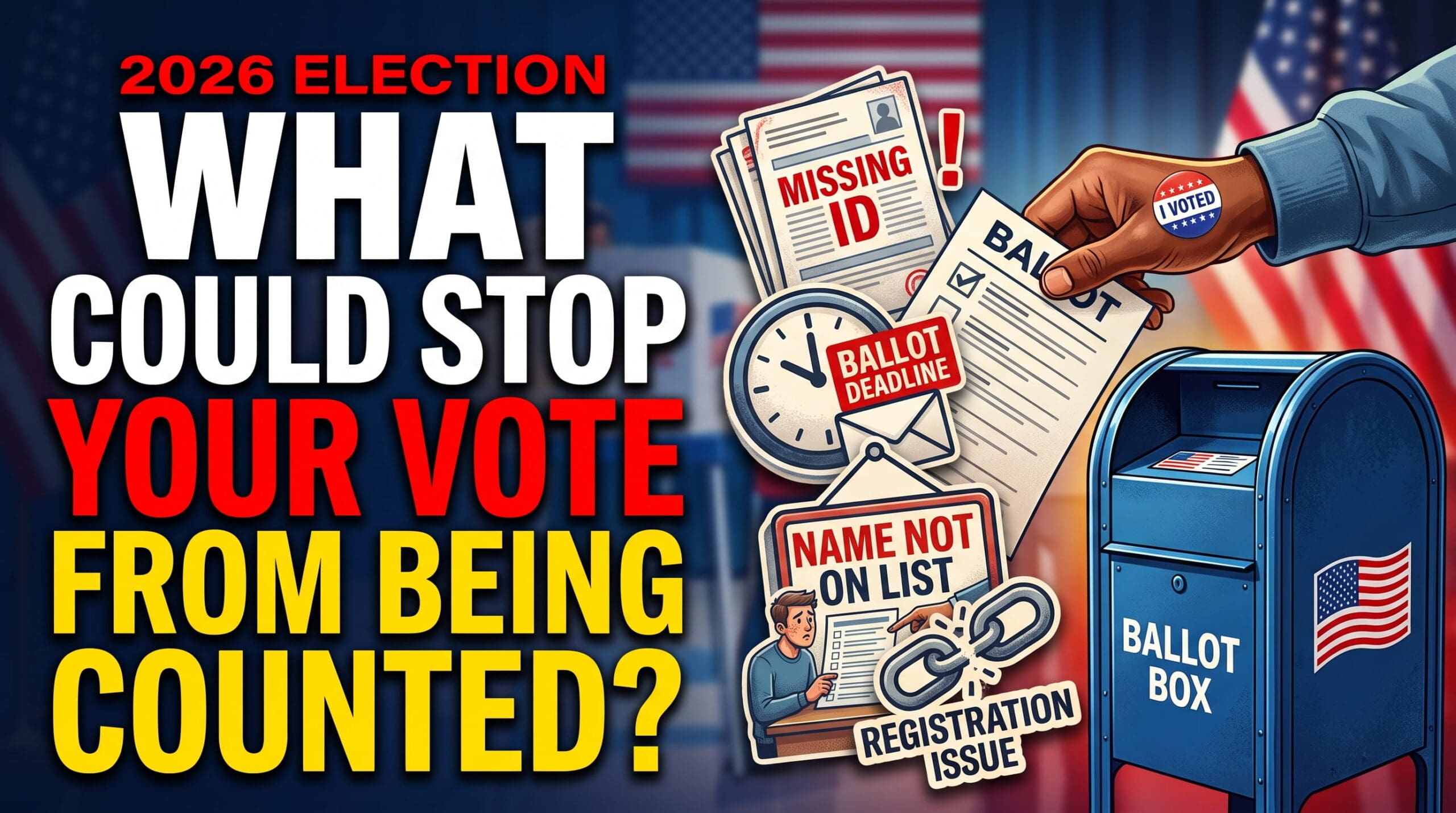
Mail Ballots, Voter ID, Registration Problems, and Your Rights at the Polls
“Will my mail ballot actually be counted?”
“What if they ask me for photo ID?”
“What if my name isn’t on the voter list?”
“What if someone challenges me at the polls?”
“What if my ballot has a mistake?”
These aren’t questions about who wins the 2026 midterms. They’re questions about whether your vote makes it into the count. And the answer depends partly on where you live.
Here’s the first thing to understand: America doesn’t have one set of voting rules.
The rules for registration, voter ID, mail ballots, and fixing ballot problems vary by state. Some rules are even being challenged in court as the 2026 midterms approach.
So this isn’t a national answer sheet. It’s a guide to the places where a vote can hit trouble — and what you can do before that happens.
Most obstacles to a counted vote aren’t dramatic — they’re procedural. Registration problems, ID requirements, envelope mistakes, missed deadlines, and signature issues can create problems for eligible voters.
A 15-minute check before Election Day can prevent many of them.
Before You Read the Rest: The 15-Minute Check
- Confirm your registration today — check your state’s official election website or use Vote.gov to find your state’s registration lookup.
- Look up your state’s ID rule — photo, non-photo, or none. Phone wallets don’t work everywhere.
- Find your state’s mail-ballot deadline — and check whether it is based on when the ballot is received, postmarked, or both.
- Return mail ballots early — early enough to address a problem if one comes up.
- Save a number: Election Protection, 866-OUR-VOTE (866-687-8683), call or text.
We’ll explain why each of these matters below.
What’s Actually Happening — The Voter Journey
Think of your vote as taking a journey.
Most voters move through that journey without a problem. But at each step, there are rules that can affect whether your ballot reaches the finish line.
So let’s follow the vote — and look at what you can do if something goes wrong.
Step 1 — Before You Vote: Is Your Registration Still Active?
Registration deadlines vary by state. In many states, the deadline arrives weeks before Election Day, which is why this is the first thing to check.
Why might a registration disappear?
States routinely maintain voter rolls by updating registration records when voters move, die, become ineligible, or when other information indicates that a record may need to be updated.
That’s necessary. But voter records can also contain outdated information or other problems, and an eligible voter may discover an issue when they try to vote.
That’s why checking your registration before Election Day matters.
What if there’s a problem?
Don’t assume you’re out of options.
Roughly half the country offers some form of same-day registration, although exactly when and how it is available varies by state.
If you’ve moved, check whether you need to update your address before voting.
And if your registration isn’t showing up, contact your state or local election office before Election Day rather than waiting until you’re standing at the polls.
Check your voter registration now. Confirm your name, address, registration status, and polling location through your state’s official election website. If something is wrong, you’ll have time to fix it before it becomes an Election Day problem.
Step 2 — When You Arrive: Will You Need ID?
Maybe.
This is one of the biggest differences between states.
Some states require photo identification. Others accept non-photo documents. And some states verify a voter’s identity without requiring an ID document at the polling place.
Even among states with voter-ID laws, what counts as acceptable ID — and what happens if you don’t have it — varies.
Voting Rules Can Change Between Elections
State voting rules can change from one election to the next — from where your polling place is located to which forms of identification are accepted.
That’s why it’s worth checking the rules before every election, even if you’ve voted at the same place for years.
Four changes from 2025–2026 show how quickly the details can change:
| State | What Changed |
|---|---|
| Kentucky (HB 139) | Removed Social Security/SNAP cards and poll-worker attestation as valid ID |
| New Hampshire (HB 323) | Removed student IDs as valid ID |
| Florida (HB 931) | Revised list of valid IDs |
| Alabama (HB 110) | Barred digital IDs |
Georgia and Tennessee also tightened rules around digital identification in 2025.
The practical lesson: If you use a digital ID in your phone wallet, bring a physical ID that your state accepts — and don’t assume the document you used in the last election is still accepted.
Your polling location can change, too. Checking your registration before Election Day can confirm both your status and where you’re supposed to vote.
What if you forget your ID?
Don’t automatically leave the polling place.
Depending on your state’s rules, you may be able to sign an affidavit, use another form of identification, cast a provisional ballot, or provide the required ID within a certain period after Election Day.
The remedy varies by state, so ask the poll worker:
“What option does my state provide if I don’t have the required ID?”
Before Election Day, check your state’s official election website for whether ID is required, which documents are accepted, whether digital ID is accepted, what happens if you don’t have the required ID, and your polling location and time.
If ID becomes a problem at the polls, ask about your state’s remedy before leaving.
At the Polls: Don’t Panic and Leave
Being told there’s a problem is not always the same as being told you cannot vote.
Step 3 — If You Vote by Mail: What Could Get Your Ballot Rejected?
More than 1 in 4 ballots nationally are cast by mail. But mail ballots come with additional requirements that vary by state — including signatures, deadlines, envelope instructions, and, in some states, identification requirements.
Common reasons a mail ballot can run into trouble include:
- A missing or mismatched signature
- A missing or invalid postmark, where relevant
- Envelope mistakes
- Arriving after the state’s deadline
- Missing required identification or information
The exact rules depend on your state.
States verify mail ballots in different ways. Many compare the voter’s signature with a signature already on file. Others verify that the ballot envelope was signed or use additional requirements such as identification or a witness.
What Does “Cure Your Ballot” Mean?
People hear the term on the news with almost no explanation. “Curing” your ballot means fixing a fixable problem — such as a missing signature, mismatched signature, or missing date — through your state’s official process.
Your State Matters
Most states provide some process for voters to correct certain mail-ballot signature problems, but the deadlines are dramatically different.
Some voters can fix a problem after Election Day. Others must act before the polls close or within a much shorter window. And not every state provides the same opportunity to cure.
Same mistake. Different state. Different outcome.
states plus Washington, D.C. have statewide processes requiring voters to be notified about certain mail-ballot signature problems and given an opportunity to correct them.
The deadline to fix the problem varies dramatically by state.📋 Same Problem, Different Deadline
In one group of states, a mismatched signature means the voter gets a notice and a window.
In states without a comparable cure process, a signature problem may result in the ballot not being counted.
Return your mail ballot early and track it if your state offers ballot tracking. If election officials contact you about a problem, respond quickly. A cure period only helps if you still have time to use it.
State Safety Nets for Common Voting Problems
The rules we’ve just discussed don’t exist everywhere — and they don’t work the same way in every state. Here’s how widely some of these protections and requirements are used across the country.
What this shows: Where you live can determine both the voting requirement you face and the safety net available if something goes wrong.
Step 4 — What If Someone Challenges Your Eligibility?
In many states, another voter, poll watcher, or other authorized challenger can formally question whether a voter is eligible.
A challenge does not automatically mean the voter is ineligible.
It starts a process. Depending on state law and the reason for the challenge, an election official may review the claim and the voter may be asked to affirm their eligibility or provide additional information.
What happens next varies by state. The voter may cast a regular ballot, use a provisional ballot while eligibility is reviewed, or follow another procedure provided by state law.
A challenge starts a process, not a verdict.
If someone challenges your eligibility, don’t simply leave the polling place. Ask the election official what the challenge is based on and what process your state provides for you to cast a ballot.
If you believe the process isn’t being followed correctly, ask for the polling-place supervisor or contact your local election office or Election Protection.
Lawful Challenge
Questions eligibility through the process allowed by state law.
Intimidation
Threatening, harassing, blocking, or coercing a voter can cross the line.
Federal law prohibits intimidation, threats, or coercion intended to interfere with someone’s right to register, vote, or have a ballot counted.
Step 5 — What If You’re Told You Can’t Vote?
If You’re in Line When the Polls Close
Stay in line.
Don’t assume you have to leave. Ask the election officials at the polling place how voters who were waiting at closing time will be processed.
You can also ask the poll worker to:
- Check the spelling of your name.
- Confirm your address.
- Check whether you’re at the correct polling location.
- Check any supplemental voter list.
- Contact the local election office if the problem can’t be resolved.
If the problem still can’t be resolved, ask whether you can cast a provisional ballot.
What Is a Provisional Ballot?
It is a ballot kept separate while election officials determine whether the voter is eligible and whether the ballot can be counted under state law.
“What do I need to do to make sure this ballot is counted?”
“How can I find out whether my provisional ballot was accepted?”
🔑 If There’s a Problem, Don’t Just Walk Away
Being told there’s a problem with your registration, identification, or eligibility is not necessarily the same as being told you cannot cast a ballot.
Ask what the problem is. Ask what remedy your state provides. Ask for a supervisor if necessary.
Before you leave, find out what your next step is.
Step 6 — What Happens to Your Ballot After You Leave?
Casting your ballot isn’t always the final step.
If you vote in person and there are no eligibility issues, your ballot moves into the normal counting process.
If you vote by mail, election officials may still need to verify that your ballot meets your state’s requirements before it can be accepted and counted.
And if you cast a provisional ballot, officials must determine whether you’re eligible and whether the ballot can be counted under your state’s rules.
That’s the difference between casting a ballot and having a ballot accepted for counting.
If You Voted by Mail or Provisional Ballot
Check whether your state provides a way to track your ballot or check its status.
For a mail ballot, tracking can tell you whether it was received and may alert you to a problem requiring action. For a provisional ballot, you should be given information about how to find out whether it was counted.
Don’t assume silence means something went wrong — check the status when a tracking system is available.
The goal isn’t simply to cast a ballot. It’s to make sure your ballot completes the journey:
Most voters will move through those steps without a problem. Knowing where problems can happen means you’re better prepared if one does.
One Last Question: Can Officials Refuse to Certify an Election?
After ballots are counted, election results still have to be certified.
Certification is generally a legal duty governed by state law, not an opportunity for an election official to simply reject results they dislike. When officials have improperly refused or delayed certification in past disputes, courts have been used to compel the process.
But certification is about making the election result official. It doesn’t determine whether your individual ballot was eligible to be counted in the first place.
We explain the full process — including canvassing, audits, recounts, and certification — in Can Voting Machines Be Hacked?
What You Can Do Before Election Day
Your 7-point checklist (about 15 minutes, once):
- ☐ Confirm your registration through your state’s official election website.
- ☐ Check your state’s ID rules and what documents are accepted.
- ☐ Know your mail-ballot deadline and whether receipt, postmark, or both matter in your state.
- ☐ Return a mail ballot early — early enough to address a problem, not on the deadline.
- ☐ Know how to track your ballot if your state offers tracking.
- ☐ Know what a provisional ballot is — if your eligibility can’t immediately be confirmed, ask whether a provisional ballot or another remedy is available.
- ☐ Know whom to call: Election Protection 866-OUR-VOTE, your local election office, or DOJ. For emergencies or threats, call 911 first.
Discussion
- Should every state be required to offer ballot tracking and a cure process for mail voters?
- Is same-day registration a good idea, or does it strain election offices?
- Where’s the line between legitimate eligibility challenges and voter intimidation?
- Does knowing that roughly half of states have same-day registration change how you think about registration deadlines?
- Who’s responsible for explaining poll rules to voters before misinformation spreads?

No discussions yet
Be the first to join the discussion and share your thoughts with the community.