
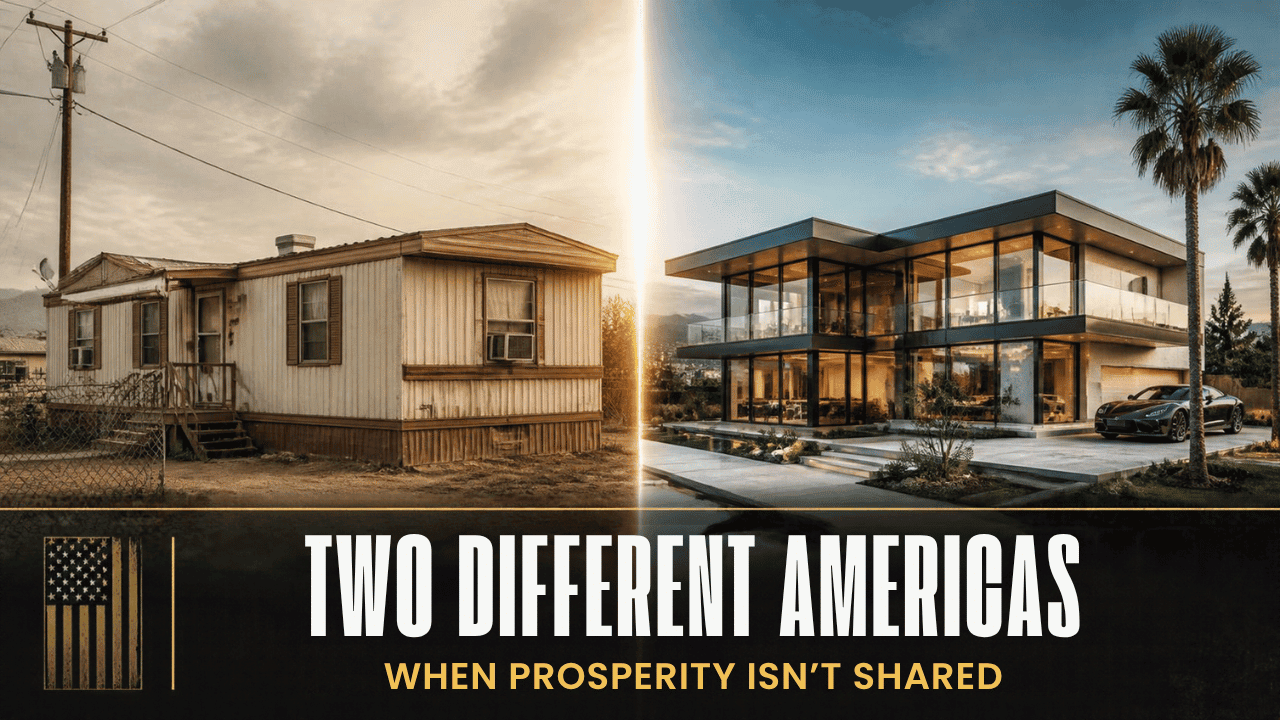
From France’s protests to America’s affordability crisis, why are people losing faith in economies that are supposed to make their lives better?
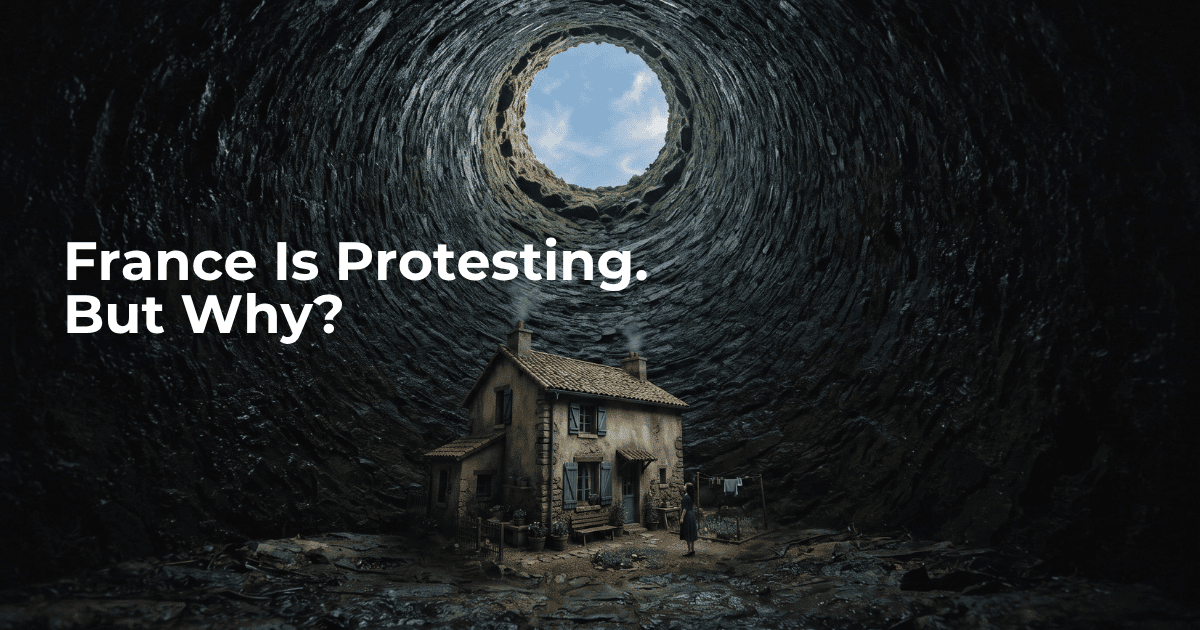
France is on fire. Not everywhere, and most protesters are peaceful, but hundreds of thousands of people have taken to the streets since September, when students protesting teacher shortages and crumbling schools sparked something much bigger. By October, unions, workers, and frustrated families had joined in, and the demonstrations had grown far beyond education: groceries, housing, wages, and a feeling that the system people pay into no longer delivers what it promised.
Some commentators blame socialism. Others point to immigration or government debt. But the frustration seems to run deeper than any single ideology, because across the Atlantic, Americans are asking a remarkably similar question.
In 1970, a middle-class family could realistically save for a house. Today, households earning what should be a comfortable income struggle to afford one. Meanwhile, the American economy has grown enormously, more output, more technology, and executives at the biggest companies now earning hundreds of times what their typical employees make.
If America is wealthier than ever, why does the American Dream feel so expensive?
France and the United States have different economies, policies, and political traditions. Yet both face the same underlying question: what happens when an economy creates enormous wealth, but the people who keep it running can no longer build a secure life?
That’s the gap this article is about; the distance between prosperity and financial security, and why it may be reshaping politics on both sides of the Atlantic.
People Are Asking
Is economic inequality behind all this frustration?
Partly, not entirely. Rising housing costs, inflation, government debt, and disagreements over immigration and public spending all feed the tension. Economic insecurity doesn’t create those disagreements, it pours gasoline on them, because people who feel they’re working harder and falling further behind stop giving the system the benefit of the doubt.
Does this mean capitalism is failing?
Not necessarily. An economy can create enormous wealth and still make everyday life unaffordable. The real fight is rarely between capitalism and no capitalism, it’s about how capitalism should work: how much worker protection, how much regulation, who pays for what. Some people think stronger protections and public investment are the answer; others argue lower taxes and lighter rules would create more opportunity. We sort out those terms below.
If the economy is growing, why don’t I feel better off?
Because growth doesn’t land evenly. Wages get eaten by housing, healthcare, childcare, and everything else competing for the same paycheck. And when stocks and property values rise, people who already own those assets gain far more than the person trying to buy their first home. That’s the difference between a country getting richer and its people feeling secure, and it’s the difference that shapes everything else in this article.
The Bigger Picture
For about three decades after World War II, the American economy ran on a simple promise: as workers produced more, they’d share in it. Wages rose alongside productivity, unions were strong, and a steady job could genuinely deliver a house, a pension, and the expectation that your kids would do better than you.
That prosperity was never shared equally, discrimination in housing, lending, and employment locked many Black families out of it entirely, a fact worth remembering before anyone gets nostalgic for the era’s economics.
Then, in the late 1970s, the tracks separated. Workers kept producing more, but their pay stopped following. The Economic Policy Institute calculates that between 1978 and 2025, American productivity rose about 86 percent. Typical worker compensation rose about 28 percent. Check out my 1950 series: Behind the Suburban Ideal: Segregation, Exclusion, and Unseen Lives in 1950s America.
Let that sit for a second. Workers nearly doubled what they produced per hour, but their compensation grew by less than a third as much.
Economists still argue about the exact size of the gap and what caused it, technology, globalization, declining unions, tax and labor policy, some mix of all of it. And there’s no denying we live with advances in medicine and technology our grandparents couldn’t have imagined. But producing more wealth doesn’t automatically mean people can afford a secure life. Nowhere is that clearer than in the distance between what corporate leaders earn and what ordinary families can.
What’s Actually Happening
1. The Pay Gap: Who Gets the Rewards?
In 1965, CEOs at America’s largest companies earned about 21 times what a typical worker made. By 2025, it was 325-to-1, according to the Economic Policy Institute.
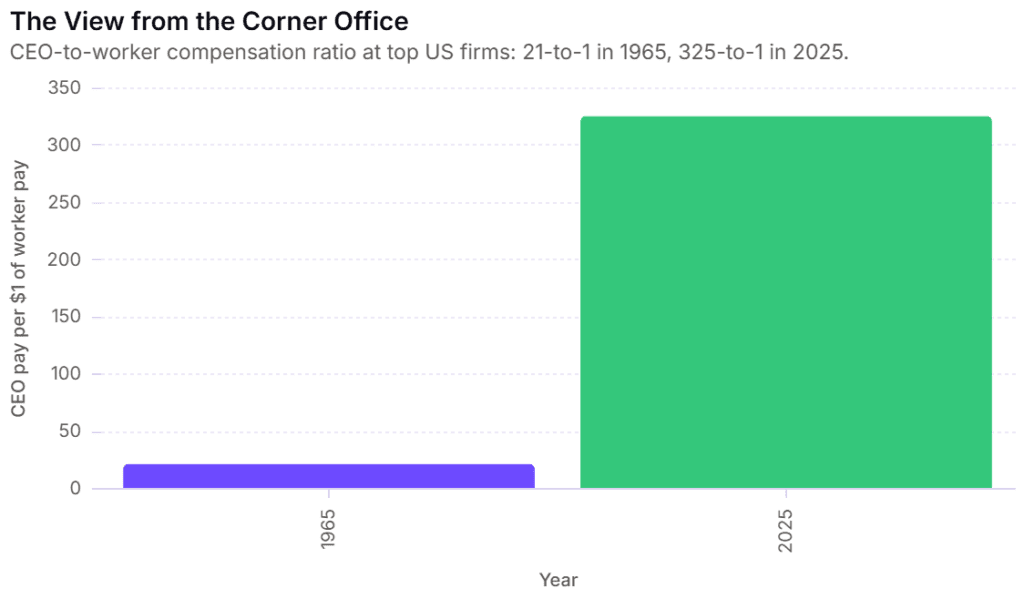
Source: Economic Policy Institute, September 2026. CEO-to-worker compensation ratios at major U.S. companies, including stock-based pay.
Running a major corporation is a genuinely hard job, and much of that pay comes in stock tied to company performance. But the journey from 21-to-325 is a change in kind, not degree, and it raises a fair question: how much of a company’s success should go to the top, and how much to the workers who helped produce it?
Keep the pay gap in perspective, though. Executive compensation is a symbol, not the whole disease, even confiscating every CEO bonus wouldn’t solve the affordability crisis.
2. Housing: The American Dream Gets More Expensive
The Federal Reserve Bank of Atlanta measures whether a median-income household can afford a median-priced home, using 30 percent of income as its benchmark.
In July 2026, owning that home would have required nearly 44 percent of household income.
By late 2025, buying a median-priced home required an income above $100,000 in 169 of America’s 387 metropolitan areas, compared with just 31 in 2020.
Among households headed by someone under 35, only about 35 percent owned their homes in mid-2026. For many young adults, the starter home has become a moving target, pushing milestones like marriage and starting a family further down the road.
3. Healthcare: When Insurance Becomes Unaffordable
Farmers, ranchers, independent contractors, small-business owners, and early retirees often purchase their own health insurance through the Affordable Care Act marketplace. When Congress allowed enhanced federal premium subsidies to expire at the end of 2025, insurance became considerably more expensive for many families. The One Big Beautiful Bill added other changes to marketplace coverage, creating additional financial uncertainty.
In one YouTube video, a retiree still too young for Medicare described watching his monthly insurance premium jump from $760 with a $1,600 deductible to having to choose a catastrophic plan costing $3,700 with a $10,600 deductible because it was the most affordable option available to him, and his story isn’t unique.
Catastrophic insurance doesn’t mean every medical emergency is fully covered from the first dollar. These plans have high deductibles, leaving patients responsible for substantial costs before most coverage kicks in.
His experience raises a troubling question: What good is having health insurance if you can barely afford to use it?
Coming soon: Healthcare in America — why getting insured can be so complicated and expensive.
4. The Cost of Everyday Life: When Everything Adds Up
And let’s not forget the everyday costs that keep adding up. Groceries, electricity, heating, and transportation all compete for the same paycheck. Wars, extreme weather, and global supply disruptions can push those costs even higher, leaving families with less money to save or simply enjoy life.
Healthcare, childcare, education, and retirement all take their cut of the same paycheck. The result is a strange contradiction: America is wealthier than ever, yet many families struggle to afford the milestones that once defined making it.
Good to Know: Is This Socialism?
Short answer: no. Wanting affordable housing, better wages, or stronger worker protections doesn’t make anyone a socialist.
Capitalism is an economic system built on private ownership and markets, with government setting the rules of the game.
Socialism calls for public or collective ownership of major economic resources — the factories, banks, and industries themselves. Socialist traditions disagree about how far that should go and what role markets should play.
Communism, in traditional theory, envisions a classless society with common ownership of nearly everything. Governments that have called themselves communist have generally looked nothing like the theory.
France runs a mixed capitalist economy: private businesses and markets alongside public healthcare, pensions, and regulation. Having universal healthcare or strong worker protections doesn’t, by itself, make a country socialist.
Think of it this way: Adding seatbelts to a car doesn’t turn it into a tank. Changing the rules of capitalism isn’t the same as replacing it. Debates about how much government should regulate markets often happen within capitalism itself, and Americans have been having them for generations.
Why People See This Differently
Are workers really falling behind?
Workers are producing more than ever, but their pay hasn’t grown nearly as fast. Economists disagree about how big that gap is. Some argue that the numbers look different when you include benefits like health insurance and account for inflation differently. Others say those adjustments don’t change the bigger picture: workers haven’t shared equally in the economy’s growth.
Are executives overpaid, or rewarded for success?
Defenders say top CEOs make decisions affecting thousands of jobs, and their pay is mostly stock, reward for performance, not theft. Critics ask whether any one person truly adds hundreds of times more value than a typical employee, and note that most corporate shares sit with wealthier households, so rising markets compound the gap rather than spread it.
Is this the market, or the rules?
One side argues it’s the market. Globalization and technology have changed how people work and earn money. Governments can’t control all those forces, so the focus should be on helping workers adapt.
The other side argues it’s the rules. Tax policies, weaker unions, and restrictions on building new housing have helped shape today’s inequality. Change those policies, they argue, and more people could share in economic growth.
The reality? Probably some of both. But identifying the cause shouldn’t become an excuse for doing nothing. Whether the problem comes from market forces, government policies, or both, the question remains: what are we going to do about it?
Real-World Impact
Financial insecurity does something worse than shrinking bank accounts. It corrodes trust.
Financial Security & Trust in Government
An 18-percentage-point gap
Source: OECD Trust Survey
Money trouble doesn’t automatically cause distrust. But when people can’t pay their bills while watching leaders tout a booming economy, official optimism starts sounding like mockery. And when people believe their concerns are being ignored, frustration can turn political.
Which brings us back to France. A country with one of the world’s most extensive safety nets still ended up with citizens marching over purchasing power, housing, and the future of public services. France’s problems aren’t identical to America’s, but the underlying question rhymes: how long can an economy be called successful if growing numbers of people don’t feel successful inside it?
We’ll dig into France’s specifics, the socialism debate, the budget math, and the proposed €54 billion savings plan, in the next article in this series.
What You Can Do
Look past the headline numbers. When you hear the economy is growing or stocks hit a record, ask what that means for regular households. Are wages beating living costs? Can people save for emergencies? A strong economy matters, but so does how it feels from the kitchen table.
Understand the fixes, and their tradeoffs. Building more housing could ease prices, but it takes time. Stronger worker protections could improve wages, but businesses worry about costs. More competition could give consumers better choices, while changes to taxes affect both investment and government services. Every solution comes with tradeoffs. The question isn’t whether capitalism should have rules — it’s which rules work best.
Watch local decisions. Housing affordability isn’t decided only in Washington. Zoning boards and planning commissions determine what gets built where you live, and those decisions shape your community for decades.
Question simple explanations, including your own. If someone blames it all on corporate greed, socialism, or immigration, ask what evidence backs that up. Economic problems almost never have one cause, and solutions that sound great in a political speech look different with their costs attached.
The goal isn’t agreeing on every policy. It’s knowing what each proposal would actually change, and who would benefit.
What This Means for You
For generations, Americans were taught that hard work, a steady job, and responsible decisions lead to a secure life. That promise was never equally available to everyone, but for millions of families it defined the American Dream, and today, a lot of people are quietly wondering if it expired.
When security slips out of reach, blaming someone feels natural: corporations, politicians, immigrants, government spending, the whole system. Some of those explanations contain real elements of truth. Complicated problems can turn into convenient targets. The challenge is knowing the difference.
But here’s the thing worth remembering: the American middle class was not an accident of nature. It was built, through economic growth, public investment, labor protections, and deliberate choices. Imperfect choices, unevenly shared, but choices.
If choices built broad prosperity once, choices can shape it again.
That won’t be easy, and nobody will fully agree on which choices. But France’s protests and America’s affordability crisis are asking the same question from two different continents: what does it mean for a country to prosper if the people running its economy can’t build a life in it?
Join the Discussion
1. Does the American Dream feel harder to reach than it was for your parents or grandparents? Whether you’re buying your first home, raising a family, or planning retirement, what specifically feels different?
2. Who should be responsible for spreading prosperity more widely — government, businesses, individuals, or a combination? Where does responsibility start and stop?
3. Could Americans agree on what a successful economy should deliver, even if we never agree on how to get there? What would you accept as a definition of success?


No discussions yet
Be the first to join the discussion and share your thoughts with the community.