
Opening
In Part One of this series, we examined the economic engine of the 1950s—showing how housing affordability, rising wages, and a unique post-WWII boom made single-income nuclear families structurally possible.
When politicians today call for a return to 1950s “family values,” they’re usually invoking a very specific image: a suburban home, a stable two-parent household, and a cohesive neighborhood.
And honestly? There’s something understandable about the appeal. If you’re 22, drowning in student debt, working a job that doesn’t pay enough to rent a decent apartment, and wondering whether you’ll ever be able to afford a house or start a family — the idea of a world where one income could support a household sound pretty good. When commentators say “we need to get back to traditional family values,” it can sound like common sense. Stability. Community. Clear roles. A simpler time.
For someone born decades after the 1950s, that isn’t really nostalgia for a life they remember. It’s nostalgia for a story they’ve inherited about what American life used to be. Affordable house. Stable job. Marriage. Children. Community. Financial security.
And like most stories about the past, some of it is true.
But it isn’t the whole picture.
The reality is that the 1950s middle-class ideal was not a universal experience. It was largely an exclusive, suburban snapshot defined by legal barriers, enforced racial segregation, severe economic hardship in rural and inner-city areas, and strict social traps that kept millions of unhappy or abused people bound to marriages they could not leave.
Think of it this way: if someone today said “marriage is declining because young people don’t value commitment,” you’d probably push back. You’d say: college costs $40,000 a year. Rent is $2,500 a month. Entry-level jobs barely cover groceries. People aren’t rejecting commitment — they’re responding to an economy that makes family formation feel out of reach.
The 1950s had the same dynamic — just with different numbers. The difference is that in the 1950s, the economic conditions happened to make marriage easy, and the legal conditions made leaving nearly impossible.
So the real question isn’t whether the 1950s sounded nice. It’s whether the policies being proposed today could recreate the beneficial parts without the harmful ones — and whether the people promoting nostalgia are telling you the full story of what that era actually looked like.
To understand the full story of family life in mid-century America, we have to turn the camera away from the suburban living room and look at the lives and communities that were left out of the frame.
Part I — The Legal Traps: What Kept Marriages Together?
When nostalgia-driven debates point to the low divorce rates of the 1950s as proof of healthier marriages, they often confuse stability with satisfaction.
Put it in modern terms: imagine if tomorrow, the government made it legally impossible to break a lease on an apartment. You could only leave if you proved your landlord committed adultery or cruelty. You couldn’t just say “this isn’t working anymore.” How many people would stay in apartments they hated? Would that prove the apartments were good — or just that the exit was blocked?
That analogy isn’t perfect, but it illustrates something important about marriage law at the time: wanting to leave wasn’t necessarily enough.
Some Americans remained legally married even when the relationship itself had effectively ended, because obtaining a divorce could be legally difficult, socially stigmatized, financially devastating — or all three.
1. Restrictive Fault-Based Divorce Laws
Before California passed the first no-fault divorce law in 1969, a spouse could not simply cite “irreconcilable differences.” To end a marriage, one spouse had to prove specific, legally recognized fault in court—such as adultery, extreme cruelty, desertion, or other legally recognized grounds.
If neither spouse could legally prove fault (or if a judge disbelieved their testimony), the state required them to remain legally married, regardless of their living situation.
Real-World Impact: The rigid nature of divorce laws created bizarre legal workarounds. Spencer Tracy, one of Hollywood’s biggest stars, lived apart from his wife, Louise Treadwell, for over 30 years while openly partnering with Katharine Hepburn. Because of deep religious and legal barriers, the marriage was never legally dissolved. While wealthy public figures could afford to support two separate households, average Americans trapped in unworkable marriages had no such option. They stayed under the same roof — or in separate bedrooms — and the divorce rate stayed low.
2. Financial Dependence and Credit Barriers
Leaving a marriage requires money. For women in the 1950s, economic independence was systematically restricted in ways that are hard to imagine today:
- Prior to the passage of the Equal Credit Opportunity Act of 1974, financial institutions could legally deny women credit cards, mortgages, or bank loans without a male co-signer (a husband or father). Think about that: a woman with her own job, her own income, and her own savings could be refused a credit card simply because she was a woman.
- A woman facing an unhappy or abusive marriage often faced immediate homelessness or financial ruin if she tried to leave. Renting an apartment or securing a car loan on her own was frequently impossible.
- Many employers could fire women for being pregnant. Schools forced pregnant teachers onto mandatory leave as early as the fifth month—a practice the Supreme Court didn’t strike down until 1974 (Cleveland Board of Education v. LaFleur). Airlines refused to hire married women as flight attendants. Many employers asked women about family plans during job interviews and used the answers to deny employment.
Quick Reality Check: If you’re a woman reading this and you have a credit card or mortgage in your own name, consider how recently federal law changed. Until the Equal Credit Opportunity Act of 1974, creditors could discriminate based on sex or marital status. Women had bank accounts before 1974—but access to credit, mortgages, and other financial tools was often far more complicated.
Read more: Could Women Really Not Open a Bank Account Prior to 1974?
3. Domestic Violence Behind Closed Doors
In the 1950s and 1960s, domestic violence was largely treated as a “private family matter” rather than a criminal act. Police routinely refused to intervene in domestic disputes unless severe physical injury was visible. Spousal abuse shelters did not exist in any organized form until the 1970s.
The case of Francine Hughes—who killed her abusive husband after years of severe beatings in 1977 and was acquitted—became one of the most visible examples of a growing national conversation about domestic violence. Her story inspired the TV movie The Burning Bed, which helped bring national attention to the reality that many women were trapped in violent marriages with few meaningful options for escape.
The legal systems of the era were structured to maintain the marriage unit at almost any cost—frequently sacrificing individual safety and mental health to keep the divorce statistics low.
🔗 Coming Up in This Series: The legal traps described here didn’t disappear on their own. They were challenged piece by piece through legislation, court decisions, and decades of activism. The Equal Credit Opportunity Act of 1974 gave women the right to credit in their own names. The Pregnancy Discrimination Act of 1978 made it illegal to fire women for being pregnant. The domestic violence movement transformed how courts and law enforcement treated abuse. Each of these changes is explored in detail in the articles that follow.
Part II — Racial Exclusion and the Myth of the Universal Postwar Dream
The government policies that built the 1950s middle class—specifically homeownership programs and veterans’ benefits—were not made available to all Americans equally. The single-income suburban lifestyle was heavily subsidized by public policy, but systemic racial discrimination prevented minority families from accessing those same wealth-building tools.
Redlining and Suburban Exclusion
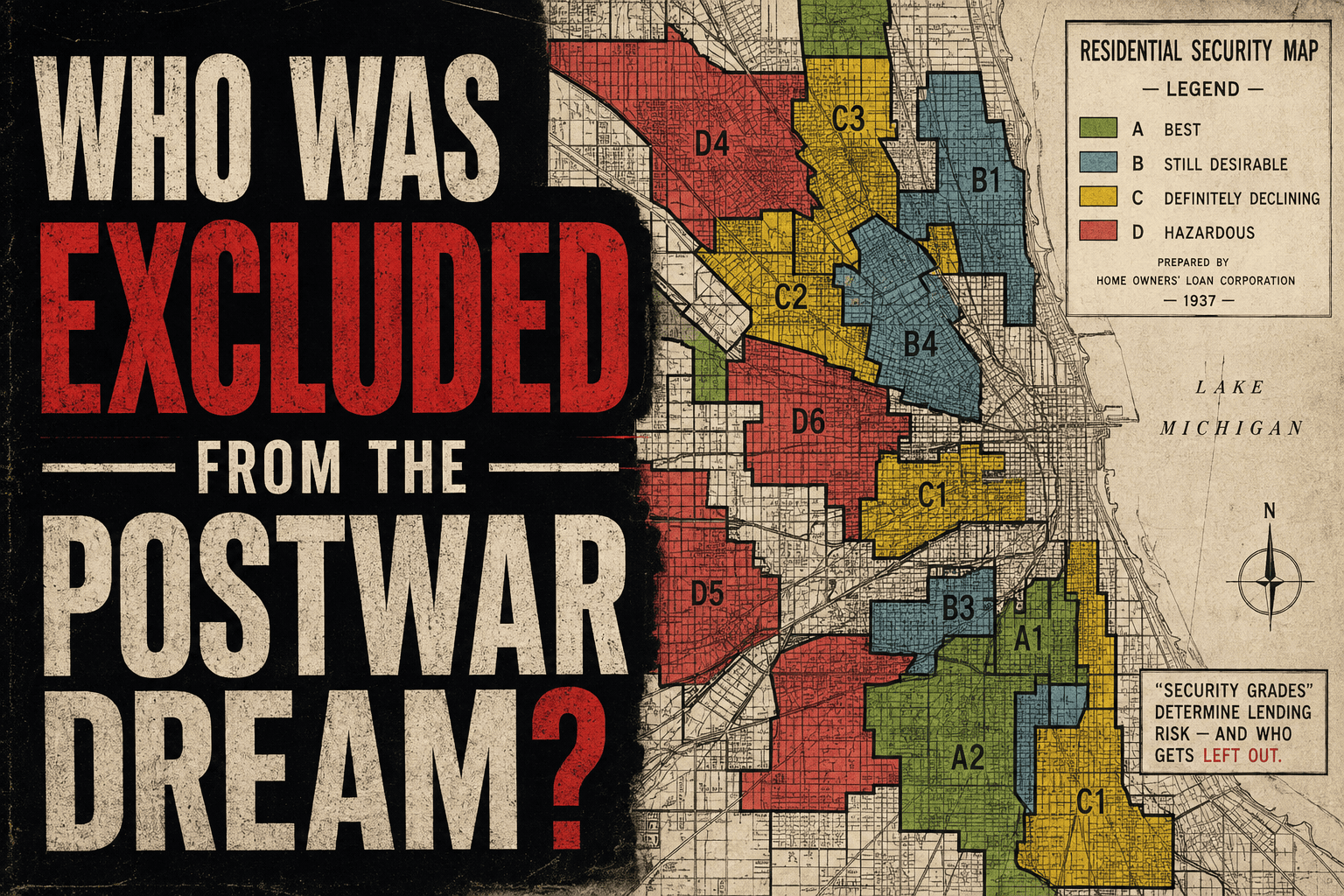
The Federal Housing Administration (FHA) and the Veterans Administration (VA) backed low-down-payment mortgages that allowed millions of working-class white families to buy suburban homes. But federal underwriting manuals explicitly warned against insuring mortgages in neighborhoods integrated by race.
Through redlining—the practice of drawing red lines on federal maps around minority neighborhoods to label them “high risk”—and racially restrictive covenants that legally banned non-white families from purchasing suburban property, Black, Latino, and Asian families were systematically shut out of the suburban housing boom.
The GI Bill Disparity
Although the GI Bill was race-neutral on paper, Black veterans often encountered discriminatory barriers when trying to use its housing and education benefits. Local and state administrators could deny VA loans. Segregated universities limited educational access. Discriminatory lending practices blocked homeownership. The result was that Black veterans returning from WWII were routinely denied the wealth-building tools that their white counterparts received.
According to Pew Research Center historical data:
- In 1960, 74% of white adults were married, compared to 61% of Black adults.
- By 2008, the white marriage rate stood at 56%, while the Black marriage rate dropped to 32%.
The economic inequality created by discriminatory 1950s housing and credit policies rippled across generations. Families denied access to suburban homeownership in the 1950s missed out on the primary wealth-building tool of the American middle class. That missed wealth compounds across decades—affecting everything from educational attainment to family stability to the ability to weather economic shocks today.
LGBTQ Lives in the Shadows
While the 1950s suburban ideal projected conformity and stability, LGBTQ Americans existed in that era at significant personal risk. Same-sex relationships could result in arrest, job loss, and institutionalization. The “Lavender Scare” of the 1950s led to the systematic purge of LGBTQ employees from federal government positions.
Some gay and lesbian Americans entered heterosexual marriages because living openly could mean losing a job, a family, a community—or even risking arrest. Those marriages still appeared in the statistics as intact heterosexual marriages. The statistics couldn’t tell us what was happening inside them.
Statistics tell us marital status. They don’t tell us marital experience.
Part III — Beyond the Suburbs: Inner Cities, Rural Areas, and Ethnic Enclaves
Popular media in the 1950s presented a homogenizing picture of American life: white, suburban, and middle-class. But vast segments of the population lived in environments that looked nothing like suburban sitcoms.
1. Inner Cities: “Urban Renewal” and Disinvestment
As middle-class tax bases migrated to the suburbs during the 1950s, American inner cities faced severe disinvestment. Under the Housing Act of 1949, federal “urban renewal” projects (frequently referred to by residents as “slum clearance”) demolished vibrant minority and immigrant neighborhoods to build highways or commercial centers. Hundreds of thousands of working-class families were displaced without adequate housing alternatives, fracturing community networks.
2. Rural America: High Poverty Behind the Farmhouse
The post-WWII boom was primarily a suburban story. In rural America, poverty rates in the 1950s were nearly double those of urban centers. The rapid mechanization of agriculture forced millions of small-scale family farmers off their land, initiating major migrations to industrial centers. Furthermore, modern suburban conveniences—such as indoor plumbing, central heating, and reliable electricity—arrived much later in rural areas, where multigenerational living remained a practical necessity rather than a lifestyle choice.
3. Ethnic Enclaves and Diversity Behind Segregation
The apparent “homogeneity” of mid-century neighborhoods was often an artifact of strict geographical and social division. In major industrial cities across the Northeast and Midwest, diversity existed primarily through distinct, self-contained ethnic enclaves.
Working-class urban neighborhoods were often divided block-by-block into Italian, Polish, Irish, Puerto Rican, or African American communities. For immigrant and first-generation families, survival and stability depended on hyper-local mutual aid societies, religious parishes, and extended family networks—far removed from the isolated nuclear family ideal promoted on television.
Race and gender weren’t the only dividing lines. Class and geography mattered too. Millions of Americans—white, Black, Latino, immigrant, rural and urban—lived in families that looked very different from the suburban nuclear family that became America’s cultural memory of the decade.
The Family You Saw on Television
There’s another reason the 1950s feel more unified in memory than they were in reality: television was exploding as a mass medium.
Family sitcoms helped create a shared image of American domestic life. Leave It to Beaver. Father Knows Best. The Honeymooners. These shows weren’t necessarily fake—families like them existed. But they were overwhelmingly white, middle-class, suburban, and economically secure.
Over time, that image became intertwined with how later generations imagined the decade itself. When politicians today invoke the 1950s family, they’re often drawing on that cultural memory—not their own recollection. Many of today’s leaders weren’t even born yet.
Television showed America one version of family life. The America outside the frame was much larger.
And that brings us back to the camera. If we only watch the sitcoms, we’ll think we understand the 1950s. If we turn the camera around, we see the full picture.
Part IV — Comparing Nostalgia to the Historical Record
When we evaluate mid-century family life, it helps to balance what nostalgia gets right with what the historical record reveals.
Because here’s the thing: the people who say “the 1950s were better” aren’t entirely wrong. Some things were better — at least for some people. If you were a white, married, middle-class man in 1955, the system worked reasonably well for you. Acknowledging that isn’t weakness. It’s honesty.
But the same era included costs that the nostalgia usually skips past.
| What Nostalgia Gets Right | What Nostalgia Leaves Out |
|---|---|
|
Expanded Homeownership for Many Families Working-class families with single earners could buy homes. |
Excluded Minorities Discriminatory lending, segregation, restrictive covenants, and unequal access to federal programs prevented many minority families from receiving the same opportunities. |
|
Cohesive Community Life Strong local social pressure encouraged civic engagement and neighborly connection. |
Severe Stigma & Conformity That same social pressure punished people who stepped outside accepted norms, including divorced women, single mothers, LGBTQ individuals, and others considered different. |
|
Low Recorded Divorce Rates Marriages statistically lasted much longer. |
Legal & Financial Barriers Fault-based divorce, discriminatory credit practices, and few domestic-violence resources made leaving a marriage significantly harder for many women. |
|
Predictable Family Timelines Clear societal expectations gave young adults a defined path into adulthood. |
Reduced Personal Choice Educational and career opportunities for women were restricted, LGBTQ Americans had no legal recognition, and race and gender could sharply limit a person’s choices. |
📊 Quick Stats: 1950s vs. Today
| Metric | 1950s / 1960 | Recent Comparison |
|---|---|---|
| Adults Married (18+) | 72% (1960) | ~48% (2024) |
| Median Age at First Marriage | Women: ~20 Men: ~22 |
Women: ~29 Men: ~30.5 |
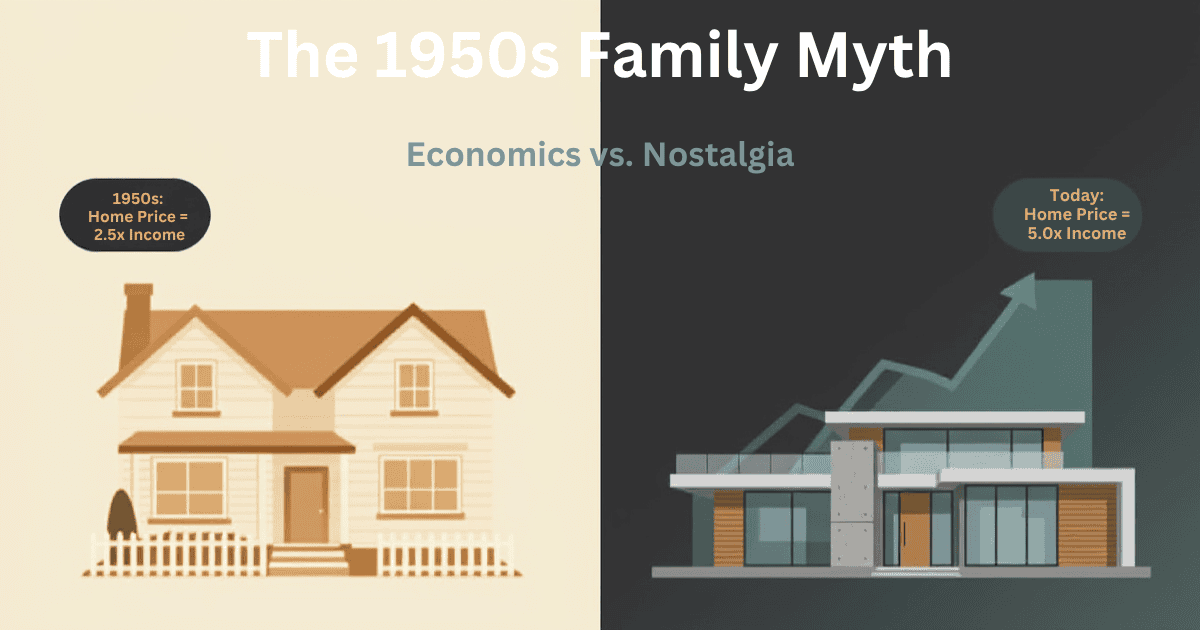
| Home Price Relative to Income | ~2.5× income | ~5× income |
| Black Adults Married | 61% (1960) | 32% (2008) |
Sources: Pew Research Center, U.S. Census Bureau, and Harvard Joint Center for Housing Studies.
Sources: Pew Research Center, Census Bureau, Harvard Joint Center for Housing Studies
The point isn’t that the 1950s were bad. The point is that the 1950s were specific — a particular moment created by a particular set of economic and legal conditions that no longer exist and that didn’t apply to everyone even then.
When politicians propose “restoring the 1950s family,” they’re not just proposing cultural values. They’re implicitly choosing which parts of that era to bring back — and which parts to leave out.
Making divorce harder without making housing cheaper isn’t recreating the 1950s family. It attempts to recreate one legal condition without recreating the economic conditions that helped make family formation easier for many people.
So the real question is:
Can we build the good parts — stability, community, economic security — without rebuilding the exclusion, the traps, and the inequality that came with them?
People Are Asking
“If divorce was so hard to get, doesn’t that mean marriages lasted?”
Yes, marriages lasted longer on paper. But lasting and thriving are different things. Countless couples lived parallel lives under the same roof, in separate bedrooms, or in separate homes, because they had no legal path to end the marriage. Legal marriage and marital quality are not the same thing.
“Were these exclusionary practices acknowledged at the time?”
For many, yes. The disparities were visible, but they were rarely named as systemic injustice. Civil rights organizations documented the inequities, but mainstream political discourse often treated them as anomalies rather than structural features.
“How does this connect to modern family trends?”
The wealth gap created by 1950s housing discrimination contributed to ongoing economic disparities that still affect family formation today. Families that were denied access to homeownership missed the primary wealth-building tool of the American middle class, and that advantage compounds across generations.
“Was the 1950s model worth preserving if it came at such cost?”
That depends on what you value. Some aspects—like affordable housing, strong unions, and community cohesion—deserve consideration. Others—like legal restrictions on personal autonomy, racial exclusion, and enforced gender roles—don’t. The real question isn’t whether to “go back.” It’s whether we can achieve the beneficial parts without the harmful ones.
What You Can Do
Read beyond the nostalgia. When you encounter commentary praising “the way things used to be,” ask who benefited and who was left out. History is often remembered selectively.
Talk to people who lived through different parts of the era. Ask elders in your family—especially those from marginalized communities—what their experience was like. Their stories will give you a fuller picture than any sitcom rerun.
Look at what the policy actually does. When a proposal promises to “strengthen families,” look beyond the phrase. Does it address housing, childcare, wages, safety, and economic security? Does it change marriage or divorce law? Which families receive support — and which do not? The name of a policy tells you its goal. he name of a policy tells you its goal. The details tell you how it intends to get there.
Support policies that help all families. If strong families are the goal, consider whether policies like affordable housing, paid family leave, childcare support, living wages, and domestic violence prevention do more to strengthen families than simply preaching about values or restricting divorce.
What This Means for You
Whether you grew up in a suburb, an inner city, or a rural town, understanding the 1950s family model helps you evaluate what politicians promise today.
If someone proposes “restoring the 1950s family,” you have every reason to ask what exactly they mean. Are they talking about affordable housing and economic security? Marriage and two-parent households? Traditional gender roles? Divorce laws?
“The 1950s family” is not one policy. It is a political shorthand for a much more complicated period of American life.
That’s why you have the right to ask:
Which 1950s are you talking about — and who was included in that version of America?
Pattern to Notice
When people compare America “then” and “now,” they often compare the outcomes—who married, who divorced, who raised children—without comparing the conditions—who could afford it, who was allowed to, who was trapped, who was excluded.
This pattern shows up in almost every political debate about families. The question isn’t just “what happened?”—it’s “under what conditions, and for whom?”
Think About It
- If the 1950s family model was built partly on exclusion and restriction, can we keep the good parts without the harm?
- How much of today’s marriage decline is about values versus economics?
- Should policymakers try to recreate the economic conditions of the 1950s, even if they can’t recreate the social restrictions?
- What parts of family life should be protected by law — and what parts should be left to individual choice?
Key Takeaway
The 1950s American family model was real, but it was incomplete. It was built on a foundation of exceptional postwar economic prosperity, but its benefits were shielded by legal restrictions, gender inequality, and systemic racial exclusion.
When we romanticize the low divorce rates or single-income households of the past without acknowledging the legal traps, segregation, and economic exclusion that accompanied them, we are not remembering history—we are editing it.
A healthy policy debate about the future of the American family shouldn’t be about forcing modern society into the mold of a selective past. Instead, it should focus on building economic security, safety, and equal opportunity so that every family can thrive in the world we live in today.
Related Articles in This Series
- The 1950s Family Myth: Modern Policy vs. Postwar Economics (Article 1)
- Why Are Some Politicians Talking About Ending No-Fault Divorce? (Why It Matters)
- Could Employers Fire Women for Being Pregnant? (Coming Soon)
- When Domestic Violence Was Considered a Private Family Matter (Coming Soon)
No discussions yet
Be the first to join the discussion and share your thoughts with the community.