
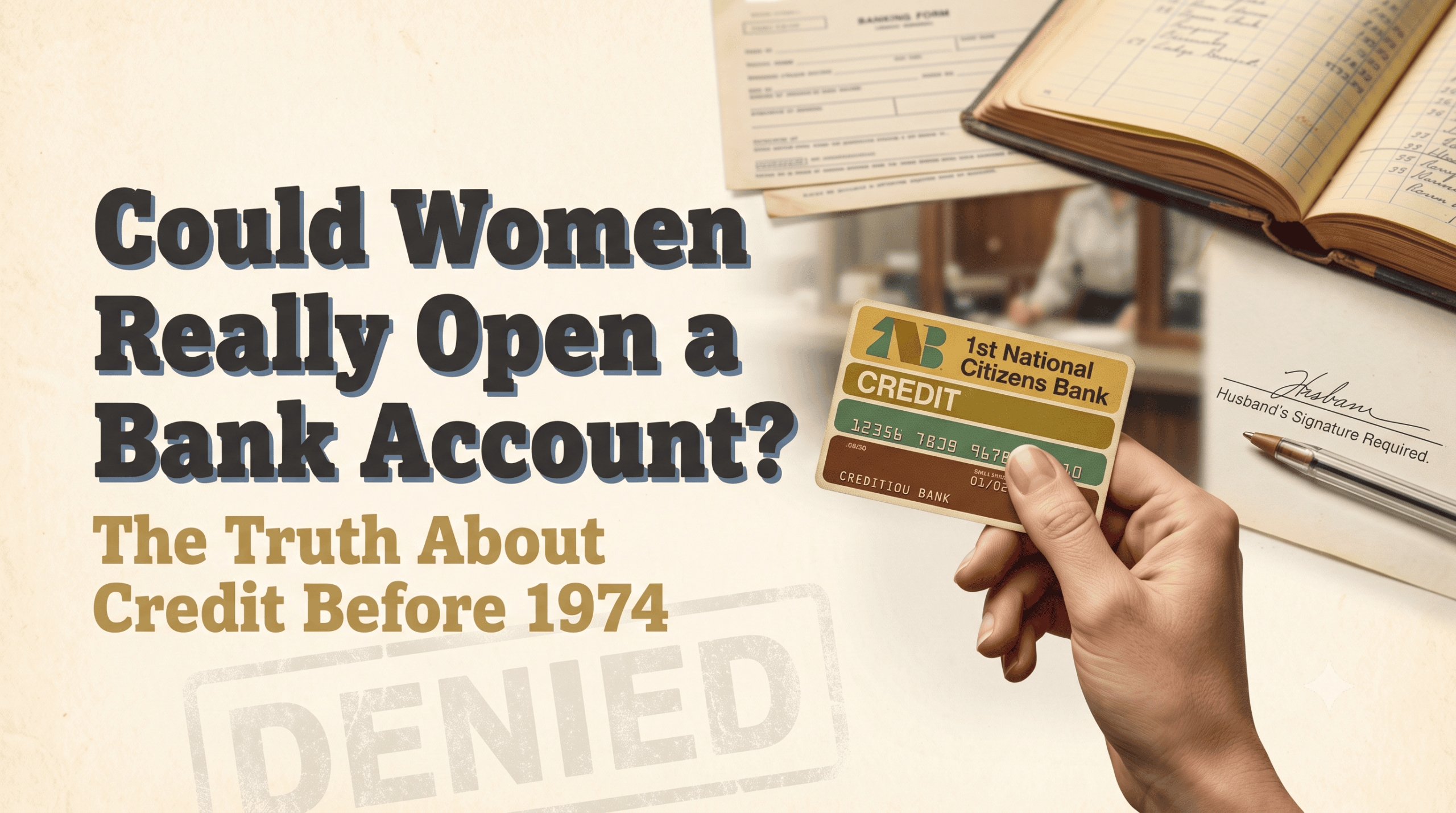
The surprising truth about women, credit, and financial independence before 1974.
Opening
Here’s something that might surprise you:
Women gained the right to vote in 1920. The Civil Rights Act became law in 1964. Yet it wasn’t until 1974 that federal law protected women from discrimination when applying for credit. For millions of women, financial independence arrived much later than many people realize.
That means many women who are alive today — your mother, your grandmother, maybe even you — personally remember a time when getting a credit card, a loan, or a mortgage without a husband’s involvement was difficult or impossible.
The story you’ve probably heard — “women couldn’t have bank accounts until 1974” — isn’t exactly right. But the truth is more complicated, and honestly, more revealing.
The Bigger Picture
Financial independence isn’t just about money. It’s about having choices. It’s about freedom. It’s about the ability to leave a bad situation, to build a life on your own terms, and to participate fully in the economy.
When we talk about the history of women’s rights, we usually focus on voting and workplace equality. But the right to access credit — to get a credit card in your own name, to buy a house, to start a business — is one of the most consequential, and least remembered, civil rights stories in American history.
What’s Actually Happening
Part I — What Was Really Going On Before 1974?
Let’s clear up the most common misconception right away.
Women could and did have bank accounts before 1974. Unmarried women, in particular, could generally open checking accounts. The legal right to have a bank account wasn’t the issue.
The problem was credit.
Before the Equal Credit Opportunity Act of 1974, banks and lenders could — and routinely did — discriminate against women in ways that severely limited their financial independence:
- Requiring a husband’s signature. Many banks required a married woman to have her husband co-sign to open certain accounts or apply for credit. A married woman seeking a mortgage might be told she needed her husband’s permission — even if she had her own income.
- Denying credit cards to married women. Credit card companies often refused to issue cards to married women in their own names. Instead, women might be listed only as an “authorized user” on their husband’s account — meaning the credit history built on that account belonged to him, not her.
- Considering women higher credit risks simply for being women. Banks could legally treat sex as a risk factor. A woman with a steady income might be denied credit while a man with identical finances was approved.
- Asking about pregnancy and family plans. Lenders could ask women whether they planned to have children — and then use that answer to deny or reduce credit, on the theory that a woman might leave the workforce to have a baby.
- Canceling credit when women married. Some women had their credit cards canceled or limits reduced when they got married, because the bank reclassified them as dependents.
None of these practices were universal, but they were common enough that millions of women encountered them.
The result was a system where a woman’s financial identity was often tied to a man — her father, her husband, or a male relative. Even if she earned her own money, the financial system often didn’t fully recognize her as an independent economic actor.
Part II — What Changed in 1974?
The Equal Credit Opportunity Act (ECOA), signed into law in 1974, made it illegal for banks, lenders, and creditors to discriminate based on:
- Sex
- Marital status
- Race
- Religion
- National origin
- Age (with some exceptions)
- Receipt of public assistance
This meant banks could no longer:
- Require a husband’s signature for a married woman to get credit
- Deny credit because the applicant was a woman
- Ask about family planning or pregnancy intentions
- Cancel or reduce credit because a woman married, divorced, or was widowed
- Report credit history under a spouse’s name only
How Credit Applications Changed After 1974
Before 1974
After 1974
Major legal rights rarely arrive all at once. Each milestone built on the ones before it — and each took decades of activism to achieve.
Part III — Why the Myth Persists
If the story isn’t exactly true, why do so many people believe it?
Several factors explain why this myth continues to spread:
- Bank accounts and credit often get confused. Checking accounts and credit products (mortgages, loans, credit cards) are legally different. Most people don’t make that distinction, so the nuance gets lost over time.
- Experiences varied by bank and state. Some banks discriminated aggressively; others didn’t. Some states had protections before federal law; others didn’t. A woman who was denied credit might tell her daughter “I couldn’t get a bank account,” and the story simplified over generations.
- Many women remember being denied credit rather than checking accounts. Being told “you need your husband’s signature” feels like being denied a bank account, even though technically it’s about credit access. The emotional impact is what sticks in memory.
- Stories passed down over time became simplified. Oral histories are powerful, but they also get compressed. A detailed story about credit discrimination becomes a shorter, punchier story about “no bank accounts.”
Understanding how historical myths develop isn’t just about accuracy — it’s a reminder that memory and history are different things. What people remember isn’t always what happened, and what happened is often more complicated than any single story can capture.
Part IV — Why This Matters
Think about what it means to not have credit in your own name.
Without a credit card, you can’t easily rent a car, book a hotel room, or make purchases online.
Without a mortgage, you can’t buy a home.
Without a loan, you can’t start a business.
Without a credit history in your own name, you can’t build the financial foundation for an independent life.
Now imagine that the reason you can’t get credit isn’t your income, your debt, or your financial history — it’s your gender. Or your marital status.
That was reality for millions of American women well into the 1970s.
This isn’t ancient history. Women who are in their 60s and 70s today grew up in a world where the financial system treated them differently because of their sex. Many of them fought for the rights that younger women now take for granted.
Connecting the Dots
Here’s where this story connects to the larger picture.
Remember the no-fault divorce debate? One of the arguments for making divorce easier was that many women had been trapped in unhappy or unsafe marriages — partly because they had no way to support themselves financially.
That wasn’t just about social attitudes. It was about law. Before 1974, a woman who wanted to leave a marriage might not be able to get a credit card, rent an apartment, or qualify for a mortgage on her own. Even if she had a job, the financial system didn’t fully recognize her as an independent person.
The Equal Credit Opportunity Act didn’t solve everything. But it removed one legal barrier that had kept women dependent — literally and figuratively — on the men in their lives.
Pattern to Notice
Financial rights often determine personal freedom.
Laws about credit, property, employment, and contracts may sound technical, but they influence everyday decisions—where people live, whether they can start a business, or whether they can leave an unhealthy relationship. Understanding these laws helps explain why changes in financial rights often become turning points in broader social history.
People Are Asking
“So women could have bank accounts before 1974?”
Yes — especially unmarried women. The common claim that “women couldn’t have bank accounts until 1974” is a simplification. What changed in 1974 was that banks could no longer discriminate against women in obtaining credit and financial services. That’s a crucial distinction.
“Were men really asked to co-sign for their wives?”
Yes, this was common practice. A married woman applying for a credit card or loan might be told she needed her husband’s signature — even if she had her own income and a solid financial history.
“Did this affect women of all backgrounds?”
Yes, though the impact varied. Wealthier women sometimes had more options, and unmarried women generally faced fewer barriers than married women. But the systemic discrimination affected women across racial and economic lines. Women of color often faced compounded discrimination based on both sex and race.
Did the law force banks to approve everyone?
No. Banks could still deny applications based on income, debt, or credit history. What changed was that they could no longer deny someone simply because she was a woman or because she was married.
“Is this still relevant today?”
The legal protections are in place. But the memory of what life was like before them — and the understanding of how recently the rules changed — matters for understanding why certain debates about gender, economics, and family continue today.
What This Means for You
If you’re a woman reading this and you have a credit card in your own name, a mortgage, a business loan, or a bank account — you’re exercising a right that wasn’t fully guaranteed until 1974. That’s within many people’s lifetimes.
If you’re a man reading this, the women in your life — your mother, your wife, your daughters — live in a world that changed dramatically in a very short period of time. Understanding that history helps explain why issues of gender equality still resonate today.
Think About It
- If you know a woman over 65, consider asking her what it was like to navigate the financial system before these protections existed. You might be surprised by what she remembers.
- Why do you think this story isn’t more widely known? It happened recently, it affected millions of people, and yet most Americans don’t know the details.
- What other rights do we take for granted today that were won surprisingly recently?
Key Takeaway
Women could have bank accounts before 1974 — but banks could legally discriminate against them in credit, loans, and mortgages based solely on sex or marital status. The Equal Credit Opportunity Act of 1974 changed that, giving women the legal right to be treated as full participants in the financial system. That protection is recent enough that millions of Americans remember life before it.
Related Articles
- Why Are Some Politicians Talking About Ending No-Fault Divorce?
- When Domestic Violence Was Considered a Private Family Matter (coming soon)
- Was the 1950s Family Really Better? (coming soon)
- What Do Politicians Mean When They Say Family Values? (coming soon)
Readers who want to explore the law itself can learn more through the Consumer Financial Protection Bureau’s Equal Credit Opportunity Act resources or read the Federal Trade Commission’s overview of the Equal Credit Opportunity Act.

No discussions yet
Be the first to join the discussion and share your thoughts with the community.