
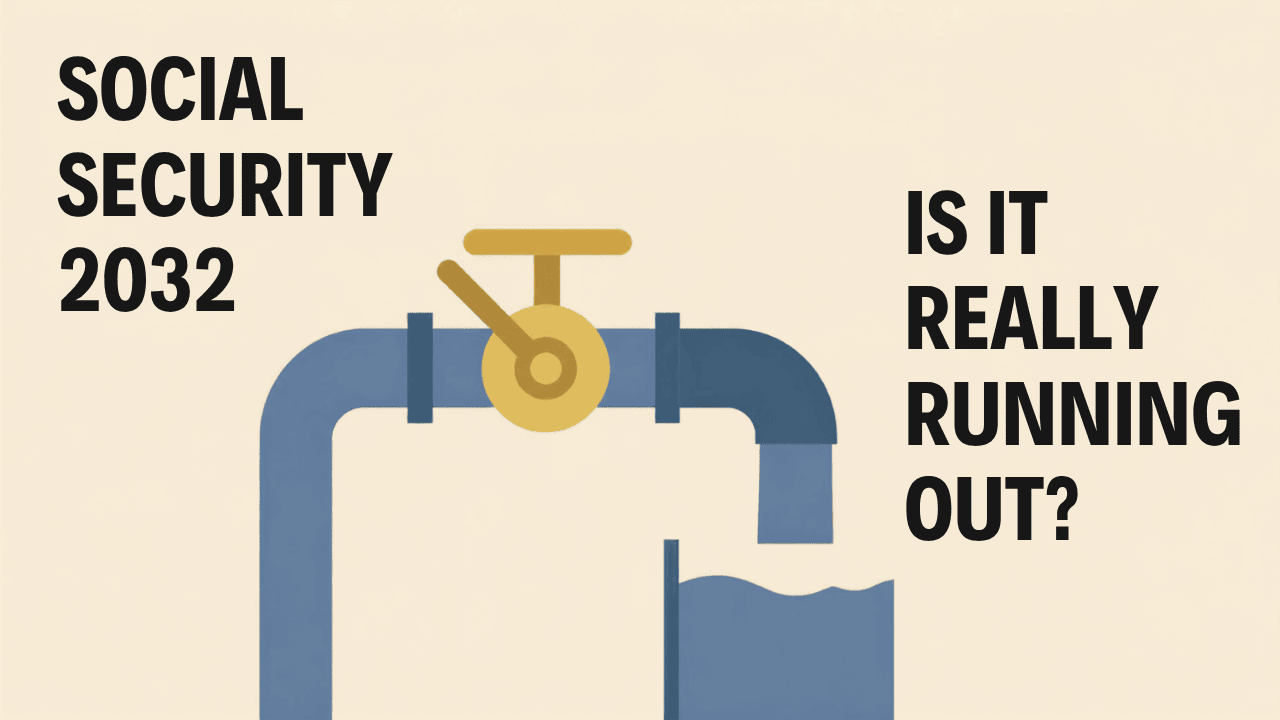
What the 2032 Warning Actually Means — and What Congress Can Do About It
“Mom, Your Check Is Not Being Cut”
Every election season, Social Security returns to the news.
You may hear:
“Social Security is running out of money.”
“Benefits could be cut.”
“Social Security is going broke.”
For people who depend on Social Security, those words can be frightening.
You may wonder:
Will my next check be smaller?
Will my payment be late?
The answer is no.
Social Security has a long-term money problem that Congress needs to fix. But Social Security is not running out of money today, and current benefits are not suddenly being cut.
📌 Key Takeaway:
Your Social Security check is not being cut now.
The problem you are hearing about is a projection for 2032.
Why Are We Hearing About This Again?
Social Security often becomes a major issue during elections because millions of Americans depend on it. For many older adults, that money helps pay for food, housing, medicine, and other everyday expenses.
That also makes Social Security a powerful political message.
There is a reason fear appears so often in political campaigns: fear gets our attention.
Psychologists have studied what are called fear appeals — messages designed to make us feel threatened and then encourage us to take action. Research has found that fear-based messages can influence what people think and do.
Fear itself is not the problem. It is a natural human response. If someone tells you that something important to you is in danger, of course you pay attention.
But that reaction can also be used against us.
Think about the difference:
“Social Security faces a funding problem that Congress needs to address before 2032.”
and
“Your Social Security is going broke!”
Both may be talking about the same underlying problem. But one gives you information. The other makes you afraid.
That doesn’t mean you should ignore a frightening warning. It means you should slow down and ask for the rest of the story.
What is happening?
When will it happen?
What would have to happen first?
And what can Congress do about it?
Once you know how fear appeals work, they become easier to recognize.
Someone can still get your attention. They just don’t get to use your fear to do your thinking for you.
So let’s take the fear out of Social Security and look at how the system actually works.
APA: Fear can motivate voters and influence elections
Part I: How Does Social Security Actually Work?
Many people think the Social Security taxes they paid during their working years are sitting in an account with their name on it. That is not how Social Security works.
Most of the money collected from today’s workers and employers is used to pay benefits to today’s retirees and other Social Security beneficiaries.
Money Comes In
Workers pay Social Security taxes from their paychecks.
Employers pay Social Security taxes too.
In 2026:
That money flows into the Social Security system and is used to pay benefits.
But There Is Also a Reservoir
For many years, Social Security collected more money than it needed to pay benefits.
The extra money built up in Social Security’s trust funds.
Think of those reserves as a reservoir.
When enough money comes in to cover benefits, Social Security does not need to draw from the reservoir.
But when benefits cost more than the money coming in, Social Security can use money from the reservoir to fill the gap.
When money coming in isn’t enough
Today, Social Security is using its reserves because the program is paying out more than it is taking in.
And that brings us to the number you keep hearing in the news:
2032
That is not the year Social Security stops receiving money.
Workers will still be paying Social Security taxes.
2032 is the year the retirement trust fund’s reserve is currently projected to run out.
That difference is extremely important.
So why is the reservoir shrinking — and what actually happens when it reaches empty?
Social Security A Summary of the 2026 Annual Reports
Part II: Why Is the Reservoir Shrinking?
Social Security worked for many years with more money coming in than going out. But America has changed.
Today, there are more older Americans collecting benefits, people generally spend more years in retirement, and there are fewer workers supporting each person receiving Social Security.
That creates a simple problem:
Fewer Workers for Each Beneficiary
As the population ages, fewer workers are supporting each person receiving Social Security.
This does not mean Social Security was badly designed or that someone suddenly “broke” it. It means the population has changed, while the system has not changed enough to keep up.
There Is Another Side of the Equation: Money Coming In
Congress also decides how much of a worker’s earnings are subject to Social Security taxes.
In 2026, Social Security taxes apply to wages up to $184,500.
That means someone earning $184,500 and someone earning $1 million do not pay Social Security tax on the same percentage of their income. Once earnings reach $184,500, Social Security tax stops for the rest of that year’s wages.
Some proposals would raise that limit. Others would remove it completely so that more earnings are taxed.
What Does the Wage Cap Mean?
Here is an easy way to see it.
| Annual Wages | Wages Subject to Social Security Tax | Worker Pays 6.2% |
Share of Wages Taxed |
|---|---|---|---|
| $80,000 | $80,000 | $4,960 | 100% |
| $184,500 | $184,500 | $11,439 | 100% | $350,000 | $184,500 | $11,439 | 52.7% |
| $1,000,000 | $184,500 | $11,439 | 18.45% |
The worker earning $1 million pays more Social Security tax than the worker earning $80,000. But once that worker reaches the $184,500 wage cap, Social Security taxes stop for the rest of that year’s wages.
Do High Earners Still Receive Social Security?
Yes.
Social Security is not limited to people with low or middle incomes. A person who earned a high salary throughout a career can still collect Social Security in retirement.
In fact, a lifelong high earner will generally receive a larger monthly benefit than a lifelong lower-wage worker.
But there is an important difference: Social Security replaces a larger share of income for lower-wage workers.
So a retired lower-wage worker may receive a smaller check, but that Social Security check is likely to represent a much larger share of the income they need to live.
This is one reason the wage cap becomes such an important part of the debate over how to fix Social Security.
Should high earners pay Social Security taxes on more of their wages?
And if they do, should they receive larger benefits in return?
Those are choices Congress has to make.
Would raising the wage cap help?
Yes. But how much it helps depends on how Congress designs the change.
For example, Congress would have to decide whether people who pay more Social Security taxes on those additional earnings should also receive higher Social Security benefits later.
That is why there is no single, simple fix.
Social Security has two sides that Congress can change:
MONEY COMING IN ↔ MONEY GOING OUT
And keeping Social Security financially healthy means finding a balance between the two.
Part III: What Actually Happens in 2032?
Now that we understand the reservoir, the 2032 warning makes much more sense.
According to the latest Social Security Trustees projection, the retirement trust fund reserve is expected to run out in late 2032 if Congress makes no changes.
But remember: the reservoir running empty does not mean Social Security has no money coming in.
Workers and employers would still be paying Social Security taxes. That ongoing revenue is currently projected to cover about 78% of scheduled retirement and survivor benefits after the reserve is depleted.
That is why the problem is serious — but very different from Social Security “going bankrupt.”
What You Hear vs. What It Means
Retirement and survivor benefits continue to be paid as scheduled.
The retirement trust fund reserve is projected to be depleted if Congress makes no changes.
Workers and employers continue paying Social Security taxes.
Continuing income is projected to cover about 78% of scheduled retirement and survivor benefits.
What Would a 22% Shortfall Mean?
This is the part we should not minimize.
If Congress did nothing and only 78% of scheduled benefits could be paid, the gap would be significant for people who depend on Social Security.
For a simple example, imagine someone was scheduled to receive $2,000 a month.
So there are two things worth remembering at the same time:
Social Security is not disappearing in 2032.
But:
Congress does need to fix the financing problem before the reserve runs out.
The good news is that Congress has several ways to do it.
Part IV: The Policy Levers Available to Congress
The good news is that Social Security’s financing problem can be fixed.
There is no single solution, however. Congress has several choices, and each one affects people differently.
Most proposals use one or more of three basic approaches:
There is no option that makes the financing gap disappear without affecting someone.
That is why the real debate over Social Security is not simply:
“Do you want to save Social Security?”
Almost everyone says yes.
The harder question is:
Who should pay more, who should receive less, or what rules should change?
Part V: Why Social Security Becomes an Election Weapon
By now, you may be wondering something obvious:
If Congress has known about this problem for years, why hasn't it fixed it?
Part IV gives us much of the answer.
Every major option creates a political tradeoff.
Raise payroll taxes, and workers and employers may object.
Raise or eliminate the wage cap, and high earners and some businesses may object.
Reduce future benefits, and retirees and workers preparing for retirement may object.
Raise the retirement age, and people who work physically demanding jobs may argue that they cannot simply work several more years.
Politically, none of those choices is easy.
Waiting Is Also a Choice
Congress does not have to choose a solution today. But waiting does not make the financing problem disappear. It means future lawmakers may have less time to make changes gradually.
That matters.
A small change introduced over many years may be easier for workers and retirees to prepare for than a larger change made close to the deadline.
So, when politicians say they will “protect Social Security,” that statement alone does not tell you very much.
The more useful question is:
How?
This Is Where Fear Can Return
Remember where we started.
Social Security is extremely important to millions of Americans. That makes warnings about its future powerful political messages.
YOU MAY HEAR
“The other side wants to cut your Social Security.”
OR
YOU MAY HEAR
“The other side wants to raise your taxes.”
Either statement might contain part of a real policy disagreement.
But neither tells you enough to evaluate the proposal.
Understanding the tradeoffs moves the conversation away from fear and toward policy.
TRY IT YOURSELF
Can You Fix Social Security?
Congress has choices. So do you. Explore real policy options evaluated by Social Security's actuaries and see what each one would require.
Your Challenge
Which changes would you consider to strengthen Social Security's finances? Select any policy to see what it would change.
These are examples of policy options evaluated by Social Security's actuaries — not recommendations from VoteView.
No changes selected yet.
What Won't You Change?
Politicians often promise to protect several things at once. What would you take off the table?
Part VI: A Global Perspective — How Other Nations Adapt
The United States is not alone in navigating this demographic shift. Germany, for instance, operates a comparable pay-as-you-go statutory pension system where current workers fund current retirees.
Germany is also dealing with an aging population and a shrinking working-age population.
So what is Germany doing about it?
It is adjusting the system.
Germany's pension contribution rate is currently 18.6%, split between workers and employers.
The government also contributes money from general tax revenue to help finance the pension system.
And Germany has been gradually raising its regular retirement age to 67 applying to people born in 1964 or later.
In other words, Germany is using several of the same levers we just discussed:
Keeping Up With the Joneses?
The United States is not the only country adjusting to an aging population. Germany faces many of the same pressures — but uses a different mix of policy levers.
United States
Germany
Has Germany Solved the Problem?
No.
Germany is still debating how much workers should contribute, how much taxpayers should contribute, what benefits retirees should receive, and how long people should work.
That's the important lesson.
The United States is not facing an impossible problem. It is facing a problem shared by many aging countries: How do we support a growing retired population when there are fewer workers supporting the system?
Other countries are wrestling with the same math. The difference is in the choices they make to deal with it.
Part VII: What Should You Ask Your Representative?
Ask Your Representative These Questions
“Protect Social Security” is a promise. These questions help you find out what the actual plan is.
What is your plan for the 2032 shortfall?
Saying you will “protect Social Security” is not a financing plan. What specifically would you change?
Would you raise Social Security taxes?
If not, where would the additional money come from?
Would you raise or eliminate the wage cap?
In 2026, Social Security taxes apply only to the first $184,500 of wages. Should higher earners pay Social Security tax on more of their wages?
Would you change benefits?
If so, whose benefits would change — current retirees, future retirees, higher-income retirees, or everyone?
Would you raise the retirement age?
If so, how would that affect people in physically demanding jobs who may not be able to work longer?
If you oppose all of those options, what is your alternative?
If you oppose higher taxes, changing the wage cap, changing benefits, raising the retirement age, and using other government revenue, how would you close the financing gap?
There may be a good answer. You deserve to hear it.The Bottom Line
Social Security is not disappearing in 2032, and benefits are not being cut today. But the program does have a real financing problem that Congress needs to address.
There are ways to fix it. None of them are free, and reasonable people can disagree about which approach is faire



No discussions yet
Be the first to join the discussion and share your thoughts with the community.