
CIVICS 101
When the Supreme Court Got It Wrong
The Court’s Greatest Failures — and How America Corrected Them
In Plain English
We often think of Supreme Court decisions as final and unquestionable. But history tells a more complicated story. Some of the Court’s most famous decisions are now considered among the greatest mistakes in American history. This lesson explores those cases, how they harmed millions of people, and how the country eventually corrected many of them.
At a Glance
- The Supreme Court can make historic mistakes.
- Some decisions have protected injustice instead of correcting it.
- The Court can overturn its own precedents.
- Constitutional amendments can also correct Supreme Court rulings.
- Understanding the Court means studying both its successes and failures.
Historical Note
This article discusses Supreme Court decisions that historians, legal scholars, and later generations have widely criticized or repudiated. The goal is not simply to judge the past, but to understand how constitutional interpretation has changed over time.
Why This Lesson Matters
Every Supreme Court justice swears an oath to uphold the Constitution.
Yet throughout history, different generations have interpreted that Constitution very differently. Sometimes the Court has protected liberty. Other times, it has protected systems of exclusion, inequality, and state power.
Understanding the Court’s greatest mistakes teaches us two important lessons: judges are human, and the Constitution is interpreted by people — not by machines.
That means the Supreme Court is powerful, but it is not infallible.
The Catastrophes: When the Court Failed the Nation
History often describes the Supreme Court as a guardian of justice. But for long stretches of American history, the Court protected prejudice, inequality, and concentrated power.
These cases represent some of the Court’s darkest hours.
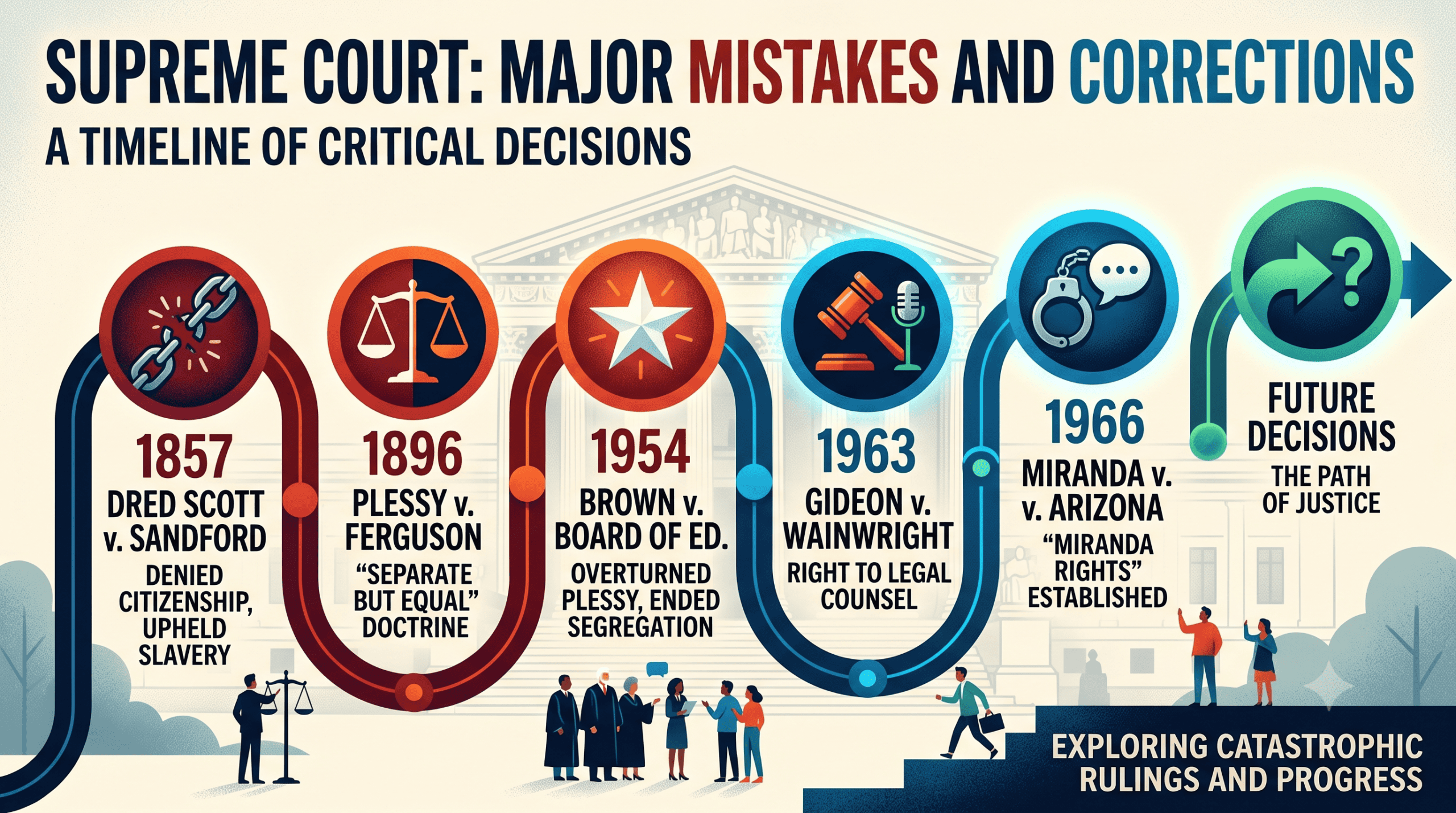
Failure #1: Dred Scott v. Sandford (1857)
The Story: Dred Scott, an enslaved man, sued for his freedom after living in free territories. He argued that his time there made him a citizen.
The Ruling: Chief Justice Roger Taney delivered a devastating opinion: Black people — enslaved or free — were not citizens and could not become citizens. The Court also struck down the Missouri Compromise, saying Congress had no power to ban slavery in U.S. territories.
The Impact: Instead of settling the slavery debate, the decision intensified it. It convinced many abolitionists that the federal government was deeply complicit in slavery, helping fuel the tensions that led to the Civil War.
The Legacy: The Fourteenth Amendment later overturned the citizenship logic of Dred Scott by guaranteeing citizenship to all people born or naturalized in the United States.
Key Lesson
Even the highest court can be blind to humanity. Sometimes it takes a war and a constitutional amendment to correct the mistake.
Failure #2: Plessy v. Ferguson (1896)
The Story: Homer Plessy, who was one-eighth Black, sat in a “whites-only” train car in Louisiana. He was arrested.
The Ruling: The Court upheld state segregation laws under the doctrine of “separate but equal.” As long as facilities were supposedly equal, separation did not violate the Constitution.
The Impact: This ruling gave federal approval to Jim Crow laws. For nearly 60 years, it legalized second-class citizenship for Black Americans across the South.
The Legacy: Plessy was overturned by Brown v. Board of Education in 1954. It remains a stark reminder that “lawful” does not always mean “just.”
Failure #3: Lochner v. New York (1905)
The Story: New York passed a law limiting bakers to 60-hour workweeks, citing dangerous working conditions and public health.
The Ruling: The Court struck down the law, claiming it violated “freedom of contract” — a phrase not found in the Constitution. The justices treated workers and employers as if they had equal bargaining power.
The Impact: For decades, the Court used this reasoning to strike down labor protections, including minimum wage laws, child labor restrictions, and workplace safety regulations.
The Legacy: The Court abandoned this approach in 1937 in West Coast Hotel v. Parrish, when it upheld government regulation of working conditions.
Key Insight
Lochner shows a different kind of failure. Dred Scott and Plessy reflected racial prejudice. Lochner reflected class bias — the assumption that unequal power between employers and workers was natural and untouchable.
Failure #4: Buck v. Bell (1927)
The Story: Carrie Buck, a young woman labeled “feeble-minded,” was ordered to be sterilized by a Virginia state institution. She sued, claiming the order violated her due process rights.
The Ruling: In an 8–1 decision, the Court sided with the state. Justice Oliver Wendell Holmes Jr. wrote the infamous line: “Three generations of imbeciles are enough.”
The Impact: The ruling validated forced sterilization programs targeting the disabled, the poor, and people deemed “unfit.” It later influenced eugenics programs abroad, including in Nazi Germany.
The Legacy: The decision has never been explicitly overturned by the Supreme Court. Although forced sterilization programs ended, Buck v. Bell remains a dark stain on the Court’s record.
Failure #5: Korematsu v. United States (1944)
The Story: Fred Korematsu, a Japanese American citizen, refused to report to an internment camp during World War II.
The Ruling: The Court deferred to “military necessity,” upholding the exclusion order that forced more than 120,000 Japanese Americans into camps based on ancestry.
The Impact: The government imprisoned citizens without trial, stripping them of property and liberty because the Court accepted the argument that national security outweighed civil rights.
The Legacy: Korematsu has been widely repudiated as a moral and legal failure. In 1988, the U.S. government formally apologized and paid reparations to survivors.
The Court’s Darkest Lessons at a Glance
| Case | Year | What Happened | Who Benefited? |
|---|---|---|---|
| Dred Scott | 1857 | Denied Black citizenship and protected slavery | Slavery and racism |
| Plessy | 1896 | Legalized segregation under “separate but equal” | Segregation |
| Lochner | 1905 | Struck down labor protections using “freedom of contract” | Corporate power |
| Buck v. Bell | 1927 | Allowed forced sterilization | State control |
| Korematsu | 1944 | Allowed mass internment of citizens | Military panic |
Why Did Anyone Listen?
Since Marbury v. Madison in 1803, the Supreme Court has possessed the authority of judicial review — the power to determine whether laws comply with the Constitution.
That authority made decisions like Dred Scott, Plessy, and Lochner especially consequential. They were not just opinions. They became binding interpretations of constitutional rights until someone — Congress, a constitutional amendment, or the Court itself — changed them.
Although the Supreme Court has no army or police force, its decisions become binding law because government officials generally accept and enforce its constitutional interpretations.
That raises the next question: when the Court realizes it was wrong, how does it fix things?
The Corrections: When the Court Changed Course
The Supreme Court is made up of human beings, and human beings make mistakes. But one of the unique features of the Court is that it can reverse course when history, legal reasoning, or constitutional understanding changes.
These cases show the Court correcting some of its own past failures.
Correction #1: Brown v. Board of Education (1954)
The Story: Fifty-eight years after Plessy, Thurgood Marshall argued that segregated schools were inherently unequal.
The Ruling: In a unanimous decision, the Court declared that “separate educational facilities are inherently unequal.” The decision directly rejected the logic of Plessy.
The Reality Check: A ruling on paper did not immediately fix conditions on the ground. Southern officials resisted. In 1957, President Eisenhower sent federal troops to Little Rock, Arkansas, to enforce school desegregation.
The Impact: Brown became a defining legal victory of the Civil Rights Movement and began dismantling legal segregation.
Correction #2: Gideon v. Wainwright (1963)
The Story: Clarence Gideon was accused of breaking and entering. He could not afford a lawyer. The judge refused to appoint one, so Gideon defended himself and lost.
The Ruling: The Supreme Court ruled that the Sixth Amendment guarantees legal counsel to anyone facing prison, regardless of wealth.
The Impact: Gideon transformed the American criminal justice system. If you cannot afford a lawyer, the government must provide one.
Correction #3: Miranda v. Arizona (1966)
The Story: Ernesto Miranda confessed after hours of police interrogation, but he had not been told that he had a right to remain silent or a right to a lawyer.
The Ruling: The Court ruled that police must clearly warn suspects of their rights before custodial questioning.
The Impact: The decision created the famous “Miranda warning.” It helped ensure that confessions came from free choice, not coercion.
The Court’s Corrections at a Glance
| Case | Year | What Changed | Why It Matters |
|---|---|---|---|
| Brown | 1954 | Ended legal school segregation | Started the end of Jim Crow |
| Gideon | 1963 | Guaranteed free lawyers for the poor | Made fair trials more meaningful |
| Miranda | 1966 | Required police warnings | Protected against coerced confessions |
Key Takeaway
The Court does not just interpret the law. It reflects the moral progress — or regression — of the country. When society changes, the Court can follow, but it often needs a push.
Constitution Connection
The Constitution itself rarely changes. Instead, Americans often change how they understand it.
Sometimes Congress passes an amendment. Sometimes the Supreme Court overturns one of its own precedents. Sometimes both happen.
The Constitution remains the same text, but its interpretation evolves across generations.
Patterns Across History
| When the Court Failed | What Changed Later |
|---|---|
| Dred Scott | The Fourteenth Amendment guaranteed citizenship and equal protection. |
| Plessy | Brown v. Board rejected “separate but equal” in public education. |
| Lochner | West Coast Hotel allowed government regulation of working conditions. |
| Buck v. Bell | States eventually abandoned forced sterilization programs, though the case was never formally overturned. |
| Korematsu | The government apologized and paid reparations to survivors. |
The Bridge to Today
For much of the nineteenth and early twentieth centuries, the Supreme Court struggled with its role. Was it a protector of minority rights, or a tool of the majority? We saw it fail spectacularly in Dred Scott and Korematsu, and we saw it succeed powerfully in Brown and Gideon.
But as the country moved into the late twentieth and twenty-first centuries, the questions shifted. The debates became less about slavery or legal segregation and more about money, privacy, elections, abortion, campaign finance, gun rights, administrative agencies, and the legitimacy of the Court itself.
The Court began issuing rulings that split the country almost perfectly down the middle. Cases like Citizens United, Dobbs, and Bush v. Gore became not just legal disputes, but national flashpoints.
Increasingly, Americans are not only asking, “Was this constitutional?” They are asking, “Can we still trust the Court?”
A Pattern Throughout History
The Supreme Court rarely changes society overnight. Instead, its decisions often reflect long-running debates already taking place in the country. Sometimes the Court leads public opinion. Sometimes it follows it. And sometimes, history judges the Court more harshly than it judged itself.
Summary: The Arc of History
| Era | Dominant Theme | Example Case | Outcome |
|---|---|---|---|
| Pre-Civil War | Protection of slavery | Dred Scott | Accelerated conflict |
| Reconstruction and Jim Crow | Entrenching segregation | Plessy | Nearly 60 years of Jim Crow |
| Civil Rights Era | Expanding equality | Brown | End of legal school segregation |
| Criminal Justice | Protecting the accused | Gideon / Miranda | Due process protections for all |
Bottom Line
The Supreme Court is one of the most powerful institutions in American government. But history reminds us that power does not guarantee perfection.
Some decisions expanded freedom. Others denied it. Some protected the vulnerable. Others protected systems of oppression.
Understanding both the Court’s successes and failures gives us a more complete picture of American democracy.
Final Thought
The Court’s greatest strength may not be that it never makes mistakes. It may be that the constitutional system contains ways to correct them — through amendments, new rulings, public pressure, and the long work of democratic change.
Continue Learning
- How the Supreme Court Works
- Why Does the Supreme Court Hear So Few Cases?
- What Is Judicial Review? (coming soon)
- What Is the Shadow Docket?
- What Is an Executive Order?
Further Reading
Coming Next in Civics 101
In the next article, we move from the Court’s historic failures and corrections to today’s divisions. Why do modern Supreme Court rulings split the country so deeply? And is the Court facing a legitimacy crisis?

No discussions yet
Be the first to join the discussion and share your thoughts with the community.