
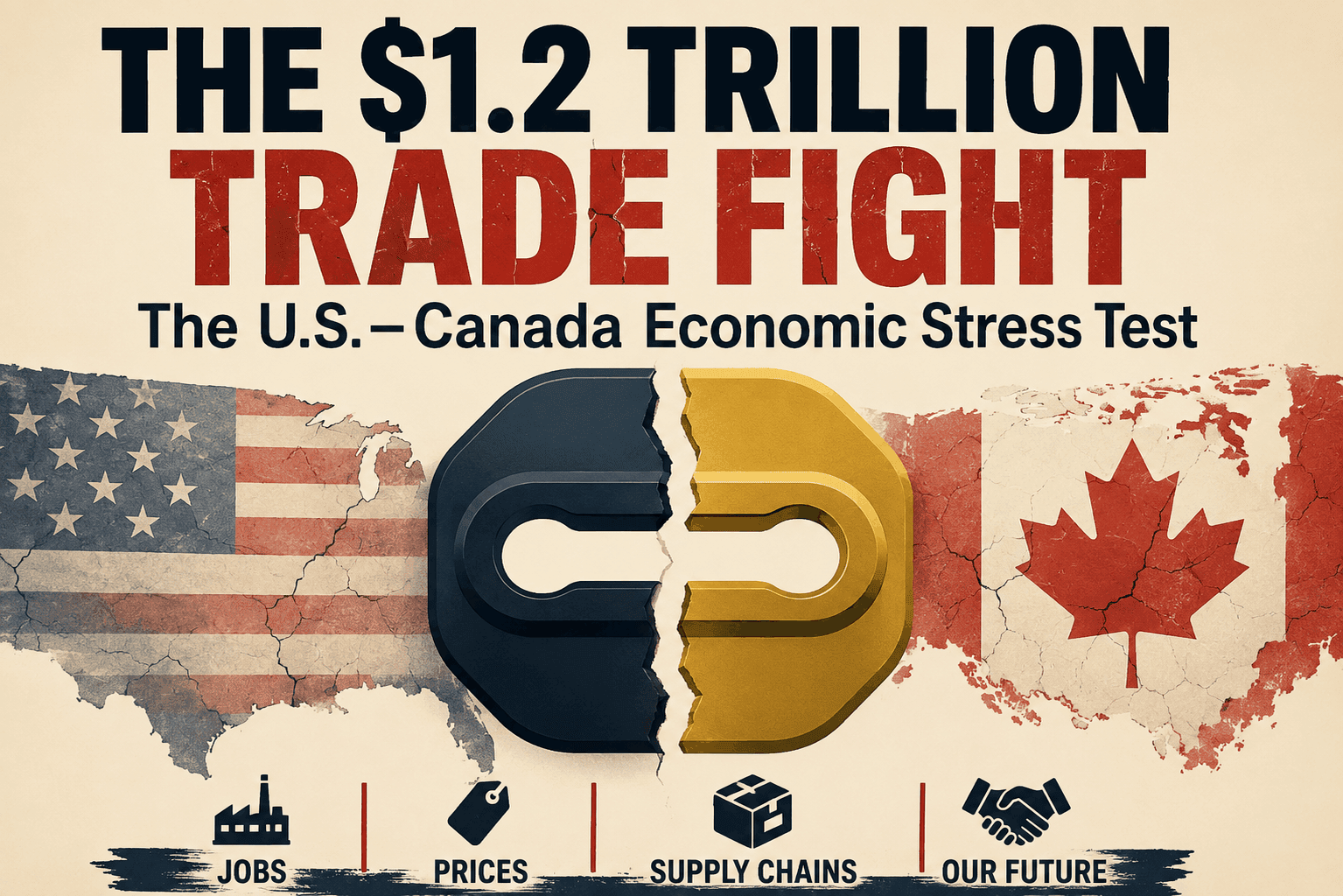
The CAD$1.2 Trillion Relationship Nobody Talks About
The United States and Canada have built one of the world’s largest and most deeply integrated trading relationships. In 2025, more than C$1.2 trillion (US$872 billion) worth of goods and services moved between the two countries. Cars, energy, steel, food, machinery, technology, and countless other products move across a border that much of the economy was built to treat as relatively seamless.
But starting in early 2025, that relationship became a battlefield.
The United States imposed new tariffs on Canadian products. Canada retaliated. Tariffs escalated. Trade negotiations became increasingly contentious.
The immediate question was obvious: Who would pay the price?
But there is a longer-term question that may matter even more:
What happens when one of your biggest customers starts wondering whether it should buy somewhere else?
That’s what makes the U.S.–Canada trade fight bigger than a dispute over tariff rates. Decades of trade have connected factories, workers, energy markets, supply chains, and consumers on both sides of the border.
Changing that relationship isn’t like switching grocery stores.
And once businesses begin building new supply chains, finding new customers, or investing somewhere else, those relationships may not automatically return when the tariffs disappear.
This isn’t about taking sides. It’s about understanding what’s actually at stake.
Part I — How Did We Get Here?
The timeline matters. This didn’t happen overnight.
U.S. tariffs hit Canadian goods, including 25% tariffs on steel and aluminum. Canada responds with counter-tariffs.
U.S. 25% auto tariffs take effect. Canada responds with tariffs on certain U.S.-made vehicles.
The U.S. imposes new tariffs of up to 50% on $27.6 billion of Canadian goods. Canada suspends negotiations and announces matching counter-tariffs.
Canada’s new counter-tariffs of 15%, 25%, and 50% are scheduled to take effect on $27.6 billion of U.S. goods.
(Sources: Stikeman Elliott LLP analysis, CBC News sector breakdown)
One of the most important legal tools behind this fight is Section 232 of the Trade Expansion Act of 1962.
Section 232 allows the president to restrict imports when the Commerce Department determines that those imports threaten national security. It has been used to justify tariffs on industries such as steel and aluminum, which the administration argues are important to U.S. industrial and defense capacity.
But by 2026, the dispute had expanded beyond Section 232. The administration also invoked Section 338 of the Tariff Act of 1930, a rarely used authority that allows the president to impose additional duties when another country is determined to discriminate against U.S. commerce.
That distinction matters. What began as a fight over particular industries had grown into a broader dispute over how the two countries treat each other’s products.
Supporters argue these tools give the United States leverage to protect domestic industries and push back against unfair trade practices.
Critics argue that repeatedly invoking national security and other broad presidential trade powers against a close ally risks damaging an economic relationship that took decades to build.
Either way, tariffs that look simple on paper run into a much more complicated reality at the border.
And that’s where the integrated supply chain becomes important.
Part II — The Integrated Supply Chain Problem
The United States and Canada don’t simply sell finished cars to each other. In many cases, they build them together.
The North American auto supply chain is so tightly connected that individual components can cross the U.S.–Canada border several times before a vehicle is completed.
Consider something as simple as a striker plate — the small metal piece that helps a car door latch.
Steel
Manufacturing
Processing
Michigan
Assembly
One tiny component can cross the U.S.–Canada border at least four times before its job is finished.
🔑 This isn’t a bug in the system. It’s the system.
Decades of trade agreements and investment created a manufacturing network in which companies placed different stages of production where they made the most economic sense. Engines, transmissions, steel, aluminum, electronics, and other components move through a supply chain that doesn’t neatly stop at the national border.
That’s why tariffs on an integrated industry work differently from tariffs on a finished product that simply arrives from overseas.
A tariff can hit a component while it is still moving through the production process. Depending on how the tariff is structured and whether exemptions or credits apply, costs can accumulate as goods move through the supply chain.
And if a critical part becomes too expensive or stops arriving altogether, an assembly plant cannot simply finish the car without it.
A factory in Canada can depend on a supplier in Michigan. A factory in Michigan can depend on a supplier in Ontario.
That’s what makes a U.S.–Canada trade fight so complicated: policies aimed at protecting one country’s manufacturers can also disrupt manufacturers on the other side of the border — including companies and workers the policy was intended to help.
Part III — The Numbers Nobody Shows You
Both governments say they are trying to protect workers.
But there’s a surprisingly difficult question buried underneath that claim:
How many jobs are actually being protected — and how many are being put at risk?
There is no simple answer.
Before the trade fight began, a significant share of Canadian employment depended on U.S. demand — particularly in manufacturing.
Manufacturing is particularly exposed.
Canadians worked in industries dependent on U.S. demand for Canadian exports before the trade fight.
Canadian manufacturing jobs were supported directly or indirectly by U.S. demand in 2024.
Decline in Canadian manufacturing employment from December 2024 to December 2025.
But here’s where trade statistics can become misleading:
A job that depends on U.S. demand is not the same thing as a job that will be lost because of a tariff.
Some industries may lose exports but keep most of their workers. Some companies may find new customers. Others may reduce production, delay hiring, cut shifts, or eventually lay off workers.
And tariffs can affect industries differently.
From December 2024 to December 2025, Canadian manufacturing employment fell by nearly 36,000 workers. Employment in motor vehicle parts manufacturing fell 9.3%, while employment at iron and steel mills and ferro-alloy manufacturers fell 8.7%.
But even those numbers require caution.
Tariffs were part of the economic environment, but they weren’t the only thing affecting factories. Production changes, retooling, chip shortages, broader economic conditions, and individual company decisions can all affect employment.
The same complexity exists on the American side.
A tariff may help a U.S. steel producer competing with imported steel while raising costs for a U.S. manufacturer that buys steel to make appliances, machinery, construction equipment, or automobiles.
That means one policy can potentially protect jobs in one part of the economy while putting pressure on jobs somewhere else.
⚠️ The one thing missing from this entire trade fight is a complete job scorecard.
We can measure tariff rates. We can measure exports. We can measure employment changes.
What we cannot yet do is point to one reliable number and say:
“This many jobs were saved, and this many jobs were lost because of the tariffs.”
That answer may take years to understand — and even then, economists may disagree about exactly what caused what.
Part IV — What’s Actually Being Negotiated?
By August 2026, the United States and Canada appeared to be getting close to a deal.
The negotiations mattered because some of the highest tariffs were hitting the industries where the two economies are most tightly connected — particularly automobiles, steel, and aluminum.
Under the proposed agreement, the United States would have reduced the tariff on Canadian cars and light-duty trucks from 25% to 15%. Tariffs on Canadian steel and aluminum would also have been reduced, although some of that relief would have depended on quotas and other conditions.
For a moment, both governments sounded optimistic.
Then the deal fell apart.
The two sides remained divided over several issues, including which vehicles would qualify for tariff relief and how Canadian products would be treated compared with imports from other U.S. trading partners.
Canada suspended negotiations rather than accept the terms being offered. The United States moved ahead with another round of tariffs, including duties of up to 50% on $27.6 billion of Canadian goods. Canada responded by announcing matching counter-tariffs on $27.6 billion of U.S. goods, scheduled to take effect September 8.
And the auto fight could escalate further. President Trump has threatened to raise tariffs on Canadian cars, trucks, and auto parts to 50% beginning January 1, 2027 if the dispute is not resolved.
But there’s an important piece of context:
The U.S.–Canada trading relationship has not suddenly become a 50% tariff relationship.
Many products that meet CUSMA requirements continue to receive preferential treatment, while particular industries and products face separate tariffs and trade restrictions. That’s why hearing that “the U.S. imposed a 50% tariff on Canada” can give readers a misleading picture of what is actually happening.
The fight is concentrated in particular products and industries — but those industries include some of the most economically and politically important parts of the relationship.
And hanging over all of this is CUSMA, the trade agreement connecting the United States, Canada, and Mexico.
What About CUSMA?
CUSMA — called USMCA in the United States — replaced NAFTA in 2020 and governs much of the trade among the United States, Canada, and Mexico.
It does not expire in 2026.
The agreement’s first required six-year joint review took place in July 2026. The three countries can agree to extend the agreement for another 16-year term. If they do not agree to extend it during a review, that does not immediately terminate CUSMA; additional annual reviews can follow. Canada says the current agreement remains in force until 2036.
Under normal circumstances, that review would be an opportunity to update a major trade agreement.
Instead, the first review took place in the middle of a trade fight.
That raises a larger question for businesses deciding where to build factories, sign contracts, or invest millions of dollars:
How certain is the North American trading relationship they are planning around?
And uncertainty itself can change business decisions — even before a tariff is paid.
Part V — The Real-World Impact
Tariffs are announced in percentages. Their effects show up in factories, paychecks, prices, contracts, and business decisions.
And more than a year into the U.S.–Canada trade fight, the effects haven’t been identical across every industry.
For Workers
The numbers in Part III tell us how many jobs are exposed to changes in U.S. demand.
But for workers and communities, the impact isn’t just about layoffs.
Trade uncertainty can also mean fewer shifts, slower hiring, postponed investments, or companies waiting to expand until they know what the rules will be.
And those effects can be concentrated.
Manufacturing plants often support more than the people working inside them. Suppliers, transportation companies, contractors, restaurants, retailers, and other local businesses can depend on the economic activity surrounding a major employer.
That’s why a disruption affecting one factory can ripple through a community even if the factory never completely shuts down.
At the same time, tariffs may benefit workers in industries that gain protection from foreign competition or see increased demand for domestically produced goods.
The effect on workers depends not only on whether tariffs create or protect jobs — but also on where those jobs are created, where jobs are lost, and how long those changes last.
For Consumers
Tariffs don’t stay at the border.
When a company importing a product has to pay a tariff, it has several choices: absorb the cost, negotiate lower prices from suppliers, change where it buys the product, or pass some of the cost along to customers.
The result varies by product and industry.
But the basic pressure is straightforward:
If an imported input becomes more expensive, someone in the supply chain has to absorb that additional cost.
In an integrated industry like automobiles, that matters because Canadian and American companies often supply one another. A tariff intended to make a foreign product more expensive can therefore raise costs for a domestic manufacturer that uses that product too.
For Businesses
This may be where the longer-term consequences become most important.
Canadian businesses haven’t simply waited for the trade fight to end. Some have started adapting.
The Bank of Canada reports that businesses are looking for customers and suppliers outside the United States. Canadian imports from the United States declined after tariffs began, while imports from other countries increased. Some Canadian exporters have also started redirecting products toward other markets.
Aluminum offers a striking example.
After U.S. tariffs were imposed, Canadian aluminum exports initially fell sharply. Some producers responded by redirecting sales to Europe, although at lower profit margins. Canadian aluminum exports to countries outside the United States increased substantially during 2025, with particularly strong growth toward the Netherlands and Italy.
Energy exports also began reaching more markets outside the United States. Canadian energy exports to non-U.S. destinations rose 22.3% in 2025, helped by increased shipments to countries including China, the Netherlands, Germany, Italy, and Singapore.
None of this means Canada can simply replace the United States.
Geography matters. Infrastructure matters. Transportation costs matter. Decades of investment were built around selling into the enormous U.S. market directly next door. The Bank of Canada warns that finding new customers and building new supply chains will take time and can be costly.
But something important has already begun:
Canadian companies have a reason to ask whether depending so heavily on one customer is still worth the risk.
And once businesses invest in new suppliers, new transportation routes, and new customers, some of those changes can outlast the tariff that caused them.
Part VI — Is This Really About National Security?
Steel and aluminum tariffs may sound like economic policy. But the legal argument behind many of them is about something else:
National security.
The Trump administration argues that the United States needs enough domestic steel and aluminum production to support its military, critical infrastructure, and industrial base during a war or national emergency.
That argument isn’t difficult to understand.
A country that cannot produce enough steel, aluminum, energy, semiconductors, medicine, or other essential goods can become vulnerable if foreign supplies are disrupted.
The harder question is how much domestic production is necessary — and which foreign suppliers should be considered a security risk.
Canada makes that question particularly complicated.
Canada is not simply another foreign supplier. It is a NATO ally, a NORAD defense partner, and one of the United States’ closest economic and security partners. Canadian and American companies also operate inside many of the same supply chains.
So there are two competing ways to look at the same relationship.
The Case for the Tariffs
The United States should not become so dependent on imports that it loses the ability to produce materials essential to its own defense and economy. Tariffs can encourage domestic production and give U.S. industries protection from foreign competition.
The Concern About the Tariffs
Treating a close ally as a national-security threat can disrupt supply chains that themselves support U.S. industry and defense. And if tariffs push Canadian producers and buyers toward other markets, the United States could weaken a relationship that has historically reduced—not increased—its supply risk.
There isn’t a purely economic answer to that question.
It’s also a political and strategic judgment about what kinds of dependence a country is willing to accept.
People Are Asking
What Can Readers Do?
You don’t need to become a trade economist to follow this story. But you do need to look beyond the headline.
When you hear that the United States or Canada has announced a new tariff, ask a few questions:
A headline may say “50% tariffs,” but that doesn’t mean every product crossing the U.S.–Canada border faces a 50% tariff. Look at which products are covered and whether CUSMA rules apply.
Are companies changing suppliers, delaying investments, moving production, or finding customers elsewhere? Those decisions can show whether the relationship itself is changing.
Look for evidence on both sides: jobs gained or protected, jobs lost, factory investment, production changes, and consumer prices.
The 2026 review — and the negotiations that follow — will help show whether the United States, Canada, and Mexico still see their integrated trading relationship as something they want to preserve, and under what terms.
A trade deficit doesn’t automatically mean a country is losing. A tariff doesn’t automatically mean domestic workers are winning. An increase in exports doesn’t automatically mean an economy is better off.
The Bigger Picture
Trade disputes aren’t new. Even close economic partners disagree over tariffs, subsidies, market access, and which industries deserve protection.
But the U.S.–Canada fight is different because of how deeply the two economies have been built around each other.
Factories share supply chains. Energy crosses the border every day. Businesses have spent decades choosing suppliers, building infrastructure, and making investments based on the assumption that trade between the two countries would remain relatively stable.
That kind of relationship doesn’t disappear because of one tariff.
But it can change.
Canada cannot easily replace the United States as a customer. The U.S. market is enormous, it is next door, and much of Canada’s transportation and energy infrastructure was built specifically to serve it.
At the same time, the trade fight has given Canadian businesses and policymakers a reason to think differently about dependence on that market.
Some businesses are already finding new customers. Others are looking for new suppliers. Governments are also investing in new trade relationships.
It means Canada has a stronger incentive to make sure it has other options.
And that may be the most important long-term consequence of this trade fight.
The risk for the United States isn’t simply that Canada buys fewer American products during a tariff dispute.
It’s that Canadian businesses spend years building alternatives — and discover they don’t need to come all the way back.
That’s why this isn’t just a tariff war.
It’s a stress test for decades of North American economic integration.
The outcome won’t be measured only by tariff rates, trade deficits, or who claims victory in the next negotiation.
It will also be measured by something much harder to see:
Where businesses invest. Who they buy from. Who they sell to. And whether the economic relationship that emerges from this fight looks the same as the one that entered it.
Related Reading
- Does a Trade Deficit Mean We’re Losing? — Understanding trade balances before the fight begins
- What Are Tariffs? — How trade taxes affect prices, jobs, and national strategy
Coming Next:
When “National Security” Means Tariffs: How a Cold War-Era Law Became a Trade Weapon



No discussions yet
Be the first to join the discussion and share your thoughts with the community.