
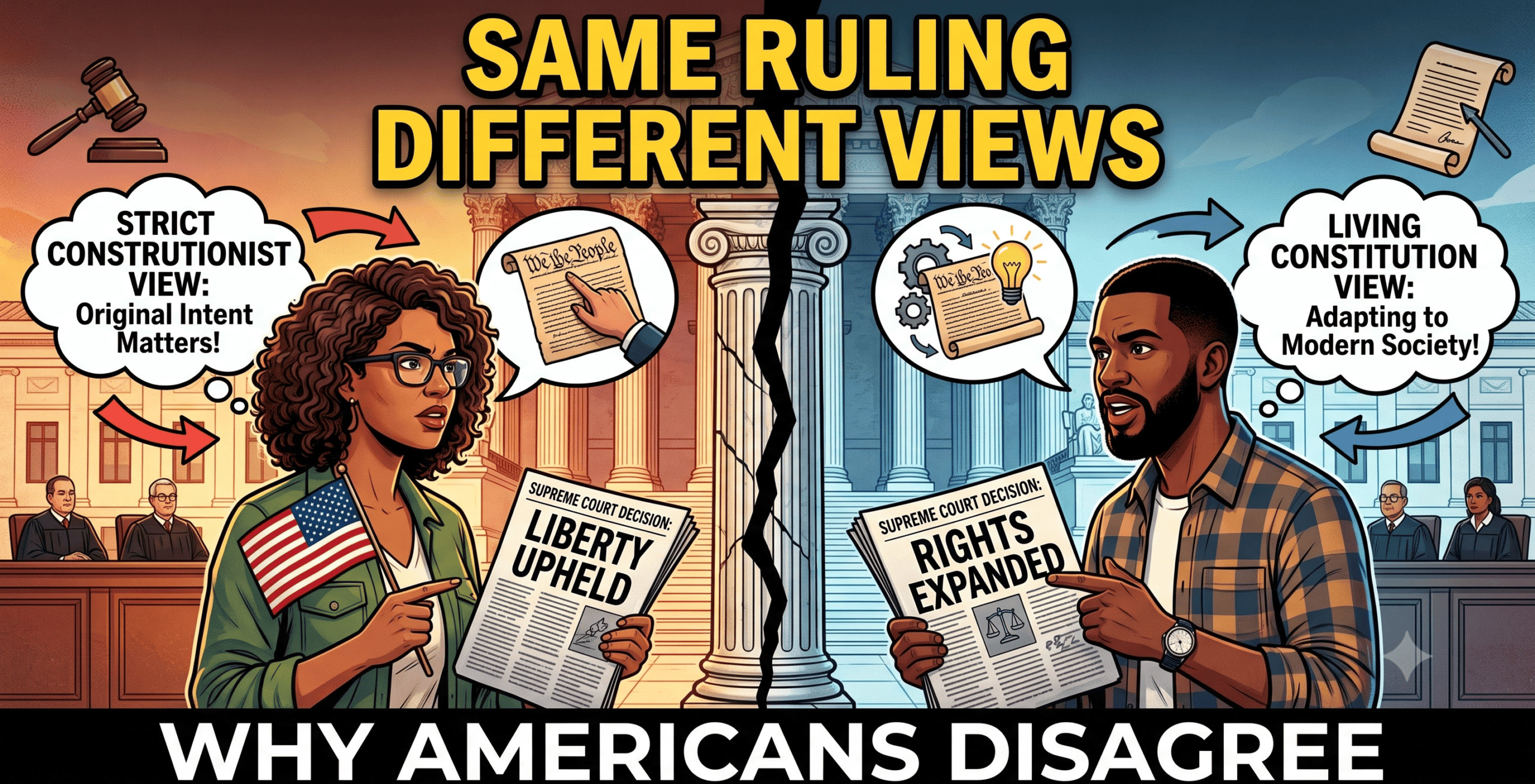
How the Same Constitution Leads to Different Conclusions
The Supreme Court rarely settles America’s biggest arguments. More often, it changes them.
Some decisions become widely accepted over time. Brown v. Board, Gideon, Miranda. People argue about implementation, but few dispute the principle anymore.
Other decisions remain controversial for decades. Dobbs. Citizens United. Bush v. Gore. Generations later, Americans are still fighting about them.
Why?
It isn’t simply politics. It has to do with history, constitutional silence, and different ideas about what government is for.
In this article, we explore why some rulings heal national wounds—and others deepen them. More importantly, we ask: Can you understand someone who disagrees with you without calling them un-American?
Decisions That Become National Consensus
Not every Supreme Court decision remains controversial forever. Some begin with fierce opposition but gradually become accepted as part of American life. The path is rarely quick or easy, but over time these rulings become part of the nation’s constitutional foundation.
| Case | Year | What Changed | Public Acceptance |
|---|---|---|---|
| Brown v. Board | 1954 | Ended school segregation | Roughly 20–30 years before broad national acceptance |
| Gideon v. Wainwright | 1963 | Guaranteed counsel for defendants who cannot afford an attorney | Accepted relatively quickly |
| Miranda v. Arizona | 1966 | Required police to advise suspects of constitutional rights | Became embedded in American culture within a decade |
| Loving v. Virginia | 1967 | Struck down interracial marriage bans | Public acceptance grew rapidly as attitudes changed |
| Tinker v. Des Moines | 1969 | Protected students’ free speech rights | Generally accepted today |
The Pattern
These cases share something important. They addressed clear violations of fundamental rights in ways that aligned with evolving moral consensus. By the 1980s and 1990s, opposing them seemed unthinkable.
Decisions That Never Stop Dividing America
Some Supreme Court rulings never become part of a national consensus. Instead, they remain political, moral, and constitutional fault lines for generations.
| Case | Central Question | Why Debate Continues |
|---|---|---|
| Roe v. Wade / Dobbs | When does constitutional protection begin? | Conflicting beliefs about bodily autonomy, fetal life, morality, and religion. |
| Citizens United | Is money protected speech? | Balancing free speech against concerns about political influence. |
| Bush v. Gore | What role should courts play in elections? | Questions about judicial neutrality and democratic legitimacy. |
| Shelby County v. Holder | How should voting rights be protected? | Different views on federal oversight versus state authority. |
Why Do Reasonable People Disagree So Strongly?
These cases are not simply legal disputes. They reflect different visions of America and different ideas about the purpose of government.
- Should abortion policy be decided primarily by individuals and their physicians, or by elected legislatures?
- Should campaign spending be treated as protected speech, or regulated to reduce political influence?
- How much authority should courts have when elections are disputed?
Each question has two defensible answers. Neither side is irrational. They often begin from different constitutional principles and different assumptions about the role of government.
Even Supreme Court decisions do not always fit neatly into traditional ideas about precedent. In Bush v. Gore, the majority stated that its reasoning was limited to the specific circumstances of that election. Many legal scholars have described the decision as a “non-precedent precedent” because the Court itself suggested its reasoning should not automatically apply to future cases. The decision remains one of the Court’s most debated rulings—not only because of its outcome, but because of the questions it raised about consistency and precedent.
The Big Idea
People don’t disagree because they read different Supreme Court cases.
They disagree because they begin with different values, different constitutional philosophies, and different ideas about what government should do.
Those starting assumptions shape how they interpret the same Constitution, the same facts, and often the same court decision.
The Constitution Doesn’t Answer Every Question Clearly
Here is where most readers get confused. We assume judges simply “follow the Constitution”—like reading instruction manual. But the Constitution is frustratingly vague in places.
| Issue | What the Constitution Says | Question the Court Must Answer |
|---|---|---|
| Privacy | No explicit right | Does liberty include personal autonomy? |
| Campaign Finance | No specific guidance | Is spending money a form of protected speech? |
| Presidential Immunity | No explicit rule | Can a president be prosecuted for official acts? |
| Affirmative Action | Equal Protection Clause | Can race ever be considered to remedy past discrimination? |
The Implication
This is not evidence that judges are ignoring the Constitution. It reflects the reality that broad constitutional principles often require interpretation. Two well-informed justices can read the same text and honestly reach different conclusions.
This isn’t incompetence—it’s ambiguity built into the founding document. The Framers knew they couldn’t predict every future scenario. So they wrote general principles and trusted future generations to interpret them.
In other words, disagreement is often built into the Constitution itself—not because the document is flawed, but because its broad principles must be applied to situations the Framers could never have anticipated.
That trust works beautifully… until it doesn’t.
What People Call “Judicial Activism” (Note: used critically OR descriptively)
“Courts should actively shape constitutional law when justice demands it.
People read court decisions through philosophical lenses. Here are the four dominant frameworks:
1. Originalists
“The Constitution means what it meant when written.”
- Logic: If we allow meanings to shift with culture, anyone can twist the document to say anything.
- Result: Often supports gun rights, limits abortion, emphasizes states’ power.
- Critics Say: Ignores historical context; assumes the Founders would want us frozen in 1787 thinking.
2. Living Constitutionalists
“The Constitution’s principles stay the same, but society changes.”
- Logic: The Framers intended for broad principles like “equal protection” to evolve alongside human dignity.
- Result: Often expands privacy rights, civil rights, LGBTQ+ protections.
- Critics Say: Lets judges legislate from the bench; substitutes personal policy preferences for law.
3. Judicial Restraint
“Judges should interfere with elected officials only when clearly necessary.”
- Logic: Legislators are accountable to voters. Judges are not. Deference preserves democracy.
- Result: Upholds controversial laws unless they clearly violate text.
- Critics Say: Protects unjust laws too easily; abandons minorities when majorities oppress them.
4. What People Call “Judicial Activism” (Note: used critically OR descriptively)
“Courts should actively shape constitutional law when justice demands it.”
- Logic: Sometimes democracy fails marginalized groups. Courts must intervene.
- Result: Brown, Obergefell, Roe—all seen as activism by supporters, tyranny by opponents.
- Critics Say: Undermines democratic self-governance; creates policy from the courthouse.
Why Do Americans Read the Same Decision So Differently?
You don’t begin with Supreme Court cases.
You begin with values.
Imagine two neighbors watching the same Supreme Court decision unfold.
| Neighbor A Begins With… | Neighbor B Begins With… |
|---|---|
| Individual liberty | Tradition and social stability |
| Personal autonomy | Protection of unborn life |
| Limited government | Community responsibility |
| Rights expand over time | The Constitution should be interpreted as originally understood |
The Big Idea
Same Constitution.
Different starting values.
Neither neighbor is necessarily dishonest or unpatriotic. They simply prioritize different constitutional principles. Those differences shape how they interpret the same Supreme Court decision.
This helps explain why one family celebrates a decision while another mourns it. The disagreement usually begins long before the Court announces its opinion.
Are We Capable to Disagree Without Questioning Patriosim?
This is the hardest question in American civic life.
What if two people read the exact same Constitution, studied the same Supreme Court case, and reached completely different conclusions—not because one ignored the law, but because they started from different beliefs about justice, history, or even human life?
That question sits at the heart of the debate over Dobbs v. Jackson Women’s Health Organization.
Many Americans believe the justices were influenced by religious beliefs, moral convictions, or a particular judicial philosophy. Others argue the decision was rooted in originalist constitutional interpretation—that the Constitution simply does not contain a federal right to abortion and that the Court’s role was to return the issue to the democratic process.
Those are not just political talking points. They represent two fundamentally different ways of understanding the role of the Supreme Court.
The consequences of Dobbs quickly became part of the national conversation. Supporters viewed the ruling as correcting what they believed was an unconstitutional precedent and allowing elected lawmakers to decide abortion policy. Critics pointed to cases such as a 10-year-old Ohio rape victim who had to travel to another state for an abortion after Ohio’s law took effect, along with documented reports of women who died after delays in receiving emergency pregnancy care under restrictive abortion laws. Supporters of those laws often argue those deaths resulted from how the laws were implemented or interpreted rather than from the laws themselves.
The debate is no longer just about what the Constitution says. It is about whether our deepest moral convictions inevitably shape how we interpret it.
So what’s next?
Democracy survives disagreement. It dies when disagreement becomes identity. Once you believe your opponent hates the country, compromise becomes treason. But once you remember they started from different values—not malice—dialogue remains possible.
Summary: Reading Between the Lines
| Aspect | Uniting Decisions | Dividing Decisions |
| Time Horizon | Accepted quickly or gradually over decades | Remain unresolved for generations |
| Value Alignment | Clarify rights most people already support | Force choice between competing sacred values |
| Text Clarity | Address clearer constitutional language | Fill gaps where text is silent or ambiguous |
| Emotional Charge | Low-to-moderate outrage | Extreme moral stakes (life, liberty, faith) |
What Comes Next?
Understanding the why leaves one critical question unanswered: What tools exist to check the Court when it oversteps?
- Can Congress override bad rulings?
- Can citizens demand ethical reforms?
- Can trust be rebuilt?
In the final installment of Politics 101, we confront Checks and Balances on the Supreme Court—the hard truth about what happens when government moves too slowly, and what ordinary citizens can do when institutional trust collapses.
Until then: Understanding doesn’t require agreement. But it does require curiosity.
Keep asking why.
Frequently Asked Questions
Q: Why can’t judges just follow the Constitution word-for-word?
A: Sometimes the text is clear. Often it isn’t. Phrases like “due process,” “equal protection,” and “unreasonable searches” require interpretation. Two honest interpreters can reach different conclusions—and both be faithful to the text.
Q: Isn’t judicial activism always bad?
A: The phrase “judicial activism” often depends on perspective. A decision one person views as a necessary protection of constitutional rights may be viewed by another as judges exceeding their proper role. For that reason, the term is often used more as political criticism than as a neutral legal description.
Q: Will Americans ever agree on the Court again?
A: History suggests yes, eventually—but usually after cultural shifts or constitutional amendments. Dred Scott took war and a new amendment to undo. Plessy took 58 years plus a revolution in public opinion. Change is slow. Trust rebuilds slower.
Final Section
Civic education does not eliminate disagreement. It makes disagreement more informed.
Can Americans disagree about Supreme Court decisions without questioning each other’s patriotism?
Continue the Supreme Court Series
- Article 1: What is the Supreme Court And How Does It Work?
- Article 2: The Worst Supreme Court Decisions in American History
- Article 3: Can the Supreme Court Correct Its Own Mistakes?
- Article 4: Why Americans Disagree About the Supreme Court.
- Next: Who Watches the Supreme Court?


No discussions yet
Be the first to join the discussion and share your thoughts with the community.