
It has been an incredibly busy week in news, marked by major domestic political debates, escalating tensions in foreign policy, and a notable moment in pop culture history.
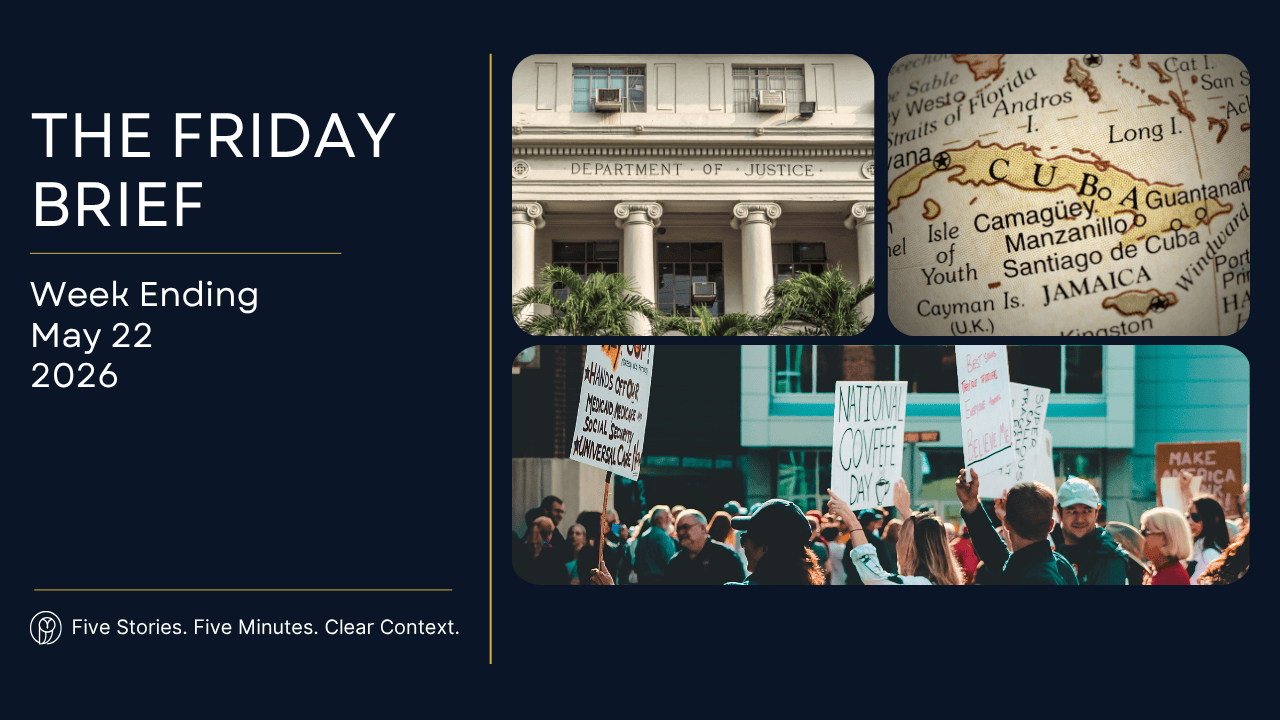
A massive political battle has erupted in Washington over the Department of Justice’s newly announced “Anti-Weaponization Fund.” The $1.7+ billion fund, intended to compensate allies of President Trump who claim they were targeted by past investigations, has faced intense scrutiny. The move has triggered a growing Republican revolt in the Senate, prompting lawmakers to delay a key immigration enforcement funding bill, while a bipartisan House bill has been introduced to completely ban federal money from being used for the payouts.
This isn’t just a political squabble; it creates a direct standoff over how taxpayer dollars are spent. Because Senate lawmakers are freezing immigration funding to fight this fund, the dispute has paralyzed essential legislative business, threatening a government shutdown if the gridlock isn’t broken.
Tensions in the Caribbean have spiked following the U.S. indictment of former Cuban leader Raúl Castro. In response, President Trump raised the possibility of U.S. military intervention in Cuba, stating “it looks like I’ll be the one to intervene.” The situation has quickly taken on a global scale, with both China and Russia formally backing Cuba, while Secretary of State Marco Rubio expressed skepticism about finding a diplomatic solution.
It abruptly shifts the geopolitical landscape by bringing adversarial military posturing right to the U.S. doorstep. Russian and Chinese backing of Cuba turns a localized regional dispute into a high-stakes proxy crisis, raising the actual risk of a direct military confrontation near American waters.
The Democratic National Committee finally released its long-awaited post-election autopsy report. The document offers a stark look at what went wrong for the party, placing significant internal criticism on Kamala Harris’s campaign execution and its struggle to retain key demographics, such as Latino voters. Progressive Democrats have already hit back at the report, criticizing it for remaining silent on the party’s stance regarding the ongoing war in the Middle East.
The report exposes deep, bitter fractures within the Democratic party just as they prepare for critical midterm elections. By openly blaming the campaign strategy and alienating progressives, the internal feuding threatens to derail their fundraising and platform unity when they need it most to win back Congress.
International eyes remain fixed on the Middle East as negotiations continue to bring an end to the U.S.-Iran conflict. Pakistani mediators reported this week that a permanent ceasefire may finally be within reach, though major sticking points—including control of the crucial Strait of Hormuz and uranium management—remain unresolved. Meanwhile, the International Energy Agency (IEA) warned that oil markets are nearing a “red zone” of volatility if the crisis isn’t resolved soon.
The resolution of this war dictates the immediate health of the global economy. With the Strait of Hormuz tied up in negotiations, global supply chains remain vulnerable, and the IEA’s “red zone” warning means a failure in talks will likely trigger an immediate spike in global gas prices and inflation.
In media and entertainment, late-night television saw the end of an era as Stephen Colbert hosted his final episode of The Late Show on CBS, wrapping up an 11-year run. The star-studded finale featured surprise celebrity appearances, an ambitious musical send-off alongside Paul McCartney, and a rare gathering of his fellow late-night hosts to bid him farewell.
Colbert’s departure is the clearest sign yet of the death of traditional broadcast late-night. As CBS rents out his historic slot to syndicated filler rather than finding a replacement, it marks a permanent cultural shift where late-night comedy is migrating entirely to streaming and social media.
- International health officials are tracking a severe Ebola outbreak in the Democratic Republic of Congo.
- The tech sector is reacting to the White House delaying a major executive order regarding artificial intelligence oversight.


No discussions yet
Be the first to join the discussion and share your thoughts with the community.