
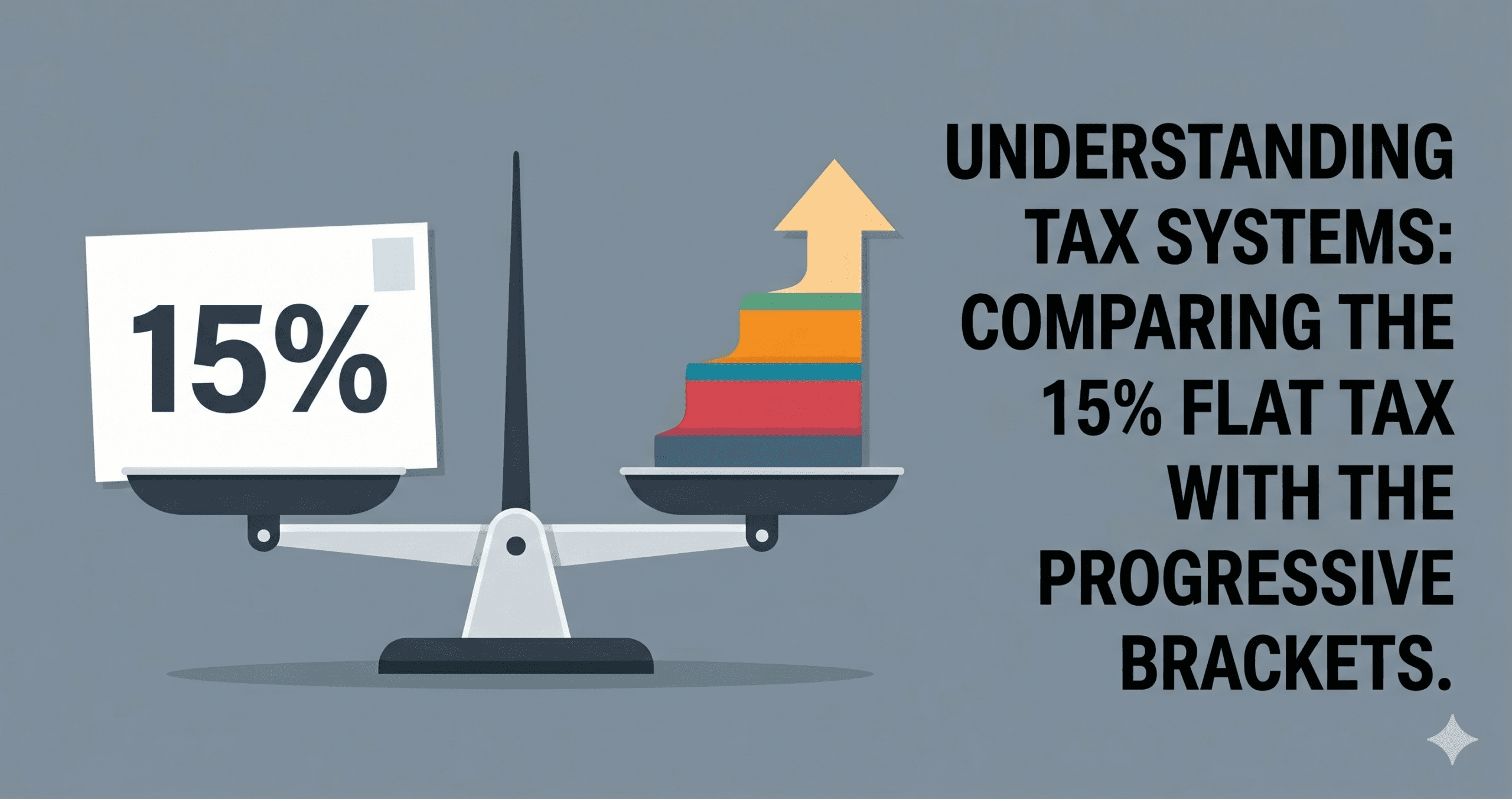
Introduction: Understanding the Debate
You might think tax policy is just a dry debate for politicians and accountants. However, the structure of our tax system quietly shapes your everyday life. It dictates the size of your paycheck, affects the quality of community schools, and decides whether local businesses can afford to hire.
The U.S. tax code spans over 70,000 pages and is packed with dense loopholes. Because of this complexity, the promise of a simple flat tax system sounds incredibly appealing. Imagine writing a single percentage on a postcard, mailing it in, and being done.
But before we embrace that comfort, we must look past the slogans and face the hard economic trade-offs. Why does this issue matter right now? How a country collects revenue ultimately defines what it values as a society. To understand the real-world stakes, let’s answer the five big questions most people are afraid to ask.
Question 1: “If I get a raise, will I actually take home less money?”
The Myth: Many workers fear that hitting a higher tax bracket penalizes their entire income, leaving them worse off than before.
The Reality: This is false. In a progressive structure, you only pay the higher rate on the extra dollars earned in that specific tier. You never lose money by climbing the income ladder.
The Impact: Flattening the rate removes this progressive ladder entirely. While it guarantees you won’t face a higher percentage for earning more, it also strips away the protective baseline that ensures wealthier citizens pay a larger share.
Question 2: “Will a single rate finally stop the rich from using loopholes?”
The Myth: “If we just have one uniform rate, everyone will pay their fair share, and the wealthy can’t cheat the system anymore.”
The Reality: Not necessarily. Loopholes are not born from having multiple brackets; they come from how the law defines what counts as taxable income.
The Wealth vs. Income Gap: High earners rarely rely on a standard bi-weekly paycheck. When an executive is compensated in stock options, real estate, or “carried interest,” that money often bypasses traditional income tax and is categorized as investment income instead.
The Lesson: A simple percentage does not stop tax avoidance unless the rewrite completely closes these definitions. Otherwise, it just gives the ultra-wealthy an easier formula to calculate their massive savings. Historical flat tax experiments in nations like Russia and Slovakia proved this point, as the wealthy still found legal paths to minimize what they owed.
Question 3: “Who pays for the roads, schools, and emergency services?”
The Myth: “We can cut tax rates to a low percentage and still maintain top-tier public infrastructure.”
The Reality: Simple math demands a trade-off. Governments require a baseline amount of revenue to fund public safety, infrastructure, and education.
The Slovakia Cautionary Tale: Slovakia implemented a flat tax model to attract foreign corporate investment, which initially sparked economic growth. Unfortunately, the government quickly realized the flat rate failed to generate enough revenue to fix crumbling roads or adequately pay teachers. Facing a severe funding deficit, they eventually abandoned the experiment and reverted to a progressive system to stabilize the country.
The U.S. Dilemma: If the United States transitioned to a single-rate model, policymakers would face a brutal binary choice:
- Setting the rate high (e.g., 25% to 30%) would match current revenue but feel like a massive tax hike for the working class.
- Opting instead to set the rate low (e.g., 15%) might keep the policy popular but force immediate, drastic cuts to public schools, highway funding, and safety nets.
Question 4: “Is it fair that a janitor and a CEO pay the exact same percentage?”
The Myth: “15% is 15%. It’s mathematically equal, so it’s inherently fair.”
The Reality: Mathematical equality does not mean economic equity. The true measure of a tax is its marginal utility—meaning how much that lost money alters your ability to survive.
The Janitor vs. The CEO:
- Consider a janitor earning $30,000 under a 15% flat rate. Paying $4,500 directly hurts their ability to secure rent, buy groceries, or cover medical bills.
- Now look at a CEO earning $30,000,000 under that same 15% rate. They pay $4.5 million, but walk away with $25.5 million. The tax has zero impact on their day-to-day lifestyle or purchasing power.
The Verdict: This real-world impact is why economists call flat taxes fundamentally regressive. The system extracts a far more painful sacrifice from low-income households than from the wealthy. Progressive taxation exists to align the financial burden with a person’s actual ability to pay.
Question 5: The Tale of Two Americas — Regional Tax Trends
The Trend: Right now, America’s economic landscape is fracturing into two entirely different experiments. On one side, fifteen states—including recent additions like Ohio, Iowa, and Georgia—have completely flattened their tax brackets. They argue a single, low rate attracts businesses and simplifies life for everyone.
The Counter-Movement: Meanwhile, places like New York are doubling down on progressive taxation. Recently, New York leadership made headlines by pushing policies to make the state’s billionaires pay a significantly larger share to close budget gaps and support public services.
Why It Matters: This split highlights a high-stakes chess game being played across state lines.
- The Risk for New York: If a state raises taxes too high on the ultra-wealthy, those billionaires can easily “vote with their feet”. Moving their residency to a flat-rate state like Arizona, or a zero-tax state like Florida, strips New York of massive amounts of revenue.
- The Risk for Flat States: Conversely, if flat states lower their rates too much to attract those wealthy residents, they risk starving their own communities—leaving them without enough revenue to fund local schools, fix transit, or support emergency services.
It is an ideological tug-of-war. Do you tax the few to fund the many, or do you tax everyone equally to keep the system simple?
The Bottom Line: There is No Magic Solution
Global experiments and economic realities teach us a definitive lesson: Simplicity is easy; fairness and financial sufficiency are incredibly hard.
Every tax code reflects a society’s core priorities:
- If your ultimate goal is simplicity and efficiency, a flat tax is highly compelling.
- If your priority is equity, a progressive system is essential to ensure those who benefit most from the economy contribute the most.
- If you want robust public infrastructure, you need a model that reliably generates substantial revenue without crushing vulnerable citizens.
The Real Question for You: Is the sheer convenience of a postcard-sized tax return worth risking public funding and shifting the burden onto the working class? Or is the frustrating complexity of our current system a necessary evil required to keep things fair?
The final answer depends entirely on what you value most: Simplicity, Fairness, or Revenue. You can track live legislative changes regarding regional state tax updates through official economic platforms like the Tax Foundation.
Key Terms to Know
- Progressive Tax: A system where the tax rate increases as income rises, targeting a higher percentage from top earners.
- Flat Tax: A system where a single, fixed tax percentage is applied uniformly to all individual income levels.
- Regressive Effect: When a tax takes a larger percentage of income from low-income earners than from high-income earners in terms of real-world impact.
- Tax Base: The total amount of assets or income that a government can legally tax to raise revenue.
- Loophole: A legal flaw or ambiguity in the tax code that allows individuals or corporations to avoid paying taxes.

No discussions yet
Be the first to join the discussion and share your thoughts with the community.