
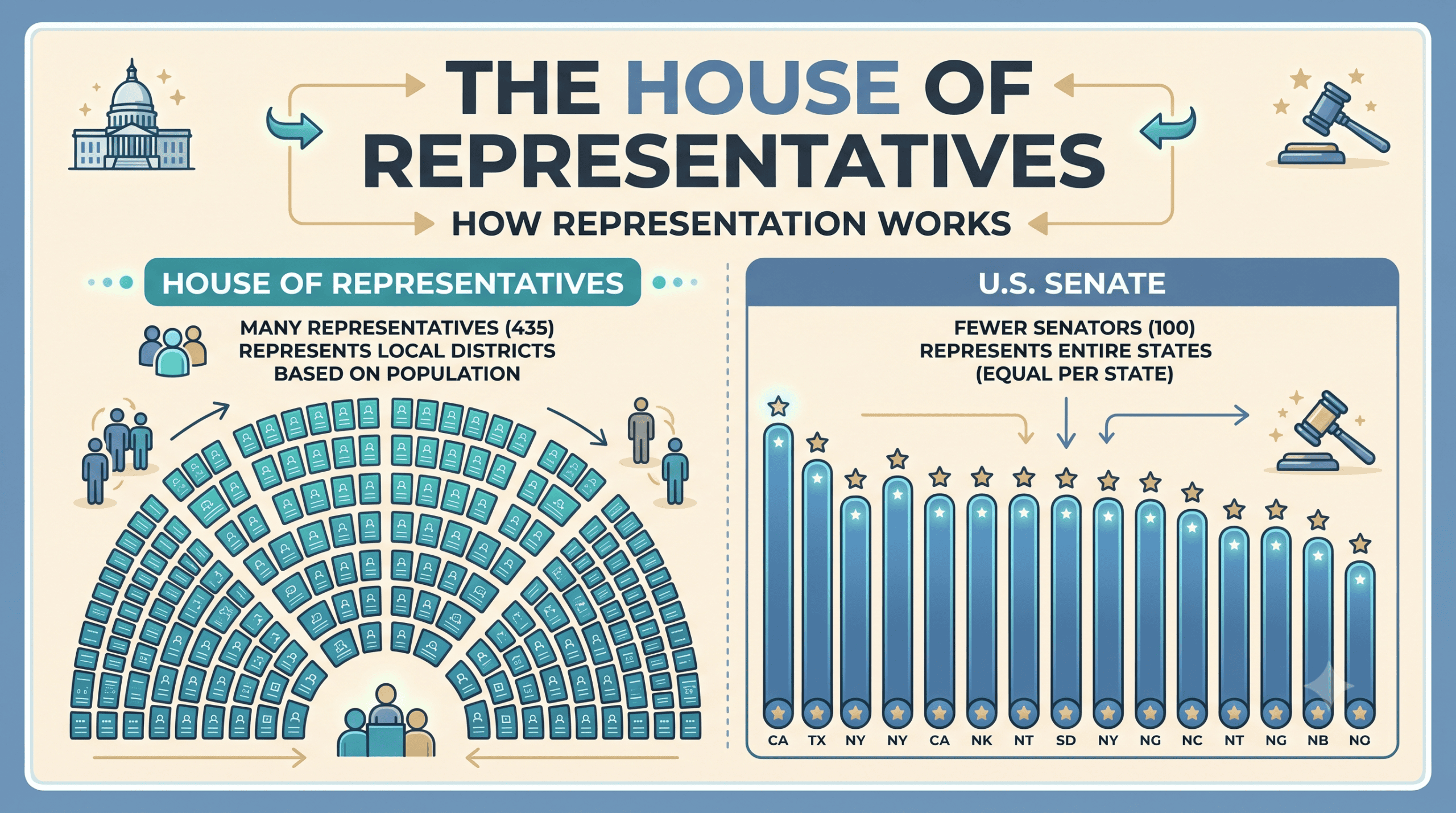
Why America’s “People’s House” Was Designed to Change Quickly
Opening
Imagine your job came with a performance review every two years — where your bosses could simply replace you if they weren’t happy. No severance. No appeals process. Just: we’re going in a different direction.
That is essentially what every single member of the House of Representatives faces. All 435 of them. Every two years.
And that is not a glitch; it is the deliberate design of the system. As we explored in our articles on Congress and Checks and Balances, the Framers built a legislature with two very different chambers — one slow and deliberate, and one fast and responsive. While the Senate was designed to cool things down, the House was designed to heat up. This is the story of why.
Part I: Why the House Exists (The Population Rule)
When the Framers designed Congress, they fought bitterly over how states should be represented. Small states wanted every state treated equally, while large states wanted representation based on population because they had more citizens.
The resulting Great Compromise split Congress into two bodies:
| The Senate | Treats every state equally, giving exactly two senators to each state. |
| The House of Representatives | Represents people, not states. States with larger populations get more representatives. |
This is why California currently has 52 House members and Wyoming has just one. It isn’t about geographic landmass or state boundaries; it is strictly about population density. This means that representation in the House changes as the country’s population changes, helping ensure that growing states gain influence while shrinking states may lose seats over time.
How the House is Organized
Under Article I, Section 2 of the Constitution, the qualifications to run for the House were intentionally kept accessible to ensure representatives stayed closer to the communities they serve:
| Category | House Rules |
|---|---|
| Total Voting Members | 435 members |
| Representation Basis | Population-based congressional districts |
| Term Length | 2 years (all members elected simultaneously) |
| Minimum Age | 25 years old |
| Citizenship & Residency | U.S. citizen for at least 7 years and an inhabitant of the state represented |
💡 Fun Fact The youngest person ever elected to the House was William Charles Cole Claiborne of Tennessee in 1797. At just 22 years old, he was technically below the constitutional minimum, but he was seated anyway because his exact age was unclear at the time.
Part II: Why Elections Happen Every Two Years
The Framers could have set House terms at four years, six years, or even lifetime appointments. However, they chose two years as a precise democratic compromise. Yearly elections were deemed too chaotic, keeping representatives in a permanent campaign mode, while six years (the Senate’s term) felt too distant from the immediate will of the people.
In Federalist No. 52, James Madison argued that the branch chosen immediately by the citizens must have an “immediate dependence on, and an intimate sympathy with, the people.” In other words, the House was intentionally designed to reflect changing public opinion more quickly than any other part of the federal government. The House needs to feel the political heat. If the public is angry, the House is designed to feel it fast.
The Structural Trade-Offs
| Advantages | Trade-Offs |
|---|---|
| High Accountability Representatives cannot hide from dissatisfied voters for very long. |
Relentless Campaigning The constant two-year election cycle consumes significant governing time. |
| Fresh Ideas New voices and perspectives enter Washington more frequently. |
Short Planning Horizons Long-term policymaking becomes more difficult when elections are always approaching. |
| Rapid Response The House quickly reflects changes in public opinion. |
Political Volatility Control of the chamber can shift dramatically in a single election. |
Think of it like this: the Senate is the older, steadier sibling. The House is the one that reacts first to trends, national crises, and sudden shifts in the public mood. Together, they create a built-in check and balance right inside the legislative branch.
Part III: Powers Unique to the House
While both chambers must vote to pass federal legislation, the Constitution gives the House a few exclusive, heavyweight powers:
💰 1. The Origination Clause (Revenue Bills)
Under Article I, Section 7, all bills for raising revenue—meaning tax laws—must originate in the House. This traces directly back to the revolutionary principle of “no taxation without representation.” If citizens are going to be taxed, the people’s most directly accountable representatives must make the first move.
⚖️ 2. The Power of Impeachment
The House holds the sole power to impeach a federal official, which is the political equivalent of filing formal charges. If a majority of the House approves articles of impeachment, the official is officially impeached—but they are not removed. The process then shifts to the Senate for the actual trial.
Step 1
🏛️ The House Votes to Impeach
If a simple majority approves one or more Articles of Impeachment, the official is formally impeached (charged).
Step 2
⚖️ The Senate Holds a Trial
Senators hear evidence and arguments. When the President is on trial, the Chief Justice of the United States presides.
Step 3
🗳️ The Senate Votes
A two-thirds majority is required to convict and remove the official from office.
Outcome
Convicted?
✅Yes: The official is removed from office.
❌No: The official remains in office.
🗳️ 3. Choosing the President
If no presidential candidate wins a clear majority in the Electoral College, the 12th Amendment mandates that the House chooses the President. However, there is a major twist: instead of all 435 members voting individually, each state delegation gets exactly one vote. In this rare contingent election scenario, Wyoming and California hold equal constitutional say.
Part IV: Why the House Often Feels So Political
Constitutional Design
The Framers wanted the House to be reactive and intensely political. By enforcing two-year terms and population-based districts, they guaranteed that the House would feel the political heat immediately. If the national mood shifts, the House is supposed to reflect that volatility.
Supporters argue this short leash keeps representatives fiercely accountable to their local communities. Critics argue it causes short-term thinking and limits long-term planning. Both views are correct; it is the exact tension the Constitution deliberately built into the building.
Modern Reality
While the Framers wanted a highly responsive chamber, modern rules have created a different kind of gridlock:
| Modern Factor | Impact |
|---|---|
| 24/7 Campaign Loop | Because elections occur every two years, representatives are almost always campaigning. Many spend substantial time fundraising instead of legislating. |
| Primary Trap & Safe Seats | In many districts, the primary election is more competitive than the general election, encouraging candidates to appeal primarily to their party’s base. |
| The Social Media Incentive | Platforms reward dramatic moments and conflict, giving lawmakers greater visibility for confrontations than for quieter bipartisan work. |
Friction vs. Dysfunction
Some conflict is intentional. Some problems come from modern incentives. That separation has become one of the strengths of understanding the House:
- Constitutional friction ensures accountability and responsiveness
- Modern dysfunction comes from systemic rules that amplify polarization and reduce competitiveness
The House is doing exactly what it was designed to do by staying closely connected to the people. But in a modern digital landscape where the people are deeply polarized, the districts are locked in place, and attention spans are brief, that connection means the House absorbs and amplifies the country’s loudest conflicts at maximum volume.
Part V: What’s Happening Now?
Recent debates over congressional district maps, partisan gerrymandering, campaign finance, and proposals to expand the House have renewed public attention on whether the institution still functions as the Framers intended. While opinions differ about the best solutions, these debates all center on the same constitutional question: how can the House remain responsive to the people while governing effectively?
In Congress, Representatives Don Beyer and Jamie Raskin have introduced the Fair Representation Act, one of the most ambitious proposals to reshape House elections in decades. Rather than changing the Constitution, the bill would change the rules governing how House members are elected, with the goal of encouraging broader competition and reducing some of the political incentives that fuel today’s gridlock.
At the same time, many states have chosen a different path. Instead of waiting for Congress, voters in several states have approved independent redistricting commissions and other election reforms through ballot initiatives or state legislation. These state-by-state experiments allow different approaches to be tested, giving Americans the opportunity to see what works—and what doesn’t—before broader changes are considered.
Part VI: Can the House Be Improved?
Throughout American history, when Americans believed the rules of government no longer reflected the country’s needs, they proposed reforms. Some ideas became law. Others never left the drawing board. But change has almost always come through the same constitutional process: citizens, lawmakers, states, and courts debating how the system can work better.
Today, those conversations are happening at both the federal and state levels. None of these proposals is universally accepted. Each has supporters, critics, and important trade-offs.
Reform Ideas Being Discussed
| Reform Idea | What It Tries to Address | Questions People Still Debate |
|---|---|---|
| Ranked-Choice Voting | Allows voters to rank candidates by preference, with votes redistributed until one candidate earns a majority. | Does it encourage broader consensus, or is it too complicated for some voters? |
| Independent Redistricting Commissions | Reduces politicians’ ability to draw district boundaries that favor one party. | Who should serve on these commissions, and how independent can they truly be? |
| Open or Nonpartisan Primaries | Gives more voters a voice in selecting candidates, which some believe encourages moderation. | Should political parties control who chooses their nominees? |
| Expanding the House | Would reduce the number of constituents each representative serves, potentially improving local representation. | Would a larger House improve representation or make Congress more difficult to manage? |
| Campaign Finance Reform | Attempts to reduce the influence of money through contribution limits, disclosure requirements, and public financing proposals. | How can campaign spending be limited while protecting free speech rights? |
People Are Asking
Why are there only 435 representatives?
Congress—not the Constitution—set the current size of the House in 1929. Congress could increase it tomorrow through ordinary legislation. That surprises almost everyone.
Why does the House pass bills so quickly, but they stall in the Senate?
Both chambers are completely equal partners but operate under entirely different rules. The House can pass a bill quickly using simple majorities, but the Senate moves slowly and often requires 60 votes to clear a filibuster. This gridlock is a feature, not a bug—designed to ensure laws have broad consensus before hitting the President’s desk.
My representative doesn’t care about our state; they only focus on a tiny handful of local towns. Why?
Unlike senators, who represent an entire state, House members represent congressional districts. A typical district holds roughly 761,000 people. Their re-election hinges entirely on local constituent services, regional infrastructure projects, and local factory closures. The House was structurally built to prioritize local, immediate concerns over statewide or long-term national consensus.
If the House voted to impeach the President, why are they still in office?
Impeachment is merely the indictment, not a conviction. Three U.S. presidents have been impeached by the House (Andrew Johnson, Bill Clinton, and Donald Trump), but none were removed because the Senate did not reach the 2/3 threshold to convict. The constitutional process deliberately splits the power to charge from the power to punish.
A Reason for Hope
Democracy is not a self-run machine. The current dysfunction in the House isn’t a sign that the American experiment has failed; it is a sign that our rules have fallen out of sync with a fast-moving, digital society.
The country will be fine — but only if we choose to engage. Stagnation breaks when citizens reject the performance art, refuse to give up, and use their votes to support the structural rules that force politicians back to the table. The tools for correction are already written into the Constitution; we just have to be active enough to use them.
Because the House is smaller, faster, and faces a relentless election cycle, it often looks louder and more performative than the Senate. Understanding the structural rules helps separate political spectacle from constitutional function.
🏛️ Blueprint for Hope
Whether Americans favor expanding the House, changing election rules, reforming campaign finance, or preserving the current system, every proposal begins with understanding how the House was designed to work. Informed citizens are better equipped to evaluate reforms, participate in elections, and hold representatives accountable.
American history shows that periods of political frustration have often led to institutional reforms. Whether today’s debates produce similar reforms will depend on elected officials, state governments, the courts, and citizens who choose to remain engaged in the democratic process.
Continue Learning
This article is part of VoteView’s Civics 101 Series — evergreen educational content designed to help you understand how government actually works.
Related Articles
Civics 101: Understanding the U.S. Senate
Congress Explained: Structure and Function
Checks and Balances: How Government Limits Power
Gerrymandering Explained: How District Lines Alter the Power Balance
Discussion Prompts
- Do you think a two-year term keeps representatives properly accountable to voters, or does it force them to spend too much time fundraising and campaigning instead of governing?
- Should the total number of House members stay capped at 435, or should Congress expand the House so that states like Delaware don’t have single representatives serving nearly a million constituents?
- Knowing that state legislatures draw congressional maps, do you think districts should be drawn by independent citizen commissions to prevent partisan gerrymandering?
Appendix: Reference Guide
📚 Key Terms Glossary
| Term | Definition |
|---|---|
| Representative | An elected member of the House who serves a congressional district. |
| Congressional District | A geographic area within a state that elects one member of the House. |
| Speaker of the House | The presiding officer of the House, elected by the majority party and second in the presidential line of succession. |
| Apportionment (Reapportionment) | The process of distributing the 435 House seats among the states based on census population. |
| Gerrymandering | The practice of drawing district boundaries to favor one political party or group. |
| Contingent Election | The constitutional process in which the House elects the President if no candidate wins an Electoral College majority. |



No discussions yet
Be the first to join the discussion and share your thoughts with the community.