
Opening
If you’ve ever heard a politician, say, “We need to get back to the family values of the 1950s,” you’re not alone.
It is one of the most persistent refrains in American political discourse. The 1950s are frequently mythologized as a golden age—defined by high marriage rates, economic stability, two-parent households, and cohesive neighborhoods. Today, nostalgia for this era drives major policy proposals regarding divorce laws, tax structures, and family benefit programs.
But when we compare families “then” and “now,” we often compare the outcomes without comparing the conditions people lived under.
Was the 1950s family really better? The answer is more complicated than it sounds. It depended on what we mean by “better”—and whether we’re talking about marriage rates, financial security, family stability, or something else entirely.
The Bigger Picture: An Extraordinary Economic Moment
The 1950s nuclear family was not simply a personal or cultural preference. It was the direct product of a highly specific historical moment: an unprecedented postwar economic boom, massive federal investments in housing and education for returning veterans, intense social pressure to conform, and strict legal barriers that made leaving a marriage almost impossible.
Those conditions helped make young marriage, homeownership, and one-income households possible for many families.
When those macroeconomic and legal conditions changed over the subsequent decades, family structures evolved as well. Understanding this shift isn’t about labeling the past as “good” or “bad”—it’s about recognizing that modern family patterns are a response to a vastly different economic landscape.
But before asking whether Americans should return to the family structure of the 1950s, it helps to understand what actually made that structure possible.
Part I — The Shift in Marriage Trends and Demographics
To understand family formation today, it helps to start with baseline demographic data. In the 1950s and early 1960s, marriage was nearly universal across the United States.
Data from the U.S. Census Bureau and Pew Research Center show a dramatic shift in how Americans organize their personal lives:
- In 1960, 72% of all U.S. adults ages 18 and older were married.
- By 2024, that figure had dropped to approximately 48%.
Americans are also entering marriage much later in life than they did during the postwar era:
| Era | Women | Men |
|---|---|---|
| 1950s | ~20 | ~22 |
| 2024 | ~28.6 | ~30.5 |
(Sources: U.S. Census Bureau, Decennial Census and Current Population Survey)
In the 1950s, marriage wasn’t just common—it was expected. Family, churches, communities, employers, movies, television, and advertising all reinforced the idea that marriage was a normal part of becoming an adult.
Today, demographic projections indicate that up to one in three young adults may reach age 45 without marrying—a historic shift reflecting that marriage is no longer treated as a mandatory prerequisite for adulthood or family life.
Key Stat: According to Pew Research Center analyses, 68% of adults aged 20–29 were married in 1960, compared to just 26% by 2008. Rather than rejecting committed relationships entirely, modern adults are delaying marriage due to career development, extended education, and financial constraints.
Part II — The Economic Anomaly of the Single-Income Household
Here’s the part that often gets lost in conversations about family values: the one-income household wasn’t sustained by values alone. It was supported by an economy that made that arrangement possible for many families.
Following World War II, robust wage growth, high union density, federal investments like the GI Bill, and rapid suburban housing construction created an economy where a single income could purchase a home and support dependents.
| Economic Measure | 1950s | Today |
|---|---|---|
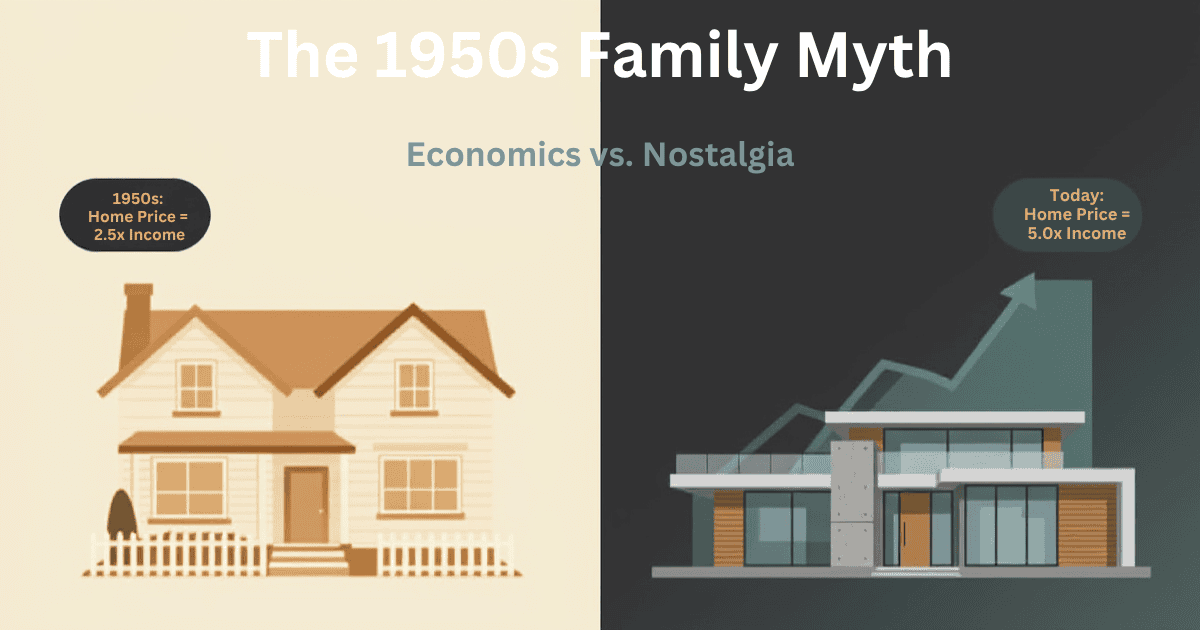
| Home Price Relative to Income | ~2.5× median income | ~5× median income |
| Women’s Labor Force Participation | ~34% | ~57% |
| Median Age at First Marriage | Women: ~20 Men: ~22 |
Women: ~28.6 Men: ~30.5 |
| College Costs | Far lower than today | Major household expense for many families |
| Childcare | More often provided within the household | Paid childcare is a major expense for many working families |
Sources: U.S. Census Bureau; U.S. Bureau of Labor Statistics; Harvard Joint Center for Housing Studies; National Center for Education Statistics; U.S. Department of Labor.
In the 1950s, the median home price was roughly 2.5 times the median annual income. With low down payments guaranteed by government programs, a single working-class income could routinely support a family in a new suburb.
Today, median home prices sit at roughly 5 times median annual income—double the historical ratio.
The Shift from One Income to Two
In the mid-20th century, approximately 70% to 80% of married households operated on a single income. Today, dual-income households are the structural norm.
This transition was not merely a sudden cultural shift; it was an economic necessity. As wage growth decoupled from productivity and key living expenses—specifically housing, healthcare, higher education, and childcare—soared, maintaining a household on one wage became mathematically impossible for the majority of working-class and middle-class Americans.
Part III — Was the Postwar Family Model Truly “Traditional”?
When commentators call for a return to “traditional family values,” they are usually describing a very specific, short-lived historic window.
From an architectural and historical standpoint, American households evolved through distinct stages:
- Extended and Multigenerational Families: Prior to the mid-20th century, American households frequently included extended family members—grandparents, aunts, uncles, and boarders—living under one roof to pool labor, share caregiving, and maximize income.
- Industrialization and Changing Household Structure: As the country shifted from an agrarian economy to an industrial one, cities grew, physical living spaces shrank, and workers moved to where job capital was centered.
- Depression-Era Delayed Family Formation: During periods of severe economic contraction, such as the Great Depression, marriage and birth rates plummeted because families could not afford independent households.
- The Postwar Nuclear Ideal: It was only under the extraordinary economic expansion following World War II—paired with government mortgage guarantees and suburban development—that the isolated, single-earner nuclear family emerged as a broad reality.
The family structure we now remember as “traditional” was real—but it was also the product of a particular moment in American history.
Part IV — When 1950s Nostalgia Becomes Policy
The debate over the traditional American family is not simply about nostalgia. Ideas about marriage, parenthood, gender roles, and family structure are influencing modern policy proposals.
Project 2025, developed by The Heritage Foundation and a coalition of conservative organizations, places significant emphasis on marriage and the nuclear family. The document calls for government programs to promote stable, married households and argues that federal policy should encourage marriage rather than unintentionally discourage it.
Since then, The Heritage Foundation and other conservative policymakers and organizations have continued developing proposals aimed at strengthening marriage and reversing declining birth rates. These include marriage and relationship education, changes to tax and benefit programs, incentives intended to make raising children more affordable, and proposals that would make it easier for one parent to remain home with children.
Separately, some conservative politicians, activists, and organizations have called for reconsidering or restricting no-fault divorce.
These proposals are not all the same, and they should not be treated as though they are one policy package. Project 2025 itself does not contain a proposal to abolish no-fault divorce nationwide.
But they share a larger political question:
Can public policy encourage Americans to return to a more traditional model of marriage and family life?
The Part That Often Gets Left Out
The young married couple buying a house, raising several children, and living primarily on one income did not succeed simply because Americans of the 1950s valued marriage more. They lived during an extraordinary postwar economic period.
Housing was far cheaper relative to income. College was substantially less expensive. Union membership was much higher. Wages were rising. The federal government invested heavily in housing, education, and infrastructure. Millions of veterans received assistance through the GI Bill. A young adult could often reach the economic milestones associated with marriage and parenthood much earlier than a young adult can today.
That is why simply telling Americans to marry younger, have more children, stay married, or return to traditional family roles misses a fundamental part of the history. The values did not exist separately from the conditions.
Making Marriage Harder to Leave Is Not the Same as Making Marriage Easier to Build
Consider the debate over no-fault divorce.
Supporters of restricting no-fault divorce argue that marriage is a serious commitment, that divorce has consequences for children and communities, and that the law should do more to encourage couples to remain together.
Those arguments deserve to be understood on their own terms.
But restricting divorce addresses what happens at the end of a marriage.
It does not address many of the pressures affecting whether young adults marry and start families in the first place.
- Making divorce harder does not make housing more affordable.
- It does not reduce childcare costs.
- It does not eliminate student debt.
- It does not increase wages.
- It does not make it possible for most families to live comfortably on one income.
- And it does not automatically make an unhealthy marriage healthy.
A policy can make marriages harder to end. That does not necessarily make marriages stronger.
That distinction matters.
Listen Carefully to the Language
When political leaders talk about “restoring the family,” “strengthening marriage,” “putting families first,” or returning to “traditional family values,” those phrases can describe goals that sound broadly appealing.
But they don’t tell you what the policy actually does.
So look underneath the language.
If a proposal says it will strengthen marriage, ask: Does it reduce the economic pressures on married couples? Does it help people form stable families? Does it provide support for children? Or does it primarily change the rules governing whether someone can leave a marriage?
If a proposal promises to support families, ask: Which families qualify for that support? Married parents? Single parents? Stay-at-home parents? Dual-income households? Extended families?
And if a politician invokes the family stability of the 1950s, ask one more question:
Which parts of the 1950s made that stability possible?
Because the answer wasn’t just marriage.
It was marriage within an economic, legal, cultural, and social system that no longer exists in the same form.
That doesn’t mean Americans cannot decide that some parts of the 1950s family model are worth pursuing again.
It means we should be clear about what we’re actually trying to recreate—and whether the policies being proposed could realistically produce the results being promised.
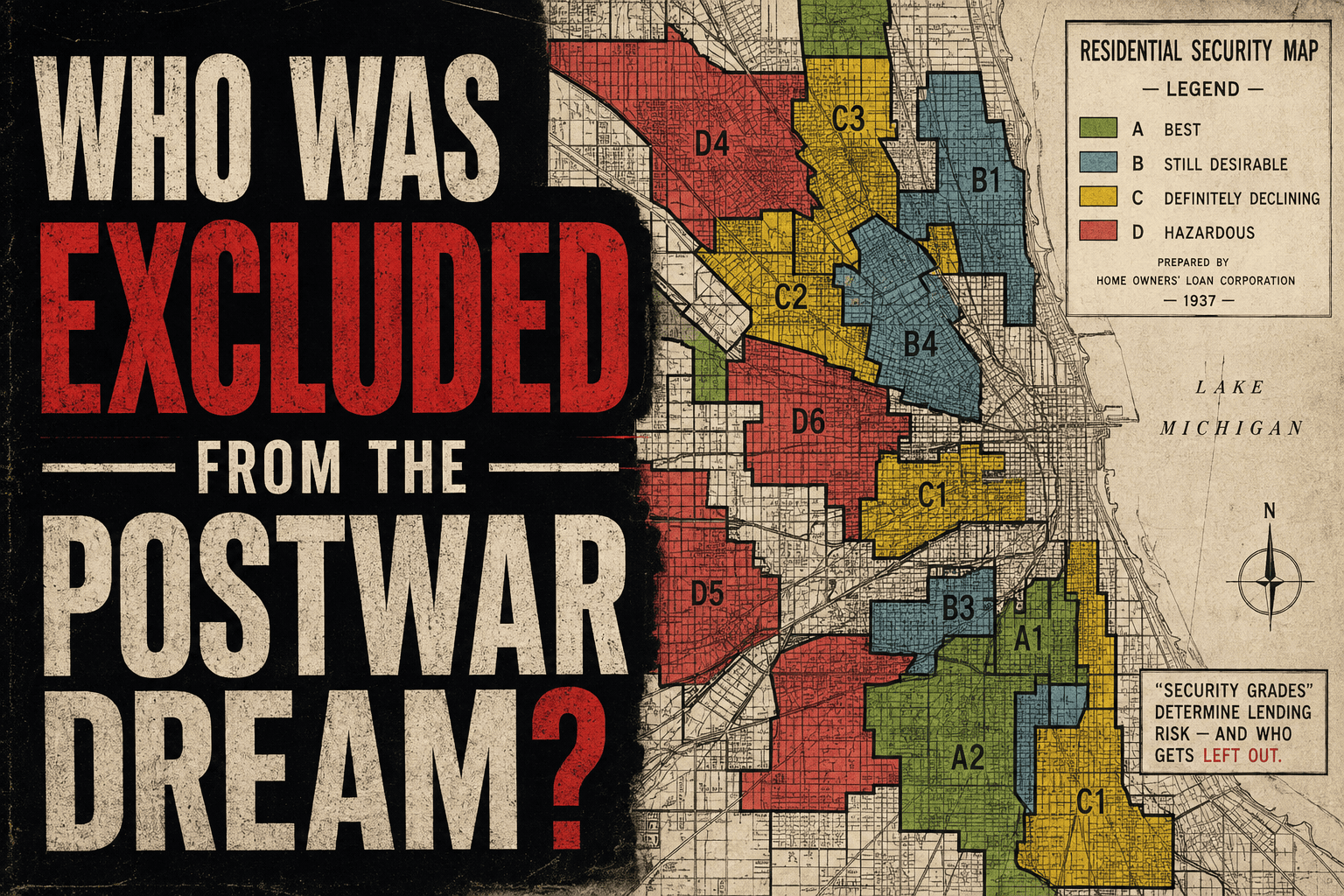
There is, however, another side to that history: who actually had access to the postwar dream, who was excluded from it, and what family life looked like behind closed doors. We will explore that in Part Two.
Related Articles in This Series
- Behind the Suburban Ideal: Segregation, Exclusion, and Unseen Lives in 1950s America (coming soon)
- Why Are Some Politicians Talking About Ending No-Fault Divorce?
- Could Women Really Not Open a Bank Account Prior to 1974?
No discussions yet
Be the first to join the discussion and share your thoughts with the community.