
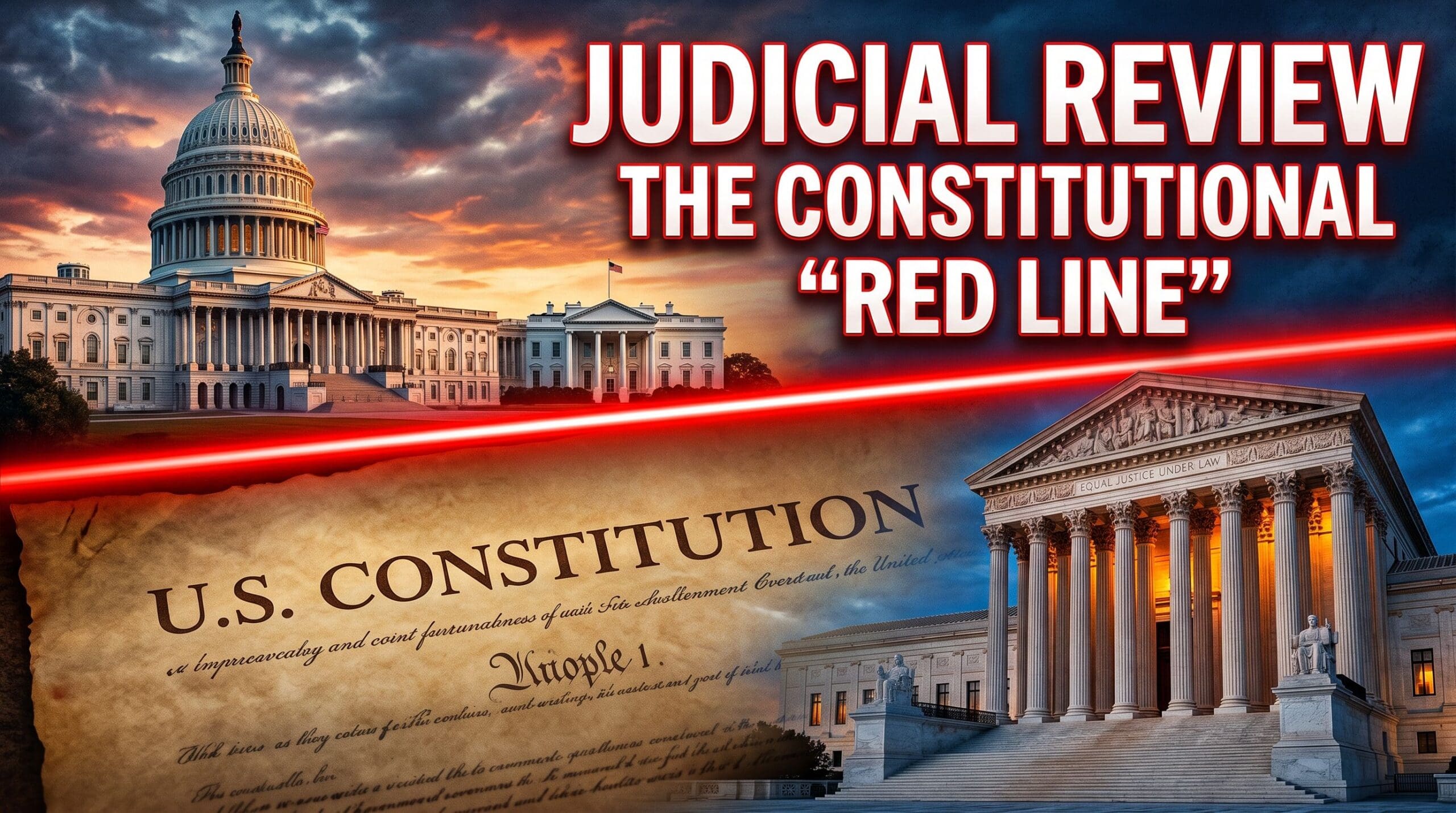
PART 1: THE RULES OF THE GAME
Who Gets the Final Say?
Have you ever played a board game where someone suddenly invents a rule that guarantees them victory? When you object, they shrug and say, “My rules, my decision.” Since they made the rule, they get to decide what it means.
At that moment, it seems completely unfair, doesn’t it? If the person who sets the rules is also the sole judge of those rules, there’s no one to stop them from taking advantage of that power.
Now apply that idea to government. Congress passes laws. Presidents and government agencies carry them out. States and local governments make rules of their own.
But what happens when one of those actions violates the Constitution?
That’s where the courts come in — through a power called judicial review.
Judicial review is the power of courts to examine laws and government actions and determine whether they violate the Constitution. If they do, courts can prevent those actions from being legally enforced.
Why Do We Need Judicial Review?
A constitution only matters if its limits can be enforced.
The Constitution limits what Congress, the President, federal agencies, states, and local governments can do. When someone argues that the government has crossed one of those constitutional lines, courts provide a place to challenge it.
That’s judicial review in action.
What Courts Can Review
Judicial review isn’t limited to acts of Congress. Courts apply it across the entire government:
| Government Action | Example |
|---|---|
| Acts of Congress | A federal law challenged as violating free speech |
| Presidential Actions | An executive order challenged as exceeding presidential authority |
| Federal Agencies | A federal agency action challenged as violating constitutional rights |
| State Laws | A state law challenged as violating constitutional rights |
| Local Actions | A city ordinance challenged under the Constitution |
PART 2: WHERE IT CAME FROM AND HOW IT WORKS
Where Did Judicial Review Come From?
Here’s a surprise: you will never find the words “judicial review” in the Constitution.
Article III establishes the federal judiciary, but it never explicitly says that courts can declare laws unconstitutional.
So how did judicial review become an established part of American constitutional law?
The Drama of 1803: Marbury v. Madison
The answer begins with a political fight during one of America’s earliest presidential transitions.
- A change in power: In the final days of his presidency, John Adams made several judicial appointments. When Thomas Jefferson took office in 1801, his administration refused to deliver some of the commissions.
- A missing job: William Marbury was one of the appointees who never received his commission. He went directly to the Supreme Court and asked it to order Secretary of State James Madison to deliver it.
- A dilemma for Chief Justice John Marshall: If the Court ordered Jefferson’s administration to comply and the administration refused, the young Supreme Court could look powerless. But backing down could make the executive branch appear beyond the Court’s reach.
Marshall engineered a brilliant escape from the trap.
The Court concluded that Marbury had a right to his commission — but that the federal law giving the Supreme Court authority to hear his claim in that way conflicted with the Constitution.
The Court therefore could not give Marbury the remedy he wanted.
— Chief Justice John Marshall, Marbury v. Madison (1803)
Marbury established the Supreme Court’s authority to refuse to enforce federal laws that conflict with the Constitution.
Source: Constitution Annotated — Marbury v. Madison and Judicial Review
How Judicial Review Actually Works
Many people imagine the Supreme Court sitting with a highlighter, crossing out whatever it dislikes in newly passed laws. The reality is very different: courts can’t review anything until a real legal fight lands on their desk.
Congress passes a law, a president issues an executive order, an agency adopts a rule, or a state or local government takes action.
A person or organization affected by the action files a lawsuit.
The court considers requirements such as standing, jurisdiction, and whether there is a real legal dispute.
If the case meets those requirements, the court determines whether the challenged government action violates the Constitution or other applicable law.
Courts Can’t Review Just Anything
Before deciding whether a government action is constitutional, courts first ask whether they have the authority to hear the dispute.
There must be a real dispute. Courts generally don’t answer hypothetical questions or simply give legal advice.
The person suing must have standing. Usually, that means showing a concrete injury connected to the government action being challenged.
The court must have jurisdiction. Different courts have authority over different kinds of cases.
Some disputes also involve questions courts consider inappropriate for judicial resolution, such as certain issues committed to the political branches.
The main idea: Someone can’t simply walk into court and ask, “Is this law constitutional?” A proper legal case has to reach the court first.
📖 Three Levels of Scrutiny
Courts don’t evaluate every constitutional claim the same way. Depending on the right or classification involved, courts may apply different levels of scrutiny.
| Standard | Generally Used For | Government’s Burden |
|---|---|---|
| Strict Scrutiny | Certain fundamental-rights claims and classifications such as race | Must satisfy an exceptionally demanding constitutional test |
| Intermediate Scrutiny | Certain classifications, including sex | Must show a sufficiently strong connection to an important government interest |
| Rational Basis | Most ordinary economic and social legislation | Usually needs only a rational connection to a legitimate government purpose |
Why this matters: The legal test a court applies can make an enormous difference in how difficult a law is to defend.
PART 3: WHAT HAPPENS AFTER A RULING
What Can a Court Actually Do?
When a headline says a court “struck down a law,” it can sound as if the entire law simply disappeared. The reality is usually more complicated.
Depending on the case, a court may:
- Block enforcement: A court can order government officials to stop enforcing a challenged policy, temporarily or permanently.
- Declare a law or provision unconstitutional: Sometimes the problem involves only one part of a larger law.
- Limit a ruling to a particular situation: A court may find a law unconstitutional as applied to the people or circumstances before it without invalidating every application of the law.
- Interpret the law narrowly: Courts sometimes interpret a statute in a way that avoids a constitutional conflict rather than invalidating it.
A higher court can also reverse a lower court’s decision or send the case back for additional proceedings.
Will the Entire Law Be Removed?
Not necessarily. This brings us to an important concept: severability.
Imagine a 500-page healthcare law. A court finds one provision unconstitutional. Does the entire 500-page law have to go?
Usually, the question becomes whether the unconstitutional provision can be separated from the rest of the law while allowing the remaining provisions to continue operating.
If it can, the court may sever the unconstitutional portion and leave the rest in place.
The takeaway: When you hear that a court “struck down” part of a law, check what the ruling actually affected. It may be much narrower than the headline suggests.
For years, federal judges sometimes issued nationwide — or universal — injunctions that blocked a federal policy from being enforced against people beyond the parties who filed the lawsuit.
In 2025, the Supreme Court significantly limited that practice in Trump v. CASA, ruling that federal courts’ traditional equitable authority generally does not permit injunctions broader than necessary to provide complete relief to the plaintiffs before them.
That doesn’t mean a federal policy can never be blocked broadly. Other legal mechanisms may still produce widespread relief.
Why it matters: When a federal judge blocks a government policy, don’t assume the ruling automatically applies to everyone nationwide. The scope of the order matters.
Source: Trump v. CASA U.S. Supreme Court (2025)
Is Judicial Review Only for the Supreme Court?
No.
Lower federal courts exercise judicial review too, and many constitutional cases begin — and end — without ever reaching the Supreme Court.
State courts also use judicial review when deciding whether state and local laws violate their state constitutions or the U.S. Constitution.
The Supreme Court gets the biggest headlines, but judicial review happens throughout the American court system.
For a deeper dive, see Why Does the Supreme Court Hear So Few Cases?
PART 4: THE DEBATE AND WHY IT MATTERS
Why Is Judicial Review Controversial?
Judicial review creates a tension at the heart of American democracy:
Who should have the ultimate say — elected representatives or unelected judges?
The Case for Judicial Review
- Protects individual rights: A political majority cannot simply vote away constitutional protections.
- Checks government power: Courts can intervene when elected officials cross constitutional boundaries.
- Enforces the Constitution: Constitutional limits mean little if no institution can enforce them.
The Concern: “Government by Judges?”
- Federal judges aren’t elected: Judges can invalidate actions taken by officials chosen by voters.
- Federal judges have lifetime appointments: Voters cannot remove them simply because they disagree with their decisions.
- Judges interpret the Constitution differently: Constitutional language does not always produce one obvious answer, leaving substantial power in the hands of judges.
That’s the democratic tension: How do we allow majorities to govern while still protecting constitutional rights and limits on government power?
Can the Other Branches Respond?
Yes. Judicial review does not give courts unlimited power.
Depending on the ruling:
- Congress can rewrite legislation when the legal problem can be corrected through a new statute, change policy within constitutional limits, or propose a constitutional amendment.
- The President can adjust executive policies and nominate federal judges when vacancies arise, subject to Senate confirmation.
- States can revise state laws or amend their own constitutions, within the limits of the U.S. Constitution.
Court decisions themselves can also be appealed, narrowed, distinguished in later cases, or eventually overturned.
Judicial review is powerful, but it operates within the larger system of checks and balances.
Judicial Review in the Headlines
You can see judicial review whenever courts are asked whether government has crossed a constitutional boundary.
Cases may involve presidential power, voting and elections, gun rights, religious freedom, privacy and reproductive rights, or conflicts between state and federal authority.
But there’s an important distinction:
Not every headline saying “a federal judge blocked” a government policy means the judge found it unconstitutional.
A court might instead find that an official exceeded authority granted by Congress, violated a federal statute, or failed to follow required procedures.
That’s why the details of the ruling matter.
A Blueprint for Challenging Power
Judicial review provides something easy to overlook: a peaceful legal process for challenging government power.
Citizens and organizations can challenge government actions in court. Judges must explain their decisions through legal rulings that can be scrutinized and, in many cases, appealed.
Courts won’t always get it right. Precedents can change, laws can be rewritten, and the Constitution itself can be amended.
But the larger principle remains: disputes over government power can be fought through law rather than force.
💬 Member Discussion: Who Should Have the Final Say?
- When courts strike down a law passed by elected representatives, is that protecting democracy — or limiting it? Where would you draw the line?
- Imagine a law you strongly support is ruled unconstitutional. Would you still defend the court’s power to strike it down? What if the ruling protected a right you strongly support?
- Federal judges are not elected and can serve for life. Does that independence make them better able to protect constitutional rights — or give them too much power?
Was it a federal district court, appeals court, state court, or the Supreme Court?
Was there a constitutional violation — or did the government violate a statute or legal procedure?
Does it affect the people who sued, a larger group, or potentially many people?
Can it be appealed, narrowed, stayed, or overturned?
Common Misconceptions
No. Courts need a proper legal case, and their decisions must rest on legal grounds — not simply whether judges agree with a policy.
No. The Constitution establishes the judiciary, but the power we now call judicial review was established through early constitutional interpretation, most famously in Marbury v. Madison (1803).
No. Lower federal courts and state courts regularly decide constitutional questions too.
People Are Asking
Can a president ignore a Supreme Court ruling?
The judiciary generally depends on executive officials and other government actors to comply with and enforce court orders. Open presidential defiance of a binding Supreme Court ruling would create an extraordinary constitutional conflict and threaten the rule of law.
Can Congress pass a new law after a court strikes one down?
Sometimes. If the problem is how Congress wrote the law, lawmakers may be able to revise it. But Congress cannot override the Supreme Court’s interpretation of the Constitution simply by passing an ordinary law. Changing the constitutional rule generally requires a constitutional amendment or a later court decision that changes the precedent.
What This Means for You
Judicial review isn’t a dusty legal abstraction.
It can determine whether government may restrict your speech, search your property, regulate firearms, change voting rules, or limit other constitutional rights.
And every time you see a headline saying a court has blocked a government action, you now know to ask a second question:
Why?
Understanding judicial review helps you separate what a headline says from what a court actually decided.
Judicial review gives courts the power to enforce constitutional limits on government. It is one of the ways the American system tries to balance majority rule with the rule of law.

No discussions yet
Be the first to join the discussion and share your thoughts with the community.