
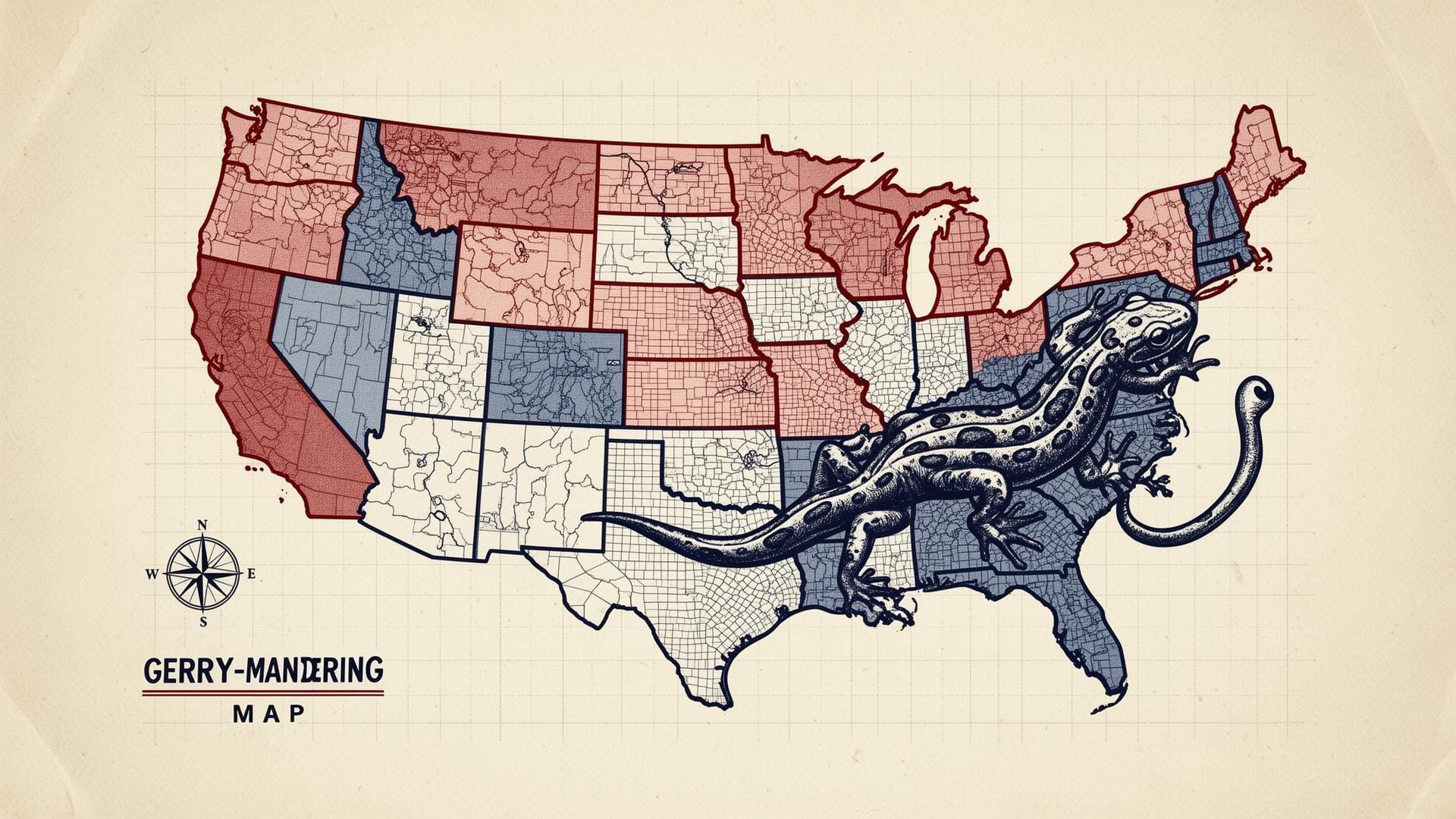
Understanding Gerrymandering
Gerrymandering is the practice of drawing voting district lines to give one political party an unfair advantage. It sounds like a dry bureaucratic process. In reality, it dictates the entire balance of power in American politics.
Why This Matters
Many voters believe that outcomes are decided purely on Election Day. However, the true winner is often determined months earlier when politicians draw the district maps.
The layout of these lines alters the core democratic process by affecting:
- Which communities are grouped together or split apart.
- How competitive a local congressional seat will be.
- The overall weight and influence of your individual vote.
The Systemic Reality: Politicians are effectively picking their preferred voters. Voters are no longer picking their politicians.
A Quick Look Back
Gerrymandering has shaped U.S. politics for over two centuries. The term originated in 1812. Massachusetts Governor Elbridge Gerry approved an oddly shaped voting district to favor his party. Observers noted that the map resembled a salamander.
The Origins: Governor Gerry + Salamander = Gerrymander
Today, both major political parties use this exact strategy whenever they hold power. Modern mapping software and big data tracking allow mapmakers to carve up neighborhoods with surgical precision.
The Core Mechanisms: Packing and Cracking
Every ten years, states must redraw their district boundaries following the U.S. Census. Mapmakers primarily rely on two tactical approaches to dilute opposing voting blocks:
1. Packing
- Mapmakers cram as many opposing voters as possible into a single district.
- The targeted party wins that lone seat by an overwhelming margin. However, their voting power is completely wasted in all surrounding districts.
2. Cracking
- Mapmakers fracture a concentrated community of opposing voters across several districts.
- By breaking them up, the minority group cannot form a cohesive majority anywhere. This guarantees they lose every single race.
The Modern Legal Battleground
The legal landscape surrounding map drawing is shifting rapidly. In 2019, the U.S. Supreme Court ruled in Rucho v. Common Cause that federal courts cannot block purely partisan gerrymandering. The court labeled it a political question rather than a constitutional issue.
This ruling opened the floodgates. State legislatures began initiating aggressive mid-decade redistricting plans. According to a detailed tracking brief on Redistricting ahead of the 2026 elections, multiple states have altered their maps outside the normal ten-year cycle to secure predictable seats.
A massive shift occurred on April 29, 2026. The Supreme Court issued its landmark 6-3 ruling in Louisiana v. Callais. The court held that a voting map drawn to protect minority voting rights was an unconstitutional racial gerrymander.
The 2026 decision fundamentally narrowed Section 2 of the Voting Rights Act. Mapmakers can now bypass traditional voting protections easily. If a state claims it drew lines for partisan advantage rather than racial bias, federal courts must give them wide deference. This has triggered an immediate national race to redraw competitive boundaries across the country.
Are There Any Viable Solutions?
Because federal courts have stepped away from policing boundaries, voters must look to state-level solutions to restore competitive races:
The Citizen Reform Blueprint
- Support Independent Commissions: States like Michigan and California bypassed politicians by utilizing citizen-led, independent redistricting commissions. These groups draw lines based on natural community boundaries rather than partisan tracking data.
- Utilize State Supreme Courts: While federal courts will not intervene, state constitutions often contain explicit guarantees of “fair and free” elections. Voters can fund and support state-level legal challenges against rigged maps.
- Pass State Ballot Initiatives: In states that allow public referendums, citizens can organize ballot measures to strip the mapmaking authority directly away from partisan legislatures.
The Bottom Line
Gerrymandering insulates politicians from accountability. When districts are engineered to be safe for one party, primary elections become the only races that matter. True democratic reform requires removing the conflict of interest entirely. Politicians should never be allowed to draw the lines that secure their own jobs.
No discussions yet
Be the first to join the discussion and share your thoughts with the community.