Part I – What Is the Debt Ceiling? (And Why Does the U.S. Borrow Money?)
Opening
Every time the debt ceiling appears in the news, many Americans ask the same questions.
“Didn’t Congress already approve this spending?”
“Why are lawmakers voting again?”
“Does raising the debt ceiling mean Congress is approving more spending?”
They’re fair questions. In fact, the debt ceiling is one of the most confusing parts of the federal government’s financial system because it separates two decisions that most people naturally assume happen at the same time.
Before you can understand the political debates that surround the debt ceiling, it helps to understand one simple idea:
Congress votes once to approve spending and later votes again on whether the government can borrow the money needed to pay for that spending.
That may sound strange, so let’s start with a simple example.
Imagine you go out to dinner with your family. Everyone orders a meal, enjoys dessert, and asks for the check. Instead of paying, the family begins arguing over whether they should borrow money to cover the bill.
At that point, the decision about eating has already been made. The only question left is how to pay for it.
That is, in many ways, what happens when Congress debates the debt ceiling.
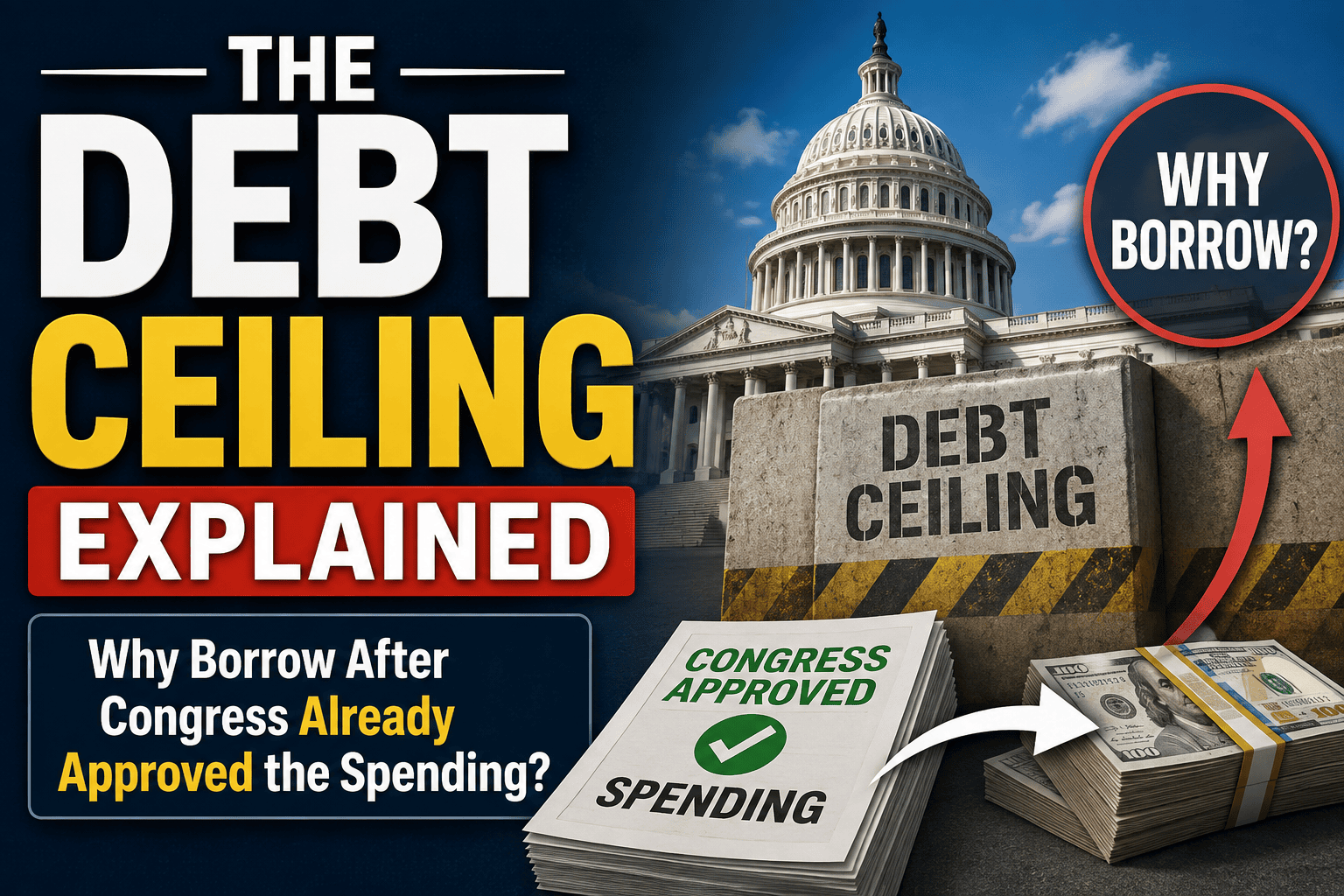
The spending has already been approved. The debt ceiling debate is about whether the Treasury can borrow the money needed to pay obligations the government has already committed to.
Understanding that distinction is the key to understanding every future debt ceiling debate.
The Big Picture: America’s Debt by the Numbers
The United States government owes more than $39 trillion as of early 2026, according to the U.S. Treasury. That total grows by roughly $5 billion every day as the government continues meeting obligations that exceed its annual revenue. The current legal debt ceiling—set by Congress in 2025—is $41.1 trillion, meaning lawmakers will eventually face another decision about whether to raise or suspend that limit.
| Current National Debt | Over $39 trillion |
|---|---|
| Growth | Approximately $5 billion per day |
| Current Debt Ceiling | $41.1 trillion |
| Debt Compared to the Economy | About 123% of GDP |
| Times Congress Has Adjusted the Debt Ceiling Since 1960 | 78 |
Figures reflect the estimates and federal data available when this article was published and may change over time.
Those numbers can sound overwhelming, but the debt ceiling itself is actually a simple concept.
It is not a limit on how much Congress can spend.
Instead, it is a legal limit on how much money the U.S. Treasury is allowed to borrow to pay obligations that already exist.
When the government approaches that borrowing limit, Congress must decide whether to:
- raise the limit,
- temporarily suspend it, or
- leave it unchanged.
If Congress does nothing and the Treasury runs out of available borrowing authority, the government could eventually be unable to pay all of its bills on time.
Where Did the Debt Ceiling Come From?
The debt ceiling has not always existed.
Before 1917, Congress approved nearly every instance of federal borrowing individually. Whenever the government needed to issue new debt, lawmakers had to authorize each transaction separately. That process worked when borrowing was relatively limited, but it became far too slow as the United States prepared to enter World War I.
To make financing the war more efficient, Congress passed the Second Liberty Bond Act of 1917. Rather than approving every loan one at a time, lawmakers established a single overall borrowing limit and allowed the Treasury Department to manage borrowing beneath that cap.
The original limit was $11.5 billion.
More than a century later, the same basic system remains in place. Only the numbers have changed.
Today, instead of managing billions of dollars in debt, the Treasury manages tens of trillions.
Why Does the Government Need to Borrow Money?
To answer that question, it helps to think about the federal government like a household or a business.
Money comes in throughout the year through taxes and other sources of revenue.
Money also goes out to pay for programs and services that Congress has approved.
Some of the government’s largest expenses include:
- Social Security
- Medicare and Medicaid
- National defense
- Veterans’ benefits
- Infrastructure projects
- Education programs
- Interest on existing debt
Revenue comes from several sources, including:
- Individual income taxes
- Payroll taxes
- Corporate income taxes
- Tariffs
- Fees and other government collections
| Money Coming In | Money Going Out |
|---|---|
| Individual income taxes | Social Security |
| Payroll taxes | Medicare and Medicaid |
| Corporate income taxes | National defense |
| Tariffs and fees | Infrastructure |
| Other government revenue | Education, veterans’ benefits, and other federal programs |
Most years, the government spends more than it collects.
When that happens, the government runs a budget deficit.
To cover the difference, the Treasury borrows money by selling U.S. Treasury bills, notes, and bonds to investors.
Those investors include:
- American citizens
- Pension funds
- Banks
- Mutual funds
- Insurance companies
- Foreign governments
Buying a Treasury bond is essentially lending money to the U.S. government in exchange for regular interest payments and repayment at a later date.
As of 2025, Japan was the largest foreign holder of U.S. Treasury securities, followed by the United Kingdom, although the majority of U.S. debt is actually held within the United States.
Every year’s deficit adds to the total national debt.
You can think of it this way:
- Revenue exceeds spending = Budget surplus
- Revenue equals spending = Balanced budget
- Spending exceeds revenue = Budget deficit (borrowing required)
The United States has rarely run a budget surplus in modern history. Because annual deficits have been much more common, the national debt has gradually grown over many decades.
Part II – Why Does Congress Vote Twice? (And Why Do People Disagree?)
Now that we know what the debt ceiling is and why the government borrows money, we can answer the question that confuses most Americans.
If Congress already approved the spending, why does it have to vote again?
The answer lies in how the federal budget process was designed.
Congress makes one decision about spending money and a separate decision about borrowing money. While those two decisions are connected, they happen at different times—and that’s what creates today’s debt ceiling debates.
The Two-Vote Process
Think of the process as six separate steps.
Step 1: Congress Approves Spending
Congress passes laws that authorize spending on things like:
- Social Security
- National defense
- Disaster relief
- Highway construction
- Veterans’ benefits
- Education programs
Once those laws are signed, the government has a legal obligation to pay those bills.
Step 2: The Government Carries Out Those Laws
Federal agencies begin operating.
Construction projects move forward.
Military personnel are paid.
Benefits are distributed.
Contracts are signed.
In other words, the government begins doing exactly what Congress instructed it to do.
Step 3: The Treasury Pays the Bills
As payments become due, the Treasury uses tax revenue and other incoming money to cover as much of the cost as possible.
Some years, that revenue is enough.
Most years, it isn’t.
When expenses exceed revenue, the Treasury must borrow the difference by selling Treasury securities.
Step 4: Borrowing Continues Until the Debt Ceiling Is Reached
Borrowing itself isn’t unusual.
In fact, the Treasury borrows money throughout the year as part of normal government operations.
The issue arises only when total borrowing approaches the legal debt ceiling established by Congress.
Step 5: Congress Must Decide Whether to Raise or Suspend the Debt Ceiling
This is where the headlines begin.
Congress is not deciding whether to approve new spending.
Instead, lawmakers are deciding whether the Treasury may continue borrowing enough money to pay obligations that already exist.
Step 6: The Treasury Continues Paying Existing Obligations
If Congress raises or suspends the debt ceiling, the Treasury continues borrowing as needed to pay the government’s bills.
The cycle then repeats until borrowing once again approaches the legal limit.
The Debt-Ceiling Process at a Glance
1. Congress Approves Spending
Congress passes laws authorizing programs, benefits, contracts, government operations, and other spending.
2. The Government Carries Out Those Laws
Agencies operate, benefits are distributed, employees are paid, and contracts are fulfilled.
3. The Treasury Pays the Bills
The Treasury uses incoming revenue and borrows when revenue is not enough to cover existing obligations.
4. Federal Borrowing Increases
The Treasury continues selling bills, notes, and bonds until total borrowing approaches the legal debt limit.
5. Congress Votes on the Debt Ceiling
Lawmakers decide whether to raise, suspend, or leave the borrowing limit unchanged.
6. The Treasury Continues Paying Existing Obligations
If Congress acts, the Treasury may continue borrowing enough money to meet obligations Congress has already approved.
Another Way to Think About It
Imagine your family decides to renovate the kitchen.
After discussing different options, everyone agrees to move forward.
You hire a contractor.
The work is completed.
The contractor sends the invoice.
Only then does the family realize it doesn’t have enough cash in the bank to pay the entire bill.
The family now needs a loan.
At that point, the debate isn’t about whether to remodel the kitchen.
That decision was already made.
The discussion is about how to pay for work that has already been completed.
The debt ceiling works much the same way.
Congress debates spending when it passes the budget and other spending laws.
The debt ceiling debate comes later, when the Treasury needs permission to borrow enough money to pay those existing obligations.
That distinction is one of the most important ideas in this entire article.
If That’s True, Why Is There So Much Political Debate?
If the spending has already been approved, why do lawmakers continue fighting over the debt ceiling?
Because people disagree about when the federal government should confront its growing debt.
Reasonable people can look at the same situation and reach different conclusions.
Viewpoint One: The Debt Ceiling Encourages Fiscal Discipline
Some lawmakers believe the debt ceiling serves an important purpose because it forces Congress to confront the nation’s growing debt.
Without a borrowing limit, they argue, Congress could continue approving spending without ever having to seriously consider how much debt the country is accumulating.
Supporters of this view point to rising interest costs.
Every dollar spent paying interest on the national debt is a dollar that cannot be spent on roads, schools, scientific research, national defense, or other public priorities.
From this perspective, debt ceiling negotiations create one of the few moments when elected officials are pressured to discuss long-term fiscal responsibility.
Viewpoint Two: The Debate Should Happen During the Budget Process
Others believe the debt ceiling is the wrong place to have that conversation.
They argue that Congress should debate spending before approving it—not after the government has already committed to paying its bills.
Using the earlier kitchen example, they would say the discussion about affordability should happen before signing the renovation contract—not after the work has been completed.
Supporters of this view worry that delaying action on the debt ceiling creates unnecessary uncertainty for financial markets, businesses, and families while doing little to reduce spending that has already been approved.
Viewpoint Three: Eliminate the Debt Ceiling Entirely
A third group believes the debt ceiling should not exist at all.
They point out that many developed democracies approve spending and borrowing through the same budget process rather than requiring separate votes.
From this perspective, Congress already controls government spending through its budget decisions.
A separate borrowing vote simply creates recurring political crises without preventing deficits or reducing the national debt.
Supporters of eliminating the debt ceiling argue that debates over taxes, spending, and deficits should continue—but during the budget process, where those decisions are originally made.
Looking Ahead
Understanding why Congress votes twice explains why the debt ceiling becomes a political flashpoint.
The next question is just as important:
What happens if Congress doesn’t act?
Would Social Security payments stop?
Could financial markets react?
Has the United States ever actually defaulted on its debt?
And how is a debt ceiling crisis different from a government shutdown?
In Part III, we’ll look at the real-world consequences, answer the most common questions, and explain why debt ceiling debates matter far beyond Washington.
Part III – Why It Matters: What Happens If Congress Doesn’t Act?
Now that we’ve explored what the debt ceiling is and why Congress votes twice, one important question remains:
What actually happens if Congress doesn’t raise or suspend the debt ceiling?
The good news is that the United States has never fully defaulted on its debt. Every time the country has approached the borrowing limit, Congress has eventually acted before running out of borrowing authority.
That doesn’t mean debt ceiling debates are unimportant.
Even getting close to the deadline can create uncertainty for financial markets, businesses, and consumers. Investors begin wondering whether the government will be able to make all of its payments on time, and that uncertainty alone can have real economic consequences.
Understanding those risks helps explain why debt ceiling negotiations receive so much attention—even when an agreement is ultimately reached.
A Real-World Example: The 2011 Debt Ceiling Crisis
One of the most significant debt ceiling standoffs occurred in 2011.
President Barack Obama and congressional leaders spent months negotiating whether to raise the debt ceiling while also addressing concerns about long-term government spending.
As the deadline approached, financial markets became increasingly nervous.
Although Congress ultimately reached an agreement before the Treasury ran out of borrowing authority, the prolonged uncertainty had lasting consequences.
For the first time in American history, Standard & Poor’s lowered the United States’ credit rating from AAA to AA+, citing political uncertainty surrounding the debt ceiling negotiations.
Following the downgrade, stock markets experienced sharp declines, and the federal government faced higher borrowing costs.
The lesson from 2011 wasn’t that the United States defaulted.
It didn’t.
The lesson was that even coming close to the deadline can affect financial markets, investor confidence, and the cost of borrowing.
Another debt ceiling standoff occurred in 2023, when Congress reached an agreement just days before the Treasury warned it could run out of available cash. Like 2011, the country avoided default, but the debate reminded many Americans how closely financial markets watch these negotiations.
| Government Shutdown | Debt Ceiling Crisis |
|---|---|
| Congress has not passed funding for parts of the government. | The government has reached its legal borrowing limit. |
| Focuses on future government operations. | Focuses on paying existing obligations. |
| Some federal offices close and employees may be furloughed. | The government may become unable to make all required payments on time. |
| National parks and some services may temporarily close. | Financial markets may react to uncertainty. |
| Has happened multiple times. | The United States has never fully defaulted because of the debt ceiling. |
Although both involve disagreements in Congress, they arise from different parts of the budget process.
A government shutdown is about funding government operations going forward.
A debt ceiling crisis is about financing commitments that already exist.
Understanding that distinction makes news coverage much easier to follow.
How Could This Affect Everyday Americans?
It’s easy to think of the debt ceiling as something that only matters in Washington.
In reality, prolonged uncertainty can affect people across the country.
Borrowing Costs
When investors become uncertain about the government’s finances, interest rates may rise.
Higher Treasury rates can eventually influence mortgage rates, auto loans, business loans, and even some credit card interest rates.
Retirement Savings
Periods of uncertainty often lead to increased stock market volatility.
That can temporarily affect retirement accounts such as 401(k)s, IRAs, and pension funds.
Market swings don’t necessarily mean permanent losses, but they can be unsettling for long-term investors.
Federal Payments
If the Treasury were unable to borrow enough money to meet all of the government’s obligations, officials could face difficult decisions about which payments are made first.
Depending on the circumstances, delays could potentially affect programs such as:
- Social Security
- Military pay
- Veterans’ benefits
- Payments to federal contractors
Fortunately, Congress has always acted before the United States experienced a full default.
People Are Asking
Has the United States ever defaulted on its debt?
No.
While Congress has sometimes waited until the last minute, the United States has always raised or suspended the debt ceiling before a full default occurred.
Who owns the national debt?
The national debt is owned by a wide variety of investors.
These include American individuals, pension funds, banks, mutual funds, insurance companies, the Social Security Trust Fund, and foreign governments.
Although Japan and the United Kingdom are among the largest foreign holders of U.S. Treasury securities, most of the debt is actually held within the United States.
Why can’t the government just print more money?
Creating large amounts of new money to pay government obligations could lead to significant inflation.
Instead, the Treasury raises money by selling Treasury securities to investors, who are repaid with interest over time.
Is the debt ceiling unique to the United States?
Largely, yes.
Many developed countries approve spending and borrowing together during their budget process.
The United States is unusual because Congress separately limits how much the Treasury may borrow, creating a second debate after spending decisions have already been made.
⭐ Why This Matters
The debt ceiling often becomes one of the biggest stories in Washington—not because Congress is deciding whether to create new government programs, but because lawmakers are deciding whether the Treasury can continue borrowing enough money to pay obligations that already exist.
That distinction is important.
The debate over how much government should spend happens during the budget process, appropriations bills, and other spending legislation. By the time Congress debates the debt ceiling, those spending decisions have largely been made.
The debt ceiling debate asks a different question:
How should the government finance commitments that already exist?
Understanding that difference makes it much easier to separate political arguments from the mechanics of how the federal government operates.
What You Can Do
You don’t have to memorize every budget law or follow every congressional debate to understand the debt ceiling.
Instead, ask yourself three simple questions whenever it appears in the news:
- Is Congress debating new spending, or borrowing for spending that was already approved?
- Are lawmakers negotiating the federal budget or the debt ceiling?
- What is the Treasury warning could happen if Congress does not act?
Those three questions will help you quickly understand what stage of the budget process is actually being discussed.
If you’d like a deeper understanding of how Congress decides what to spend in the first place, read Understanding the Federal Budget Process, which explains how spending decisions are made before the debt ceiling ever becomes an issue.
What This Means for You
The debt ceiling will almost certainly remain part of American politics for years to come.
As the national debt continues to grow, Congress will face repeated decisions about taxes, spending, borrowing, and long-term fiscal responsibility. Those debates aren’t going away—and reasonable people will continue to disagree about the best path forward.
Some believe the debt ceiling encourages important conversations about government spending.
Others believe those conversations should happen during the budget process rather than when the government is approaching its borrowing limit.
Still others think the debt ceiling should be eliminated altogether.
VoteView isn’t here to tell you which position is correct.
Our goal is to help you understand what is actually being debated so you can evaluate those arguments for yourself.
If there’s one lesson to remember from this article, it’s this:
Congress decides what the federal government will spend.
The debt ceiling determines whether the Treasury may borrow enough money to pay for obligations Congress has already approved.
Once you understand that distinction, future debt ceiling headlines become much easier to follow—and much less confusing.
🤔 Think About It
- Should Congress debate borrowing separately from spending, or should both decisions happen at the same time?
- Does the debt ceiling encourage fiscal responsibility, or does it create unnecessary financial uncertainty?
- How can citizens stay informed about complicated financial issues without becoming overwhelmed by political rhetoric?
Continue Learning
If you found this article helpful, these related Civics 101 articles provide additional context:
- Understanding the Federal Budget Process
- Budget Reconciliation Explained
- Government Shutdowns Explained
- How Congress Makes Spending Decisions (coming soon)


No discussions yet
Be the first to join the discussion and share your thoughts with the community.