
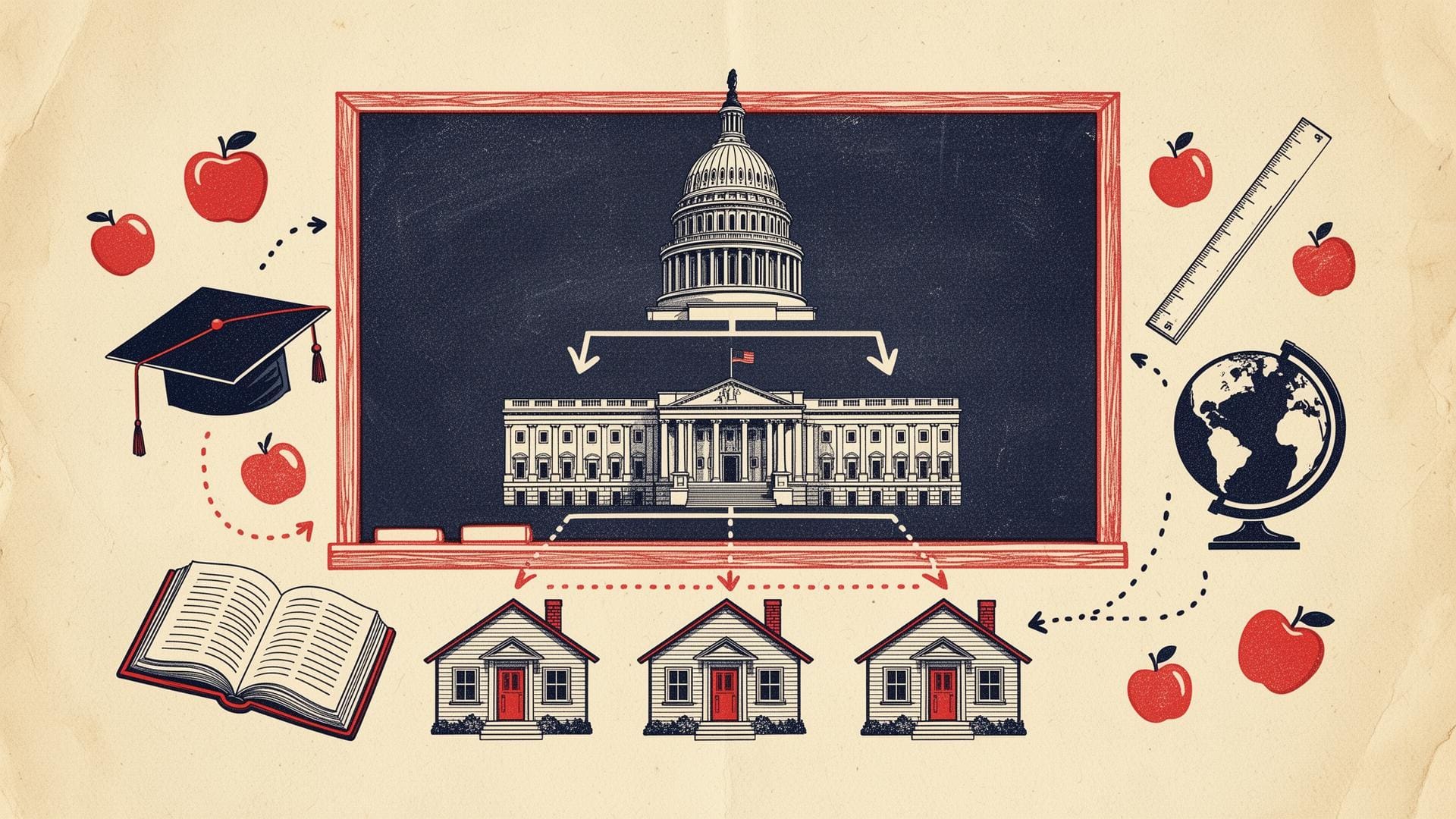
Education policy is one of the most fiercely debated topics in American politics. Yet, it remains deeply misunderstood. Because local, state, and federal governments share overlapping roles, it can be hard to tell who is actually in charge of our classrooms.
When public school performance slips, voters often blame Washington D.C. However, the reality of school governance tells a completely different story. Let’s break down the biggest education policy misconceptions.
The Top Education Policy Misconceptions
The federal government dictates school curriculum
The Reality: Washington has virtually zero direct control over what your kids learn. Under the U.S. Constitution, education is a power reserved for the states. Local school boards select textbooks and set graduation rules.
The U.S. Department of Education primarily funds public schools
The Reality: Most people assume Washington foots the bill. In truth, federal funding accounts for less than 10% to 13% of total K-12 school budgets. The remaining 90% comes from state revenues and local property taxes.
Eliminating the federal department would end public schooling
The Reality: Political calls to close the department make big headlines. However, doing so would not erase public schools. Core aid programs for low-income and special education students would simply transfer to other agencies.
School quality is equal because standards are uniform
The Reality: Funding relies heavily on neighborhood property values. Wealthy areas generate massive school budgets. Meanwhile, lower-income districts fall behind. This setup creates vast quality gaps across the nation.
Case Study: The Battle Over Religion in the Classroom
State power over education is clear in current battles over religion. Recently, states like Louisiana and Texas pushed laws requiring public classrooms to display the Ten Commandments.
Critics argue these laws violate the First Amendment. They say the government cannot endorse a religion. However, the U.S. Fifth Circuit Court of Appeals recently cleared Louisiana’s law to take effect. This shows how aggressively states can use their authority while courts review the cases.
The Hard Truth: Why Outcomes Vary by Zip Code
National education rankings show a clear pattern. Top-tier public schools are heavily concentrated in states with high local wealth.
Research on the Property Tax-School Funding Connection by the Lincoln Institute of Land Policy reveals a major fact. Nearly 80% of local school funding comes entirely from community property taxes.
This creates an extreme imbalance. Imagine a wealthy county and a poor county. Both set a 1% property tax. The wealthy county raises enough money to buy “apples.” They get top-tier technology and high teacher salaries. Meanwhile, that same 1% tax in a poor county might only buy “apple cores.”
We see this inequality within individual states. In New York State, New York City and its rich suburbs have highly funded schools. Conversely, property-poor counties upstate face tight budgets.
To fix this, states use formulas to send extra cash to poor areas. However, a Foundation Aid Report by the Rockefeller Institute of Government shows a flaw. These formulas often use outdated data, leaving struggling schools behind.
Blaming Washington for underfunded schools is an exercise in misdirection. The responsibility rests entirely on state capitals and local leaders who control the tax distribution.
The Action Plan: What Can Parents and Citizens Do?
You do not have to move to an expensive neighborhood to find a great school. Because the system is local, citizens can exert major influence right at home:
- Target Local School Board Elections: School boards decide local policy and manage budgets. These elections often see voter turnout under 10%. A small group of organized parents can completely shift a district.
- Audit Your District’s Spending: School budgets are public record. See how your tax dollars are spent. Is the money going to classrooms and teachers, or is it stuck in administrative overhead?
- Lobby for State Funding Reform: Property taxes favor wealthy areas. Write to your state representatives. Demand modernized formulas that adjust for a neighborhood’s true financial needs.
- Leverage Choice Programs: Many states offer open-enrollment policies. This lets parents send kids to schools outside their neighborhood zone without moving. Check your state’s specific transfer laws.
The Bottom Line
American education is a hyper-local system hiding under a national umbrella. True accountability does not start with the President. It starts at the ballot box for your local school board trustees and state representatives.


No discussions yet
Be the first to join the discussion and share your thoughts with the community.