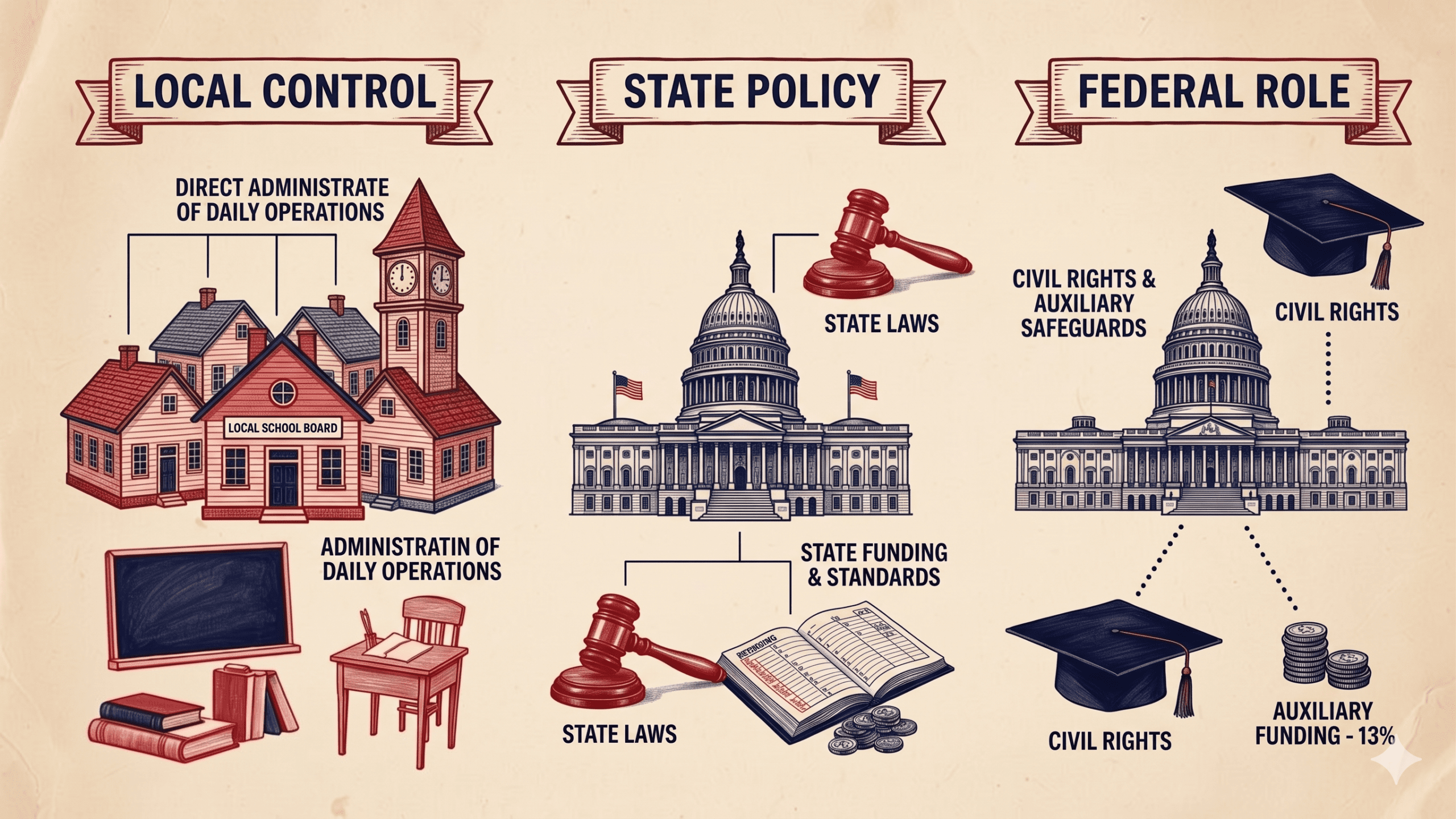
When looking at who controls education in the US, the answer is found primarily at the state and local levels rather than inside the federal government.
That surprises many people because national policy debates often imply that Washington holds direct control over local schools. In reality, key choices regarding classroom materials, budgets, and daily administration are decided by localized communities. This foundational guide is part of our foundational Politics 101 educational archive.
Who Controls Education in the US? The Balanced Breakdown
| Area | Federal Government | State Governments | Local School Districts |
|---|---|---|---|
| Curriculum (What is taught) | No direct control; cannot dictate specific courses. | Establishes graduation requirements and baseline academic standards. | Selects specific textbooks, instructional materials, and elective offerings. |
| School Funding | Provides roughly 13% of total funding, targeted at high-need populations (per the NCES). | Contributes roughly 45% of revenues via state income and sales taxes. | Generates roughly 42% of revenue locally, primarily via property taxes (per the U.S. Census Bureau). |
| Education Laws & Policy | Ties broad federal aid to compliance metrics (e.g., standardized testing windows). | Enacts state-level laws, safety regulations, and school calendars. | Drafts and enforces community-specific district codes of conduct. |
| Civil Rights Enforcement | Investigates systemic discrimination through the Department of Education. | Monitors local compliance with federal equality guidelines. | Executes day-to-day legal protections for students and staff. |
| Teacher Requirements | No direct mechanism for hiring or evaluation. | Sets mandatory certification, licensure, and background check rules. | Manages active hiring, local compensation scales, and direct terminations. |
| Daily Operations | None. | Maintains standard administrative oversight and state testing data. | Manages direct facility upkeep, student transportation, and daily scheduling. |
State governments maintain absolute constitutional authority over public education, allowing them to dictate general graduation blueprints. However, states typically delegate substantial operational control to local school boards. This system ensures individual communities retain the direct power to select textbooks and manage zoning to match domestic neighborhood priorities.
The federal role functions primarily as an auxiliary safeguard. By utilizing targeted formula funding—such as Title I grants for low-income communities—the federal government incentivizes states to adopt certain standards while strictly protecting student civil rights on a national baseline.
A common source of confusion regarding who controls education in the US stems from landmark historical court cases. Many people incorrectly point to events like Brown v. Board of Education (1954) or the famous Scopes Monkey Trial (1925) as proof that Washington calls the shots in local school systems.
However, a closer look at the legal architecture reveals the opposite:
- Brown v. Board of Education: When the Supreme Court ruled that racial segregation in public schools was unconstitutional, it was enforcing individual civil rights under the 14th Amendment’s Equal Protection Clause. The federal government stepped in as a constitutional referee to halt systemic rights violations, not to manage daily local school operations or construct class schedules. You can read the original case details courtesy of the Administrative Office of the U.S. Courts.
- The Scopes Monkey Trial: This famous legal battle over teaching evolution in classrooms was actually centered on a state statute—Tennessee’s Butler Act. It was an example of a state exercise of power over curriculum. Decades later, when the U.S. Supreme Court ultimately barred states from banning evolution, it did so strictly because those bans violated the First Amendment’s Establishment Clause regarding the separation of church and state.
In both historical instances, federal intervention set the legal boundaries for civil liberties; it did not take away the baseline infrastructure of state and local control over public classrooms.
Recognizing this decentralized power balance explains why public school policies look starkly different depending on what state line you cross. It emphasizes that citizens looking to understand or impact local education will find the most direct leverage points at local school board meetings and state legislatures. For a deeper look at how public policy directly hits home, read our ongoing companion series, Why It Matters.
While federal structural interventions protect civil liberties on a national scale, state and local authorities control nearly 87% of all school budgets alongside the vast majority of day-to-day administrative and curricular choices.
No discussions yet
Be the first to join the discussion and share your thoughts with the community.