
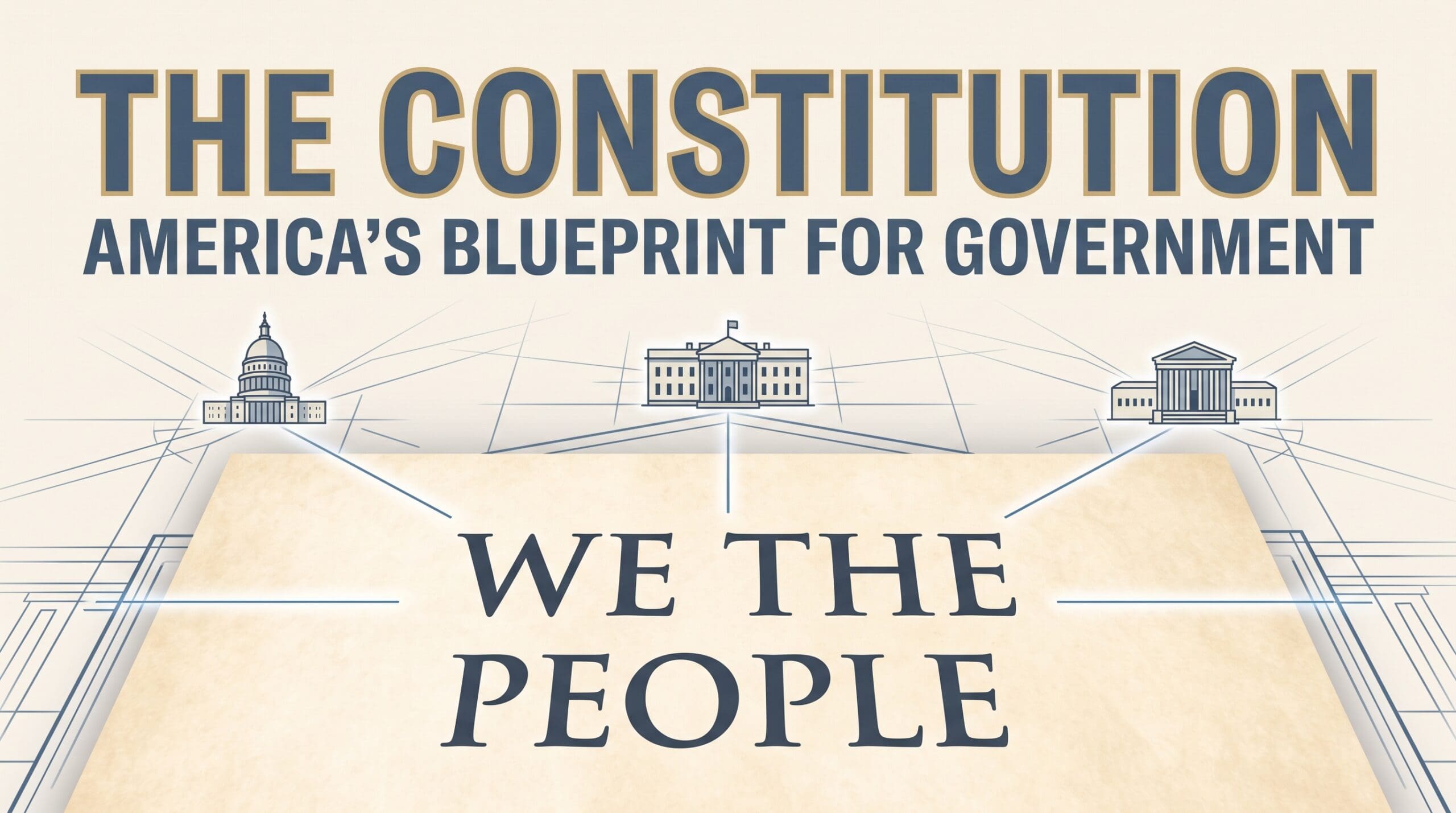
What It Does, What It Protects, and Why It Still Matters
Introduction — More Than an Old Document
The U.S. Constitution is only about 4,500 words long — shorter than many magazine articles. Yet it has guided the world’s most powerful nation for over two centuries, through civil war, industrial revolution, global conflicts, civil rights movements, and the digital age.
You’ve heard the phrases: “constitutional right,” “unconstitutional,” “constitutional crisis,” “the Framers’ intent.” They show up in headlines, campaign speeches, and your uncle’s Facebook posts.
But what does the Constitution actually do?
At its core, the Constitution does something both simple and extraordinary: it creates a government, gives that government power, and then places limits on how that power can be used.
That’s it. Everything else — every Supreme Court ruling, every political debate, every controversy over executive orders — flows from that basic framework.
Part I — Why America Needed a Constitution
The First Government Wasn’t Working
When Americans declared independence from Britain in 1776, they weren’t setting out to build a unified national government. Each former colony considered itself essentially independent. The first attempt at a national framework — the Articles of Confederation, adopted in 1781 — created a national government so weak it nearly collapsed.
Here’s what went wrong:
| Problem | What It Meant |
|---|---|
| Congress couldn’t effectively tax | The national government had to request money from states, which frequently refused to pay. The country couldn’t pay its war debts. |
| No power to regulate interstate commerce | States imposed their own tariffs and trade rules on each other, creating economic chaos. |
| No separate national executive | There was no president. No single leader to enforce laws or conduct foreign policy. |
| No national judiciary | No federal courts existed to resolve disputes between states or interpret national laws. |
By 1786, the situation was dire. Unpaid Revolutionary War veterans were rebelling (Shays’ Rebellion in Massachusetts), states were fighting over trade and borders, and the young nation looked fragile.
The Constitutional Convention
In May 1787, delegates from 12 of the 13 states gathered in Philadelphia. (Rhode Island refused to attend.) Their official mission was to revise the Articles of Confederation.
Instead, they threw the Articles out entirely.
Over four months of debate behind locked doors, they designed an entirely new framework. The Constitution was signed on September 17, 1787.
The Central Problem
The delegates wrestled with one question that still echoes through every constitutional debate today:
How do you create a government powerful enough to govern — without creating one powerful enough to threaten liberty?
The Constitution’s entire architecture — separation of powers, checks and balances, federalism, a Bill of Rights — is an attempt to solve this problem. Power had to exist, but it had to be divided, limited, and held accountable.
Part II — What Does the Constitution Actually Do?
It Creates the Federal Government
The first three articles establish the three branches:
Congress
Makes laws through the House of Representatives and Senate.
President
Enforces laws, serves as commander-in-chief, and conducts foreign policy.
Federal Courts
Interpret laws and resolve disputes under federal law.
Note: Congress is listed first. Many Framers believed the legislative branch — closest to the people — should be the most powerful.
It Divides Power
The Framers didn’t trust concentrated power:
Separation of Powers — Authority is split among three branches. Congress writes laws, the President enforces them, courts interpret them. No single branch has all the power.
Checks and Balances — Each branch can limit the others. The President can veto laws. Congress can override vetoes with two-thirds vote. Courts can strike down unconstitutional acts.
Federalism — Power is divided vertically between national and state governments. Some powers belong to the federal government (defense, foreign policy). Others are primarily handled by states and local governments (education, local law enforcement). Some are shared (taxation, roads).
It Gives Government Powers
Among the powers granted to Congress:
- Taxation — Direct fix to the Articles’ biggest failure
- Regulating interstate commerce — Prevents the economic chaos of the 1780s
- National defense — Raising armies, maintaining a navy
- Foreign relations — Making treaties (with Senate approval)
- Coining money — States could no longer print their own
- Establishing post offices and roads — Connecting the nation
These are enumerated powers — explicitly granted. The government doesn’t have infinite authority.
It Limits Government Power
The government cannot simply do whatever elected officials want:
The Constitution itself — Government can only exercise powers granted. This is the principle of enumerated powers.
Separation of powers — No branch can act alone. Even a popular president can’t make law unilaterally.
Federalism — State governments have their own sovereign powers the federal government cannot simply take.
Individual rights — The Bill of Rights places specific protections the government cannot violate.
Judicial review — Courts can determine whether government actions are constitutional.
Part III — The Seven Articles: The Constitution’s Blueprint
| Article | What It Establishes |
|---|---|
| Article I | Congress — the legislative branch |
| Article II | The Presidency — the executive branch |
| Article III | Federal Courts — the judicial branch |
| Article IV | Relationships among states |
| Article V | The amendment process |
| Article VI | The Supremacy Clause — the Constitution and valid federal law are supreme |
| Article VII | Ratification process |
Article VI’s Supremacy Clause declares that the Constitution and federal laws made under it are “the supreme Law of the Land.” When a state law conflicts with a valid federal law enacted within Congress’s constitutional authority, federal law generally prevails.
Article V gives us the amendment process — intentionally difficult. An amendment can be proposed by two-thirds of Congress or by a convention called by two-thirds of the states. Either way, three-fourths of the states must ratify it. This ensures constitutional change reflects broad consensus, not temporary passions.
Part IV — The Bill of Rights and Individual Liberty
Why Was a Bill of Rights Added?
Not everyone at the Constitutional Convention wanted one.
Federalists (like Alexander Hamilton) argued a Bill of Rights was unnecessary — listing rights might imply the government had powers not listed.
Anti-Federalists (like Patrick Henry) argued explicit protections were essential. Without them, the new government could become tyrannical.
The Anti-Federalists lost the ratification battle, but the Federalists kept their promise. In 1789, James Madison drafted the first ten amendments. Ratified in 1791.
The First Ten Amendments
| Protection | Key Amendments |
|---|---|
| Speech and Religion | First Amendment — speech, press, religion, assembly, and petition |
| Criminal Procedure |
Fourth — search and seizure Fifth — self-incrimination and due process Sixth — speedy trial Eighth — cruel punishment |
| States and People | Tenth Amendment — Powers not given to the federal government are reserved for the states or the people |
| Other Protections |
Second — arms Third — troops Seventh — civil juries Ninth — unlisted rights still exist |
The Ninth Amendment is often overlooked. It says listing certain rights doesn’t mean other rights don’t exist.
Rights Expanded Over Time
The original Constitution did not protect everyone equally:
- Slavery was accommodated and protected (the Three-Fifths Clause and Fugitive Slave Clause), even though the document avoided using the word “slavery.” It took a civil war and the 13th Amendment (1865) to abolish it.
- Voting rights at the founding were largely controlled by states and restricted to white men, often with property, tax-paying, or other requirements that varied from state to state. The 15th Amendment (1870) prohibited denying voting rights based on race, color, or previous condition of servitude. The 19th Amendment (1920) prohibited denying voting rights on the basis of sex.
- Citizenship wasn’t clearly defined until the 14th Amendment (1868), which guaranteed birthright citizenship and equal protection — a direct response to the Dred Scott decision that denied Black Americans citizenship.
The Constitution’s promise of liberty expanded over 200 years — through amendments, laws, and court interpretations.
Part V — How Can the Constitution Change?
The Constitution changes in two ways.
Formal Change: Amendments
Article V provides the amendment process. It’s deliberately difficult — requires broad consensus.
27 amendments have been ratified:
| Amendment | Year | What It Did |
|---|---|---|
| 13th | 1865 | Abolished slavery |
| 14th | 1868 | Birthright citizenship and equal protection |
| 15th | 1870 | Voting rights regardless of race |
| 19th | 1920 | Prohibited denying voting rights based on sex |
| 22nd | 1951 | Limited presidents to two elected terms |
| 26th | 1971 | Lowered the voting age to 18 |
Interpretation Changes Too
The Constitution also changes through interpretation:
Congress passes laws defining how powers work in practice. The Commerce Clause now regulates everything from railroads to the internet.
Presidents exercise constitutional authority in ways that set precedents. Executive orders aren’t explicitly mentioned — they derive from the “take care” clause.
Courts interpret constitutional provisions. Judicial review isn’t explicitly stated — established by Marbury v. Madison (1803). Since then, the Court has shaped constitutional meaning through rulings.
Supreme Court precedents can change. Brown v. Board of Education (1954) overturned Plessy v. Ferguson (1896)’s “separate but equal” doctrine.
Part VI — What the Constitution Does NOT Say
This might surprise you: a lot of what Americans take for granted isn’t actually in the Constitution.
The Framers couldn’t anticipate everything. Political parties appeared almost immediately (despite Framers’ warnings against “factions”). The filibuster developed as a Senate procedural tool.
America’s system developed through:
Constitution + laws + court decisions + congressional rules + traditions + historical practice
Part VII — What’s Happening Now? Why the Constitution Is Still Debated
Americans argue about the Constitution every day — always have. That’s not failure. It’s the system working as designed.
Today’s debates:
- Presidential power — Emergency authority, national security, immigration
- Congressional authority — Has Congress given too much power to federal agencies?
- Federal versus state power — Where should the line be drawn?
- Gun rights — What does the Second Amendment protect?
- Voting rights — How far can states regulate elections?
- Privacy — Not explicitly mentioned, yet courts recognize privacy rights
- Religious liberty — When does religious freedom conflict with other rights?
- Federal agency power — Do federal agencies have too much power, sometimes called the “administrative state”?
- How to interpret the Constitution — Original meaning? Framers’ intent? Evolving standards?
The Bigger Question
Most constitutional disagreements come down to one question:
Where should government power begin — and where should it end?
Different constitutional philosophies produce genuinely different answers. The Constitution contains both specific commands and broad principles. Americans have disagreed about their meaning since the founding. Constitutional disagreement is not new — it’s part of American political history.
Part VIII — Blueprint for Hope: A Constitution Designed to Survive Disagreement
The Constitution was not designed assuming Americans would always agree.
The Framers knew political disagreement, competing interests, ambition, and power struggles were inevitable. James Madison wrote: “If men were angels, no government would be necessary.” They weren’t.
The Constitution’s tools for managing disagreement:
Why It Matters
“I disagree with this policy.”
“The government does not have the constitutional authority to do this.”
Confusing policy disagreements with constitutional questions is one of the most common forms of political misinformation. Understanding the Constitution helps separate:
📰 Navigating the News: “That’s Unconstitutional”
When someone says “That’s unconstitutional,” ask:
What part of the Constitution? Which Article, Amendment, or clause applies?
Whose power are we talking about? Congress? The President? A state? A court?
Has a court actually ruled on it? A politician or commentator declaring something unconstitutional doesn’t settle the legal question.
Is this constitutional — or simply controversial? Bad policy, unpopular policy, and unconstitutional policy are not the same thing.
Someone claiming something is unconstitutional doesn’t itself make it unconstitutional.
Courts decide constitutional questions in cases brought before them. The Supreme Court usually has the final word in the courts. But Congress and the President must follow the Constitution too.
🎯 Final Takeaway
The Constitution establishes America’s government, distributes power, limits that power, protects rights, and creates a system for resolving disagreements and adapting over time.
Understanding the Constitution doesn’t mean memorizing every clause. It means understanding the framework that determines who has power, what limits that power, and what happens when Americans disagree about how it should be used.
That framework — over 230 years old — is still the operating system of American democracy.
Frequently Asked Questions
What is the Constitution? The supreme law of the United States. It structures the federal government, defines powers, limits them, and protects individual rights.
Why was it written? The Articles of Confederation was too weak to function. It couldn’t tax, regulate commerce, or enforce laws.
What are the seven Articles? Articles I–III establish the three branches. Article IV covers state relations. Article V covers amendments. Article VI contains the Supremacy Clause. Article VII covers ratification.
What is the Bill of Rights? The first ten amendments (1791), protecting liberties including speech, religion, due process, and protection from unreasonable searches.
What is an amendment? An amendment can be proposed by two-thirds of Congress or by a convention called by two-thirds of the states. Either way, three-fourths of the states must ratify it.
Why is it called “supreme law of the land”? Article VI says the Constitution and federal law override conflicting state laws.
Who decides whether something is unconstitutional? Courts decide constitutional questions in cases brought before them. The Supreme Court usually has the final word in the courts. Congress and the President must follow the Constitution too.
Can the Constitution be changed? Yes, through amendments (27 so far). It also “changes” through court interpretation, legislation, and historical practice.
Does the Constitution give the President more power than Congress? Congress has the most explicitly listed powers. Presidential power has expanded considerably through precedent, legislation, and court decisions.
What happens when the Constitution doesn’t address something? Other sources fill the gap: statutes, state laws, court decisions, institutional traditions, historical practice. Many permanent-seeming features (political parties, filibuster) exist through development over time.
Glossary
Constitution
Supreme law of the United States, establishing government framework
Articles of Confederation
First national government framework (1781–1789), proved too weak
Article
One of seven main divisions of the Constitution
Amendment
Formal change. 27 ratified.
Bill of Rights
First ten amendments (1791), protecting individual liberties
Separation of Powers
Division among legislative, executive, judicial branches
Checks and Balances
Each branch can limit the others
Federalism
Division between national and state governments
Judicial Review
The power of courts to decide whether government actions violate the Constitution. Firmly established by Marbury v. Madison (1803).
Supremacy Clause
Article VI: Constitution and federal law are highest law, overriding conflicting state laws
Ratification
Formal approval. Constitution ratified 1787–1790
Related VoteView Articles:
- The Supreme Court Explained
- The Supreme Court Series: When the Supreme Court Got It Wrong
- Checks and Balances Series: What Are Checks and Balances?
- The Manufacturing of Culture Wars (upcoming)
Primary Sources & Government Resources
| Topic | Source |
| Full Constitution Text | National Archives |
| Articles of Confederation | National Archives |
| Declaration of Independence | National Archives |
| Bill of Rights Text | National Archives |
| Treaty of Tripoli (1797) | Avalon Project (Yale) |
| Constitution Annotations | Library of Congress |


No discussions yet
Be the first to join the discussion and share your thoughts with the community.