
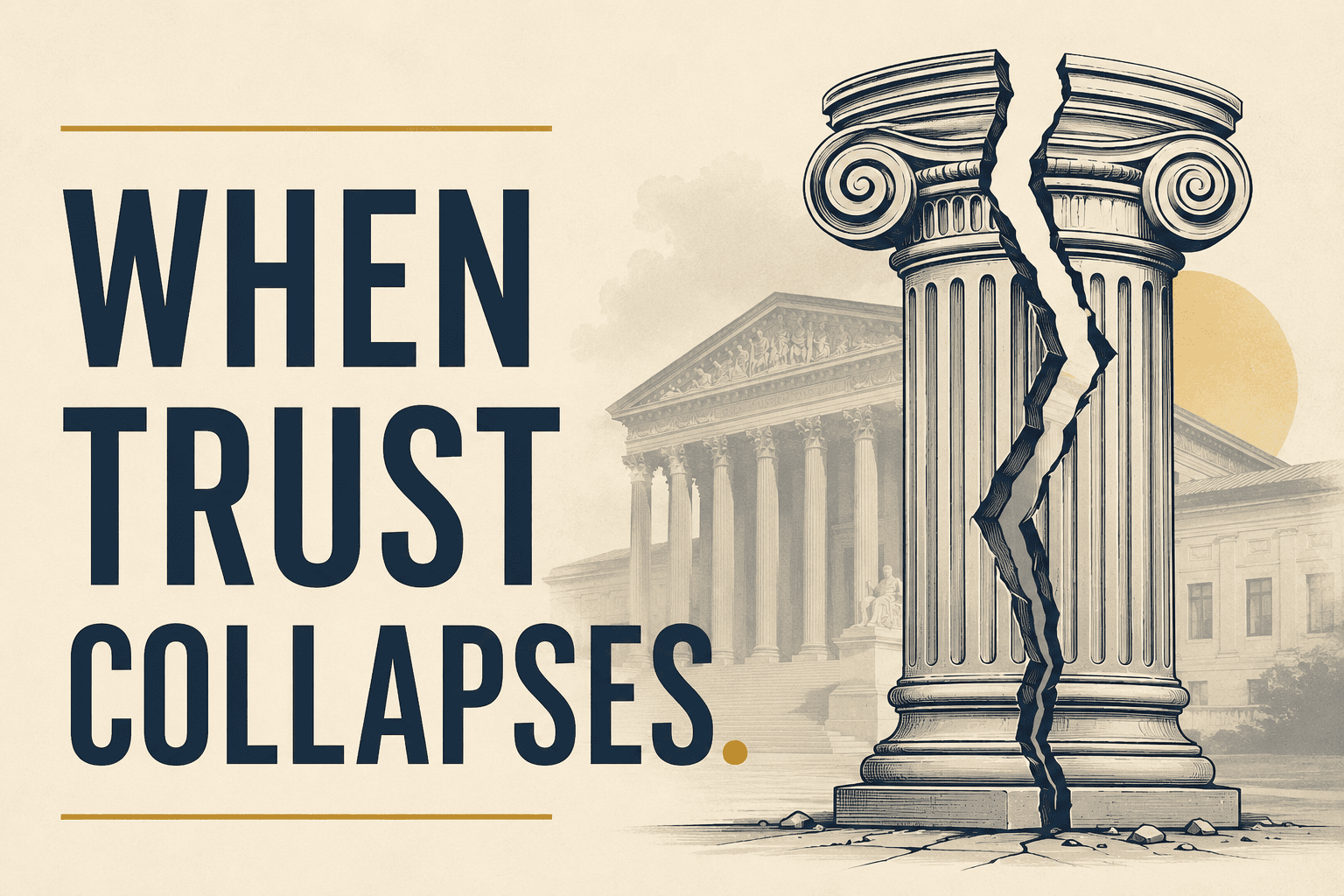
Historical Crises, Modern Ethics, and the Fragile Power of Institutional Legitimacy
Americans are angry right now—at the presidency, at Congress, at an entire system that seems to reward the connected and punish everyone else. That frustration didn’t appear overnight. It’s been building across administrations, across both parties, across decades of promises made and broken.
The Supreme Court doesn’t exist in a vacuum. When every branch of government appears compromised, the Court’s ethics failures don’t feel like isolated incidents. Instead, they feel like symptoms of a system that has quietly stopped policing itself.
And when the final, impartial backstop starts looking like just another power center with its own favors to repay, the collapse in public trust isn’t just understandable. It’s rational. When institutions appear unable to police themselves, many Americans naturally begin questioning whether those institutions deserve the confidence they’ve traditionally been given.
The Fragile Currency of the Court
The Supreme Court has no army.
Its authority depends on whether Americans continue believing its decisions deserve to be followed.
When public confidence drops—whether driven by deeply polarizing decisions or mounting scrutiny over judicial ethics—a dangerous systemic question emerges. What happens if the public or political leaders simply decide to ignore the Court?
Understanding how delicate this balance is helps us look past the noise of current headlines. History shows that America has faced deep crises of judicial legitimacy before. Looking at how we overcame them provides a blueprint for how everyday citizens can handle institutional frustration today.
📌 KEY TAKEAWAYS
- No Forces of Its Own: The Court’s authority depends entirely on public acceptance—it has no army, no budget, and no enforcement power of its own.
- We’ve Been Here Before: America has survived severe judicial legitimacy crises historically: FDR’s court-packing fight (1930s) and the desegregation defiance at Little Rock (1950s).
- The Ref-less System: The Court’s 2023 Code of Conduct has no independent enforcement mechanism—it is an honor system with no referee.
- Historic Lows: Only 25% of Americans express strong confidence in the Court (Gallup), dropping further to 22% in recent 2026 tracking.
- The Playbook Exists: Citizens possess clear constitutional tools to respond: statutory overrides, amendments, the ballot box, and legislative oversight.
- Healthy Anger: Anger at institutions is a healthy part of a democracy. Abandoning the constitutional framework entirely is not.
The Historical Firestorms (And How We Survived)
When public trust in the judiciary plummets, it feels like uncharted, apocalyptic territory. But a look back at American history proves that the relationship between the people, the political branches, and the Court has always been a high-stakes balancing act.
📜 Case Study 1: The Court vs. Economic Survival (1930s)
The Crisis: During the height of the Great Depression, the Supreme Court repeatedly struck down President Franklin D. Roosevelt’s New Deal legislation. To a starving public, a handful of wealthy, lifetime-appointed judges seemed to be intentionally choking national economic recovery.
The Resolution: FDR fought back politically by threatening his famous “court-packing” plan to add up to six new justices to the bench. While Congress ultimately rejected the plan to preserve judicial independence, the institutional pressure worked. Recognizing the threat to its own legitimacy, the Court shifted its voting patterns—a move historians call “the switch in time that saved nine”—and began upholding the economic relief programs.
📜 Case Study 2: Direct Defiance and Desegregation (1950s)
The Crisis: Following the landmark Brown v. Board of Education ruling, more than 100 Southern lawmakers signed the “Southern Manifesto,” explicitly pledging to resist desegregation. In 1957, the Governor of Arkansas went so far as to deploy the state’s National Guard to physically block Black students from entering a high school, directly defying a federal court order.
The Resolution: President Dwight D. Eisenhower understood that if a state executive could simply choose which Supreme Court rulings to obey, the rule of law would cease to exist. He federalized the Arkansas National Guard and deployed the 101st Airborne Division to Little Rock to enforce the Court’s decree. The crisis proved Alexander Hamilton’s foundational rule: the Court’s judgment completely depends on the Executive branch’s force to survive.
📌 Why This Matters
The Supreme Court cannot enforce its own rulings.
Unlike the President, it commands no military. Unlike Congress, it controls no budget. The Court depends on the executive branch to enforce its decisions and, ultimately, on the American people accepting its constitutional authority.
If public confidence erodes too far, constitutional disagreements risk becoming political power struggles instead of legal ones.
The Modern Ethics Dilemma
Today, public confidence in the Court has hit historic lows. According to Gallup, only 25% of Americans expressed “a great deal” or “quite a lot” of confidence in the Supreme Court—the lowest figure in the poll’s nearly 50-year history. A 2026 Verasight survey found that number has dropped further, with just 22% of registered voters expressing strong faith in the Court. Perhaps most strikingly, nearly half of Republicans polled said the Court needs stronger ethical controls. This isn’t a partisan frustration. It’s a systemic one.
Much of that frustration centers on a structural reality: the Supreme Court polices itself. And the system it built to do that policing is fundamentally toothless.
The Structural Design Flaw
The Design Problem:
The Supreme Court’s 2023 Code of Conduct relies entirely on self-enforcement. There is no independent panel, no inspector general, and no neutral watchdog to investigate or penalize violations. When a system relies purely on the honor system, public trust naturally erodes. The question isn’t just whether individual actions cross a legal line—it’s whether the appearance of a conflict of interest damages the institutional armor the Court needs to function.
Recusal decisions are left to individual justices. If a justice declines to step away from a case involving a personal connection, there is no higher authority to overrule that decision. The justice’s word is final.
What This Looks Like in Practice:
Reports have surfaced of justices receiving undisclosed luxury travel, real estate arrangements, or gifts from individuals with interests before the Court. Furthermore, flags associated with political movements have been displayed at a sitting justice’s residences without triggering investigation or recusal. The institution’s response has been consistent: silence, deflection, or reliance on self-interpretation of its own voluntary code.
That’s not a failure of individual character. It’s a failure of institutional design. A system that allows the accused to also serve as judge and jury isn’t a justice system. It’s a courtesy. The question isn’t just whether these actions are wrong. It’s whether the system itself is designed to prevent accountability—and whether Americans even agree on what counts as corruption anymore.
⚖️ Why People See This Differently
Complaints are often politically motivated, disproportionately targeting conservative justices. Imposing external congressional oversight could threaten judicial independence, creating a dangerous tool for political leverage over rulings. The 2023 code, while voluntary, marks a meaningful first step.
The pattern of undisclosed benefits goes far beyond anything in modern history. The absence of accountability—not the pursuit of it—is what truly threatens independence. When the public believes justice can be influenced, the entire institution’s legitimacy collapses regardless of technical legal lines.
What both sides increasingly agree on: the current system isn’t working. When confidence in the Court drops to historic lows across party lines, the question isn’t whether reform is partisan—it’s whether inaction is sustainable.
The Constitutional Playbook for Citizens
When civic anger boils over, there is a temptation to declare the entire system broken. But the Constitution was designed with mechanisms that allow citizens to pursue change without abandoning the rule of law.
| Constitutional Tool | How It Works |
|---|---|
| 📜 Statutory Override | If the Supreme Court interprets a federal law in a way Congress did not intend, Congress can pass a new law that changes or clarifies the statute. |
| 📝 Constitutional Amendment | When the Court’s decision is based on the Constitution itself, the people—through Congress and the states—can amend the Constitution. This is difficult by design but provides the ultimate constitutional check. |
| 🗳️ The Ballot Box | Presidents nominate Supreme Court justices, and the Senate confirms them. Elections gradually shape the future direction of the Court. |
| 🏛️ Legislative Oversight | Congress can hold hearings, investigate ethics concerns, consider legislation affecting the Court’s administration, and debate proposals such as ethics reforms or transparency requirements. |
💡 The Big Idea
Frustration with the Supreme Court does not mean citizens are powerless.
The Constitution provides peaceful, democratic ways to respond—from voting and legislation to constitutional amendments. The challenge is using those tools rather than abandoning them.
People Are Asking
Can Congress force ethics rules on the Court?
Congress has broad authority under the Constitution’s Necessary and Proper Clause to regulate the Court’s operations. It has done so before—setting the number of justices, establishing lower courts, and creating judicial circuits. However, whether Congress can constitutionally mandate recusal decisions or create an external enforcement body with disciplinary power remains an open legal question.
Has a Supreme Court justice ever been impeached?
Yes—once. Justice Samuel Chase was impeached by the House of Representatives in 1805 on charges of judicial misconduct. He was acquitted by the Senate and remained on the bench. No Supreme Court justice has ever been convicted and removed through the impeachment process.
What makes a Code of Conduct enforceable?
A Code of Conduct is essentially a set of guidelines the institution writes for itself; it depends entirely on voluntary compliance. An enforceable ethics law would create an independent body—like an inspector general or ethics commission—with the power to investigate complaints, publish findings, and impose consequences. The Court’s 2023 Code of Conduct is the former.
Summary: Fragile, Not Shattered
Democracy requires a very difficult, dual commitment from its citizens: the willingness to hold powerful institutions accountable, combined with a foundational respect for the roles those institutions play.
Anger directed at the Supreme Court is a healthy sign of an engaged electorate. But when that anger turns into a desire to bypass or dismantle the judiciary’s constitutional authority entirely, the system begins to fracture. The ultimate goal of civic awareness is not to make us hate our government—it is to teach us how to use the gears of the machine to keep it balanced.
What This Means for You
If you’ve felt angry watching the Supreme Court operate without meaningful oversight, you’re not wrong to feel that way. You’re paying attention. And if your confidence in the Court has been shaken, you’re part of a broad majority of Americans who no longer express strong confidence in the institution. Rebuilding public trust begins not by ignoring those concerns, but by understanding how our constitutional system allows citizens to demand accountability while preserving judicial independence.
Rebuilding public trust begins not by ignoring those concerns, but by understanding how our constitutional system allows citizens to demand accountability while preserving judicial independence.
But anger without a channel can turn into cynicism, and cynicism is what broken systems count on. The Constitution was written by people who understood that unchecked power eventually creates danger. That is why the system includes peaceful, democratic tools for correction.
Here is what that looks like in practice:
Four Things You Can Do
- Vote like the Court depends on it — because it does. Presidents nominate Supreme Court justices, and senators confirm them. Over time, elections shape who sits on the bench.
- Contact your representatives about ethics legislation. Tell them whether you support binding, independently enforced ethics rules for the Supreme Court instead of relying only on voluntary codes.
- Support organizations doing the work. Groups focused on court reform, transparency, voting rights, and government accountability can help turn public frustration into organized civic pressure.
- Stay informed and share what you learn. Confusion protects broken systems. When you understand the process well enough to explain it to someone else, you become part of the accountability mechanism.
The Bottom Line
The system is fragile. That is not a reason to give up on it.
It is a reason to handle it carefully, demand better from the people inside it, and use the constitutional tools citizens still have.
- Part 1: What Is the Supreme Court? (How the Court works, who’s on it, and why it matters)
- Part 2: The Worst Decisions (The rulings that history regrets)
- Part 3: Can They Correct Themselves? (How — and whether — the Court overturns its own mistakes)
- Part 4: Why Americans Disagree About the Supreme Court (The ideological divide explained)
- Part 5: Who Watches the Supreme Court? (Accountability mechanisms, impeachment, and reform proposals)
- Why It Matters Series: When Public Trust in the Supreme Court Collapses ← You are here

No discussions yet
Be the first to join the discussion and share your thoughts with the community.