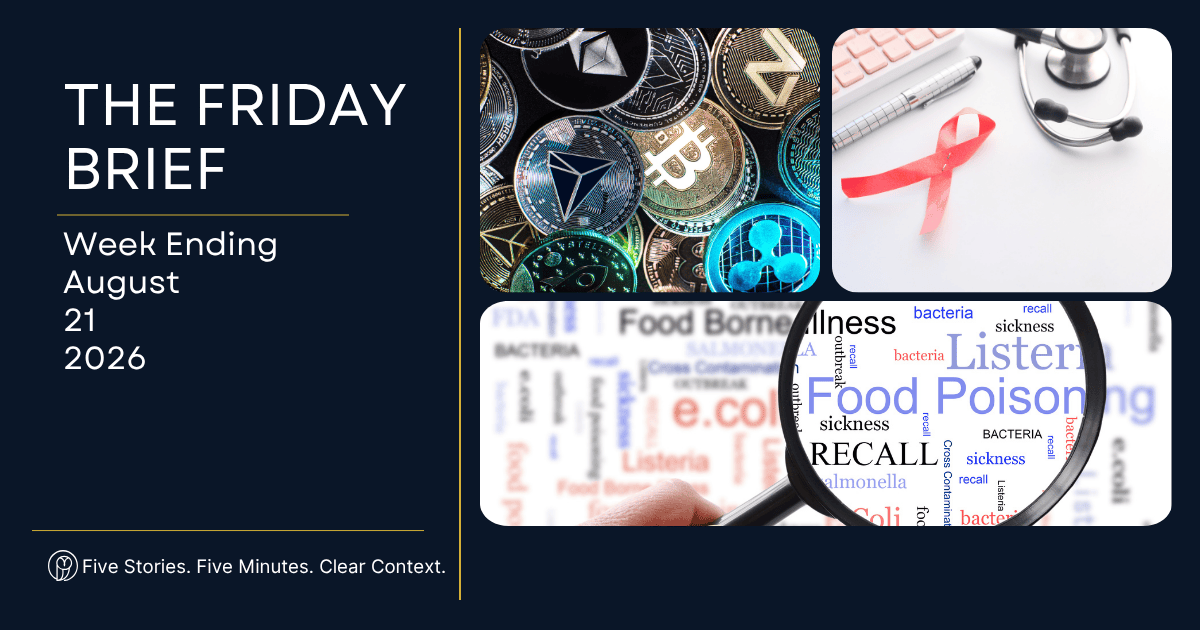
Friday Brief | August 15-21
This Week in the News: What Happened, Why It Matters & What the Noise Really Means
U.S. National Debt Crosses $40 Trillion
📰 The News
Treasury data confirmed this week that gross federal debt surpassed $40 trillion for the first time in history. The milestone was driven by a combination of deficit spending, rising interest payments on existing debt, defense costs, and tariff-related economic disruption, according to reporting from the Financial Times and other outlets.
🔎 Why It Matters
This isn’t simply a number on a screen. The national debt reflects decades of bipartisan fiscal decisions — spending, tax policy, wars, recessions, COVID relief, and increasingly expensive interest payments. Every dollar the government spends on interest is a dollar unavailable for infrastructure, education, health care, or emergency response.
Crossing $40 trillion raises real questions about the long-term sustainability of the federal budget, the strength of the U.S. dollar, and the future of programs like Social Security and Medicare.
But the important question isn’t simply “Who ran up the debt?” — every recent administration, Republican and Democratic, has contributed.
The educational question is: What exactly is the national debt — and who controls the spending that creates it?
Check out how the national debt impacts social security.
🏛️ Civic Connection: The Power of the Purse
Congress — not the president — holds the constitutional power of the purse. Congress passes spending and tax legislation, while the president signs or vetoes it. The Senate amends and approves them. The president signs or vetoes them.
That means every dollar of debt was authorized by representatives you elected. Budget reconciliation, discretionary spending, tax structures, and borrowing limits all pass through Congress. When we talk about the national debt, we’re really talking about the cumulative result of thousands of individual legislative decisions made over decades.
➡️ What You Can Do
Track how your specific representatives vote on budget, spending, and tax legislation. The Congressional Record and sites like GovTrack.us let you see every vote your senator or representative casts on fiscal policy. You can also ask your representative directly: What is your plan for reducing the deficit without cutting programs my community depends on?
Read Financial Times reporting on the $40 trillion milestone →
Trump Hosts Crypto CEOs at the White House — and Raises Conflict-of-Interest Questions
📰 The News
On Wednesday, August 19, President Trump held a press conference in the Roosevelt Room with the leaders of America’s largest cryptocurrency companies. Attendees included Coinbase CEO Brian Armstrong, Gemini co-founders Tyler and Cameron Winklevoss, Robinhood CEO Vlad Tenev, Ripple CEO Brad Garlinghouse, Kraken co-CEO Arjun Sethi, Nasdaq CEO Adena Friedman, and others. SEC Chair Paul Atkins and CFTC Chair Mike Selig were also in the room.
Trump urged Congress to pass the stalled CLARITY Act, which would create a permanent regulatory framework for digital assets — determining whether crypto is regulated more like securities (under the SEC) or commodities (under the CFTC). He also announced the CFTC is working to bring the Hyperliquid perpetual-futures platform to the U.S. “in a fully compliant and legal fashion.”
Bitcoin jumped above $71,000. Coinbase shares surged nearly 10%.
🔎 Why It Matters
This wasn’t just a photo op. The president is personally lobbying Congress to pass legislation that would reshape an industry he and his family have significant financial interests in. The Trump family’s crypto venture, World Liberty Financial, has business ties to several companies represented at the meeting — including Chainlink and BitGo, which Trump called “a big deal” during the event. The White House and World Liberty have denied any conflicts.
Supporters of the CLARITY Act, including Coinbase’s Brian Armstrong, argue that clearer regulation could help prevent collapses like the FTX scandal and give consumers stronger protections. Critics and ethics experts raise concerns about a president shaping rules for an industry connected to his family’s finances.
Rather than asserting that this is “corrupt,” it’s worth understanding what the rules actually are — and what they aren’t.
🏛️ Civic Connection: Conflicts of Interest and Presidential Ethics
A conflict of interest exists when a public official’s personal or financial interests could influence their official duties. That doesn’t automatically mean wrongdoing occurred — but it creates a situation where the public can reasonably question whether decisions are being made for the public benefit or private gain.
Regulatory capture refers to a situation where an industry effectively influences the agencies that regulate it, potentially tilting rules in its favor. When industry executives and regulators are literally in the same room helping shape policy, citizens are right to ask whether the rules serve the public or the industry.
Here’s the complication: U.S. presidents are largely exempt from federal conflict-of-interest statutes that apply to other government officials. The primary check is political — public scrutiny, congressional oversight, and the ballot box — rather than legal.
So the questions worth asking are: What ethics rules actually apply to presidents? Who regulates cryptocurrency — Congress, the SEC, the CFTC, or all three? And what safeguards, if any, exist when an industry connected to a president’s family finances is being regulated by that same president’s administration?
➡️ What You Can Do
Ask your representative whether they support the CLARITY Act and what consumer protections it includes. Follow the bill’s progress — it has been stalled, and public pressure matters. Understanding the difference between SEC and CFTC regulation isn’t just industry jargon; it determines what consumer protections apply when you or someone you know interacts with crypto products.
Read NYT reporting on Trump’s crypto ties and the White House meeting →
Read Bloomberg’s coverage of the CLARITY Act push →
The Food-Safety System Under Strain: Outbreaks, Recalls, and Diminished Capacity
📰 The News
Multiple major foodborne illness outbreaks are active right now, and together they paint a picture of a safety system facing significant stress.
The largest is a Cyclospora outbreak linked to iceberg lettuce from Taylor Farms de Mexico, with case counts approaching 10,000 — making it the largest known cyclosporiasis outbreak in U.S. history. The FDA began onsite inspections at Taylor Farms’ Mexican facilities on August 13.
A Salmonella Javiana outbreak linked to jalapeño peppers from Sinaloa, Mexico has sickened 345 people across 27 states, hospitalizing 36. Recalls have expanded to include products from Whole Foods, Taylor Fresh Foods, and other distributors.
Separately, approximately 1.5 million dozen eggs received the FDA’s highest-risk recall classification over possible Salmonella contamination.
And these are just the outbreaks with identified sources. The FDA’s active outbreak investigation table shows several more ongoing investigations with no product yet identified:
| Pathogen | Product Linked | Cases | Status |
|---|---|---|---|
| Cyclospora | Iceberg lettuce — Taylor Farms de Mexico | Verify before publication | Active — FDA onsite inspection |
| Salmonella Javiana | Jalapeño peppers — Coast Citrus | 345 | Active — 27 states affected |
| Salmonella Oranienburg | Not yet identified | 97 | Active |
| Listeria monocytogenes | Not yet identified | 9 | Active |
| E. coli | Frozen blueberries — Publix / GreenWise | 61 | Active — recall issued |
| Cyclospora | Not yet identified | 172 | Active |
🔎 Why It Matters
Food doesn’t stop at state borders — and neither do the pathogens that contaminate it. These outbreaks demonstrate why the country needs a functioning, well-resourced interstate public-health infrastructure: state health departments identify local cases, the CDC looks for multi-state patterns, and the FDA traces products through complex international supply chains.
But that system is under strain.
What’s changed under the Trump administration:
- USDA entered 2026 with approximately a 20% workforce reduction — more than 20,000 employees departed between January and June 2025, including 15,114 through the White House’s Deferred Resignation Program.
- FDA salaries accounts were cut by $415 million in FY 2026 to reflect agency-wide workforce reductions.
- Foreign food safety inspections reached their lowest level in more than a decade (ProPublica analysis, 2025).
- The FDA food-traceability rule — designed specifically to help investigators rapidly trace contaminated foods to their source — has been delayed again.
Experts warn that the agency’s most labor-intensive, experience-dependent functions — outbreak investigation and laboratory analysis — degrade first when staffing drops.
Here’s where it’s important to separate what we know from what we’re still learning:
The outbreaks are documented. The staffing cuts are documented. But establishing that specific policy changes directly caused specific outbreaks requires longer-term epidemiological analysis that hasn’t been completed.
What we can say is that these outbreaks are raising legitimate questions about whether the country’s food-safety system currently has enough inspectors, surveillance capacity, and regulatory tools to identify contaminated food quickly.
It’s also worth noting that the administration has proposed tightening some food oversight — including requiring manufacturers to notify the FDA about food additives previously self-certified as “generally recognized as safe.” That makes this story more nuanced than a simple narrative of deregulation.
🏛️ Civic Connection: Who Keeps Our Food Safe?
Food safety in the U.S. involves overlapping layers of government:
- Local and state health departments investigate outbreaks in their jurisdictions
- The CDC identifies multi-state patterns and coordinates investigations
- The FDA regulates most foods (produce, dairy, processed foods) and traces contamination through supply chains
- USDA’s Food Safety and Inspection Service regulates meat, poultry, and processed egg products
- Congress funds all of these agencies and sets the laws they enforce
When any layer is weakened — through staffing cuts, budget reductions, or delayed rules — the entire system has less capacity to detect and respond before people get sick.
➡️ What You Can Do
Check foodsafety.gov for active recalls. If you or someone you know experiences symptoms of foodborne illness, report it to your local health department — case reports are how outbreaks get detected. Contact your representatives and ask whether they support full funding for FDA and CDC food-safety programs.
Read the FDA’s outbreak investigation page →
Read FoodNavigator’s reporting on FDA/USDA staff cuts and food-safety risks →
Read ProPublica’s analysis of declining foreign food inspections →
Breakthrough in mRNA Cancer Vaccine Trials — A Reason for Hope
📰 The News
Moderna and Merck announced positive late-stage Phase 3 trial results for an experimental, personalized mRNA-based cancer vaccine combined with immunotherapy to treat melanoma. Nature described it as the first mRNA-based cancer treatment to demonstrate success in a late-stage trial.
The treatment works by analyzing a patient’s individual tumor mutations and creating a customized mRNA vaccine that teaches the patient’s own immune system to recognize and attack their specific cancer cells — reducing the risk of melanoma returning after initial treatment.
🔎 Why It Matters
Millions of Americans first heard about mRNA technology during the COVID-19 pandemic. Now the same underlying platform is being used to fight cancer in a fundamentally personalized way — not a one-size-fits-all treatment, but one designed around an individual’s unique tumor biology.
This is not a preventive “cancer vaccine” in the way we think about flu shots or the measles vaccine. It’s a personalized treatment intended to help prevent melanoma from recurring after a patient has already been treated. That distinction matters — but it doesn’t diminish the significance.
This is government-funded science, university research, and private industry working together — and producing something extraordinary.
🏛️ Civic Connection: Public Investment in Science
Much of the foundational research behind mRNA technology was supported by federal funding through the National Institutes of Health (NIH) and other agencies. Government doesn’t just regulate science — it invests in it. When we debate federal budgets, NIH funding isn’t an abstraction. It’s the research that helped make breakthroughs like this possible.
➡️ What You Can Do
If someone in your life has been affected by melanoma, this is a development worth discussing with their oncologist — clinical trials are ongoing. And when budget debates reach Congress, remember that funding for medical research isn’t just “spending” — it’s an investment that can change lives.
Read GoLocalProv’s summary of the announcement →
Liberia Begins Accepting U.S. Deportees Who Aren’t Liberian
📰 The News
The first 20 people arrived in Liberia on Thursday under an agreement allowing the United States to send as many as 1,200 third-country nationals there over the next year. Many are expected to come from Latin American countries including Venezuela, Cuba, and Colombia. Liberia says they will be treated as guests and may remain, seek asylum, or leave.
🔎 Why It Matters
The United States is deporting people to a country where many of them have never lived.
That raises a fundamental question: Can the U.S. deport someone to a country where that person has never been a citizen or resident?
The answer, under current U.S. immigration law, is that the government can pursue removal to a third country under certain circumstances — but the practice raises serious legal and ethical questions about due process, asylum protections, and the limits of executive authority over immigration.
Supporters of third-country removals argue they help the U.S. manage deportations when a person’s home country refuses to accept them or when diplomatic agreements make return impractical. Critics argue that sending someone to an unfamiliar country — without community ties, language, or support networks — can amount to a form of exile rather than lawful deportation.
🏛️ Civic Connection: Executive Authority, Due Process, and the Courts
Immigration enforcement is primarily an executive branch function. The president and federal agencies like Immigration and Customs Enforcement (ICE) have significant authority over how and where deportations are carried out.
But that authority isn’t unlimited. Federal courts can review individual cases. Asylum protections, due process requirements, and international human rights norms all constrain what the government can do.
The deeper question: What process does the law require before the government sends a person to a country they’ve never known?
➡️ What You Can Do
Ask your representatives where they stand on third-country removal agreements. Organizations providing legal aid to immigrants — including the ACLU, RAICES, and local immigration legal services — are actively monitoring these cases. Supporting their work, financially or by volunteering, is one direct way to help ensure due process is upheld.
Read Reuters coverage of the Liberia agreement →
👀 Worth Watching
These stories didn’t make the Top 5, but they reveal important questions about government capacity, technology, and global stability.
Indonesia’s 7.7 Magnitude Earthquake
A powerful earthquake struck Indonesia on August 15, collapsing buildings and causing significant loss of life. The disaster is another reminder of the importance of early-warning systems, resilient construction, and disaster preparedness in countries along the Ring of Fire.
AI Data Centers: Who Pays for the Boom?
The federal government is encouraging rapid AI development while states and local communities confront the physical consequences: electricity demand, water use, zoning, tax incentives, and enormous new data centers.
The bigger question: Who pays for America’s AI boom — and who gets to decide where the infrastructure is built?
UAE-Funded Mercenary Operation in London
An ITV investigation reported that a UAE-backed private security operation targeted a British activist in London, raising questions about foreign interference, private military contractors, sovereignty, and accountability.
Solar Flare Reaches Moderate Levels
NOAA reported an M8.1 solar flare on August 20, with potential radio disruptions. Space weather is a reminder that government scientific monitoring is also part of the infrastructure protecting communications and daily life.
Also on our radar: escalating Iran-UAE economic tensions, the sentencing of Evergrande founder Hui Ka Yan, and questions about U.S. Navy readiness following a destroyer’s extended power failure in the South China Sea.
Think About It
This week’s stories share a hidden theme: Who writes the rules — and who benefits from them?
- Crypto: industry regulation and presidential conflicts of interest.
- Food safety: regulation and government capacity.
- Debt: congressional spending and taxation.
- Immigration: executive authority and judicial limits.
- Medical research: public investment, universities, and private industry working together.
Government isn’t just politicians arguing in Washington. It is the rules governing our money, our food, emerging technology, immigration — and sometimes the scientific infrastructure that helps create the next medical breakthrough.
Brooks and Atkins Stohr on ‘Woke’ Politics in America
A thoughtful discussion from differing political perspectives about how the term “woke” is being used in American politics — and what political labels can reveal, simplify, or obscure.
Continue Learning
Sources and Further Reading
- National debt: Financial Times — U.S. debt surpasses $40 trillion
- Crypto/White House meeting: New York Times — Trump hosts crypto executives | Bloomberg — CLARITY Act push | Forbes — Bitcoin soars
- Food safety outbreaks: FDA — Salmonella/Jalapeño | FDA — Cyclospora/Iceberg Lettuce | Food Safety Magazine — Taylor Farms inspection | CDC — Salmonella outbreak info
- FDA/USDA staffing cuts: FoodNavigator — Trump purge at FDA and USDA | Newsweek/ProPublica — Foreign food inspections at all-time low | Kentucky Lantern — USDA staff cuts
- mRNA cancer vaccine: GoLocalProv — Top news August 20
- Liberia deportations: Reuters — Trump hosts crypto executives (cross-reference) | Liberian Observer — Liberia agrees to receive deportees
- Indonesia earthquake: The Hindu — Top news August 15
- UAE London operation: ITV News — Exclusive investigation
- Solar flare: The Watchers — M8.1 solar flare
- Iran/UAE trade: Jerusalem Post — Economic D-Day threats
- Evergrande sentencing: Financial Times — Evergrande founder sentenced
- Navy destroyer: Just Security — Early Edition August 18



No discussions yet
Be the first to join the discussion and share your thoughts with the community.