
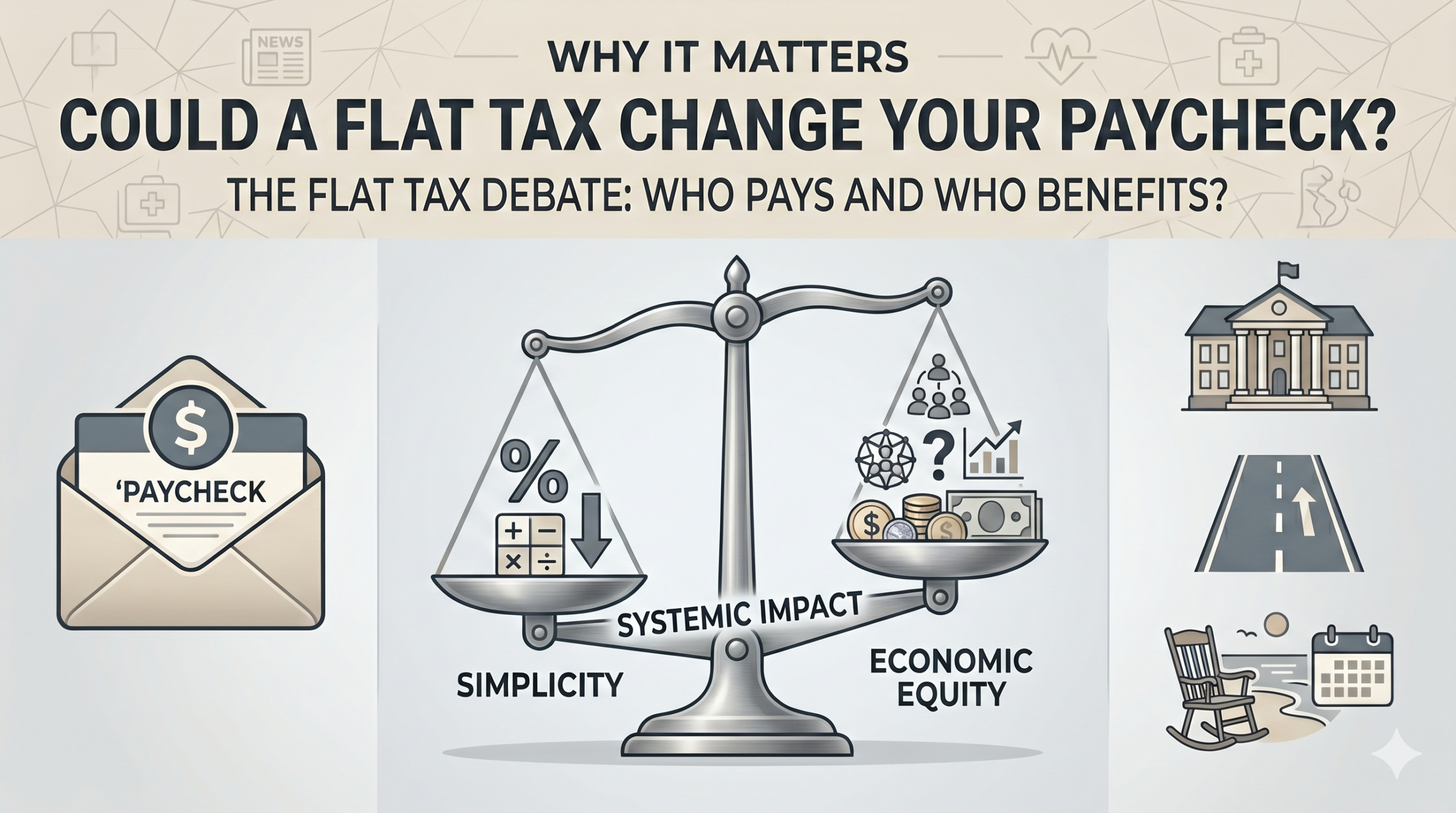
Why It Matters: Could a Flat Tax Change Your Paycheck?
When people discuss a flat tax, they are often asking whether the change would increase or decrease their take-home pay.
Flat tax vs wealth tax debates may sound like something only politicians, economists, or accountants care about. But tax policy affects everyday life in very real ways.
It can affect your paycheck, your local schools, your roads, your retirement programs, and the public services your community relies on.
That is why the debate over flat taxes, progressive taxes, and taxing wealth matters far beyond campaign speeches.
How a Flat Tax Could Affect Your Paycheck
For many people, the first question is simple:
Would I pay more or less?
The honest answer is: it depends on the rate.
If a flat tax rate is set low, some households may pay less. If the rate is set higher to fund current services, some families could pay more.
There is no tax change that benefits everyone equally. Any major tax reform creates trade-offs.
Your Community
Taxes help fund the things people often notice only when they stop working well:
- Public schools
- Roads and bridges
- Emergency services
- Public transportation
- Libraries and community programs
- Healthcare and safety-net programs
Supporters of flat taxes argue that lower and simpler taxes can encourage growth, attract businesses, and eventually strengthen the economy.
Critics worry that if revenue falls, governments may have to cut services or raise other taxes to make up the difference.
That is why tax debates are not just about what you pay. They are also about what your community can afford.
Your Retirement
Taxes also help support major programs like Social Security, Medicare, and Medicaid.
A flat tax would not automatically eliminate these programs. But if tax revenue changed significantly, lawmakers would eventually have to decide how to respond.
That could mean:
- Reducing spending
- Increasing borrowing
- Raising other taxes
- Changing eligibility or benefits
- Reforming how programs are funded
Why Some People Support a Flat Tax
Supporters of flat taxes often focus on simplicity.
Many people are frustrated by a tax system that feels confusing, full of loopholes, and difficult to understand.
To them, a flat tax sounds fair because everyone pays the same percentage.
They may also believe lower taxes help people keep more of what they earn and encourage businesses to invest, hire, and grow.
Why Others Are Skeptical
Critics focus on fairness and impact.
A flat tax may use the same percentage for everyone, but the impact of that percentage is not the same for every household.
For example, losing 15% of income feels very different to a family living paycheck to paycheck than it does to a millionaire.
That is why critics argue that tax systems should consider ability to pay, not just equal percentages.
Why Your Neighbor Might See This Differently
One of the reasons tax debates become so heated is that people experience the tax system differently.
A retired couple living on a fixed income may see taxes very differently than a small business owner trying to expand a company.
A teacher may prioritize funding for schools and public services. A contractor may prioritize keeping more of each paycheck.
Neither person is necessarily wrong.
They may simply be experiencing different parts of the economy.
That is also why there is rarely a tax proposal that makes everyone happy.
Most tax reforms create winners, losers, and trade-offs that affect different groups in different ways.
The Question Behind Every Tax Debate
When politicians debate taxes, they are usually debating something bigger.
- How large should government be?
- What services should taxpayers expect?
- Who should pay the largest share of the bill?
- How much inequality is acceptable?
- How much should growth matter compared to fairness?
These questions do not have universally agreed-upon answers.
That is why tax debates continue decade after decade, regardless of which party is in power.
Understanding those underlying questions can make political discussions feel less confusing and more productive.
What This Means for You
The debate over a flat tax is really a debate about trade-offs between simplicity, fairness, growth, and government revenue.
The next time you hear a politician promise a flat tax, a tax cut, or a new tax on wealthy residents, do not just ask:
Would my tax bill go down?
Also ask:
- What services could be affected?
- Who benefits the most?
- Who pays more?
- Would the system become simpler?
- Would the system become fairer?
- How would lost revenue be replaced?
Those questions matter because tax policy shapes the communities we live in, the services we rely on, and the opportunities available to future generations. View current IRS tax information
Read tax policy research from the Tax FoundationPeople Are Asking
Would a flat tax automatically lower my taxes?
No. It depends on the rate, your income, your deductions, and how the government changes the rest of the tax system.
Would everyone pay the same amount?
No. Under a flat tax, everyone pays the same percentage, but higher earners still pay more total dollars.
Why do people disagree so strongly about taxes?
Because taxes reflect different values. Some people prioritize simplicity and growth. Others prioritize fairness and public services.
Could lower taxes help the economy?
Possibly. Lower taxes may encourage spending, investment, or business growth. But the outcome depends on the broader economy and how the tax change is designed.
Could higher taxes on wealthy residents help public services?
They can raise revenue, but critics worry that very high taxes may encourage some wealthy residents or businesses to relocate.
The Bottom Line
Flat tax vs wealth tax debates are really debates about trade-offs.
A simpler tax system may be easier to understand, but it may raise questions about fairness and revenue.
A more progressive tax system may ask more from those with greater ability to pay, but it can also create concerns about complexity, migration, and competitiveness.
The real question is not whether taxes should be simple. Most people agree they should be.
The harder question is whether a tax system can be simple, fair, and strong enough to fund the services people expect.
What do you think? When it comes to taxes, what matters most to you: simplicity, fairness, economic growth, or funding public services?

No discussions yet
Be the first to join the discussion and share your thoughts with the community.